A Cappadocia red green tour is a one-day trip that joins two classic routes in central Turkey. This post covers the stops, the geology, the underground city and the booking rules. The homepage lists more Greece Tours for the Greek islands.
Every tour card below opens a live GetYourGuide booking. Pickup points and group sizes are shown on each card.
What is a Cappadocia red green tour and how does the day run?
Pickup starts a day on a Cappadocia red green tour, linking northern Red sites with southern Green sites. An air-conditioned vehicle and a guide come along, and formats last from five to eight hours.
Red and Green also exist as separate day trips of their own. The Red route stays in the northern part of the region, while the Green route travels further south. Visitors on a Cappadocia red green tour see both areas in a single day. That suits readers who want everything in one outing.
For more days in Turkey, the homepage lists Turkey tours across the old cities and the coast.
Distances set the two routes apart. Sites on the Red route sit close together, which makes that day feel relaxed. The Green route involves longer travel distances and more walking than the Red route. One combined itinerary is a full schedule, which means an early start and a busy day.
The day starts at the hotel. One eight-hour format includes hotel pickup and drop-off, with the pickup time confirmed the day before. A van format collects guests from hotels across Cappadocia, including Goreme, Uchisar and Nevsehir. Travellers on a Cappadocia red green tour give the hotel name when booking.
Group size and guiding language differ by format. Visitors on a Cappadocia red green tour join up to 45 people on one large format, guided in English. A small-group format caps the party at 15 travellers. A private format and an eight-hour format name English and Spanish. One seven-hour format runs daily tours in five languages.
That seven-hour format keeps a stated order. The Goreme Open Air Museum comes first, then Pasabag. Lunch follows at a local restaurant, and Pigeon Valley and an underground city come after the meal. The day ends with a panorama from Esentepe Hill, then the return drive to the hotel in the early evening.
Another format opens at Love Valley and moves on to Pasabag, Zelve, Devrent Valley and an Avanos pottery demonstration. Uchisar Castle is a viewpoint stop, and the visit does not include climbing the castle. Guests on a Cappadocia red green tour enter either Ozkonak or Kayasehir in the afternoon. The group and guide decide which.
On the Love Valley format, weather, traffic and local conditions can alter the order. That day also holds a leather workshop and a short snack stop before the return. The seven-hour format adds optional shopping stops when the group is interested. A small-group format makes one pottery workshop visit and no other shopping stop.
Inclusions change from format to format. On the seven-hour format, lunch at a local restaurant is part of the booking. Museum tickets and tips are not. The Love Valley format puts entrance fees and lunch into an all-inclusive option only. A small-group format of five to six hours includes entrance fees to all museums and ruins.
More about Cappadocia: Cappadocia Tour From Istanbul.
Day length depends on the format. A small-group format runs five to six hours, and a private format runs six to eight hours. The large format and one other group format take eight hours. Each day ends with a drop-off at the hotel.
The combined day suits visitors with limited time who want the main sights of the region. One operator sells it that way. Another calls it a comprehensive introduction to the key highlights in a single day. Photographers and lovers of history and nature on a Cappadocia red green tour match the audience a third operator names.
Which stops sit on the red half of a Cappadocia red green tour?
Uchisar castle rock, Pasabag valley, Avanos town and Devrent valley make up the red half. The private format names all four during a Cappadocia red green tour. Uchisar and Pasabag also appear on the mini-group format.
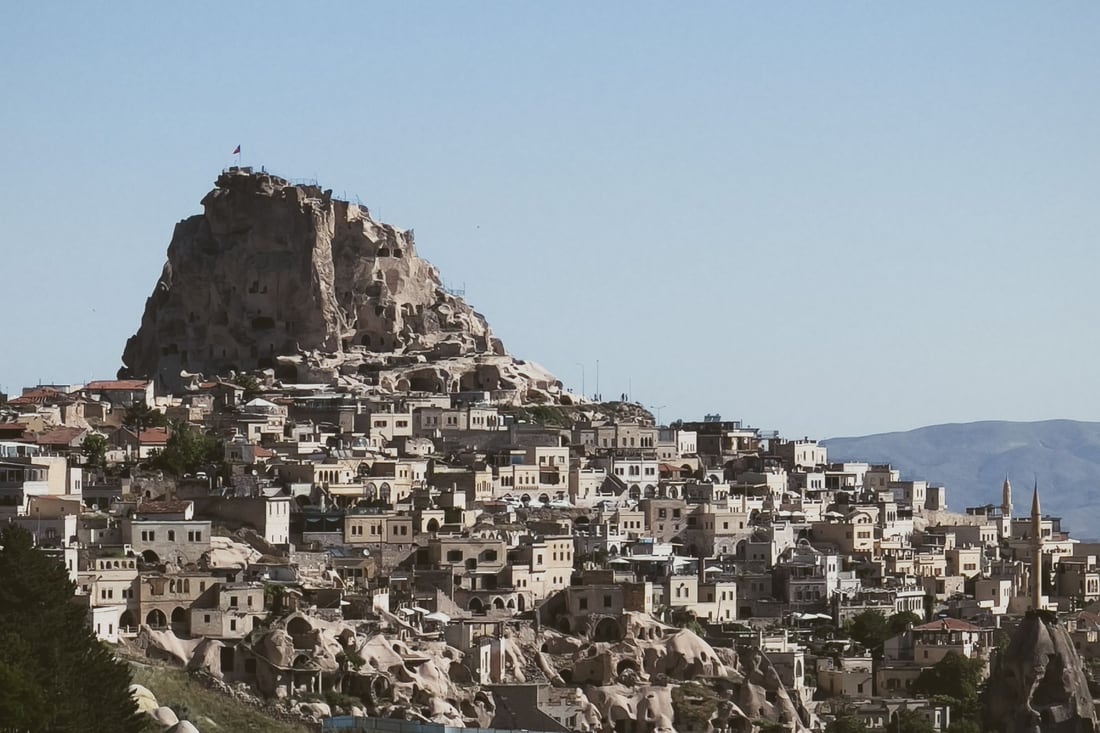
Uchisar sits beside Goreme National Park, at about 1,270 metres above sea level. The Turkish name means outer citadel, and the citadel is a huge rock cone. The old village huddles around the foot of that cone. A further district lies closer to the Nevsehir to Goreme road.
Passageways and rooms cross the inside of the cone, but they are largely blocked or impassable. Byzantine residents used them as homes. On the private format, a climb to the top is the lookout stop during a Cappadocia red green tour. Views from the summit take in Goreme, Avanos and Cavusin, says the national tourism site.
The private format also lists a Goreme panorama stop. Goreme sits about 1,104 metres above sea level, in the middle of a network of valleys. A photograph from a hill on the south-east edge of town shows Roma Kalesi. This fairy chimney holds a rock-cut Roman tomb.
Visitors see carved chimneys at Pasabag during a Cappadocia red green tour. Pasabag lies one kilometre in from the Goreme to Avanos road. The culture portal says the valley was formerly named the Valley of the Priests. Chapels and sitting rooms were carved inside its multi-bodied, multi-headed chimneys.
Another page that includes Cappadocia is Cappadocia Tour From Antalya.
Pasabag also has a three-headed chimney with a chapel and a cell named for Saint Simeon. A narrow tunnel shaped like a chimney leads to the cell, and crosses decorate its entrance. The ministry’s museum page says that in the fifth century Simeon lived as an ascetic near Aleppo.
A red-day listing names Zelve beside Pasabag in its title. The stop list of each format settles whether Zelve is visited during a Cappadocia red green tour. Zelve spreads over three valleys cut into the northern slopes of Aktepe. The culture portal says the valleys formed an important Christian settlement from the ninth to the thirteenth century.
The first valley holds a bulgur mill, the Fish and Grape churches and a winery. The Holy Cross church stands in the second valley. The third valley has a village square and a monastery carved into one dome-shaped mass of rock. A mosque stands opposite, and pigeon houses are cut high on the slopes. Villagers lived there until nineteen fifty-two.
Avanos stands 18 kilometres north of Nevsehir, at about 920 metres above sea level. On the private format, Avanos adds a pottery workshop during a Cappadocia red green tour. Kizilirmak, whose name means Red River, divides the town, and four bridges join the banks. One bridge is stone and 151 metres long.
Wheel-thrown pottery has been made in Avanos since Hittite times, and the craft passed from father to son. Potters sieve soft, oily clay from the hills and the old river bed, then knead it into mud. A foot-turned wheel shapes each pot. Pots dry in the sun and then the shade before firing in kilns.
Devrent lies near Avanos and is also called Imagination Valley, since people read shapes into its rocks. The private format includes Devrent valley during a Cappadocia red green tour. Devrent’s camel-shaped rock has become its symbol. The national tourism site says its chimneys resemble animal figures, and sunlight adds to the sight.
What do the rock churches add to a Cappadocia red green tour?
Rock-cut churches and monks’ rooms fill the Goreme Open Air Museum, where monastic life continued until the thirteenth century. Visitors meet walls painted with Bible scenes after a Cappadocia red green tour stops in the Goreme valley.
Hermits formed the first small communities in Cappadocia in the fourth century. Monks and nuns lived in rooms they cut from the rock. At Goreme, nearly every rock block held churches, chapels, dining rooms and seating areas. The museum site opened to visitors in nineteen sixty-seven.
Cappadocia also features in 6 Day Istanbul Cappadocia Tour Package.
The Maidens’ Monastery is cut into a cliff on multiple floors. Nuns had cells there, and the common rooms included a refectory and a kitchen. A small chapel with frescoes belongs to the complex. Walkers can study the layout after a Cappadocia red green tour reaches the cliff.
The museum stands in the old village of Korama. In Byzantine times, Goreme was two neighbouring villages, Korama and Matiana. Goreme leads Cappadocia in painted churches, and hermitages and monasteries stand there too. Saint Basil’s Chapel is a dark room with grated openings in its floor, and those openings are tombs.
Carvers cut rooms out of the rock, so they planned no supporting walls. They still copied columns and pilasters from built architecture, and those parts carry no load. Altars, pews and baptismal fonts were cut from the same stone in the usual case. Anyone can see the result after a Cappadocia red green tour enters a church.
Cross-shaped plans, domes and barrel vaults shape the church interiors. Outer walls can carry blind arcades, gables and columns. All of these rock churches draw strongly on Byzantine church architecture. Saint Barbara’s chapel has a cross-dome, one central apse and two side apses. Its red ochre patterns were painted directly on the rock.
Plain geometric decoration in Cappadocian rock churches dates from the eighth and early ninth centuries. Crosses, zigzag lines, diamonds and rosettes were drawn on the rock walls in red paint. Once Byzantine Iconoclasm ended in the ninth century, painters added ever more complex frescoes. Older churches were largely repainted, so little of the early painting survives.
Tokali, the Church of the Buckle, is the largest church in Goreme. Pale red and green strips mark the Old Church, and indigo fills the larger one. The nave carries ninth-century frescoes, while the three apses hold paintings from the eleventh century. Those paintings greet any group after a Cappadocia red green tour pauses at the church.
A related page on Cappadocia: Marmaris to Cappadocia Tour.
The Apple Church dates from around the middle of the eleventh century. Its frescoes flake in places, and earlier paintings show beneath them. Travellers notice this after a Cappadocia red green tour arrives at the church. The Sandal Church takes its name from two footprints below a fresco at its entrance.
Visitors enter the dim Dark Church after a Cappadocia red green tour reaches it. A small opening admits little light. That gloom is credited with keeping the pigments fresh. Its frescoes are among the better preserved in all of Cappadocia. Flash photography is banned in the church interiors, which protects the valuable frescoes.
In nineteen eighty-five the World Heritage List added Goreme National Park with the Rock Sites of Cappadocia. The listing covers cultural and natural heritage, and the museum forms part of it. Painters in the region used two methods: paint applied directly to the rock and the fresco-secco technique. Bible scenes and the life of Jesus supply the subjects.
Which valley walk belongs inside a Cappadocia red green tour?
Ihlara canyon and the Selime rock monastery belong to the green day. One combined-day format names Pigeon Valley as its walk. Read the stop list throughout a Cappadocia red green tour. Stop lists show the valley a day holds.
Rock-cut churches recur throughout a Cappadocia red green tour. Ihlara canyon is lined with them. The canyon sits at the south-western edge of the region, inside Aksaray Province. Selime closes the canyon at the north-west end, and Ihlara village opens it at the south-east. The walls drop deeper than one hundred metres in places.
The Melendiz stream cut this canyon in prehistoric times. The stream is also called the Potamus and rises at Ihlara town. Monks later dug houses and churches out of the cliff stone. A stairway of almost four hundred steps starts at the north end of Ihlara village. It descends more than one hundred metres into the canyon.
Painted ceilings recur throughout a Cappadocia red green tour. Agacalti church carries the Ascension in its dome. The church stands south of the entrance stairs and follows a free-cross plan. Purenliseki lies about three hundred metres from Agacalti, toward Ihlara village, roughly thirty metres above the river. The puren herb that grows nearby gave it its name.
Locals named Sumbullu church after the hyacinth flowers growing around it. It sits about twenty metres above the river. The site is a two-level carved complex, and the church fills the lower level. Kokar church holds two tomb rooms. Their decoration includes the first known red-paint work in the area.
Cappadocia comes up again in Fethiye to Cappadocia Tour.
Kirkdamalti church stands in Belisirma village and is the highest church in the region. A donor couple commissioned its decoration, and an inscription dates the work to the late thirteenth century. A portrait of a Seljuk sultan appears among the paintings. Part of the rock broke away and destroyed the entrance section.
Selime marks the end of the Ihlara canyon. Its cathedral is cut into high rock and has two levels. Two rows of columns divide the inside into three sections. It is the largest cathedral structure in the Cappadocia region. The monastery there trained clergy for the region, and the tomb of Selime Sultan stands in the village.
Cooking rooms cut from rock recur throughout a Cappadocia red green tour. Selime has a pyramid-shaped kitchen, and its niches were built to hold lamps. The three-aisled basilica church is the only example of its plan in the region. The upper part of the cathedral was built as a castle, and its walls and defensive positions are still visible.
Pigeon Valley links Uchisar with Goreme, and the walk between the two towns takes around two hours. The valley takes its name from pigeon nests carved into its rock walls. Niches inside the carved rooms gave the birds places to roost. A waterfall also flows from a height of fifteen metres in the valley.
Cliff rooms served farm work throughout a Cappadocia red green tour. Pigeon droppings, called guano, served as fertiliser. Local people used the manure on their vineyards. Pigeon guano stayed in wide use as fertiliser into the nineteen seventies. The carved pigeon houses in the valley walls remain from that farm use.
Valley stops vary between listings throughout a Cappadocia red green tour. Ihlara, Selime and Pigeon Valley follow the underground city on one full-day green format. One combined-day format lists Pigeon Valley as a scenic walk and names no Ihlara stop. Another combined format closes the day at the Pigeon Valley and Esentepe viewpoints.
For more on Cappadocia, see Cappadocia Bus Tour From Izmir.
How does the underground city fit into a Cappadocia red green tour?
Kaymakli or Derinkuyu supplies the one visit below ground, depending on the format, and both lie in Nevsehir Province. Learn the plan before a Cappadocia red green tour descends, because the ministry puts Derinkuyu about eighty-five metres deep.
The Ministry of Culture and Tourism estimates that Cappadocia holds between one hundred fifty and two hundred underground settlements. The ministry names two reasons. One is a secure refuge. The other is climate, because the rooms are cool in the summer and warm in the winter. A large settlement links hundreds of rooms through galleries and tunnels.
Formats do not all name the same city. One combined format goes below ground at Kaymakli, while formats of the green day name Derinkuyu. A second combined format says only “an underground city” without a name. Compare the named stop before a Cappadocia red green tour enters either city, because the two differ in plan.
Derinkuyu lies in Derinkuyu district, thirty kilometres from Nevsehir on the highway towards Nigde. The ministry gives its depth as about eighty-five metres and describes eight floors. The Turkish name means deep well. It comes from the deep shafts that carried water to both the city and the town above.
The entrance floors, carved first, held the stables, since getting animals to lower floors was hard. Kitchens and grape presses stand on the upper floors, where grapes and food were easy to carry. Walkers pass these rooms before a Cappadocia red green tour reaches the missionary school on the second floor.
The school has a barrel-vaulted ceiling, a form the ministry calls rare in underground cities. The rooms to the left of the hall were study rooms. From the third and fourth floors, stairs lead straight down to the cross-planned church below. Derinkuyu also has a confession place and a baptism pool, which Kaymakli lacks.
Large stone cylinders close the tunnel entrances and exits, and every floor can be shut off alone. The doors close from the inside. In places, tunnels between rooms are wide enough for only one person. A group therefore passes in single file before a Cappadocia red green tour returns to daylight.
A ventilation shaft fifty-five metres deep links the city to the surface and also serves as a well. The main central shaft measures roughly three metres by 2.8 metres, and its openings on different levels never overlap. That layout appears built to move air. Kitchens were shared, since not every family had one.
Readers interested in Cappadocia can open Cappadocia Tour From Izmir.
Note the scale before a Cappadocia red green tour goes below. Derinkuyu is estimated to have sheltered up to twenty thousand people, along with livestock and food. A resident repairing his house knocked through a basement wall in nineteen sixty-three and found a room behind it. Only about a tenth of the city opens to visitors.
Kaymakli lies twenty kilometres from Nevsehir, and village houses stand beside one hundred or more of its tunnels. Its passages are lower, narrower and more sloped than at Derinkuyu. Its rooms cluster around ventilation shafts. Four of its eight floors are lit, and visitors walk those before a Cappadocia red green tour leaves.
The first floor holds stables. The second floor has a church with a single nave and two apses, with seating platforms along the walls. Storerooms, wineries and kitchens fill the third floor, beside an andesite block with fifty-seven holes cut into it. The ministry calls it the widest city explored in Cappadocia.
How did the volcanoes shape the land seen from a Cappadocia red green tour?
Eruptions of Gollu Dag, Hasan and Erciyes prepared the ground for a Cappadocia red green tour. Ash from those volcanoes hardened into soft tuff. Wind, water and frost later cut that rock into cones, valleys and gorges.
Erciyes rises east of the Nevsehir plateau, and Hasan rises to its west. Erciyes is a huge stratovolcano, and Hasan is a composite stratovolcano with two peaks. Those two mountains frame the country that matters for a Cappadocia red green tour. Gollu Dag, a third volcano, stands in Nigde Province.
Gollu Dag is a lava dome that has produced rhyolite. Obsidian lay on the mountain in abundance, and people used it as a raw material for tools. Hasan sits in Aksaray Province, and the city of Aksaray lies north-west of it. Kayseri lies north of Erciyes.
Tuff began as ash blown out of a volcanic vent and turned into solid rock. It stays relatively soft, which made it a building stone in ancient times. A pyroclastic flow is a hot mix of particles and gas that races away from a volcano. The rock it leaves is ignimbrite, a welded tuff where the heat fused the particles.
Cesme to Cappadocia Tour covers Cappadocia too.
The Miocene ignimbrite sequence of Cappadocia is a listed geological heritage site of the International Union of Geological Sciences. Nine ignimbrites in it were identified, mapped and dated. The sequence is more than 430 metres thick and alternates with sedimentary rocks of the same basin. That sequence is the rock record for a Cappadocia red green tour.
Climate does much of the carving. The region has big temperature swings and strong winds, and both speed up erosion. In freeze-thaw cycles, water seeps into cracks and expands when it freezes, which splits the rock. Rain and running water then wash the loosened pieces away.
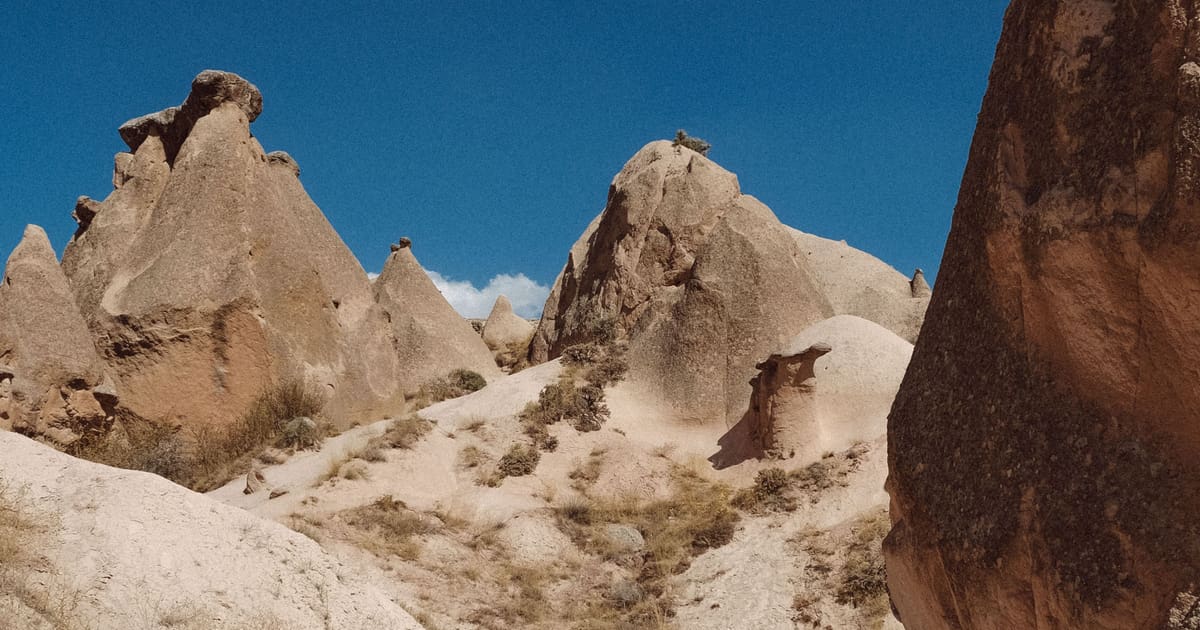
A fairy chimney starts as a thick layer of soft rock under a thin layer of hard rock. Cracks in the hard layer let the soft rock below wash away. The heavy cap presses down and gives the pedestal its strength. Landforms of this kind line the route for a Cappadocia red green tour.
Caps of tougher rock hold up the towers and cones of tuff that survived. These capped forms look like mushrooms or chimneys. When a cap is undercut and falls, the cone beneath it erodes quickly. Rock types wear at different rates, so the shapes range from sharp spires to rounded towers.
Plate movement sits behind all of this. The Afro-Arabian continent has pushed toward the Eurasian plate since late Miocene times, and that push fed the volcanism. Erosion then cuts the plateaus up, and cooling fractures are one place where it starts. The rock for a Cappadocia red green tour carries that history in its layers.
Soft tuff made digging easy. The malleable rocks and cones around Goreme let people carve out cave homes. In the Middle Ages, eroded formations were hollowed out to make churches and houses. Hand-cut rooms add a second layer to the scenery for a Cappadocia red green tour.
Kizilirmak, the river historically called the Halys, rises in Sivas Province and reaches the Black Sea near Bafra. The middle course of the Halys lay inside ancient Cappadocia. North of the Nevsehir plateau it flows mainly within volcanic and lake-and-river deposits. Past and present rivers have cut valleys and deep gorges into the plateau.
Cappadocia Hot Air Balloon covers Cappadocia too.
When can a Cappadocia red green tour run and which rules apply?
Nevsehir has a continental climate, so the season sets what to wear and bring on rugged paths. Compare the rules, access lines and cancellation cut-off with a Cappadocia red green tour listing before booking, because formats differ.
The Nevsehir climate table draws on the Turkish State Meteorological Service. Precipitation falls through the year at Nevsehir, with a slight peak in spring. Snow and cold mark the winter months, and summer turns warm and dry. Walkers travelling with a Cappadocia red green tour meet each of those seasons on rugged, uneven paths.
The same table averages 8.9 snowy days in January and 5.7 in February. March still shows 6.8, April 1.5 and November 1.8. From late spring to September it records none, and October shows 0.2. The national tourism board adds that snow covers the valleys in winter.
Nevsehir has logged a record high of 39.5 degrees Celsius and a record low of minus 23.6. Goreme stands at an elevation of 1,104 metres. One combined-format listing suggests a hat for sun protection and a light jacket for cooler mornings. Packing for a day with a Cappadocia red green tour starts with those two items.
The guided group format lists a camera, sunscreen, water, comfortable clothes and comfortable shoes. On the private format, stops involve walking and uneven terrain. That listing advises checking comfort on hillside sites before booking. Footwear matters for travellers with a Cappadocia red green tour booking. The group listing says to wear comfortable shoes for walking.
The guided group listing calls the day unsuitable for people with claustrophobia or mobility impairments. A private half-green, half-red listing does not recommend the day for travellers with poor cardiovascular health. Both statements belong to single listings. Another format can read differently, so the access line on each card settles the question.
One private full-day listing says infants must sit on the lap of an adult. A private half-green, half-red listing says specialised infant seats are available. A further private listing asks parents to check that children are comfortable walking in outdoor conditions. Families travelling with a Cappadocia red green tour compare the age lines of each listing before choosing.
Cappadocia Horse Riding covers Cappadocia too.
On one full-day format, vegetarian, vegan and gluten-free meals can be requested at booking. That listing asks travellers to tell the provider about dietary needs ahead of time. A private half-green, half-red listing includes lunch with meal options. The full-day listing adds that solo travellers can join.
On the combined format with hotel pickup, the voucher arrives by email. Guests show it on a phone, together with valid photo ID, when they reach the starting point. The group format bars pets, alcohol and drugs. The ministry page for the Goreme museum lists an audio guidance service.
The cards on this page check live availability by date. One listing advises checking availability early, since the day can sell out. A group format takes bookings up to six hours ahead. A combined listing and a full-day listing both offer reserve-now, pay-later. Booking with a Cappadocia red green tour listing then holds a place without upfront payment.
Cancellation terms with a Cappadocia red green tour booking name a cut-off counted in hours before the start. Free cancellation applies before that cut-off, which follows the local clock of the experience. One private listing also sets a floor on group size. When bookings fall under it, the provider proposes another slot, another experience or a refund in full.