A Cesme to Cappadocia tour leaves the Aegean peninsula behind for the tuff valleys of central Anatolia. This page follows the route, the rocks, the Nevsehir area, balloon flights, local food and the entry rules. Closer to the sea, the homepage lists Greece Tours on the islands.
The cards in this page link to live GetYourGuide listings with current dates.
What does the route look like on a Cesme to Cappadocia tour?
A Cesme to Cappadocia tour fills two days and one night on the plateau. A long leg carries you inland from the Aegean coast, and a second long leg brings you back. The hours between the two legs belong to the rock valleys.
This route starts with the long leg from Cesme to Cappadocia, then holds one night in the Nevsehir area. Day one covers the Nevsehir area and nearby valleys. Day two covers Goreme and the balloon fields. The long leg back to the Aegean closes the trip. Seen whole, a Cesme to Cappadocia tour puts the plateau between two journeys.
Planning beyond the plateau? The homepage lists Turkey tours along the whole coast.
Cesme is a municipality and district of Izmir Province. It sits at the westernmost end of Turkey, on the tip of the peninsula that shares its name. The trip starts at this edge of the Aegean and heads east. Cappadocia lies deep inland, so the map alone shows why both legs are long.
The first stretch leads to Izmir, which lies 85 kilometres east of Cesme. Izmir Adnan Menderes Airport stands 14 kilometres south-west of the city centre, in Gaziemir. Anyone who flies therefore starts with a road transfer from Cesme. A Cesme to Cappadocia tour by air has that short drive built in.
Historically, Cappadocia is a region of Central Anatolia. It falls largely within Nevsehir, Kayseri, Aksaray, Kirsehir, Sivas and Nigde provinces. The tourist part of the region is in Nevsehir Province. On this Cesme to Cappadocia tour, the night therefore falls in the Nevsehir area. The Taurus Mountains close the region off from the Mediterranean in the south.
The road from Cesme to Cappadocia runs for more than 700 kilometres. Buses from Izmir take it via Konya, and that ride lasts more than ten hours. Cesme lies another 85 kilometres west of Izmir. A Cesme to Cappadocia tour by coach therefore spends ten hours or more on the road each way.
Driving your own car covers the same road. The drive from Cesme to Cappadocia takes more than ten hours without a single stop. Breaks for fuel, food or rest come on top of that figure.
The air route replaces the long coach ride. Direct flights link Izmir Adnan Menderes Airport with Kayseri, and the flight takes about an hour and a half. Kayseri Airport lies 5 kilometres north of Kayseri and is a major hub for Cappadocia. A Cesme to Cappadocia tour with a flight leg lands there or at a second airport.
The second airport is Nevsehir Kapadokya Airport, in the north-west of Nevsehir Province and 30 kilometres from Nevsehir town. Flights from Izmir to it change planes in Istanbul and take more than four hours. From Kayseri, the road to Goreme measures at least 70 kilometres, and the transfer lasts over an hour.
Time on the plateau is what the flight changes. A direct flight from Izmir takes about an hour and a half, against ten hours or more by road. A Cesme to Cappadocia tour that flies hands that time back to the valleys. The drive to Izmir still comes first.
What does the Cesme peninsula show before a Cesme to Cappadocia tour?
The peninsula shows the sea-level start: an Ottoman castle, a yacht harbour, thermal springs and Alacati’s windsurfing bay. A Cesme to Cappadocia tour begins in this setting and then swaps the coast for an inland plateau.
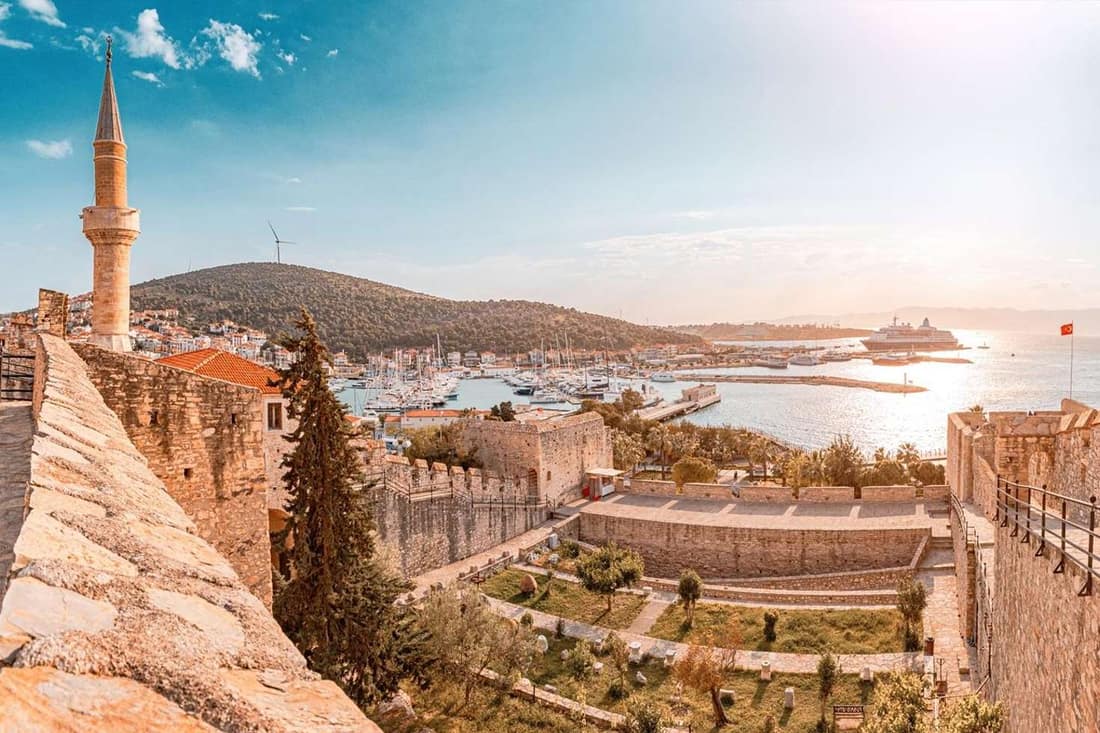
The castle at Cesme is built as a stone rectangle with six bastions, and moats run along three sides. It once stood right on the shoreline, and later changes to the coast left it farther inland. Anyone starting a Cesme to Cappadocia tour in town has this fort close at hand.
The castle dates to the reign of Sultan Bayezid II, in the early sixteenth century. Today it houses the Cesme Archaeology Museum, with finds from the ancient city of Erythrai. Umur Bey Tower holds a display on the Ottoman-Russian naval war on its lower floor. Cezayirli Gazi Hasan Pasha has a monument in front of the castle.
The sea battle of Cesme was fought in the area that lies between Chios and the western tip of Anatolia. It lasted from the fifth to the seventh of July in the eighteenth century. Fire took nearly the whole Ottoman fleet. Yachts lie in the harbour, and the town offers marinas, clubs and restaurants.
Alacati is a neighbourhood of the Cesme district. For a Cesme to Cappadocia tour from the peninsula, it belongs to the same starting area. Stone houses with coloured windows line its narrow, paved streets. The houses that belonged to Ottoman Greeks stand out through their enclosed balconies.
Alacati bay ranks among the leading windsurfing bays of the world. The sea there is very shallow, so beginners feel safe. The bay is a training field for them. From mid-June to mid-September the wind comes from the north. Stone windmills on the hill above the village are the town’s symbol.
Ilica takes its name from its thermal springs, and hot water also rises from the sea bed. The water is shallow and warm, so swimmers can wade as far as 100 metres out. The village lies about 5 km from Cesme town, close to where a Cesme to Cappadocia tour begins.
The Ilica springs also offer underwater massage, electrotherapy, and mineral pools and baths. The mineral content has earned the water the name of a natural miracle. Cesme counts among the largest sources of thermal water. Ilica also has a good beach of its own, 1.5 km in length.
Other beaches on the Cesme coast include Altinkum, Boyalik, Cark and Pirlanta. White-sand beaches stretch along a road lined with houses. Sand and thermal water set the opening scene of a Cesme to Cappadocia tour. The trip then turns away from the sea.
The toll motorway O-32 runs for 77.7 km from Balcova, in Izmir, to Cesme. It is a six-lane road. The section between Balcova and Urla was the first to open to traffic, and the last section was finished later.
Sand, thermal water and stone lanes make the peninsula the sea-level end of the route. The other end of a Cesme to Cappadocia tour lies inland, where the sea no longer comes into view.
How did the rocks behind a Cesme to Cappadocia tour take their shape?
Eruptions buried central Anatolia in ash that set into soft tuff. Erosion then cut cones and pillars out of it. A Cesme to Cappadocia tour reaches this rock, which UNESCO protects as a World Heritage Site.
The plateau at the end of a Cesme to Cappadocia tour belongs to the Cappadocian Volcanic Province. This belt of volcanic rock runs north-east to south-west for about 300 kilometres and is 20 to 50 kilometres wide. Experts attribute its formation to the convergence of the Afro-Arabian and Eurasian continents.
The rocks of the plateau include thick sheets of ignimbrite, a deposit left by eruptions. The sequence formed in the Miocene epoch and is more than 430 metres thick. River and lake sediments lie between the sheets. The vents that fed them were large calderas, and those craters lie buried.
The Goreme park lies in country between two large volcanoes. Mount Erciyes stands in Kayseri Province, and Mount Hasan in Aksaray Province. Hasan carries the Ulukisla caldera on its eastern flank and the Kecikalesi caldera on its south-western flank. Melendiz, east of Hasan, is more worn down than the steep cones of Hasan.
Tuff is rock made of volcanic ash thrown out of a vent, and it is relatively soft. Where hot ash grains fused after landing, the tuff is called welded, and that takes more than 600 degrees Celsius. Cooler flows left ash sheets that stayed relatively loose.
Fairy chimneys form by uplift and erosion of the ignimbrite, and a Cesme to Cappadocia tour looks at the result. They need the right thickness, welding and slope of rock to appear. A pillar starts as a flat plateau top that erosion then cuts apart.
Measurements of chlorine-36 in the rock give the speed of that wear. A flat plateau top loses 0.58 to 0.93 centimetres in a thousand years. Once a plateau starts to split, the loss climbs to about 4.5 centimetres. The caps of chimneys lose about 3.2 to 3.4 centimetres in the same time.
More about Cappadocia: Cappadocia Tour From Istanbul.
When a cap finally drops or erodes away, the soft neck below it is quickly destroyed. After the chimneys have vanished, the ground wears down by about 28 centimetres in a thousand years. The cap is what protects the neck.
The plateau that a Cesme to Cappadocia tour arrives at is lava-covered tuff. Erosion carved it into hundreds of cones and lava-capped pillars. The International Union of Geological Sciences places the Miocene Cappadocian ignimbrite sequence among its 100 geological heritage sites.
The same softness shaped the human side of a Cesme to Cappadocia tour. Tuff is easy to sculpt, so people hollowed homes out of it. Monks and other settlers linked cells into underground communities with chapels, storerooms and living quarters.
The Goreme part of a Cesme to Cappadocia tour sits inside a World Heritage property. UNESCO inscribed the Goreme park and the Rock Sites of Cappadocia in nineteen eighty-five. It meets cultural criteria one, three and five and natural criterion seven. The property covers about 9,884 hectares. IUCN names erosion among the pressures on it.
Readers interested in Cappadocia can open Cappadocia Hot Air Balloon.
Which sights around Nevsehir join a Cesme to Cappadocia tour?
Five places in and around Nevsehir fit into a Cesme to Cappadocia tour. They are the town, the Kursunlu Mosque, Ozkonak Underground City, the St Jean church at Gulsehir and the Hacibektas museum. All five lie in Nevsehir Province.
On a Cesme to Cappadocia tour, the town of Nevsehir explains itself through its name. The older name was Muskara, and Nevsehir means New City in Persian and Ottoman Turkish. Damat Ibrahim Pasha, a grand vizier and son-in-law of Sultan Ahmed III, was born in Muskara. The building of mosques transformed a village of only 18 houses.
A castle stands on the hill in the middle of the town. It dates from the Byzantine period, when the region lay on the frontline. Two churches stand near it. They are the Mother Mary Church and the Hagios Georgios Church, also called the Canli Church.
The Kursunlu Mosque stands in the city centre, so a Cesme to Cappadocia tour meets it inside town. Damat Ibrahim Pasha had the complex built in the eighteenth century, and the mosque dates from seventeen twenty-six. The complex also holds a theological school, a library, a charity institution and a bathhouse.
Ozkonak Underground City lies in the town of Ozkonak, 14 kilometres from Avanos. People dug it into thick layers of volcanic tuff on the northern slopes of Idis Mountain. A local farmer found the city in nineteen seventy-two. He was tracing where his irrigation water drained away.
Protection against attacks drove the design. Defenders rolled huge millstone doors across narrow passages and wedged them from inside. Holes above the tunnels were meant for pouring hot oil or sand on intruders. A Cesme to Cappadocia tour that stops here shows how people sealed themselves in during a siege.
For more on Cappadocia, see Cappadocia Tour From Antalya.
Long, narrow shafts about 5 centimetres wide carried air to the rooms. The same shafts let people call to each other between floors. The city also has a water well and a winery. Tunnels join its galleries across a large area.
Gulsehir adds a rock church to a Cesme to Cappadocia tour. The Church of St Jean is cut into the rock on two floors. Animals and geometric shapes decorate the ground floor, where the human figures were erased. Frescoes fill the upper floor, and an inscription dates them to the early thirteenth century.
The south wall of the upper floor once showed the Last Supper and the Kiss of Judas. The town has a pasha’s complex too. A grand vizier, Karavezir Mehmet Seyyid Pasha, sponsored a mosque, a madrasah and a fountain there. The town then had only 30 houses.
Hacibektas lies 45 kilometres from Nevsehir on the Kirsehir road. A Cesme to Cappadocia tour that adds this town stops at a former dervish convent. It has served as a museum since nineteen sixty-four. The convent stayed in use until nineteen twenty-five. Haci Bektas Veli, a thirteenth-century Sufi saint, gave the town its name.
Cappadocia also features in Fethiye to Cappadocia Tour.
The museum complex has three courtyards, and the tomb of Balim Sultan lies in the third. Alevis and Bektashis from across Turkey and the world make pilgrimages to the tomb complex of Haci Bektas Veli. The mausoleum has a double door with iron bars under a large archway.
What do sunrise balloon flights add to a Cesme to Cappadocia tour?
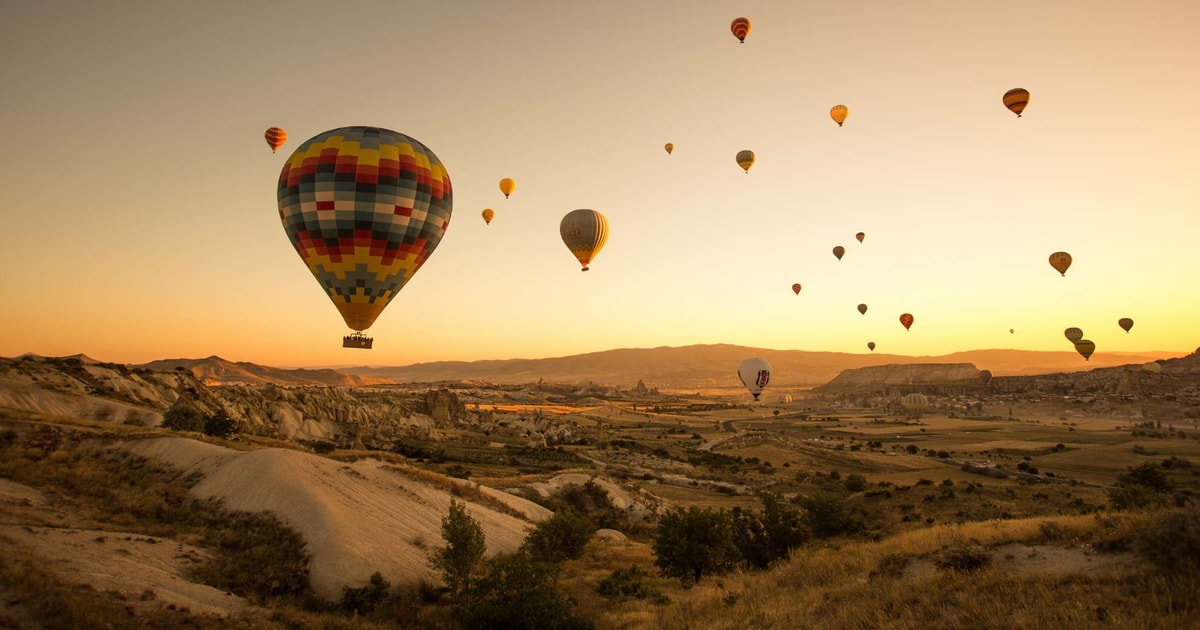
A sunrise flight adds about an hour above the valleys to a Cesme to Cappadocia tour. This route treats it as an optional extra on the second morning, before the long drive back to the coast. Dawn suits it because the wind is light around sunrise.
A balloon rises because heated air is lighter than the same volume of cold air. A burner fed with liquid propane sends a flame up into the open mouth of the envelope. The envelope holds the hot air, and the basket below carries the passengers. The air inside the envelope is capped at about 120 degrees Celsius.
To go down, the pilot lets hot air out through a vent at the top of the envelope. To land, the pilot lowers the flame or opens a flap that releases air. Steering is not exact: the pilot climbs or sinks until a wind blows the wanted way.
Wind starts with the sun heating the ground unevenly, and the air is light around sunrise and again around sunset. Later, the warm ground sends up thermals, which are columns of rising air that make a flight bumpier. Light wind at dawn explains why this Cesme to Cappadocia tour sets the flight at first light.
The take-off areas are in Goreme, and visitors gather there in the dark before sunrise. A sunrise flight on a Cesme to Cappadocia tour opens among crowds, since demand in the early hours is high. Up to 100 balloons can rise together into the sky over the Urgup and Goreme area.
Another page that includes Cappadocia is Cappadocia Tour From Ankara.
Any balloon flight added to a Cesme to Cappadocia tour runs under the General Directorate of Civil Aviation. The same directorate is the licensing authority for ballooning companies. Pilots must meet standards of training, experience, age and health before they receive a licence. In the air, they coordinate by radio with air traffic control.
The directorate also decides whether the weather allows flying, and every company must comply. Strong wind stops rides, and fog, rain or a low cloud base also keep balloons on the ground. Balloons fly on roughly 220 days each year. This Cesme to Cappadocia tour keeps its other stops if a flight is cancelled.
Below the basket lie villages, vineyards and fruit orchards, spread across a landscape like the surface of the Moon. Houses cut into the rock stand among the chimneys, and the valleys wind between them. As day breaks, colour spreads across the landscape. A flight lasts about an hour.
Skip the flight on a Cesme to Cappadocia tour, and you can still watch the balloons from Uchisar Castle. This rock formation is 60 metres high and open to the public, with views from its summit. Visitors who stand there before sunrise watch the balloons rise over the valleys.
Marmaris to Cappadocia Tour covers Cappadocia too.
Basket sizes differ widely. The widely used sport size holds about 2,800 cubic metres of air and carries three to five people. A balloon built for sightseeing carries well over two dozen. The envelope fabric is nylon or dacron, a polyester.
Which food, wine and crafts go with a Cesme to Cappadocia tour?
Testi kebab, manti and sweets made with grape juice suit a Cesme to Cappadocia tour. Local white Emir wine joins them. Craft stops add clay pots, handwoven carpets and onyx jewellery, all sold in the region.
Testi kebab is the clay-pot dish of the Nevsehir area. Cooks seal meat and vegetables inside the pot and bake it slowly in a traditional earthen oven. That slow heat gives the food a smoky aroma and extra flavour. Your night stop on this Cesme to Cappadocia tour sits in the same area.
Potters in the town of Avanos make the pots for this dish. At the table the pot is broken open, and the smoky aroma bursts out. For a souvenir from the same craft, Cappadocia workshops let you shape your own clay pot on a wheel.
Manti are dumplings with a spiced meat filling. Cooks cut the pasta dough into stamp-sized squares. Garlic yoghurt and spicy butter sauce can go on top, with sumac and mint as a garnish. Cappadocia’s food list puts manti beside testi kebab, so a Cesme to Cappadocia tour has two dishes to order.
Nevsehir’s dessert list includes pumpkin dessert, koftur and dolaz. Koftur is a kind of Turkish delight made with grape juice of the region. Dolaz is a flour halva with butter. Grape molasses sits on the same list, and every item on it uses local ingredients.
Cappadocia comes up again in 6 Day Istanbul Cappadocia Tour Package.
Fruit meets meat in two dishes. Kayisi yahnisi is a stew of dried apricots and meat, simmered over a wood stove and served in Cappadocia’s restaurants. Nevsehir’s food list also names apricot and quince stuffed with minced meat and different spices.
Emir is the white grape to know. It is native to Cappadocia and grows mainly in Nevsehir Province. Emir wine is pale straw in colour, with green reflections, and the taste is crisp and mineral. Try a glass with your meal on a Cesme to Cappadocia tour.
The land behind the wine is volcanic. Vineyards sit above 1,000 metres, in soil of sand, decomposed tuff and limestone. Red grapes grow here too. Kalecik Karasi is named after a district of Ankara Province. It is among the Anatolian grapes of the area, and its wine is ruby red.
Rugs are the next craft. Cappadocia is home to handmade carpets of silk and wool, and each handwoven piece is unique. A pure silk carpet is thin and very smooth. Carpet shops are one more stop that the Cesme to Cappadocia tour can add to its day.
A related page on Cappadocia: Cappadocia Bus Tour From Izmir.
Onyx is one of the long-established symbols of the Cappadocia region. The stone goes into jewellery and ornaments. It is believed to bring good luck and give peace to whoever carries it. A piece of onyx jewellery makes a small keepsake from any Cesme to Cappadocia tour.
Ceramics come in all shapes: plates, bowls, vases, trivets and coffeepots. Local wines, handwoven carpets, onyx jewellery and pots all rank among the souvenir options. Cappadocia wineries open to visitors all year long, so a tasting fits any season.
How do the weather, clothing and entry rules shape a Cesme to Cappadocia tour?
Your Cesme to Cappadocia tour trades a Mediterranean coast for a continental plateau. July highs reach 30.8 degrees Celsius at Cesme and 28.5 at Nevsehir, yet January nights inland fall below freezing. Carry a valid passport, settle your visa rule, and dial 112 in an emergency.
Cesme has a Mediterranean climate, with hot summers and very low summer rainfall. July brings 0.31 millimetres of rain and 379.7 hours of sunshine on average. That dry sun greets you when a Cesme to Cappadocia tour leaves the coast.
Winters at Nevsehir are cold and snowy, while summers are warm and dry, so the climate counts as continental. The town sits on a plateau at an elevation of 1,224 metres. The state weather service records a July mean low of 13.7 degrees.
January shows the widest gap. Cesme averages 13.6 by day and 5.9 at night, with 114.29 millimetres of rain. Nevsehir averages 4.0 by day and minus 3.6 at night, with 12.31 rainy days. A winter Cesme to Cappadocia tour needs a warm coat and shoes that grip wet ground.
Cappadocia comes up again in Cappadocia Tour From Izmir.
June and September look balanced in the tables. In June the mean highs are 29.0 at Cesme and 24.9 at Nevsehir. In September they are 27.9 and 24.5, with 3.42 rainy days inland. The national tourism site names September and October as the months to enjoy the landscape.
Pack for two climates in one bag. A hat and sun cream cover the coast, and a fleece covers cool evenings inland. Closed shoes with a grip sole suit rock steps. Carry water on a Cesme to Cappadocia tour, because Nevsehir gets only 9.4 millimetres of rain in July.
The culture ministry’s website shows the Goreme Open Air Museum open daily. It gives the Dark Church a page of its own, and the yearly museum card is not valid there. Entering the church on a Cesme to Cappadocia tour takes a separate ticket.
Museum Pass Cappadocia is valid for three days from your first museum visit. It covers more than 10 sites run by the culture ministry, and each museum takes one entry per card. It does not work at Night Museology entrances. A two-day trip fits inside that window.
Readers interested in Cappadocia can open Private Cappadocia Tour From Alanya.
The foreign ministry’s visa pages list entry terms country by country. One entry there frees its passport holders from a visa for up to 90 days inside a 180-day window. Settle this before booking a Cesme to Cappadocia tour. The e-visa at evisa.gov.tr covers tourism or commerce only. Work and study visas come from embassies or consulates.
The same ministry sets the passport rule. The ministry wants an expiry date 60 days or more beyond the stay your visa or other permission allows. It further recommends six months of validity, counted from your arrival date in Turkey.
Call 112 in any emergency. The interior ministry joined the fire, medical, police, gendarmerie, disaster, forest-fire and coast guard numbers under it. Sockets in Turkey are type C and type F, and mains power runs at 50 hertz. The cards below list live availability by date for a Cesme to Cappadocia tour.