A Cappadocia tour from Antalya links the Mediterranean coast with the rock valleys of central Turkey. It runs on a night coach and fills two days. Below you find the coach, the museum, the valleys, the underground city and the practical rules. For the islands, open Greece Tours on the homepage.
Tap a card below to see which dates are open on GetYourGuide.
How does the night coach run on a Cappadocia tour from Antalya?
A scheduled coach between Antalya and Cappadocia runs for more than eight hours. This route therefore leaves in the evening and reaches Cappadocia at first light. A Cappadocia tour from Antalya spends its first night on the road.
Antalya’s bus terminal, called the otogar, handles the big coaches to other Turkish cities. Minibuses to places inside the province run from it too. The building holds a left-luggage room, cash machines, a post office and currency exchange offices. The tram ride to the Ismetpasa district in the centre takes about half an hour.
Planning more days in Turkey? Turkey tours on the homepage reach Istanbul, the Aegean coast and Gallipoli.
Private companies run Turkey’s intercity coaches. Cities and towns of any size each have an otogar, where tickets are sold at booths or online. Major routes see dozens of departures a day. A Cappadocia tour from Antalya by coach simply rides that network inland.
Scheduled coaches from Antalya to Goreme take more than eight hours. Stops hold the average speed of a Turkish coach to no more than 60 kilometres an hour. Those hours explain the plan of this Cappadocia tour from Antalya. The ride takes the night, and the valleys get the days.
One coach line from Antalya to Nevsehir stops at Burdur, Isparta, Konya and Aksaray, in that order. Aksaray is the last stop before Nevsehir, and Goreme belongs to Nevsehir Province. The towns on that list show how far inland a Cappadocia tour from Antalya reaches.
Rest stops are called mola in Turkish. A coach halts at one about every two to two and a half hours. Each tea break lasts about fifteen minutes, and drinks, snacks and meals are on sale there. Longer meal stops of half an hour at roadside cafeterias are rarer.
Two state roads leave Antalya toward the north. Highway D650 connects Burdur, Afyon, Kutahya and Sakarya. A second road, D685, connects to Isparta. On Turkish coach lines, journeys of over ten hours tend to run at night. This route applies that idea to a shorter run.
Night buses let a traveller cover a long distance without losing a travel day. That is the reasoning behind this Cappadocia tour from Antalya. The coach takes the hours between dusk and dawn. Day one then starts in Cappadocia, not with a long ride. Timetables for the Antalya to Goreme run list departures late in the evening and after midnight.
Long-distance coaches from all over Turkey serve Goreme, and the village has a coach station of its own. Nevsehir lies west of Goreme, and buses, minibuses and taxis link the two. The intercity station of Nevsehir sits southwest of the city centre. At first light, a Cappadocia tour from Antalya hands the group on to the valleys from there.
The coach back to Antalya closes the plan after the second day’s stops.
Do planes and cars beat the night coach on a Cappadocia tour from Antalya?
A direct flight takes about an hour and a quarter, yet it lands more than 70 kilometres from Goreme. A car needs six to seven hours at the wheel. This Cappadocia tour from Antalya therefore keeps the coach as its plan.
Direct flights join Antalya Airport and Kayseri Erkilet Airport, and the air time is about an hour and a quarter. Antalya Airport lies 13 kilometres north-east of the city centre, so a road trip to the terminal comes first. Any flight-based Cappadocia tour from Antalya begins and ends with that short coastal drive.
Antalya Airport has three terminals: two for international flights and one separate Domestic Terminal. A flight to Kayseri is a domestic flight, so it leaves from that third building. The road leg to the valleys begins only after the landing, never before it.
Kayseri Erkilet Airport serves Cappadocia, yet it stands in Kayseri Province, while Goreme belongs to Nevsehir Province. Between them runs a road of about 75 kilometres, and the drive takes roughly an hour. The flight saves time in the sky and gives part of it back on the ground.
Nevsehir Kapadokya Airport is the second airfield. Its flights run to Istanbul, so a plane from Antalya must change there. The whole air trip takes about five and a half hours. From that airfield, Goreme is less than 50 kilometres away, a drive of roughly forty minutes. A Cappadocia tour from Antalya gains little on this branch.
A private transfer from Kayseri Erkilet Airport runs direct and takes 60 to 75 minutes. A shared shuttle makes multiple stops and takes 60 to 90 minutes. Both are road legs that a flight adds to the plan. This Cappadocia tour from Antalya counts those legs as part of the travel time, not as extras.
Driving your own car from Antalya takes six to seven hours at the wheel, before any stops. The roads are Turkish state roads, called Devlet Yollari, and the General Directorate of Highways runs them outside the towns. They are mostly dual carriageways, but traffic lights and junctions still appear on them.
A self-drive Cappadocia tour from Antalya also repeats the road on the way home. The return leg holds the same six to seven hours, so one driver faces two long drives in two days. On a coach, nobody in the group has to drive at all.
Long-distance buses from all over Turkey serve Goreme, so a coach needs no airport transfer at the far end. The plane adds an airport at each end and a road leg of about an hour. This route stays with the coach for the long leg. A coach-based Cappadocia tour from Antalya keeps the whole long leg in a single ride.
What does the Goreme Open-Air Museum show on day one of a Cappadocia tour from Antalya?
The Goreme Open-Air Museum holds a rock-cut monastery with a dining hall, a kitchen and painted chapels. On this route, it is a day-one stop on a Cappadocia tour from Antalya, set in volcanic rock.
The museum stands in the Goreme valley of Nevsehir Province. Visitors follow designated routes, and the physical structure of the rock site sets the arrangements. Flash photography is not allowed inside the churches, to protect the frescoes.
UNESCO lists the area as the Rock Sites of Cappadocia, together with Goreme National Park. The listing is mixed, so it counts for both cultural and natural value. The UNESCO summary names rock-hewn dwellings and churches, and examples of post-iconoclast Byzantine art. A Cappadocia tour from Antalya meets that art inside this museum.
Four criteria stand behind the listing: i, iii, v and vii. In plain words, two name a masterpiece of human creative genius and a testimony to a cultural tradition. The other two name a traditional human settlement and a superlative natural phenomenon.
The nuns’ monastery has floors carved into a rocky cliff. They held the nuns’ cells and the shared rooms: the refectory and the kitchen. On a Cappadocia tour from Antalya, visitors enter a large dining room with stairs up to a small frescoed chapel.
On a Cappadocia tour from Antalya, the largest church in Goreme is Tokali, the Church of the Buckle. It has four chambers: the Old Church, the larger New Church, a side chapel and the Lower Church. The New Church was added at the end of the tenth century or early in the eleventh.
Deep indigo panels dominate the New Church. The painters made that blue from lapis lazuli stone from Badakhshan. In the Old Church, the barrel vault carries three rows of scenes on each side. From the top row down, they tell the infancy, the miracles and the passion of Christ.
More about Cappadocia: Cappadocia Tour From Istanbul.
The Apple Church, Elmali Kilise, was built around the middle of the eleventh century. Four irregular pillars, carved with the sign of a Greek cross, carry its central dome. On a Cappadocia tour from Antalya, the Last Supper to the right of the altar shows a fish symbol. Its Greek letters stand for Jesus Christ, Son of God, the Saviour.
The Sandal Church, Carikli Kilise, is named after two footprints at the foot of its Ascension fresco. Its eleventh-century frescoes show the four Evangelists, the Nativity, the Crucifixion and the Baptism.
Saint Barbara’s chapel dates from the late eleventh century. The church has a cross-dome plan with one central apse and two side apses. Monks drew red ochre lines on the rock to give the look of cut stone. The north wall shows Saint George and Saint Theodore on horseback, fighting a dragon and a snake.
Every church named here dates from after the iconoclast period, which ran from 725 to 842. Decoration across the region was held to a minimum in those years, with symbols such as the cross. A Cappadocia tour from Antalya therefore sees coloured frescoes from the years after that period.
How did the chimneys of Pasabag and Devrent form on a Cappadocia tour from Antalya?
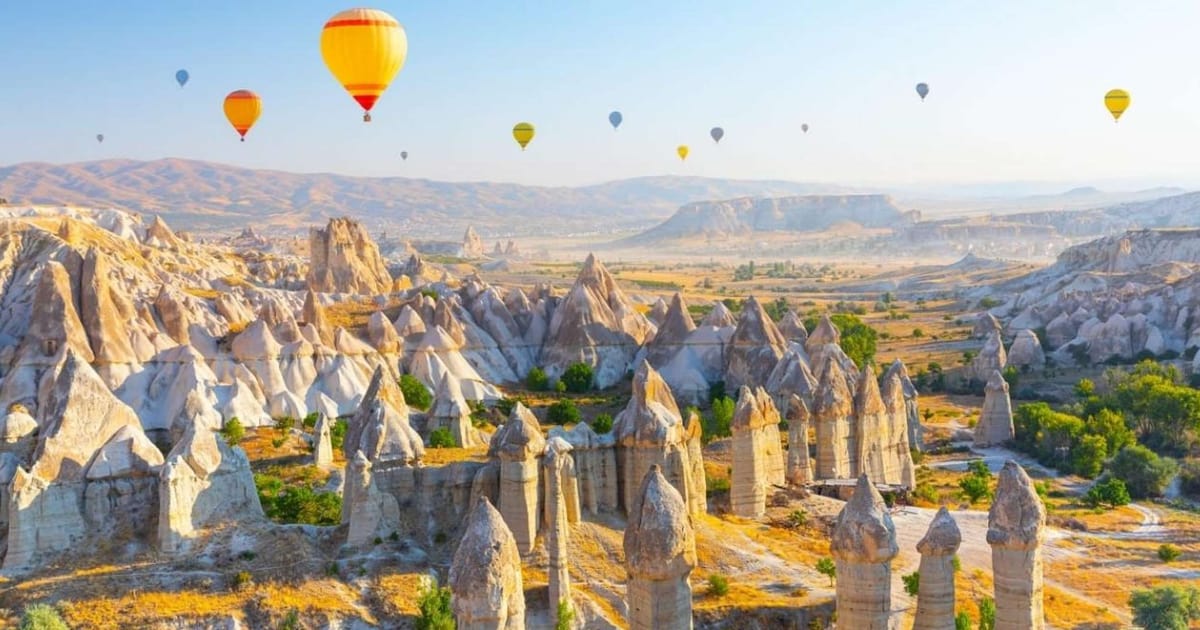
Volcanic ash set into soft tuff, and rain, frost and wind cut that rock into cones under harder caps. A Cappadocia tour from Antalya shows the result at Pasabag, with dark-topped pinnacles, and Devrent, with animal shapes.
Three volcanoes made the ground that a Cappadocia tour from Antalya crosses: Erciyes, Hasan and Gollu Dag. The ignimbrite eruptions ended about three million years ago. Erciyes is a large stratovolcano surrounded by vents and lava domes. Gollu Dag is a lava dome whose obsidian was traded as far as Cyprus and Syria.
A related page on Cappadocia: Cappadocia Red Green Tour.
Ignimbrite is the deposit of a pyroclastic flow. That flow is a hot, fast cloud of gas and particles from a volcano. Where the particles were hot enough on landing, they welded together. Erosion by wind and water then took millions of years to shape the soft rock. Near Goreme, it left hundreds of pillars and minaret-like forms.
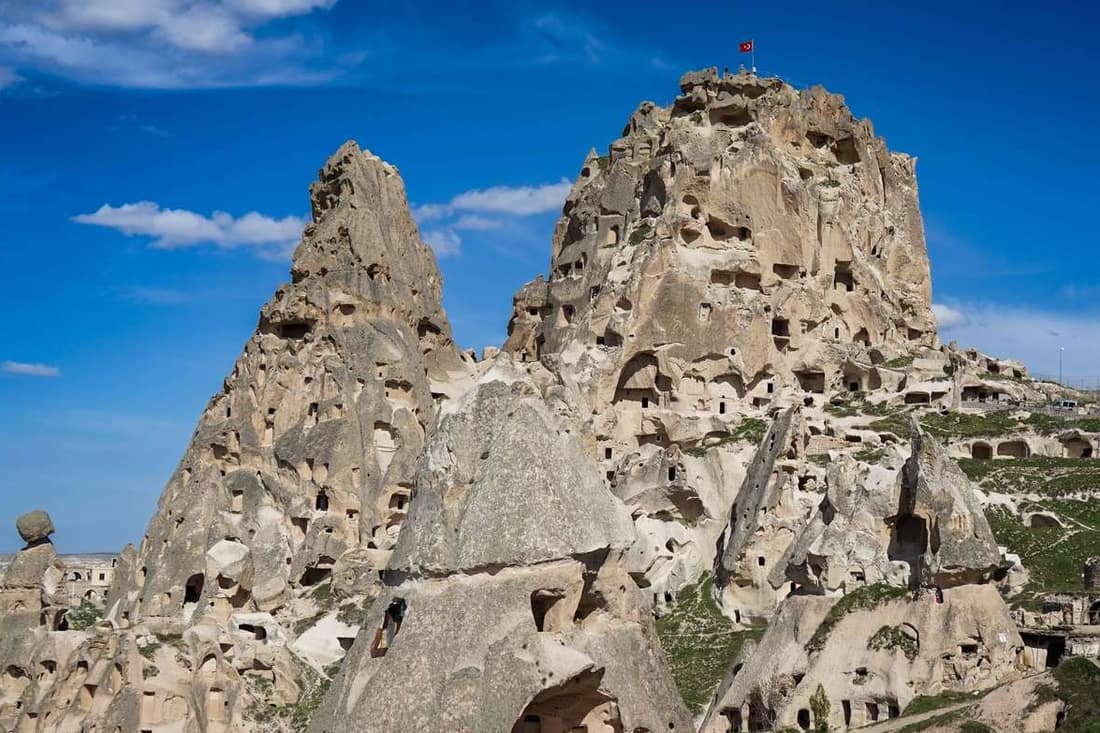
Pasabag shows the layers plainly to anyone who joins a Cappadocia tour from Antalya. A thick bed of soft ash settled first. A darker, denser, harder rock then lay on top. The top rock resisted erosion longer than the ash beneath. Its caps work like stone umbrellas over the soft cone below.
Surface water follows small faults and cuts the first channels. The channels deepen once they reach the softer layers. Gaps between the pillars then widen, until only patches of the hard top layer remain. Frost widens cracks too, because water expands by almost ten percent as it freezes.
The layers differ in colour. The soft lower strata are paler, and the hard top layer contrasts with them. Weight matters twice. The pile of layers can press the lower strata into firmer rock. The heavy cap then presses on its pedestal and gives it strength to resist erosion.
Readers interested in Antalya can open 7 Day Budget Istanbul Cappadocia Antalya Tour.
Pasabag, a stop on this Cappadocia tour from Antalya, takes its name from the Turkish for the Pasha’s vineyard. Its pinnacles are tawny tuff topped by dark rock bombs, and the valley is known for mushroom-shaped rocks. One three-headed chimney contains a chapel and a hermitage dedicated to Saint Simeon.
At Devrent, a Cappadocia tour from Antalya trades paintings for shapes. Unlike other Cappadocian valleys, it has no rock-cut churches with frescoes. Wind and rain carved a camel, a seal and an alligator ready to hunt. Another rock resembles the Virgin Mary. All of these shapes are natural.
On this Cappadocia tour from Antalya, both valleys fall on day one. Fairy chimneys in the region rise up to 40 metres. Researchers tested Cappadocian tuff with wetting and drying, freezing and thawing, and salt crystallisation. Weathering tests and field observations pointed to poor durability, and weathering and erosion are active in these rocks.
What do Avanos and Uchisar Castle add to a Cappadocia tour from Antalya?
Avanos gives a Cappadocia tour from Antalya a pottery town built on river clay. Uchisar Castle adds a carved rock with views from its summit. This route visits Avanos on day one and Uchisar on day two.
Day one reaches Avanos, a town beside the Kizilirmak. The Hittites called that river the Marassantiya, and it marked the western edge of Hatti, their core land. The Greeks called it the Halys. The river is not used for navigation. To a Cappadocia tour from Antalya, the river matters for the mud it brings down.
Cappadocia also features in Fethiye to Cappadocia Tour.
The ground here suits pottery. Avanos stands on volcanic land, with good mud from the river and clay beds close by. The oily red earth passes through a series of processes until it becomes a high-quality ceramic paste. Hands then shape that paste in the workshops.
Assyrian traders from Mesopotamia taught the Hittites to make pots. Later peoples of the region kept the craft going. A mound called Zank Hoyuk, in the Avanos area, has yielded pottery from the middle Bronze Age. The pots of Avanos tie a Cappadocia tour from Antalya to a craft with Bronze Age roots.
The old town sits on the north bank of the river, and newer streets spread over the south bank. Its houses come in two kinds. The first is built of stone blocks wholly above ground. The second rises partly above ground, over cellars carved into the rock. Builders cut the blocks from soft tuff.
Day two turns to Uchisar. The old village clusters at the foot of a huge rock cone. The new village lies nearer the Nevsehir to Goreme road. The cone is Uchisar Castle, a rock hollowed out into rooms and tunnels. Its summit is the lookout stop of this Cappadocia tour from Antalya.
Another page that includes Cappadocia is 6 Day Istanbul Cappadocia Tour Package.
Underground passages and rooms run through the rock, and blocked stretches limit where a visitor can go. In Byzantine times the rooms served as homes. Visitors can enter the castle, and the summit offers views.
Uchisar first appears in a chronicle of the fourteenth century, yet people used the area long before that. In the seventh century the Byzantines created a buffer zone here against Islamic expansion. The terrain suited defence, and camouflaged buildings strengthened it. Day two of the Cappadocia tour from Antalya thus lands inside an old Byzantine buffer zone.
The village holds a sixth-century church of St Basil, set inside a rock cone and not easy to reach. In the town centre, a tunnel about 100 metres long runs beneath the houses. Builders cut it from tuff. Certain old stone houses carry carvings on their facades.
Uchisar has two lesser pinnacles besides the castle, both carved out. Tiraz Castle lies east across the valley, with a walking trail around it and a view of Uchisar Castle. Kekligin Castle is the other. This route skips both, which leaves the Cappadocia tour from Antalya with the main rock alone.
Marmaris to Cappadocia Tour covers Cappadocia too.
Which underground city can you enter on a Cappadocia tour from Antalya?
Visitors can enter Derinkuyu and Kaymakli, and both lie in Nevsehir Province. This route goes below ground once, on day two. Then the Cappadocia tour from Antalya ends with the coach ride back to the Mediterranean coast.
Derinkuyu means “deep well” in Turkish. The town of that name is the seat of Derinkuyu District, in Nevsehir Province. Its underground city is open to the public. On day two, this Cappadocia tour from Antalya enters one underground city. The paragraphs below name the cities that are open to visitors.
Entering Derinkuyu on a Cappadocia tour from Antalya means stepping into a refuge. Cappadocia’s underground cities were dug to give protection during periods of persecution. Christians sheltered at Derinkuyu from the Seljuk invasions of the area in the eleventh century. They used it again during the Mongol incursions of Timur in the fourteenth century.
Cappadocian Greeks and Armenians used the underground cities to escape periodic persecutions. That use lasted until the population exchange between Greece and Turkey. After the exchange, the tunnels of Derinkuyu and Kaymakli were abandoned. Both cities then stood empty of the families who had used them as shelters.
Defence networks of traps ran through the levels of the underground cities. Large round stones blocked doors. Holes in the ceiling let defenders drop spears on intruders. Only a fraction of the Kaymakli complex is open to the public. A Cappadocia tour from Antalya therefore sees part of the defence plan, not all of it.
For more on Cappadocia, see Cappadocia Bus Tour From Izmir.
Tunnels connect Derinkuyu with Kaymakli. A third city, Mazi, lies in the village of Mazi, in Urgup district. It sits 18 kilometres south of Urgup and 10 kilometres east of Kaymakli. Excavations there revealed four entrances. The main entrance is a huge passage cut from the rock, with stables on both sides.
Stables take up much of Mazi, and their size points to livestock kept below ground. A small part of the caverns stored wine. Holes in the ceiling, closed with rocks, let grapes drop into the cellar. For any Cappadocia tour from Antalya that adds Mazi, the city shows the working side of life underground.
The church of Mazi has an apse decorated with reliefs. Its entrance can be sealed with a millstone door. Rock tombs with pillared and gabled facades are cut into the rocks around the village. A well-preserved rock chapel stands south of the village, an extra for a Cappadocia tour from Antalya that reaches Mazi.
Tatlarin lies in the Acigol district of Nevsehir Province. It allows access to only two floors. Traps 2 to 3 metres deep sit in the middle of its corridors. Spacious interiors, more than one church, cellars and murals point to a large settlement. A military garrison and a monastery complex are both proposed as its purpose.
Cappadocia comes up again in Cesme to Cappadocia Tour.
Which coach rules, weather swings and entry rules shape a Cappadocia tour from Antalya?
For this Cappadocia tour from Antalya, coach rules give each passenger 30 kilograms of free luggage and a numbered seat. The plateau lies over 1,000 metres up, while Antalya sits 30 metres above the sea. Each end of the route needs its own clothes and papers.
Turkish coach rules record who is on board a Cappadocia tour from Antalya. On scheduled services, each ticket carries your name, your seat number, and the date and time of departure. A foreign passenger’s nationality and passport number go on it too. An unscheduled coach needs a passenger list with the same passport details.
Seats are numbered, and a seat sold to one passenger cannot be sold to another. The rules bar carrying anyone outside the numbered seats, so nobody rides standing in the aisle. Keep your ticket with you for the whole journey.
Luggage follows its own rules during a Cappadocia tour from Antalya. Up to 30 kilograms per passenger travels free. Each bag gets a two-part label, one half tied to the bag and the other stuck to your ticket. Flammable, explosive and poisonous goods are banned, even in the hold.
Cappadocia has a markedly continental climate, because it lies inland and high. Antalya has a hot-summer Mediterranean one. Going inland on a Cappadocia tour from Antalya changes the climate zone as well as the scenery.
Cappadocia comes up again in Cappadocia Tour From Izmir.
The record lows show the gap, even in summer. July has not dropped below 14.8 degrees Celsius at Antalya, yet Nevsehir has fallen to 3.8. Antalya’s February record is minus 4.6, and snow there is very rare. July air differs too: relative humidity averages 58.0 per cent at Antalya and 47.5 at Nevsehir.
Pack a hat, a warm layer you can peel off, and sturdy shoes with grip for rock paths. Those three items suit a Cappadocia tour from Antalya in any season. The coast and the plateau sit at very different temperatures.
The Ministry of Culture and Tourism sells MuseumPass Cappadocia as an e-card. It covers more than ten of the Ministry’s museums and archaeological sites. Its page shows them on a map and links a list of sales points.
Balloon flights are not part of this coach tour. They run at sunrise, and the sport is popular particularly around Goreme. Strong wind keeps balloons grounded, so no flight is guaranteed. Treat any balloon ride as a separate plan beside the Cappadocia tour from Antalya.
Readers interested in Cappadocia can open Cappadocia Hot Air Balloon.
Which visa you need depends on your passport. If you need one, apply on the Foreign Ministry’s own site, evisa.gov.tr. You enter your identity, passport and travel dates, pay online and download the e-Visa. It covers tourism and commerce only. A visa for work or study comes from an embassy or consulate.
Dial 112 in an emergency. The Ministry of Health runs an interpreting unit for foreign-language calls to 112 about foreign patients. It works round the clock in six languages, English among them. Plugs in Turkey are types C and F.