
A Perge Aspendos Side tour from Antalya is a one-day trip to three Roman-era cities on the Turkish coast. This post covers the day, the ruins at each city, the Manavgat waterfall and the booking rules. The homepage lists more Greece Tours for the Greek islands.
Every tour card below opens a live GetYourGuide booking. Pickup points and group sizes are shown on each card.
What is a Perge Aspendos Side tour from Antalya and how does the day run?
The day starts with hotel pickup in Antalya and runs east by coach, minibus or van to ancient cities. Day length on a Perge Aspendos Side tour from Antalya runs from eight to ten hours, depending on the format.
Pickup comes first on a Perge Aspendos Side tour from Antalya. Hotel pickup and drop-off are included on the nine-hour coach format. Its air-conditioned coach takes up to 45 guests, and the guide speaks English. Drinks stay outside the package on that format, while lunch sits inside it.
For more days in Turkey, the homepage lists Turkey tours across the old cities and the coast.
Smaller formats use smaller vehicles. A small-group format takes up to 15 travellers and runs eight to nine hours. The private highlights format hands a sedan to one to three guests and a minivan to four to eight. A private riverside-lunch format counts two to ten guests.
Start hours vary by format. The eight-hour group format begins at around eight in the morning. The riverside-lunch format collects guests between half past seven and eight. One format picks up from Kaleici to Lara. It advises guests to contact the operator the day before for the exact time.
The order of stops on a Perge Aspendos Side tour from Antalya changes with the format. One full-day format runs Perge, Aspendos, a riverside lunch, Side, then ends at the Manavgat waterfall. The coach format also runs Perge, Aspendos, lunch and Side, then adds a local shop before the return.
The minibus format lists no Side stop. Its day runs from Perge to lunch by the river in Belkis village, then Aspendos and the waterfall. One all-inclusive format lists Aspendos before Perge. The private highlights format keeps to Perge, Aspendos and Side, with no waterfall in its stop list.
Each stop has its own time. The eight-hour group format puts the drive from Perge to Aspendos at about 45 minutes. It gives Perge about an hour and a half and Side about two hours of free time. A second format allows about an hour by the sea at Side.
Lunch sits in a different place on each format. The coach format serves a traditional Turkish lunch at a local restaurant between Aspendos and Side. The minibus format serves a main course and dessert by the river. The eight-hour group format puts lunch before the Manavgat waterfall.
For more on Antalya, see Antalya Tour From Istanbul.
Entrance tickets change with the format on a Perge Aspendos Side tour from Antalya. Tickets to Perge, Aspendos and the waterfall come with the eight-hour group format. Side is not on that list. The coach format includes entry fees on one option only. On the private highlights format, guests pay at Perge and Aspendos on the spot.
Guide language follows the format on a Perge Aspendos Side tour from Antalya. English runs on the coach, eight-hour group, minibus and riverside-lunch formats. Turkish joins English on the private highlights format, where the driver acts as an informal guide. One all-inclusive format is offered in German and two other languages.
The formats name different kinds of guest. The coach format suits history enthusiasts and casual travellers. A full-day format is aimed at history lovers and nature enthusiasts. A format with pickup across Antalya names couples and families with older children. A private format is tagged easy and lists family, friends and couples.
What does a Perge Aspendos Side tour from Antalya show at Perge?
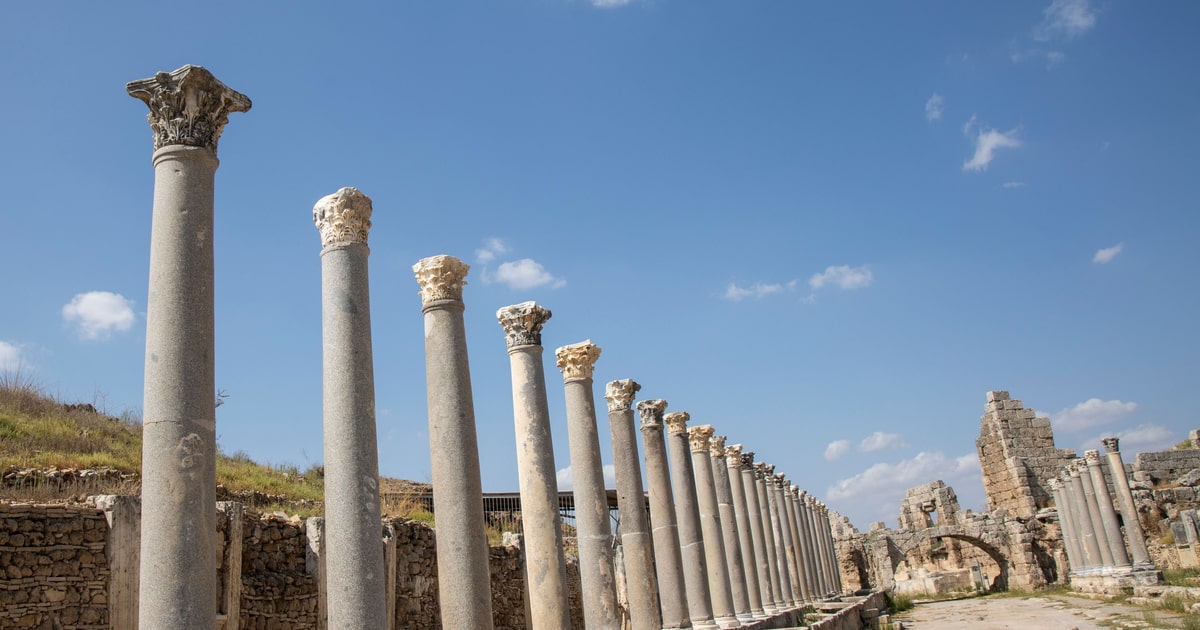
Perge shows two Hellenistic towers, a main street with a water channel, an agora, baths and a stadium. The Turkish ministry says Hittite texts called the city Parha. Ruins seen during a Perge Aspendos Side tour from Antalya stand on that old ground.
Perge turns up in Hittite records under the name Parha. A bronze tablet from Hattusa holds a treaty of Tudhaliya IV with his vassal, the king of Tarhuntassa. It fixes the western border of that kingdom at the city of Parha and the Kastaraya River.
Antalya Turkish Riviera Tour covers Antalya too.
Ceramics from the acropolis suggest settlers in the Early Bronze Age. Persia took Perge with the other cities of Pamphylia in the sixth century BC. Diodorus Siculus names Perge among the cities that rebelled against Persian rule. Alexander, after taking Phaselis, was welcomed in Perge with his army.
In the late third century BC, builders raised a wall around the lower town and gave it three gates. At the southern one stood a pair of towers, three floors high and capped with cones. These towers count among the ruins met during a Perge Aspendos Side tour from Antalya. Ministry texts call them symbols of Perge.
Plancia Magna, a local noblewoman and priestess of Artemis, enlarged the Hellenistic gates. Her work, early in the second century AD, made them a monumental gate complex. Hadrian’s reign added a triumphal arch in the north wall of the court. Costly marble, columns and statues dressed its facades.
Colonnaded streets and a nymphaeum are named among the sights during a Perge Aspendos Side tour from Antalya. Water ran down the main street in a channel of cascading pools, unique for a Roman city. Hadrian’s nymphaeum, at the acropolis edge, caught the abundant outflow and fed the channel.
A building boom ran through the second century AD, fed by the Roman peace and by wealth. The city centre spread to the south side, and philanthropists paid for monumental buildings. The Roman golden age gave Perge a theatre, stadium, city gate, agora with market building, and palaestra.
A related page on Antalya: 7 Day Budget Istanbul Cappadocia Antalya Tour.
Baths and a stadium are among the ruins covered during a Perge Aspendos Side tour from Antalya. Perge’s south baths, from the first century AD, are well preserved and noteworthy for size. The stadium seats about twelve thousand spectators. The theatre stands beyond the walls, close to the stadium, and is larger than those at Myra and Patara.
Perge is known for its architecture and marble sculpture. Sculptures dug up there helped make the Antalya Museum one of Turkey’s main sculpture museums. Second- and third-century figures of myth went to the museum, with statues of emperors and empresses. Towers, streets and baths show the architecture during a Perge Aspendos Side tour from Antalya.
Digging at Perge began in nineteen forty-six under Arif Mufid Mansel. Work up to two thousand and twelve cleared the theatre, the south bath and the agora with its macellum. They also cleared the Kestros fountain and the main colonnaded street. The Caracalla fountain was excavated as well.
Christian history adds a late layer to ruins visited during a Perge Aspendos Side tour from Antalya. Constantine’s reign made Perge a centre of Christianity, and basilicas followed in the fifth century and the sixth. St Paul came by the Aksu River, and his road to Pisidian Antioch began in the city.
Readers interested in Antalya can open Pamukkale Tour From Antalya.
Why is Aspendos the midday stop of a Perge Aspendos Side tour from Antalya?
Aspendos holds a Roman theatre of the second century that survives almost intact. Seljuk use as a palace helped save its stage wall. Roman stonework greets visitors after a Perge Aspendos Side tour from Antalya, stage columns included.
Zenon, a Greek architect born in Aspendos, planned the building. An inscription names two brothers, Curtius Crispinus and Curtius Auspicatus, as the men who ordered the work. The building was dedicated to the gods and to the emperors of the day. It rose in the second century.
The whole theatre measures 96 metres across, and its seats form 41 rows of benches. Part of the bowl leans on the hill, a natural base visible after a Perge Aspendos Side tour from Antalya. Stone arcades carry the rest of the stand. The orchestra at its foot is 23.9 metres across.
The stage wall stands complete, and the columns that support the high stage are still in place. Only the wooden ceiling that once sloped above the stage is gone. Fifty-eight holes in the upper level mark where poles stood. The poles allowed a large awning, the velarium, to shade the seats.
Seljuk rulers of Rum repaired the theatre periodically, and it served as a caravanserai. During the thirteenth century the stage building became their palace. Seljuk repairs stand out after a Perge Aspendos Side tour from Antalya. Plaster in dark red zigzags and a monumental gate mark the outer front.
A research project called ERATO took measurements at Aspendos and at Jerash in Jordan. The team used them to adjust its computer models of Roman theatres. Those models showed high clarity but low sound strength in open-air theatres. The researchers link that result to speech, the purpose of such theatres.
9 Day Footprints of St Nicholas Turkey Tour is a close match for this topic.
The Roman aqueduct, 19 kilometres long, adds to what visitors recall after a Perge Aspendos Side tour from Antalya. Builders raised it between the middle of the second century and the end of the third. The last two kilometres form an inverted siphon, where water dipped into the valley and rose again.
The central stretch stood on 46 arches, and 29 of them still stand. The siphon ran in three bridge sections. Two square towers, 5.5 metres on each side and still 30 metres high, separate them where the line bends. The limestone pipes were sealed with a lime and olive oil mortar.
Aspendos stood on the Eurymedon, known in Turkey as the Koprucay, about 16 kilometres inland. Thucydides wrote that the river was navigable up to the city. That setting frames the ruins seen after a Perge Aspendos Side tour from Antalya. Strabo recorded a lake, Caprias, near the river mouth.
Seljuk stone sits on Roman foundations at the bridge, worth spotting after a Perge Aspendos Side tour from Antalya. Romans spanned the river with nine semicircular arches. In the thirteenth century Sultan Kayqubad I built the Seljuk bridge over its fallen remains. The later bridge zigzags through two right-angle bends and has pointed arches.
Antalya also features in Sunken City and Antalya Tour From Istanbul.
A legend pits two brothers against each other, one building the aqueduct and the other the theatre. A king gave first prize to the theatre. Modern restoration returned the building to its original state. The Turkish State Opera and Ballet has organised a festival at Aspendos since nineteen ninety-four.
Which parts of Side and the Manavgat waterfall fit in a Perge Aspendos Side tour from Antalya?
Side holds a Roman theatre, harbour temples and a museum in an old bath. The Manavgat waterfall adds a wide, low river fall. Roman stonework runs throughout a Perge Aspendos Side tour from Antalya, Side’s share sitting on a peninsula one kilometre long.
Side occupies a small peninsula, long from north to south. A wall and a moat cut the headland off from the mainland. That layout keeps the ruins close together throughout a Perge Aspendos Side tour from Antalya. Distances stay short, since the headland is about one kilometre long and 400 metres across.
The Hellenistic main gate, called Megale Pyle, is the way into the ruins. It dates from the second century BC, so it is older than the Roman theatre and temples. The colonnaded street once had marble columns, and their remains lie close to the Roman baths.
Harbour history explains why Side matters throughout a Perge Aspendos Side tour from Antalya. Rome began to use the port as a naval base in its struggle against pirates. A sea harbour and a river port together stimulated economic growth. In the third century the port also carried soldiers east.
The theatre of Side dates from the second century and is colossal. It is less well preserved than the theatre at Aspendos. In the fifth or sixth century it was converted into an open-air sanctuary with two chapels. The early Roman Temple of Dionysus stands near the theatre.
Antalya comes up again in Antalya Duden Waterfall Boat Tour.
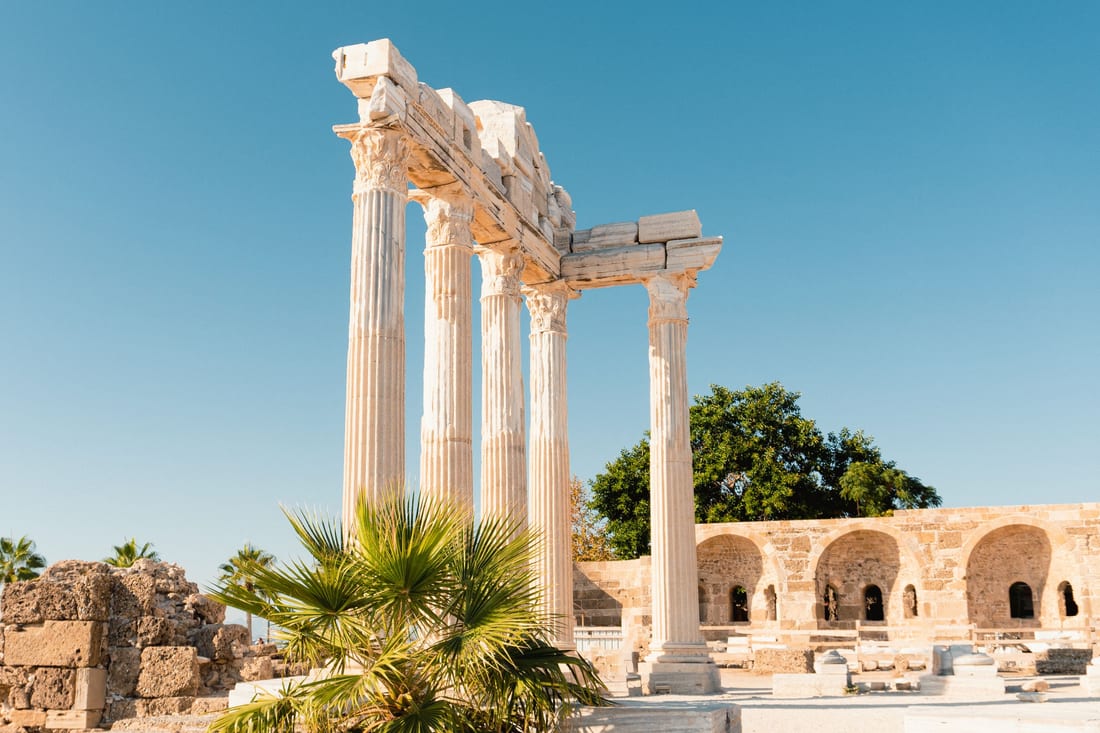
The temples of Apollo and Athena stand together at the tip of the peninsula. Both date from the middle of the second century. The Apollo temple is Roman, in the Corinthian style, from the reign of Antoninus Pius. Its five standing columns and their capitals were restored between nineteen eighty-four and nineteen ninety.
Side’s agora, the old public square, belongs to the same picture throughout a Perge Aspendos Side tour from Antalya. Remains of a round temple for Tyche and Fortuna stand in it. Twelve columns ringed the temple, and it dates from the second century BC. Pirates later sold slaves there, which made the square a trading centre.
The Side museum fills an ancient bath. The rectangular bathhouse has five halls: a cold room, a sweating room, two warm rooms and a hot room. A courtyard behind it reaches to the sea walls. Restoration ended in nineteen sixty-one, and the museum opened in nineteen sixty-two.
The museum sums up the city throughout a Perge Aspendos Side tour from Antalya. Works on show come mainly from excavations at Side between nineteen forty-seven and nineteen sixty-seven. Statues, sarcophagi, inscriptions, reliefs, terracotta, glass and bronze finds are among them. Coins of the Hellenistic, Roman and Byzantine periods are on display.
More about Antalya: Antalya Hamam.
The Manavgat waterfall lies on the Manavgat River, about 3 kilometres north of Manavgat town. The river begins high in the Western Taurus, where small springs join. Its course to the sea runs about 90 kilometres, largely through canyons. Pliny the Elder treated the river, then called the Melas, as the boundary between Pamphylia and Cilicia.
The falls are the one natural sight throughout a Perge Aspendos Side tour from Antalya. Manavgat water drops from a low height but spreads across a wide area. White, foaming water pours over the rocks. A high viewpoint suits the falls. In floods, high water can hide them. Shady tea gardens stand near the water.
How do the season and the booking rules shape a Perge Aspendos Side tour from Antalya?
Heat on the ruins depends on the month. Antalya’s mean daily maximum is 21.8 °C in April and 27.3 °C in October. Read the entrance and cancellation terms before a Perge Aspendos Side tour from Antalya. Formats differ on both.
Spring is cooler than summer in Antalya. Table values give mean daily highs of 21.8 °C for April and 26.4 °C for late spring. November reaches 21.6 °C. These figures help when you pick a month before a Perge Aspendos Side tour from Antalya. Rain averages 6.43 days in April and 4.87 days in October.
Summer brings the longest sunny days. Mean daily sunshine reaches 11.0 hours in June and 11.1 hours in July. The average ultraviolet index is 10 in both months, against 7 in April and 5 in October. July has an average of only 0.67 rainy days.
Pack the kit before a Perge Aspendos Side tour from Antalya. Sunscreen or a hat, comfortable shoes and a water bottle are named on one coach format. Another lists an umbrella, a hat and comfortable shoes. A third names a sun hat and comfortable clothes. Comfortable shoes and a hat appear on each list.
Another page that includes Antalya is Cappadocia Tour From Antalya.
Rules depend on the format. One guided format lists drones, bikes and electric wheelchairs as not permitted. On the private car format, drivers are not permitted to enter museums or archaeological areas. They give background and suggestions before visitors explore on their own. Licensed guides for the inside of the sites are available but not included.
Compare entrance tickets before a Perge Aspendos Side tour from Antalya. Fees depend on the format. One coach format includes the entrance fees for its sites. The small-group and private formats leave the Perge and Aspendos tickets to be paid on the spot. A further listing sells base and fee-covered versions.
Museum Pass The Mediterranean is a regional card for sites under the Ministry of Culture and Tourism. It covers over 40 museums and historical sites in Antalya, Mersin, Adana and Denizli provinces for seven days. The card and its variations are not valid for Night Museum visits.
The ministry portal lists a cafe, a shop and a restroom at Perge. At Aspendos it lists a restroom, a shop and car parking. Check the food rules before a Perge Aspendos Side tour from Antalya. Vegetarians have an option on one small-group format. The private car format leaves out meals and beverages.
Antalya comes up again in Antalya Aquarium.
Child rules depend on the format. One coach format counts travellers aged seven and above as adults and those aged six and younger as children. Other formats seat infants on an adult’s lap. The private car format offers specialised infant seats. At Perge, the ministry portal sets the adult ticket category from age eight.
Access depends on the format too. The small-group format lists wheelchair-accessible transport and says it suits all fitness levels. The same format does not recommend the day to travellers with poor cardiovascular health. A coach format is not suitable for wheelchair users. One format warns that walking at the archaeological sites means uneven surfaces.
Booking works in one order before a Perge Aspendos Side tour from Antalya. Date comes first, then availability. A group below a format’s minimum number of travellers is offered a full refund or a different date or experience. Refund cut-off times differ by format and follow local time.