An Antalya hamam is a Turkish bath where heat, a scrub and a massage follow one another. This post covers the session, the rooms, the history, the treatments, the old town and the booking rules. The homepage lists more Greece Tours for the Greek islands.
Every tour card below opens a live GetYourGuide booking. Session types and options are shown on each card.
What happens at an Antalya hamam from the door to the last rinse?
The session moves from a sauna and steam room to peeling, then a foam massage, then an oil massage. Guests at an Antalya hamam receive Turkish tea after the treatments on the base format. The sauna and steam room belong to the same booking.
The base format has no pickup, so each guest at an Antalya hamam reaches the meeting point without a transfer. The bath house stands in the Muratpasa district of Antalya, close to public transport. The session is booked as a Kaleici session, in the old town. Guests return to the same meeting point when the session ends.
After the bath, the homepage lists Turkey tours for the coast, Cappadocia and Istanbul.
A second format adds hotel pickup and drop-off. Pickup is an option chosen in a later step of the booking, not a fixed part of every session. The transfer brings guests back to the hotel after the session. Hotel transfers are left out of the base format.
On a pickup format, guests give the name and address of their hotel in the next step of the booking. On the day, they wait in the hotel lobby shortly before the pickup time. If the hotel has no lobby, they wait at the entrance.
On one package, guests contact the local operator after booking to confirm the pickup time. The voucher carries further details. That package serves hotels in Antalya, Side, Belek and Kemer. Its stages start with a sauna and move on to the hamam, with peeling and foaming treatments.
Timing at an Antalya hamam changes with the format. The formats with hotel pickup run for about two hours. The oil massage on those formats lasts twenty minutes, and one package adds a twenty-minute rest before the massage. The sauna, steam room, peeling and foam stages have no stated time.
A guest at an Antalya hamam warms up first in the sauna or steam room. A full-body scrub and peeling session follows. Next come a foam massage and a soap massage. The last stage is a full-body oil massage with aromatherapy oil, which completes the hamam ritual on that format.
Reception staff greet guests and lead them to a changing cubicle. A locker holds each guest’s belongings during the session. The formats with hotel pickup provide a towel, and one of them describes it as cotton and linen. On the base format, the space also supplies slippers.
Antalya comes up again in Pamukkale Tour From Antalya.
The base format includes the sauna, the steam room, peeling, a foam massage, an oil massage and Turkish tea. Face masks and hotel transfers are left out of it, along with drinks other than tea. A pickup format leaves out extra massages as well. One description lets guests use the sauna and steam rooms throughout the visit.
Couples, small groups and solo travellers at an Antalya hamam share the same order of stages. The base format suits first-time visitors to Turkey who want a genuine hamam session. It is sold as a quick but comprehensive session and as a calm break during a holiday. The format is suitable for all physical fitness levels.
Visitors at an Antalya hamam meet English-speaking staff on the base format, which helps those who do not speak Turkish. English is the language of the pickup formats too. German is offered as well on certain listings, and one two-hour listing names English, German and Russian.
What do you find inside an Antalya hamam?
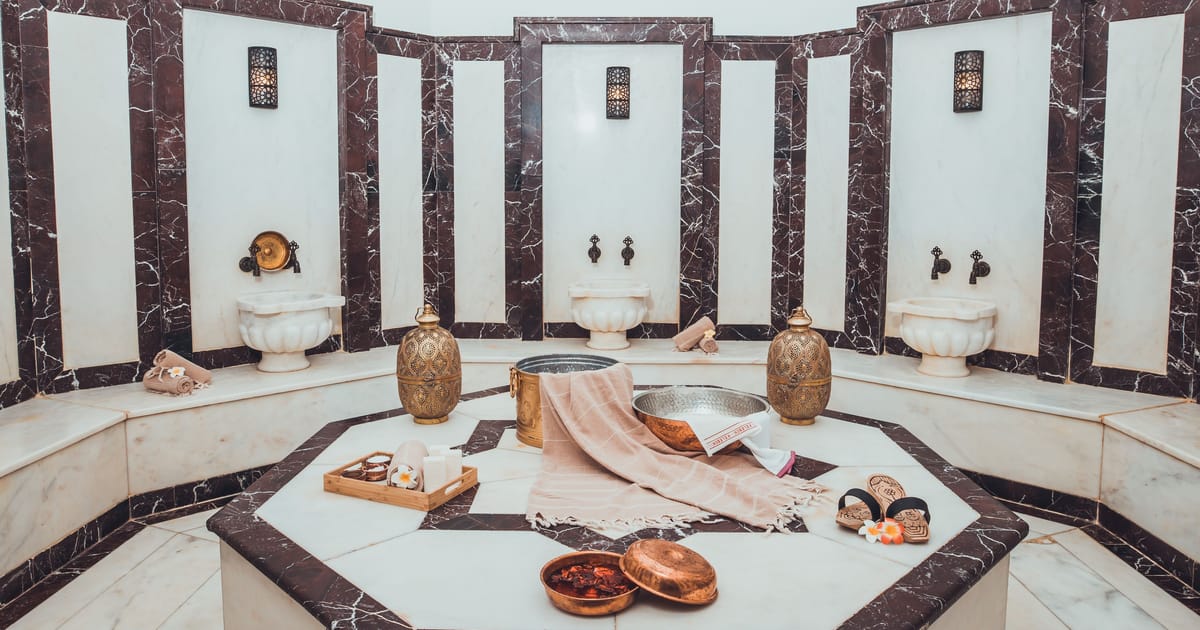
Rooms run from cool to hot, one after another. A heated marble platform fills the hot room, and inside an Antalya hamam, domes cover every steam room. The session on offer adds a sauna and a steam room.
A hamam is planned as a chain of rooms, and bathers walk through them in one fixed order. Inside an Antalya hamam built on the classic plan, the first room is the changing hall. Turkish speakers call it the camekan. A decorated hall can hold a fountain in the middle, with benches around it.
Ottoman builders handled the middle rooms with a lighter touch. The cool room is sometimes left out or joined to the changing hall. The warm room gets little decoration and is at times only a passage to the hot one. Turkish names for the cool, warm and hot rooms are sogukluk, iliklik and sicaklik.
The hot room is the heart of the bath. In the classic Ottoman plan it carries the richest decoration and can be the biggest domed room in the building. A large heated marble platform fills the centre. Its Turkish name is gobek tasi, or belly stone, and bathers lie on it to sweat.
A related page on Antalya: Antalya Tour From Istanbul.
Inside an Antalya hamam planned in the Ottoman style, the hot room can centre on a dome. Up to four side halls, called iwans, flank that domed space and give the plan a cross shape. The corners between the iwans can hold small domed chambers called halvets. Bathers used them for private washing.
Inside an Antalya hamam, daylight reaches the steam rooms through small holes or skylights pierced in the domes and vaults. The same openings let extra steam escape. Builders use squinches to move from the square room to the round dome. Early Ottoman builders decorated domes with spiral grooves, geometric patterns and carved plaster.
Humidity decides the building materials. Ceilings and walls are clad in steam-proof surfaces, such as varnished plaster. Marble covers the lower walls and the floors, and those lower walls stay plain. Traditional hammams also add marble seating. A wet floor is slippery, so bathers once wore the nalin, a clog of wood or mother-of-pearl.
Inside an Antalya hamam heated the traditional way, a furnace burns in a separate service space by the hot room. Hot air and smoke flow through channels beneath the floor of the steam rooms. A large cauldron above the furnace warms the water. Furnaces in the old plan supply both hot water and steam.
The pestemal is the wrap of the bath. It is a cloth of silk or cotton that covers the body, like a pareo. The hamam version is handwoven cotton, light yet absorbent, with a traditional pattern. Bathers strip down to a modesty garment or a loincloth before the hot rooms.
Readers interested in Antalya can open Antalya Turkish Riviera Tour.
The session on offer adds two more heated rooms to the classic plan. Inside an Antalya hamam booked for this session, a sauna and a steam room come with the bath. The sauna is a hot room where guests sit back and sweat. The steam room holds hot, wet air instead.
Seen from the door, the route is easy to follow. A warm outer chamber comes first, and a hotter inner chamber with the central marble slab comes next. A cooler chamber for resting after the steam closes the route. Marble is the main material of all these rooms.
Which history lies behind an Antalya hamam?
Roman public baths gave the hamam its model, and Seljuk and Ottoman builders carried the idea on. That long line stands behind an Antalya hamam tradition in Kaleici. King Attalos II of Pergamon is looked on as the city’s founder, in the second century BC.
Roman cities treated their public baths as community centres. The bathing took so long that conversation was necessary. Such baths stood in Roman and Hellenistic towns around the Mediterranean. Perge, a Roman city in Antalya Province, has south baths from the first century AD. The baths are well preserved and noted for their size and their sculptures.
The Romans heated their baths with a hypocaust. Pillars raised the floor above the ground, and a furnace sent hot air and smoke into the space below. The heat rose through flues in the walls. The historic hammam took over a version of this system, which puts Roman engineering behind an Antalya hamam floor.
A hypocaust took constant attention to the fire and plenty of fuel. So it belonged to large villas and public baths. Baths stayed important in the cities of the early Byzantine Empire up to around the mid-sixth century. Attaleia was a major city of that empire and the capital of the Theme of the Cibyrrhaeots.
For more on Antalya, see Antalya Aquarium.
Baths were part of life in Turkey in Greek and Roman times, and Seljuk Turks continued to build hammams. Eastern Roman, Persian and Turkic cultures shaped one another across Anatolia. The Ottomans built hammams as social centres in almost every city of their lands. Early Ottoman examples remain in Edirne and Bursa.
At times, sultans and prominent figures commissioned large hamams as charitable endowments, called vakif, that served the public. Mosque complexes acted as community centres and places of worship. In a number of towns, a bath house formed part of the complex. That pairing of mosque and bath lies behind an Antalya hamam legacy.
Women’s hamams were communal spaces where women gathered weekly to socialise, sing and swap remedies. For men, the hamam was a place of rest and informal business talk. Hammams stayed a vital part of urban life until the early twentieth century, when indoor plumbing reached private homes. This town life lies behind an Antalya hamam custom.
The city took the name Attaleia from its royal founder, and his fleet used the port as a naval base. It grew under Roman rule, and the emperor Hadrian visited it in AD one hundred and thirty. A gate was built in his honour. The Turkish name of the gate is Uckapilar, which stands for the Three Gates.
The gate was later built into the walls around the city and the harbour. The upper part of its northern tower was rebuilt under the Seljuk sultan Alaeddin Keykubat I. That work dates from the thirteenth century, in its first half. The Seljuk period also added a series of inner walls to the city walls.
Kaleici keeps bath houses from different centuries, and each one lies behind an Antalya hamam story of its own. A double bath of the sixteenth century held two separate baths, one for women and one for men. Another bath, built for the non-Muslim community, dates from the nineteenth century’s second half.
Another page that includes Antalya is Cappadocia Tour From Antalya.
Bali Bey built one bath in the late fifteenth century, in the same years as the Bali Bey Mosque. The bath’s east gate looks to the mosque and opens to its furnace and woodshed. In nineteen eighty-four the Turkish Ministry of Culture and Tourism received the Golden Apple Award for preserving and restoring Kaleici.
Which treatments come with an Antalya hamam?
Peeling, foam massage and oil massage come with an Antalya hamam session on the sauna, peeling and massage format. The peeling uses a rough mitt, the kese, which scrubs dead cells from the surface of the skin.
The sauna and the steam room supply the heat. In a steam bath such as the hammam, the air holds humidity close to saturation. A Finnish sauna holds much drier air. Medical sources see no clear sign that dry heat beats wet heat. Heat raises the heart rate and brings on sweat, a change that mimics exercise.
Heat also makes the blood vessels widen, which sends more blood through the body. Sore muscles tend to respond to heat as well. On the sauna, peeling and massage format, the warmth softens the skin before the scrub. That warm-up goes with an Antalya hamam steam room.
Dead cells make up the outermost layer of skin, the stratum corneum, and the body sheds them all the time. Removing them on purpose is called exfoliation. Rubbing them off with a gritty surface is mechanical exfoliation. On this format, the full-body job that goes with an Antalya hamam scrub falls to a trained attendant.
The kese survives in the modern hammam as a rough mitten used for scrubbing. It is rubbed over the skin in long, circular strokes. In the old bath houses, the attendants were young men called tellak, who soaped and scrubbed their clients. Washing meant soap and vigorous rubbing.
Antalya also features in Antalya Duden Waterfall Boat Tour.
Body scrubs tend to be on the rough side, so skin experts keep them off the face. Facial skin is thinner and more delicate. Skin on the rest of the body can take more exfoliation. The body sheds skin all the time, and the pace slows with age, which can leave skin looking dry.
The foam massage involves a warm foam bath in which silky bubbles cleanse and soothe the whole body. In plain terms, the step is a full-body wash in warm water and fragrant bubbles. This format also names a soap massage, a treatment that belongs with an Antalya hamam wash.
The calming oil massage that comes with an Antalya hamam bath covers the whole body and uses aromatic oils. It helps release tension. Massage means working the soft tissues of the body by rubbing and kneading. Oils, lotions and creams help the hands glide and moisturise the skin.
Swedish massage is the category that is recognised and used more widely than any other. It rests on five basic strokes: sliding, kneading, tapping, friction and vibration. Health sources describe it as a gentle, full-body style that can help calm the nervous system. It is the classic choice for relaxation.
Aromatherapy is a practice that uses aromatic materials, among them essential oils. People apply blends to the skin, use them in massage, or breathe them in. Concentrated oils are mixed with a carrier oil, such as olive or jojoba oil, before use on the skin. Research finds no clinical evidence that aromatherapy prevents or cures any disease.
Turkish tea is offered after the treatments on this format, a rest that comes with an Antalya hamam visit. It sits on the inclusions list beside the sauna, steam room, foam massage and oil massage. The bath house long kept a habit of relaxing, drinking tea, coffee or sherbet, and talking before and after bathing.
Perge Aspendos Side Tour From Antalya covers Antalya too.
Where does an Antalya hamam sit among the lanes of Kaleici?
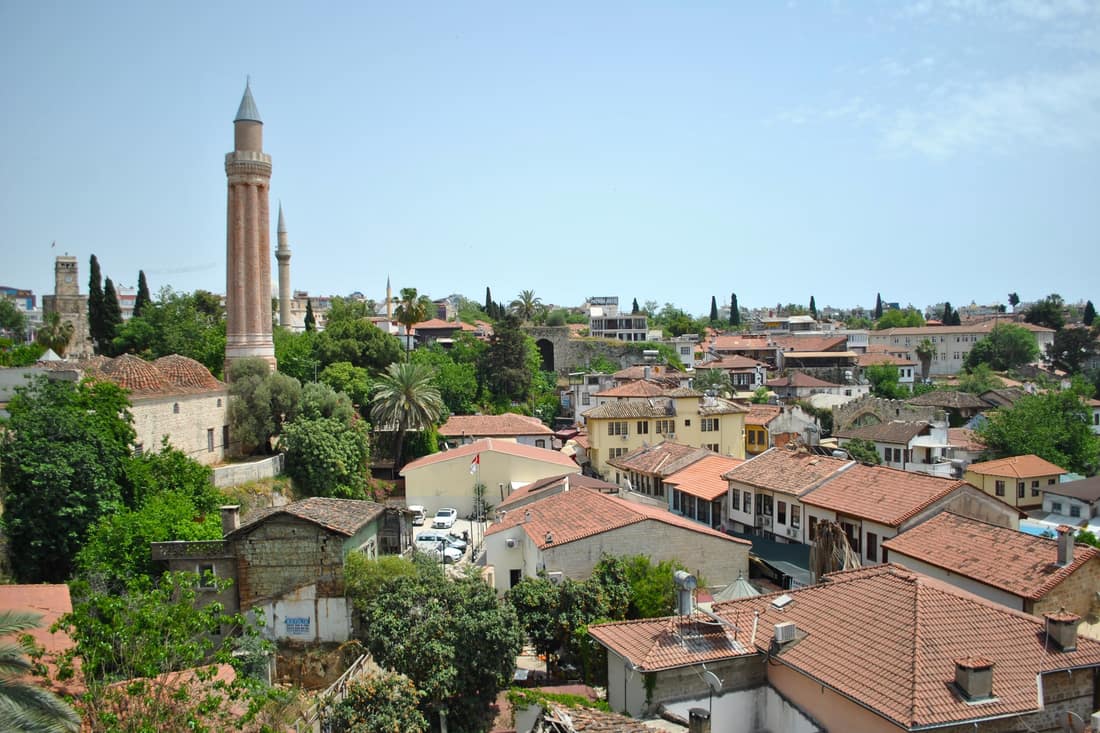
Kaleici, the old town of Antalya, is the setting, a horseshoe of lanes within a double ring of walls. The alleys around an Antalya hamam doorway are narrow and cobbled, between red-tiled houses. The district lies on the Mediterranean coast.
The name Kaleici means Inner Castle, and the quarter keeps its old shape. Protection records list 473 examples of civil architecture, 72 monumental structures and 56 registered wells. The area was declared a protected urban and archaeological site in nineteen seventy-three. The stone lanes around an Antalya hamam entrance belong to that listed quarter.
Hadrian’s Gate is the only entrance gate of the old walls left standing, and it opens into Kaleici. A tower stands on each side of it. Its passageways carry floral and rosette reliefs, and it rises about eight metres. In ancient times a street ran from the gate to Hidirlik Tower. It was called Platae and had shops.
Hidirlik Tower marks the south-western corner of the walls, where the land walls meet the sea walls. A door on its east side opens into a small room with a narrow staircase. Its name is linked to Hidirellez, a spring festival. Each lane around an Antalya hamam door lies within the ring of walls that this tower closes.
The Yivli Minaret rises along Cumhuriyet Street, near the square of Kale Kapisi. It belongs to a complex that also holds two madrasas and two tombs. A small door on the north side opens onto a staircase of ninety steps. Cut stone forms the lower part of the minaret, and red brick forms the fluted shaft.
Kale Kapisi was the main gate of the old town on the land side. Roads from the east, west and north once ended there. The clock tower rises from a bastion of that gate, with a clock on all four sides. A walker leaving the lanes around an Antalya hamam building for the land side reaches this spot.
More about Antalya: 7 Day Budget Istanbul Cappadocia Antalya Tour.
Below the walls lies the marina, a semi-circular natural port with an entrance 110 metres wide. Seawalls stand on older wall remains, and towers once stood on both sides of the entrance. The Forty Stairs lead from inside the city wall down to it. The sheltered port made the old town a place to live from ancient times.
South of the old town, Karaalioglu Park covers about 140,000 square metres. Three parallel streets run through it toward the sea and end in three viewing terraces at the shore. The park looks out over the cliffs and the Gulf of Antalya, a large bay of the eastern Mediterranean. The city is flanked by the Taurus Mountains.
Museums and old mosques wait inside the same walls as the lanes around an Antalya hamam neighbourhood. The Ataturk House Museum is a former Greek-owned mansion that became a museum in nineteen eighty-six. The Ethnography Museum fills two neighbouring nineteenth-century mansions. The Kesik Minare stands in the southern half of Kaleici, and agora remains lie in its area.
The alleys climb the slope from the harbour and trace the contours of the inner walls. The park south of the walls is easy to reach on foot. On the base format, transfers are left out, so guests choose their own way in. A format sold with transfers adds hotel pickup and drop-off, chosen in the booking step.
When can you book an Antalya hamam and which rules apply?
Book any date that shows availability, and cancel at least a day before the start to keep a full refund. Heat sets the other rule for an Antalya hamam stay. July averages 34.2 degrees Celsius at its highest.
A booking cancelled a full day ahead of the start earns a full refund. This holds on the base session and on the transfer format alike. On the base session, a cancellation inside that last day or a missed start is charged in full. Being late for the departure counts as a missed start too.
For more on Antalya, see Sunken City and Antalya Tour From Istanbul.
The cards show live availability, so a date can be checked before anything is booked. Booking early is what holds a place on the base session. The high season, public holidays and weekends add to that need. Plan ahead for an Antalya hamam slot on those days.
The climate of Antalya brings hot, dry summers and mild, rainy winters. August follows July at 34.1 degrees Celsius, and July rain falls on under one day on average. The daily mean for July is 28.6 degrees Celsius. The water rules below carry extra weight for an Antalya hamam visit in summer.
Dehydration is one of the biggest risks of sauna use, so drink water before and after a session. The transfer format also advises fluids before the sauna and following the rules of the bath house. A second transfer format calls for plenty of water as well. Bringing a bottle of water is suggested for the base session.
January in Antalya has about twelve rainy days and an average highest temperature of 15 degrees Celsius. The sunshine figure for January is only 4.9 hours, against 11.7 in July. The sauna and steam room of the base session give that weather a warm answer. Winter is a plain reason for an Antalya hamam session.
Pack for an Antalya hamam outing with water shoes, large towels and a bathrobe, as the transfer format advises. Bring personal care products needed for allergies or preference. On the base session, a towel or a bikini bottom is the wear. On a second transfer format, bathers entering the hot-air room are draped in a linen body cloth.
On the base session, men and women use separate areas. The foam and peeling stages can be vigorous, so a bather prone to sensitivity tells the therapist first. The risk of harm from massage appears low. Reports of a blood clot, nerve injury or bone fracture are rare and include cases of vigorous deep tissue massage.
For a similar plan, see 12 Day Turkey Tour.
Heart conditions lead the cautions for an Antalya hamam sauna. A heart attack or stroke that has just happened rules out a sauna. A person with heart disease, severe aortic stenosis, heart failure, or high or low blood pressure asks a doctor first. The same step applies to epilepsy and to anyone taking medication.
Pregnancy calls for a doctor’s advice first, and the base session is not recommended for pregnant travellers. People under sixteen or over sixty-five also check first. Anyone who has been drinking alcohol keeps out of a sauna. A bather who feels dizzy, weak or unwell leaves the sauna and seeks medical help.
Both the base session and the transfer format advise against very young children. A newcomer to saunas starts with five minutes and adds time on each visit. Heat can make eczema itchier, so keeping cool matters for anyone with that condition. Skin with cuts or open sores is checked before any scrub.