
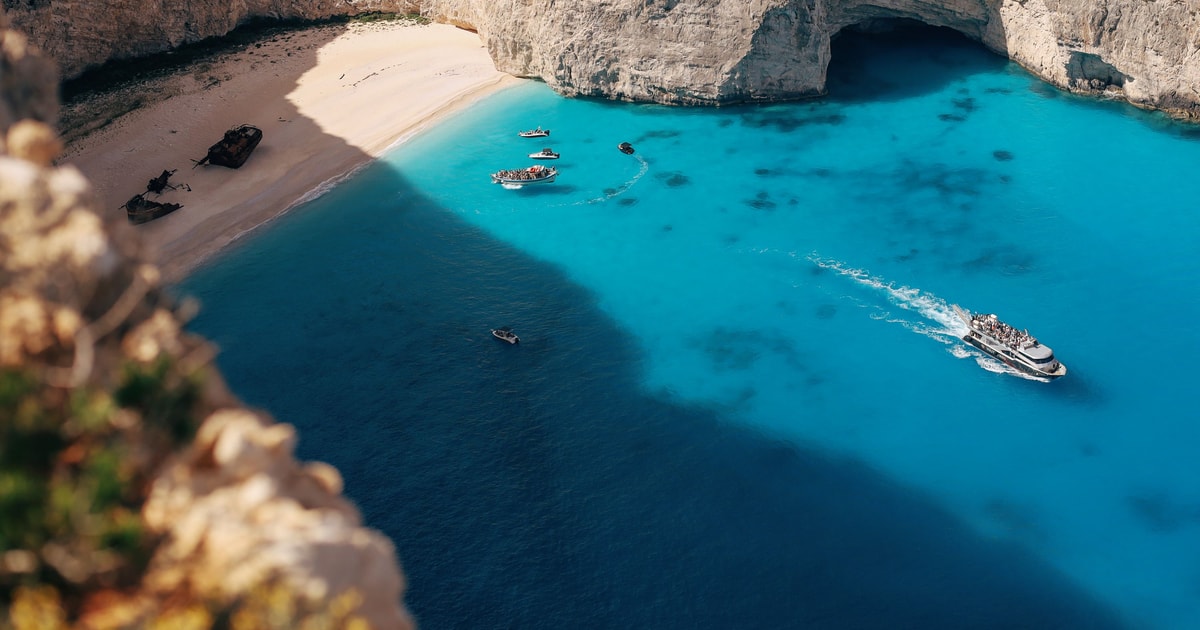
A Zakynthos shipwreck beach tour pairs a clifftop view with a boat ride along the coast. This post covers the day, the cove, the viewpoint, the Blue Caves and the booking rules. The homepage lists more Greece Tours for the Ionian islands.
Every tour card below opens a live GetYourGuide booking. Pickup points and group sizes are shown on each card.
What is a Zakynthos shipwreck beach tour and how does the day run?
The land and sea format joins hotel pickup, a minibus drive and a boat ride in one outing. Time on a Zakynthos shipwreck beach tour runs seven to nine hours, depending on the day. A transfer back ends it.
Pickup comes first, and it falls in the morning. The fare covers hotel pickup and drop-off inside a stated radius. Airport or port pickup is offered too. Pickup beyond the radius is charged separately. Travellers on a Zakynthos shipwreck beach tour receive the exact time the day before, by email or message.
Planning to visit Turkey as well? The homepage also lists Turkey tours for the coast and the cities.
The land part runs by minibus or van, and the vehicle depends on the option booked. The driver doubles as the guide on the minibus versions. Other versions let travellers go straight to a meeting point in Zakynthos Town. The drive then heads toward the coast and the harbour where the boat leaves.
The first land stop is a short photo stop at Bochali. This high point has views over Zakynthos Town and the coast. Versions that name their land stops open with it. The Navagio viewpoint comes before the boat on one version and after the swim stops on another.
Boats on a Zakynthos shipwreck beach tour come as a glass-bottom boat or a speedboat, depending on the option chosen. The sea leg covers the Navagio cove and the Blue Caves. One version puts up to fifty passengers on the boat. The harbour where the boat leaves differs between versions.
One small-group version times the boat cruise at three hours, with swim and snorkel stops. Swimming vests come with that version. On that version the boat leg runs before lunch, and the other stops follow it. Other versions name White Beach as a swim stop on the boat leg.
Hours run from seven to nine, and the small-group van versions state eight. Group, semi-private and private options exist. Group sizes on a Zakynthos shipwreck beach tour vary with the option. A vehicle on a small-group van version holds up to twenty-three travellers. The ride back ends at the accommodation or the pickup point.
Bottled water is included on the versions that list their inclusions. Tastings of wine, olive oil and local products are part of the land stops. Insurance covers the day on the versions that name it. Where the boat ticket is sold separately, it is paid to the guide in cash on the day.
A related page on Zakynthos: Blue Caves Zakynthos.
A lunch stop at a restaurant sits on the route. Lunch eaten on a Zakynthos shipwreck beach tour stays outside the fare, so travellers pay for the meal themselves. Vegetarian and vegan dishes are available at the restaurant on one version. Travellers can bring their own food and snacks on that version.
Guides on a Zakynthos shipwreck beach tour speak English on each version that states a language. Greek is named on two versions. The day suits families, couples and solo travellers. The format fits a reader who wants a rundown of the island without arranging separate activities. It also mixes viewpoints, villages and time on the water.
What does a Zakynthos shipwreck beach tour show of the cove and the wreck?
Seen from the sea during a Zakynthos shipwreck beach tour, Navagio is a cove on the north-west coast. Vertical limestone cliffs rise up to 200 metres around it. No road or path reaches it, and a rusted wreck lies on the white shore.
Navagio is the Greek name of the beach, and Shipwreck Beach is its English name. The beach is an exposed cove in the Ionian Islands, on the coast of Zakynthos. It lies on the north-west shore of the island. High cliffs isolate the cove from the land around it.
During a Zakynthos shipwreck beach tour, cliffs frame the cove. Vertical walls of rock rise up to 200 metres around the beach. They belong to a stretch of steep cliffs, 10 kilometres long, on the same coast. The rock is mainly limestone, and the faces are sheer.
For a similar plan, see Porto Vromi.
No road or path leads down to the cove, and the shore has no pier. The beach lies below a steep cliff, so the way in is across the sea. The beach is made of white pebbles and limestone gravel. Small white stones run down into the water.
Boats float on turquoise water during a Zakynthos shipwreck beach tour. Sea colour in the cove is a dazzling turquoise. White stones run down into the sea, and the sea shows an intense turquoise-blue as a result. Light explains the blue: water absorbs the red part of the spectrum and leaves the blue part for the eye.
Depth decides whether the seabed adds to the colour of the water. In shallow water the bottom reflects light, and the eye can see it. Light reflecting off white sand creates a turquoise colour there. In deep water the bottom does not reflect incoming sunlight.
Light changes through the day. The sun sits high in the sky at one hour and low at another. The angle at which its light hits the water changes with it. Water reflects the colour of the sky, from cyan to light azure. The balance between that reflection and light from below depends strongly on the viewing angle.
For more on Zakynthos, see Zakynthos Glass Bottom Boat.
A wrecked cargo ship lies in the middle of the beach. The ship ran aground in nineteen eighty, and its hull is rusted. The ship was abandoned there, and the wreck remains at the site. It rests in the gravel of the shore, at the centre of the cove, inside the ring of cliffs.
On one small-group format, the boat stop gives time to look at the wreck from a distance and take photographs. Hull, stones and cliffs share the view during a Zakynthos shipwreck beach tour. Boat excursions and photography make the cove a top highlight.
Angles differ between the boat and the viewpoint. A viewpoint on the cliff top looks over the cove from above. Viewers on the water and on the cliff see one cove from two angles during a Zakynthos shipwreck beach tour. Walls of rock stand above the boat, and the beach lies at the foot of them.
Where does the viewpoint fit into a Zakynthos shipwreck beach tour?
A small platform above the cliffs gives the only view of the wreck from the land side. On formats with a land leg first, that stop comes before a Zakynthos shipwreck beach tour reaches the cove.
Zakynthos has two halves that look different. The eastern half is a densely populated, fertile plain with long sandy beaches, and the road network is thickest there. The western half is a mountainous plateau, and its coast drops steeply to the sea. The viewpoint stands in that western upland.
Zakynthos Turtle Spotting Cruise covers Zakynthos too.
A main road runs north from Zakynthos town through Katastari to Volimes. Provincial Road 6 is the route from the capital to Volimes. The village stands close to the Ionian Sea coast in the mountainous north-west. Volimes lies 23 kilometres north-west of the town, a distance to check before a Zakynthos shipwreck beach tour begins.
A road along the mountain ridge links Keri in the south with Volimes in the north. It passes Exo Chora, Maries and Anafonitria on the way. Exo Chora lies 2 kilometres south of Maries, near the rugged west coast. It is 19 kilometres west of Zakynthos town.
Anafonitria lies on the mountain ridge, 2 kilometres from the coast. A viewing terrace over the wreck belongs to the village, which also has two Greek Orthodox monasteries. The cove lies 3 kilometres north-west of Anafonitria. The small platform stands above vertical rock walls round the beach, so the view runs down to the sand.
On the format that boards at Porto Vromi Maries, pickup leads to a photo stop at the Shipwreck Viewpoint. The stop shows the scene from above. It comes before a Zakynthos shipwreck beach tour boards its boat. A longer format lists a thirty-minute stop at the Navagio viewpoint.
Beach comes up again in Elafonisi Beach.
The steep west coast is the foot of Mount Vrachionas. Vertical sea cliffs drop abruptly into the water along it. Sheer limestone walls close the cove itself. The rock is not fixed. A cliff above the beach has collapsed, and a later landslide followed an earthquake.
Shrubs and phrygana grow on the cliffs of the protected coast. Phrygana is a low scrub that grows on limestone soils around the Mediterranean. Rocky hills behind the coast are partly covered by Aleppo pine forest, and cultivated areas also occur. A mild Mediterranean climate and plentiful winter rain give the island dense vegetation.
Olive trees cover 36% of the island, a fact to keep before a Zakynthos shipwreck beach tour sets out. Olive oil, currants, grapes and citrus fruit are the principal crops. The Zante currant is a small, sweet, seedless grape that is native to the island.
The Monastery of Anafonitria stands inside a fortified complex. A covered passage forms the entry, and a square tower in two parts is built against it. Inside, a basilica with three aisles and a wooden roof holds frescoes on the central nave and the sanctuary. The wooden screen carries six icons.
The village took its name from the monastery. Saint Dionysius, the patron saint of Zakynthos, was known to have spent his final years there. Agios Gerasimos, the patron saint of Cephalonia, was known to have lived in Anafonitria as a hermit. Both stories are quick to read before a Zakynthos shipwreck beach tour starts.
A related page on this site is Corfu Cave Tour.
What do the Blue Caves add to a Zakynthos shipwreck beach tour?
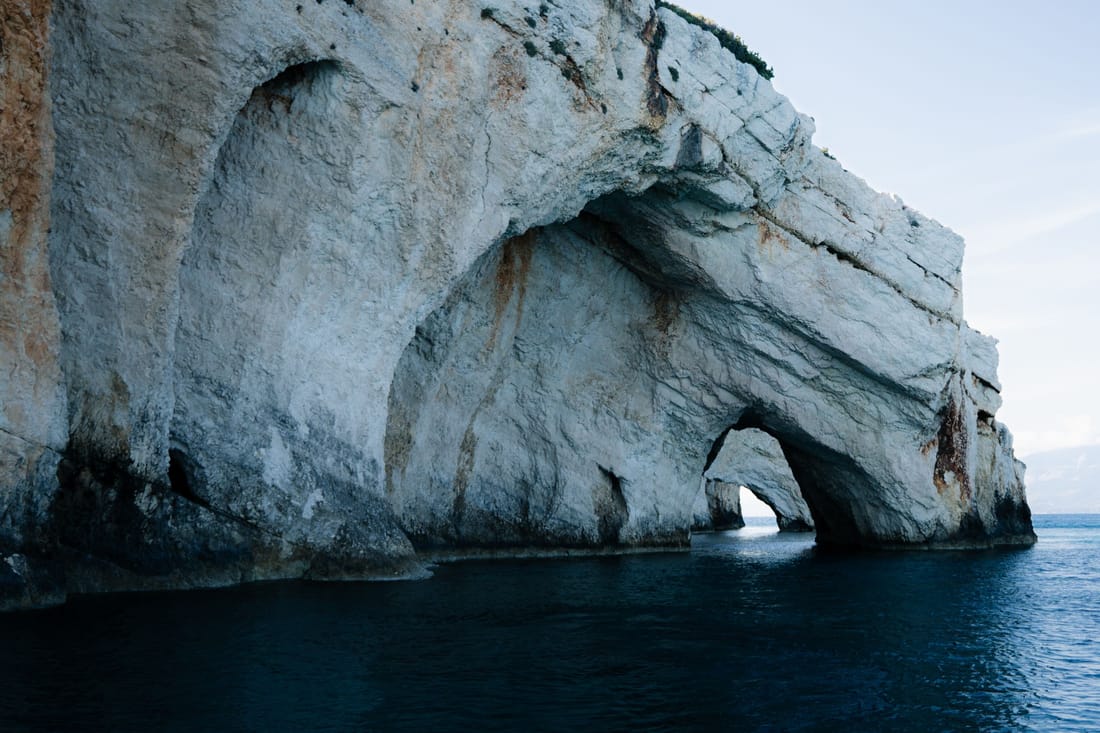
Natural caves are cut into the cliffs around Cape Skinari, the island’s northern tip, and only small boats reach them. On the land and sea format they come alongside a Zakynthos shipwreck beach tour itinerary as a boat stop. Sunlight gives the caves a blue shine.
Zakynthos is shaped like an arrowhead, and Cape Skinari is its tip, pointing north-west. The harbour of Agios Nikolaos lies on that northern tip, in the community of Volimes. A ferry from the same village connects to Argostoli on Kefalonia. The normal boat route to the main Blue Grotto starts at this harbour.
The main Blue Grotto lies hundreds of metres south-east of the cape. Its mouth is nearly invisible at the foot of a steep cliff. Korithi village is one kilometre away, yet the cave is very hard to reach from there. Postcards of the grotto show white cliffs, white beaches and blue sea, but not the cave.
Two caves lie very close together, the Big Cave and the Small Cave. They seem to be the last remains of one older karst cave, which formed in limestone. Breakers widened that first cave. Sea urchins drill into such rock and can remove stone from the floors and lower walls.
A blue grotto is a partly flooded cave that has a connection to the sea. Sunlight enters the cave through the water. On that path the red tones drop out and blue light gets in. The grottoes of Cape Skinari show shades from emerald green to turquoise.
Next on this subject: Kos Glass Bottom Boat.
Skinari lighthouse stands on Cape Skinari itself, about 1.5 kilometres north of Korithi. Its tower is round and built of stone, with a lantern and a gallery. The keeper’s house is joined to the tower. The lighthouse dates from eighteen ninety-seven, and its light sits at a height of 66 metres.
The land and sea format blends inland drives with coastal time. After the road leg, the day continues by boat to the Blue Caves area. Those caves sit alongside a Zakynthos shipwreck beach tour route that starts on land. On a related cruise format, the boat goes on to the caves for water-level views.
On the semi-private format the cave visit runs alongside a Zakynthos shipwreck beach tour cruise. The boat enters the caves, so guests see the colours up close. A rock formation called Poseidon’s Face gets a photo stop. The long swim stops of that cruise are Sfogio Beach, White Beach and Porto Steniti.
Coast stops differ by format. One all-day format lists a one-hour stop at Xigia Beach, a sulphur-rich beach. The small-group format boards a glass-bottom boat at Agios Nikolaos harbour and lists the beaches of Xigia and Makris Gialos. These beach stops fit alongside a Zakynthos shipwreck beach tour day only where the listing names them.
Related page: Mykonos Catamaran Cruise.
Swimming alongside a Zakynthos shipwreck beach tour group differs by format. One cruise format lists swimming stops where guests climb down a ladder from the boat. One small-group format lists swim and snorkel stops at protected coves, including Sfogio. On the glass-bottom option the floor shows the seabed and marine life.
When can a Zakynthos shipwreck beach tour run and which rules apply?
Weather and sea shape the day. On the land and sea option, stops for a Zakynthos shipwreck beach tour change order with the sea conditions. Rain falls on only 0.5 days in July against 13.2 in December.
Zakynthos sits in the Mediterranean climate zone: dry, hot summers and rainy winters that run mild to cool. The airport normals show the swing. December brings 169.9 millimetres of rain, while July brings 5.0 millimetres. Weather for a Zakynthos shipwreck beach tour differs sharply between winter and midsummer.
Rain days stay low from late spring to September. The normals count 2.5 days in late spring, 1.1 in June, 0.9 in August and 2.8 in September. October jumps to 8.1 days. Mean daily highs fall to 14.4 degrees Celsius in January and 14.5 in February, against 30.7 in July.
Wind builds the sea. Friction between moving air and the water surface creates waves. Their size is limited by wind speed, how long it blows and the distance it covers. Waves that leave the wind’s area are then called swell. Sea conditions for a Zakynthos shipwreck beach tour matter because Navagio is described as an exposed cove.
Compare this with Corfu Glass Bottom Boat.
The semi-private option changes its itinerary when weather affects the sea and land routes. One semi-private cruise format reschedules, modifies or cancels activities for weather. One operator offers small-group, semi-private and private options. Its weather guarantee covers a cancelled activity with free rescheduling or a refund.
Rules for a Zakynthos shipwreck beach tour shift with the day. The national tourism site advises checking the current situation before planning a visit to Navagio. The land and sea option sails only when enough travellers book. Falling short brings an alternative date, another experience or a full refund.
Packing for a Zakynthos shipwreck beach tour starts with swimwear and a towel. Add sunscreen, a hat and comfortable clothing. The small-group option names snorkelling equipment as well, and one operator’s small-group list names goggles. The private boat option adds sunglasses and cash to the bag.
Walking and standing for extended periods is part of the stops on the semi-private option, and sturdy footwear is advised. Wheelchair users cannot join the small-group, private car and boat, or private boat options. Strollers are also barred on the small-group and private car and boat options. The private boat option rules out people with reduced mobility.
Pserimos Day Trip From Kos is a close match for this topic.
Health limits differ by format. The small-group and private car and boat options are not suitable for pregnant people or the elderly. The private boat option is accessible to pregnant women, toddlers and the elderly. The semi-private cruise format lists people prone to seasickness as unsuitable.
Age and swimming rules are simpler. The small-group, private car and boat, and private boat options all state no age restriction. One operator welcomes everybody of all ages. Swimming is a key part of the day, so non-swimmers are a poor fit. The boat journey crosses open water, which is why seasickness can be an issue.
Booking the semi-private option needs no upfront payment, and the payment follows later. A full refund follows cancelling at least a day before the start. That holds on the semi-private, small-group and land and sea options. The booking cards for a Zakynthos shipwreck beach tour show live availability, so open dates are visible before you commit.