
A Corfu tour for first time visitors links the old town with the bays of the west coast. This post covers the day, the old town, the coast, the sights nearby, the food and the booking rules. The homepage lists more Greece Tours for Corfu and the islands.
Every tour card below opens a live GetYourGuide booking. Pickup points and group sizes are shown on each card.
What is a Corfu tour for first time visitors and how does the day run?
The half-day land tour lasts about four and a half hours. Travellers ride on a Corfu tour for first time visitors, stopping at Paleokastritsa and Corfu Town before the return. The ride comes with air conditioning and an English-speaking driver.
The half-day format is a land tour built around one vehicle and one driver. It lasts about four and a half hours from pickup to drop-off. Two places make up the route, the coast at Paleokastritsa and Corfu Town. The rest of the day is travel time and free time.
Planning to visit Turkey as well? The homepage also lists Turkey tours for the coast and the cities.
Pickup and drop-off both happen at the cruise port. The driver meets passengers there, and the ride back leaves plenty of time to reboard the ship. Starting times depend on the traveller’s own schedule. Hotel pickup belongs to other formats, which are described further down in this section.
The person at the wheel is a professional driver who speaks English. Travellers on a Corfu tour for first time visitors hear a short briefing from that driver about what lies ahead. A dedicated tour guide is not part of the half-day format. The vehicle is air-conditioned, so the ride stays cool and comfortable.
The half-day format includes port pickup and drop-off, the driver, air-conditioned transport, and the taxes and fees. Food and drinks are not included. A traveller on a Corfu tour for first time visitors pays separately for meals and an optional cave boat trip.
The order on a Corfu tour for first time visitors starts with the coast. After pickup, the vehicle drives to Paleokastritsa, a journey of about an hour. Corfu Town comes second. The last leg is the ride back to the port, where the day ends.
At Paleokastritsa, travellers have about an hour to explore the beach at their own pace. Corfu Town gets roughly two hours of wandering through the old streets, shops and cafes. Time at each stop on a Corfu tour for first time visitors stays limited. No site gets a deep visit.
Other formats change the shape of the day. One shared bus tour for cruise passengers takes about five hours. It adds an English-speaking tour leader and an audio guide. One full-day coach tour runs about ten hours, collects travellers at hotels and adds a professional guide. Long rides come with the longer day.
Free time splits differently on other formats. On one shared bus tour, the beach at Paleokastritsa gets about two hours. The Old Town gets about an hour and a half after the drop-off. The half-day tour moves the balance towards town. It gives about an hour at the coast and about two hours in Corfu Town.
Private minivan tours keep the vehicle for one party only. On one private half-day tour, the traveller picks the pickup point: a hotel, a holiday apartment or the port. The driver adds local commentary. Another private minivan tour lasts five hours in an air-conditioned vehicle. Its driver answers questions about the island.
Readers interested in Corfu can open Corfu Shore Excursion.
The half-day format is made for cruise passengers and for visitors with limited time. Newcomers on a Corfu tour for first time visitors get a full but easy first look at the island. The format is hassle-free from start to finish. The trade-off is pace, because the day gives short stops, not long visits.
Which old town streets and squares does a Corfu tour for first time visitors cross?
On foot through a Corfu tour for first time visitors, Spianada, the Liston and cobbled kantounia lanes mark the route. They sit in a car-free old town that UNESCO listed in two thousand and seven.
In two thousand and seven UNESCO named the Old Town of Corfu a cultural World Heritage site. The listing rests on criterion four. The core area is 70 hectares, with a wider buffer of 162 hectares around it. A walk through a Corfu tour for first time visitors winds inside that protected old town.
UNESCO places the old town in a strategic spot at the entrance to the Adriatic Sea. Venetian rule lasted about four centuries, and French, British and Greek governments followed. The housing stock is mainly neoclassical, partly from Venetian times and partly built later, notably in the nineteenth century.
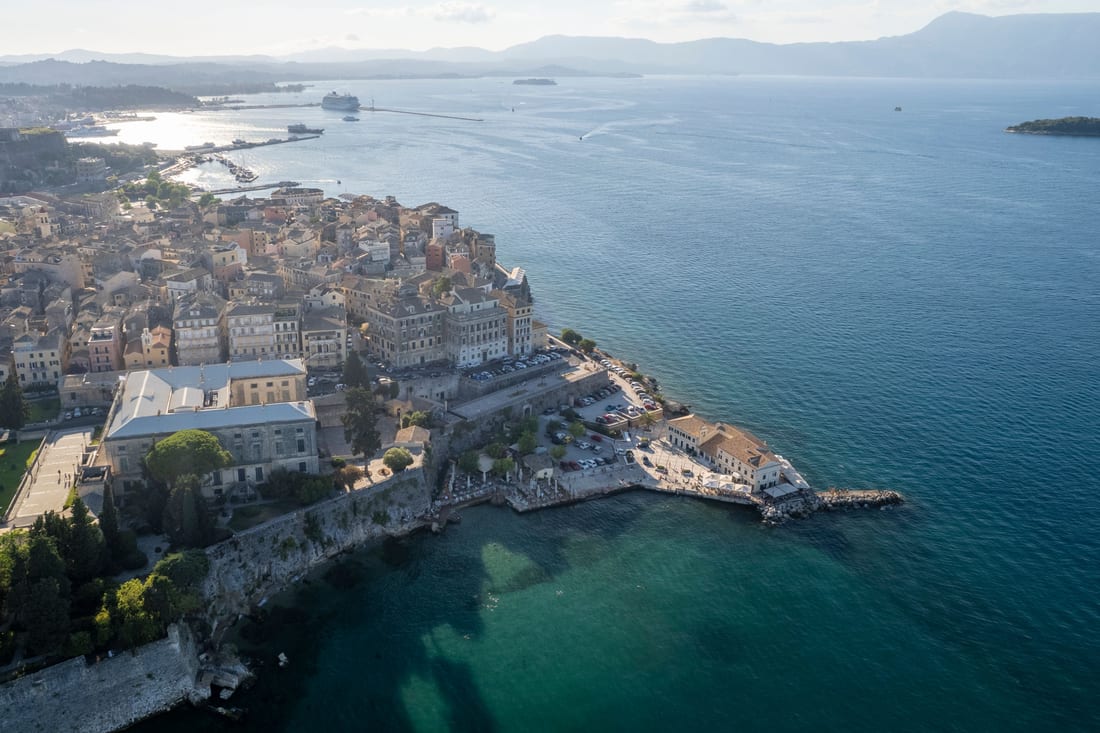
The route through a Corfu tour for first time visitors goes on foot in the car-free historic core. The narrow streets are called kantounia and are paved with cobbles. Washing lines hang between the buildings. On the half-day tour, this stop is a wander past shops and cafes.
Campiello is the oldest quarter of the old town, and it lies north of the historic centre. Narrow alleys wind between tall stone houses, carved wells and small squares. Ornate balconies give the quarter a clearly Venetian character. The Venetian style still shapes the architecture of the old city.
The Spianada is the largest square in Greece and lies in front of the Old Fortress. The Upper Square is long and narrow, with dense greenery and flower beds, while the Lower Square is open grass. The open ground gives a stroll through a Corfu tour for first time visitors breathing space.
The name comes from a Venetian word for open, flat ground. The square took its present form under the French, during their brief rule of the Ionian Islands. Under the British, Sir Thomas Maitland focused on developing the Spianada. The circular Maitland Rotunda, a Roman-style monument in the Upper Square, commemorates him.
Cricket reached Corfu with the British, who ruled the Ionian Islands in the nineteenth century. The Lower Square holds the cricket ground, and official tournaments and friendly matches are played there. The national cricket federation has twenty member clubs, and nearly all of them are based on the island.
A related page on Corfu: Corfu Pirate Ship.
The Liston is a pedestrian street, 150 metres long, on the western edge of the Spianada. The French imperial commissioner Mathieu de Lesseps designed it on the model of the Rue de Rivoli in Paris. Restaurants and bistros fill its arcade. A wander through a Corfu tour for first time visitors takes in the Liston and its cafes.
The Old Town Hall stands on Town Hall Square, called Plateia Dimarchiou in Greek. The building began as a gathering place for the Venetian nobility of Corfu. In seventeen twenty it was converted into a theatre, the first modern theatre in Greece. The theatre carried the name Nobile Teatro di San Giacomo before the building became the town hall.
An ICOMOS evaluation for the UNESCO listing gives a figure for the British years. Of the buildings older than the twentieth century, about seventy per cent belong to that period. One circuit through a Corfu tour for first time visitors shows Venetian, French and British work.
Where do the two fortresses of Corfu Town fit into a Corfu tour for first time visitors?
Venetians built two fortresses at Corfu Town, the Old Fortress on a rock and the New Fortress on a hill. The Old Fortress is named as a landmark within a Corfu tour for first time visitors. Engineers designed both for Venice.
The rocky peninsula under the Old Fortress is 600 metres long and 200 metres wide. It lies between the Gulf of Kerkyra to the north and Garitsa Bay to the south. The old town of Corfu first grew on this rock in Byzantine times. Two peaks crown it, and the western name Corfu comes from the Greek Coryphe.
A sea channel called the Contrafossa, cut by the Venetians, joins the Gulf of Kerkyra with Garitsa Bay. The cut made the rock an artificial island. A steel bridge about 60 metres long links the gate to the town. Look for that bridge within a Corfu tour for first time visitors. Timber carried the first bridge, a movable one.
On the half-day tour, the Corfu Town stop names the Old Fortress among its landmarks. The New Fortress is not named there. The private Paleokastritsa and Corfu Town tour drives guests to the old town centre to visit the Old Fortress. Format decides how close a visitor gets to the walls within a Corfu tour for first time visitors.
Towers crown the peaks inside the walls. The Old Tower, renamed the Sea Tower, is built on bedrock at the eastern top. The Land Tower holds the western top, and the lighthouse with its annexe stands on that tower. Between the two, British builders added hospital buildings. The Clock Tower also stands inside the walls.
The church of Saint George, on the southern side, was built for the British garrison. It takes the form of a Greek Doric temple. UNESCO adds that the fortifications keep traces of Venetian work, but mainly changes from the British period. That mix of rulers frames the Old Fortress within a Corfu tour for first time visitors.
Saint Mark’s hill carries the New Fortress, which rises at the north-western edge of Corfu Town. Ferrante Vitelli, a military engineer, was its original architect. It guarded the suburbs outside the old rock, and the harbour of Spilia beside them. Builders cleared the older buildings on the hill and reused their materials. The work was done in stages.
More about Corfu: Corfu Cave Tour.
The compound has two levels. The lower level faces the sea and shields the harbour of Spilia. The higher level faces inland and carries the twin bastions. A dry moat runs along the western walls. The Seven Winds bastion stands 55 metres above the sea. Keep that height in mind within a Corfu tour for first time visitors.
Porta Otturata, the official gate, is framed by half-columns and crowned by a stone relief of the winged lion. Only the commander used it. The southern gate, formed by pillars with half-columns, was the main entrance. An inscribed stone from the eighteenth century on the ramparts shows the Lion of Saint Mark.
The New Fortress forms part of the Venetian walls round the suburbs. After the suburbs were walled, the Old Fortress served as a fortress and an administrative centre. Tell the rock from the hill within a Corfu tour for first time visitors. Quarters for the commander and other officials were the only homes in the New Fortress.
What does the Achilleion palace add to a Corfu tour for first time visitors?
Achilleion, a palace at Gastouri about ten kilometres south of Corfu city, was built for Empress Elisabeth of Austria. Set alongside a Corfu tour for first time visitors, Achilles statues and gardens give longer routes a royal stop.
Empress Elisabeth of Austria had the palace built on Corfu. Alexander von Warsberg, an Austrian official and travel writer, suggested it. Warsberg shaped the idea and bought the land, but he died before the work ended. The site was an older villa that had belonged to the Corfiot diplomat Petros Vrailas-Armenis.
The palace was her refuge after the loss of her only son. Corfu was her favourite holiday island, and she admired Greece, its language and its culture. She wrote that she wanted pillared colonnades and hanging gardens, protected from prying eyes. Her husband, Emperor Franz Joseph, disliked sea voyages and never saw the palace.
The Italian architect Raffaele Caritto designed the palace, and the estate was built on 200,000 square metres. The design was meant to suggest the ancient palace of mythical Phaeacia, a land in Homer’s Odyssey. Thucydides tied Phaeacia to Corfu. Travellers who add the palace alongside a Corfu tour for first time visitors meet that local legend.
The palace takes its name from Achilles, the hero of Homer’s Iliad. Paintings and statues of him fill the main hall and the gardens. They show heroic and tragic scenes from the story of Troy. The building is of Pompeian style, and Elisabeth had it decorated with statues and images.
Ernst Herter, a German sculptor, made the Dying Achilles in Berlin, and the statue carries its date, eighteen eighty-four. The empress acquired it for her palace, where it became the centrepiece of the gardens. Any garden walk alongside a Corfu tour for first time visitors passes this statue.
Corfu to Albania Day Trip covers Corfu too.
A second Achilles stands in the gardens. Kaiser Wilhelm II bought the palace in nineteen hundred and seven. He asked the sculptor Johannes Goetz for a huge bronze figure. It shows Achilles dressed as a hoplite, a Greek foot soldier, with a gorgon’s head on the shield. Palm trees surround it, and it faces north towards the city.
The gardens sit on top of a hill at Gastouri. They look out over green hills and valleys, with the Ionian Sea behind. The view also takes in Corfu city to the north and the southern part of the island. Alongside a Corfu tour for first time visitors, Gastouri adds open scenery to the day.
The Kaiser took a keen interest in the plants of the park. He hired the botanist Carl Ludwig Sprenger, who lived at the palace for about three months each year. The Greek state later made the palace a museum. The casino scene of a James Bond film was shot there.
The full-day private tour joins the palace with Paleokastritsa and the old town of Corfu. It lasts up to eight hours, with private transport and hotel pickup and drop-off. Routes that include the Achilleion alongside a Corfu tour for first time visitors cover more ground than the half-day tour.
Another private route lasts four to six hours and lists the palace. Entry to the palace is paid on its own on each of these routes. The half-day land tour names only Paleokastritsa and Corfu Town as stops. Anyone who wants a royal stop alongside a Corfu tour for first time visitors checks the stop list before booking.
What do the bays of Paleokastritsa give a Corfu tour for first time visitors?
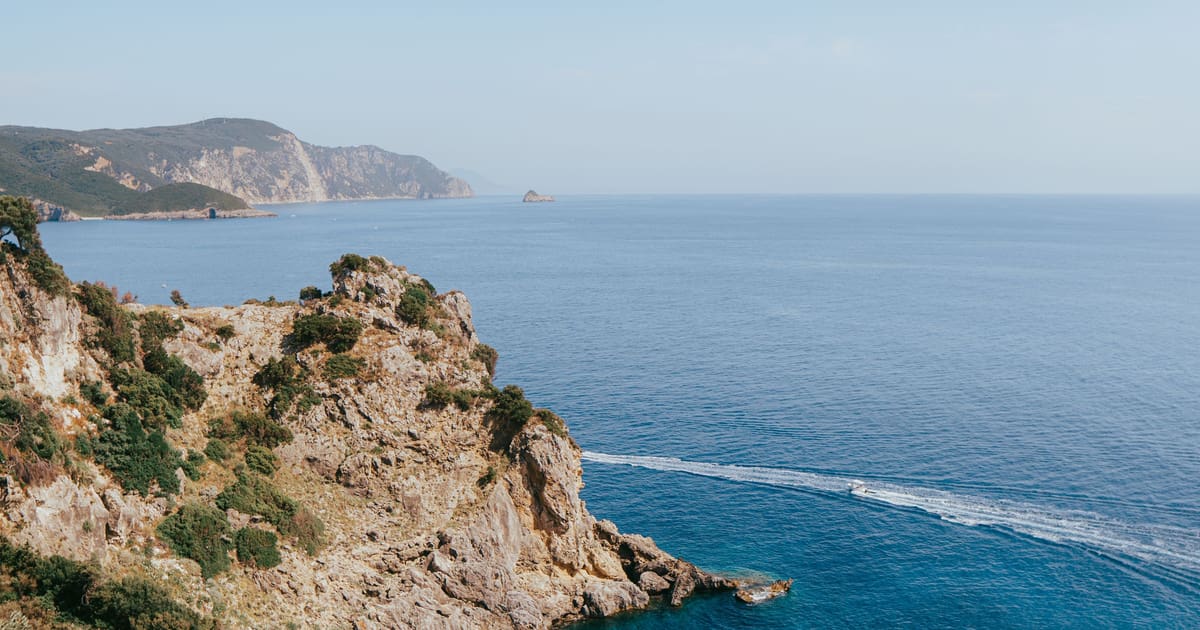
Paleokastritsa gives the stop along a Corfu tour for first time visitors cliffs, sea caves and small turquoise coves. Angelokastro stands 305 metres up on a steep cliff above the sea. A monastery sits on a green hill beside the bay.
Paleokastritsa sits south of Angelokastro, on the western shore of Corfu. Its name means Old Little Castle and points to that fortress. Tall cliffs and the beaches nearby are what the village is known for. Liapades lies three kilometres away, and both villages belong to one municipal unit.
The small coves hold deep turquoise water. One rocky inlet is reached by 142 steps. Strong currents keep the sea at the main beach cold. On the half-day tour, Paleokastritsa is a stop. The sights along a Corfu tour for first time visitors show these cliffs and coves.
Myth also marks the bay. Corfu has been suggested as the mythical island of the Phaeacians. The bay is held to be where Odysseus came ashore and first met Nausicaa. Nearby, Liapades has a beach called Giofyra, the Greek word for bridge. The beach of Paleokastritsa itself has a sandy shore and turquoise water.
Another page that includes Corfu is Corfu Private Yacht Cruise.
A monastery stands on the highest point of a green hill, on the right side of the bay. Where a format visits the hill, the view along a Corfu tour for first time visitors sweeps over the coves. The ruins of Angelokastro are in sight from there too.
The chapel, the monks’ cells and the courtyard of the monastery were built in the eighteenth century. The monastery museum keeps Byzantine and post-Byzantine icons and other religious relics. A small traditional olive press stands inside the monastery. The icons kept there are mainly of Cretan style.
Angelokastro crowns the highest peak of the shoreline in the north-west, close to Paleokastritsa. At 305 metres, the castle sits on a steep cliff over the water. In parts the walls are built right on the cliff edge, and the west side was left unwalled. From the castle, Corfu city and the mainland mountains lie to the south-east.
The high ground of the coast along a Corfu tour for first time visitors belongs to Angelokastro. The fortress is placed in the twelfth or thirteenth century, but no written source confirms it. Its position let it control part of the southern Adriatic. The citadel crowns the hill, and a bulwark lower down protects the weaker sides.
The church of the Archangel Michael stands at the top of the citadel. It was built on the site of an Early Christian church with three aisles. A small chapel to Saint Kyriaki is hewn from the rock at the east end. Paintings inside it date from the eighteenth century. Three underground cisterns supplied the castle with water.
National road 24 is one of two national roads on Corfu. It runs from the city of Corfu in the east to Paleokastritsa in the west. The monastery, the beach and Angelokastro are the places of interest along it. Paleokastritsa, one place along a Corfu tour for first time visitors, sits at the western end of that road.
A scenic road leads up to the monastery through areas overgrown with cypresses, olives and other plants. Lakones was the seat of the former municipality of Paleokastritsa. Liapades spreads over the slopes of Mount Kourkouli and reaches up to the North Valley. Other beaches there are reached by paths, sometimes through dense vegetation.
How do Kanoni and Mouse Island shape a Corfu tour for first time visitors?
Kanoni is a peninsula south of Corfu Town, with a pedestrian bridge to Vlacherna islet and boats to Mouse Island. Beyond a Corfu tour for first time visitors, travellers find Kanoni as a viewpoint stop on a four-hour half-day format.
Kanoni lies within the natural bay of Garitsa. Its name goes back to a battery placed there in seventeen ninety-eight. The viewpoint faces two islets, Vlacherna and Pontikonisi, which dominate the seascape. The monastery on Vlacherna seems to rise from the middle of the sea.
The stop depends on the format. The half-day tour of Paleokastritsa and Corfu Town lists no Kanoni stop. The peninsula therefore sits beyond a Corfu tour for first time visitors, Vlacherna and Mouse Island with it. A four-hour half-day format lists Kanoni as a viewpoint stop, with Mouse Island in view.
Corfu also features in Corfu Glass Bottom Boat.
Vlacherna Monastery stands on a small island about 300 metres from the near shore. It was erected in the seventeenth century. A narrow walkway joins the islet to the mainland and doubles as a dock for fishing boats. Inside the church, a wood-carved screen and the icons draw the eye.
Boats leave from the small dock at the monastery for the islet opposite. An excursion boat makes the crossing, and visitors can also rent a boat there. That crossing takes a traveller beyond a Corfu tour for first time visitors, Pontikonisi being the islet reached.
The name Pontikonisi means Mouse Island in Greek. The islet covers about one hectare and has no residents. A Byzantine chapel of Christ Pantokrator stands on it, dating from the eleventh or twelfth century. The islet sits at the mouth of the lagoon, beside Vlacherna.
Old stories cling to the small islet. One legend says it is the ship of the Phaeacians that carried Odysseus to Ithaca and was turned to stone. The islet has also been linked to the subject of Arnold Boecklin’s Symbolist painting, Isle of the Dead.
The viewpoint also overlooks the lagoon of Chalikiopoulos, where the ancient Hyllaic harbour once lay. Planes draw watchers too, because the main runway of the airport runs close by. The airport stands about half a kilometre north of Pontikonisi. Plane watching is a pastime beyond a Corfu tour for first time visitors, runway views being the draw.
Beyond a Corfu tour for first time visitors, Mon Repos stands a five-minute drive from Kanoni. The villa was built from eighteen twenty-eight to eighteen thirty-one as a summer residence for the British Lord High Commissioner. Colonel George Whitmore made the neoclassical design in the English Regency style. The estate lies in the forest of Palaeopolis.
The park covers about twenty-three and a half hectares. Shaded paths run downhill and open views of the east coast. Inside the villa, the Museum of Palaiopolis opened in two thousand and one. The first floor shows finds from the digs of the Palaiopolis area. The ground floor recalls life in the nineteenth century.
The Temple of Hera lay at the western edge of the Mon Repos estate. It counts among the earliest examples of archaic Greek architecture. Terracotta lions on its roof served as tiles with water spouts. That ancient ground lies beyond a Corfu tour for first time visitors, Palaiopolis finds filling the villa’s museum.
For more on Corfu, see Corfu Paxos Antipaxos Cruise.
Which churches and museums join a Corfu tour for first time visitors?
Corfu Town holds St Spyridon’s church, the cathedral, the Museum of Asian Art and the Archaeological Museum. The half-day format names the old town as a stop, not a single building. A traveller inside a Corfu tour for first time visitors picks among these sights.
The church of St Spyridon is a single-nave basilica of the late sixteenth century. Its bell tower is the tallest on the Ionian Islands. The tower is similar in design to San Giorgio dei Greci, a church in Venice. A walker inside a Corfu tour for first time visitors spots that tower from different points of the old town.
A silver reliquary holds the saint’s relic. It was made in Vienna in eighteen sixty-seven. Panagiotis Doxaras painted the ceiling in seventeen twenty-seven, with scenes from the life of the saint. The marble screen of the church dates from eighteen sixty-four. The church marks the saint’s day on the twelfth of December.
In the centre of Corfu Town, a visitor inside a Corfu tour for first time visitors finds the Metropolitan Cathedral. Panagia Spilaiotissa, a three-aisled basilica in the Ionian style, replaced an older church of Saint Vlasios. The icon of Panagia Spilaiotissa and the relics of Saint Theodora, in a silver shrine, are its holy objects.
The palace of Saints Michael and George is a neoclassical building made of limestone from Malta. Colonel George Whitmore designed it. It is the largest building of the period of the United States of the Ionian Islands. A grand staircase and a rotunda lead to the Throne Room and the state dining room.
The Museum of Asian Art began with a gift from Gregorios Manos, a Greek ambassador to Austria. He bought roughly nine and a half thousand Chinese, Korean and Japanese pieces. The first-floor Manos wing shows Chinese art, and a second wing shows India and Japan. A guest inside a Corfu tour for first time visitors chooses between the two wings.
The Archaeological Museum was built to house the finds from the Temple of Artemis. The Gorgon pediment, from the sixth century BC, is the oldest stone pediment in Greece. A Gorgon fills the centre, with her children Pegasus and Chrysaor and two big cats at her sides. A crouching stone lion, once a grave marker, is another exhibit.
The Reading Society stands on Kapodistriou Street, across from the palace. Fourteen young citizens who had studied in Western Europe founded it in eighteen thirty-six. Its model was a reading society in Geneva. A stroller inside a Corfu tour for first time visitors notes the house’s Renaissance look. The library holds books from the sixteenth century.
The Philharmonic Society of Corfu was founded in eighteen forty. Its first artistic director, Nikolaos Mantzaros, led it until his death in eighteen seventy-two. He composed the music of the Greek national anthem. Brass bands called philharmonics play in the Palm Sunday litany, the longest of the processions of St Spyridon.
The Byzantine Museum of Antivouniotissa fills a church from the close of the fifteenth century. It is an aisleless basilica with a timber roof and a coffered ceiling of gilded carvings. The museum holds icons from the fifteenth to the nineteenth century. A sightseer inside a Corfu tour for first time visitors weighs these icons against the Asian galleries.
For a similar plan, see Mykonos Shore Excursion.
Which Corfiot dishes and drinks go with a Corfu tour for first time visitors?
Ionian cooking shows more Italian influence than any other part of Greece. Corfiot plates pair with a Corfu tour for first time visitors, led by pastitsada, sofrito and bourdeto. Tsitsibira ginger beer and kumquat liqueur are the local drinks.
Pastitsada, a traditional Sunday dinner in Corfu, is the plate to eat with a Corfu tour for first time visitors. Meat is braised in a spicy tomato sauce and served over pasta. The name comes from the Venetian word pastizzada. Grated kefalotyri or Parmesan goes on top.
Sofrito is thin slices of veal cooked in a pot with a white garlic sauce. The dish is of Venetian origin. Corfu’s cooking shows a strong Venetian influence, and that influence gave the island its own local dishes. Savoro is another plate: fried fish dressed with garlic, rosemary and vinegar.
Bourdeto, a fish dish from Corfu, is one to try with a Corfu tour for first time visitors. Onion and red sweet and hot pepper make the sauce, and lemon finishes it. The Corfiot recipe uses scorpionfish or tope. The name comes from the Venetian word brodetto, which means broth.
Ginger beer is the drink to sip with a Corfu tour for first time visitors. Tsitsibira is the local name, a remnant of the British era. It is a fizzy ginger and lemon soft drink that ferments and matures in the bottle. Ginger beer is more strongly flavoured with ginger and less sweet than ginger ale.
The kumquat is the signature fruit of Corfu. Its name means golden orange in Chinese, and the fruit has Protected Geographical Indication status. The taste is intense and slightly bitter, so the fruit is rarely eaten raw. Kumquat and bergamot orange are used for spoon sweets and liqueurs.
Kumquat liqueur is the island’s own drink to taste with a Corfu tour for first time visitors. Tradition serves it as a digestive after meals. Local distilleries offer white and orange versions. The taste is sweet and aromatic, with notes of orange and strawberry. The liqueur is also a base for cocktails.
Olive trees dominate the island, and together with cypress trees they form the typical Corfiot landscape. The centuries-old olive grove is the island’s trademark. It supplies olive oil, black olives and soap. The village of Kynoplastes keeps a well-preserved olive press of the early twentieth century, with tools inside.
Corfu is planted mainly with olive groves and vineyards, and it has produced olive oil and wine since antiquity. The indigenous white Kakotrygis and the red Petrokoritho are the main wine grapes. Moschato, Skopelitiko and Rozaki also grow in the vineyards. Vineyards dot the landscape.
Santorini Private Tour With Local Guide is a close match for this topic.
Corfiote graviera is a local variant of gruyere cheese. Corfiot butter is an intensely flavoured cooking and baking butter made from ewe’s milk. Noumboulo is cured, smoked pork, flavoured with orange peel, oregano and thyme. Dairy and charcuterie products both have a long tradition on the island.
Corfiot meals traditionally end with sweets such as mandolato, honey and almond nougat. Mandoles are caramelised almonds. Pasteli are honey bars made with sesame, almonds or pistachios. Fogatsa is a Venetian-style tsoureki, a type of bread, and sykomaida is a fig cake from the island. Kolombina is a dove-shaped Christmas bread.
The Liston arcade in Corfu Town is lined with cafes and restaurants. It is one place to enjoy these dishes with a Corfu tour for first time visitors. Sokraki is a traditional village in the northern part of Corfu. It has a local taverna for Corfiot dishes and traditional cafes on two squares.
When can a Corfu tour for first time visitors run and which rules apply?
Start times differ by date, so the live cards show when the half-day tour runs. On that format, free cancellation lasts until a day ahead. Before a Corfu tour for first time visitors sets off, cover the shoulders at any monastery and wear walking shoes.
The island’s climate is the hot-summer Mediterranean type: dry and hot in summer, mild and very rainy in winter. January has a mean daily high of 13.9 °C and a mean daily low of 5.3 °C. Before a Corfu tour for first time visitors begins that month, note that the record counts 14.8 rainy days.
The long record counts 122.4 rainy days in a year. February has 13.4 rainy days, March has 12.9, and July has 3.3. Relative humidity reads 75.6 per cent in January and 61.7 per cent in July. A thin waterproof layer suits the months with more rainy days.
July records 364.5 hours of sunshine, and December records only 110.9. July’s mean daily high is 31.2 °C, and August’s is 31.5 °C. August also has a mean daily low of 19.3 °C. A sun hat and a bottle of water suit that heat and the long July daylight.
On a sunny afternoon, an island coast can feel a sea breeze. This is a wind that blows by day from the cool sea onto the warm land. Land and water heat at different rates, which drives it. Before a Corfu tour for first time visitors leaves the port, a light layer suits that cooler air.
Greek monasteries ask for tops that cover the shoulders, long trousers for men and long skirts for women. Before a Corfu tour for first time visitors stops at a church or monastery, pack a scarf. A monastery can lend long skirts and scarves at the entrance to anyone not suitably dressed. Visitors keep quiet inside places of worship.
Compare this with Mykonos Private Tour.
The cruise-friendly half-day tour needs moderate fitness, because it involves walking and standing, above all in the Old Town. One private half-day minivan tour suits all physical fitness levels, and infant seats are available. Another private half-day tour is not wheelchair accessible. Before a Corfu tour for first time visitors runs, ask the operator about mobility needs.
The packing advice for the half-day tour names a camera and comfortable walking shoes. Vehicles are not allowed inside the historic core of Corfu Town. Visitors reach it on foot from the modern centre, by taxi, or by city bus. The bus stops are called Spianada and Saroko, and cars use car parks at the edge.
Booking runs through the live cards on this page, which show open dates. On the half-day tour, a place can be reserved first and paid for later. Before a Corfu tour for first time visitors departs, the cruise-friendly format confirms at least twelve hours ahead.
The half-day tour meets and returns at the cruise port. On the cruise-friendly format, pickup times follow the ship’s arrival. The return leaves time to reboard the ship or to carry on alone. Match the start time to the ship’s schedule.
The airport lies south of Corfu Town, and bus services run between it and the city centre. City buses also run to Gouvia and Pelekas. A car or taxi covers the trip into town in about ten minutes.