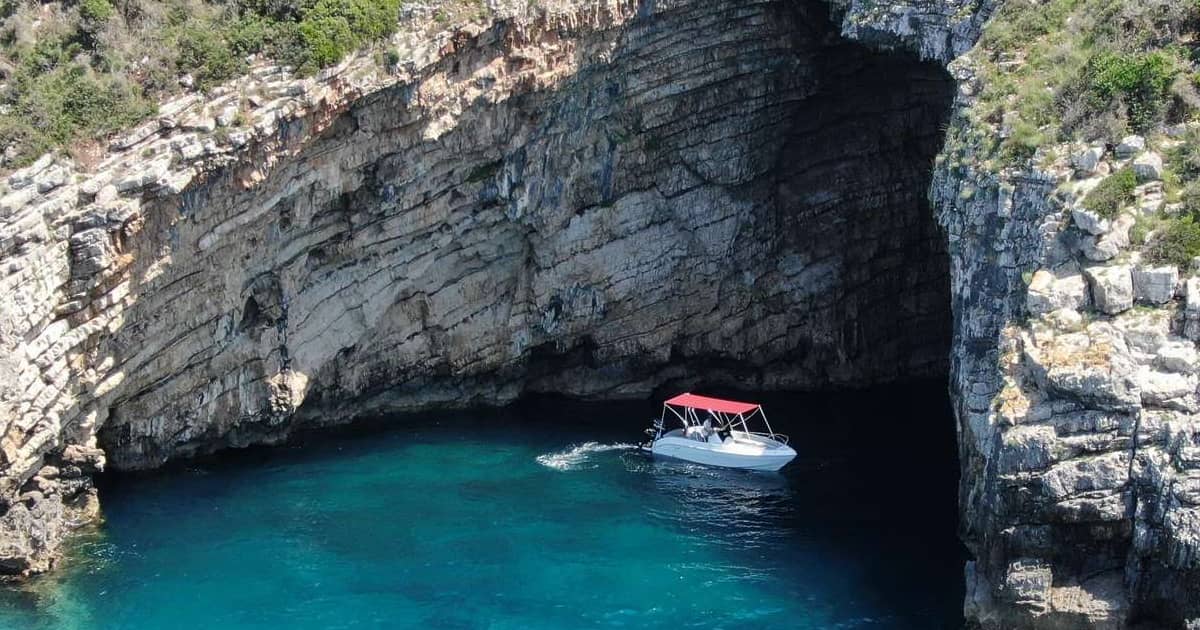
A Corfu cave tour is a boat trip along the west coast of Corfu to its sea caves and coves. You swim in clear water and see the cliffs from below. This post covers the caves, the coast, the sailing day, the season and the booking rules. The homepage lists more Greece Tours like this one.
Each tour card below opens a live GetYourGuide booking. Dates, departure times and group sizes are shown there.
What is a Corfu cave tour and which caves does it visit?
A Corfu cave tour is a boat trip to the sea caves of Corfu, with swim stops at beaches. The boats leave from Paleokastritsa on the west coast. The boat time runs from 45 minutes to 6.5 hours, depending on the format.
A Corfu cave tour begins in Paleokastritsa, a village in north-west Corfu that lies south of Angelokastro. The boats leave from Alipa port or from Agios Spiridon beach. The sea caves are reached by boat. The formats below differ in length, group size and swimming.
If you plan to cross into Turkey as well, the homepage also lists Turkey tours.
The sunset mini cruise is a short format. It leaves from Agios Spiridon beach and sails along the Paleokastritsa and Liapades coast. The route passes the Blue Caves and Limni beach, and it ends at Paradise beach. The cruise lasts 1.5 hours and has no swim stop. The evening closes with the sunset over the Ionian Sea.
The speedboat tour is the small-group format of a Corfu cave tour. It leaves from Alipa port and lasts 2 hours. The group is limited to 9 people. The route covers two blue sea caves, Paradise beach and Yali beach, with a swim stop at each beach.
A semi-private cruise starts at Ermones beach and heads north up the west coast to Paleokastritsa. It returns to Ermones afterwards. The trip lasts 2.5 hours and takes up to 9 guests. The swim stop is at Giali beach and lasts about 30 minutes. The other beaches are seen from the boat, with short photo stops.
A Corfu cave tour on a traditional wooden boat starts with a speedboat. The speedboat picks guests up at Alipa beach and takes them to Limni, a double beach. A wooden boat then collects them and visits the sea caves. The swim stop at Kasteli follows, and the trip ends at Agios Spiridonas beach.
Coach tours add a boat leg. The sunset tour from Corfu Town to Paleokastritsa lasts 4 hours 30 minutes. The boat trip is an optional extra. On the version made for cruise visitors, that sunset cruise lasts 45 minutes. A cruise ship excursion lasts about 4 hours and enters the grottoes by local boat.
The long format of a Corfu cave tour sails from Benitses marina on a wooden sailboat. This semi-private cruise lasts 6.5 hours and takes up to 22 guests. It visits Papanikolis Cave and the Blue Lagoon. On the way back it stops at a secluded cove.
A private boat is another format. One private cruise lasts 2 hours on the water and adds 45 minutes of free time in Paleokastritsa. It carries up to 10 people. The two swim stops last 30 minutes each, at Paradise beach and Kasteli bay.
Four caves come up by name on these tours. The Paleokastritsa boats name three of them. The cruise from Benitses names the fourth, Papanikolis Cave, a historical site from the Second World War. The list gives the names as the tours spell them.
- Nausica’s Cave
- The Blue Eye
- Saint Nicholas’ Cave
- Papanikolis Cave
A Corfu cave tour suits couples, friends and families. The semi-private cruise from Ermones welcomes all three groups. Swimmers enjoy the speedboat tour, which has a swim stop at both beaches. A guest who cannot swim can still join the speedboat tour and watch from the boat.
Each tour fixes its start point, its route and its length. You choose the format, and the format decides the swimming. The sunset mini cruise has no swim stop. The speedboat tour has one at each beach. The Ermones cruise has one at Giali beach. On a coach tour, the boat trip is the part you add.
Which rocks and bays shape a Corfu cave tour on the west coast?
A Corfu cave tour passes limestone cliffs on the west coast, where two peninsulas shape the six coves of Paleokastritsa. Boats reach the sea caves cut into those cliffs, and the coves around them have pebble shores and turquoise water.
Paleokastritsa is a village in north-western Corfu, 24 kilometres north-west of Corfu Town. It lies north of Liapades on the west coast. The sea caves that a Corfu cave tour visits are cut into the cliffs of this village. Above the bay, a monastery from the thirteenth century stands on a rocky promontory over the sea.
The bay of Paleokastritsa has two peninsulas and six coves. Rocky headlands separate one cove from the next. Pine and cypress trees cover the promontories that reach into the sea. The shores differ from cove to cove. Agios Spiridon has a crescent-shaped sandy shore. The hidden beaches to the south have white pebbles.
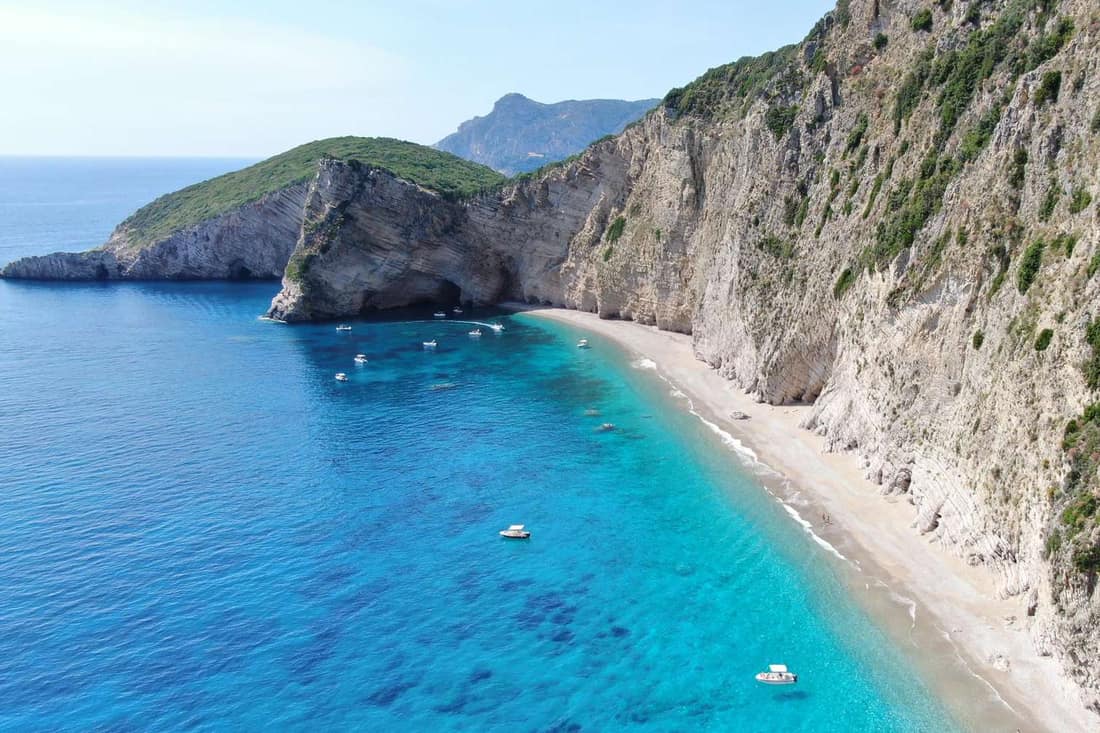
Rock decides what a Corfu cave tour can show. Corfu is made of limestone formations, and the cliffs at Paleokastritsa are limestone. Rainwater absorbs carbon dioxide and becomes a weak carbonic acid. That acid dissolves the calcium carbonate in limestone and widens cracks into passages. The caves near Paleokastritsa beach formed by karst processes and by erosion by the sea.
The sea works on the same cliffs from the other side. A sea cave starts at a weak zone in the rock. In layered rock, that zone can be a gap between two layers. Waves force water and air into the crack and widen it. Sand and stones in the waves scrape the walls.
The sea caves of Paleokastritsa include Nafsika, Saint Nikolas and the Blue Eye. They are carved into the cliffs. A Corfu cave tour reaches the Blue Eye by boat, because the cave can be entered only from the sea. The Nafsika cave, also spelled Nausicaa, can be seen from the main beach.
The Blue Eye takes its name from a patch of very blue water that looks like an eye. Sunlight shines into the cave through a hole in the rock. The water inside glows turquoise. Sunlight that strikes the rock formations of these caves also creates colour effects and optical illusions.
The colour of the sea changes from cove to cove. Water absorbs the red part of sunlight, which leaves blue. Agios Spiridon has calm turquoise water, and Agios Petros has deep blue water. The hidden beaches in the south have emerald water. Ampelaki lies in a small bay of sand and pebbles with transparent water.
Paradise Beach is a pebble beach that is accessible only by sea. Bright white pebbles and transparent water mark the cove, and tiny caves are carved into the rock formations around it. On a Corfu cave tour, Yali Beach is another swim cove. White fine pebbles cover its shore and seabed, and its name comes from its clear water.
Limni lies among the Ermones and has two beaches. A narrow strip of pebbles separates them. One side has green water that looks like a small lake, and the other has blue shades. The main way in is by sea, though a steep trail leads down. A Corfu cave tour can include Limni as a swim stop.
Kasteli is a quiet cove with calm water. Stelari has pebbles and turquoise water, and it is accessible by sea. Impressive cliffs surround Iliodoros. Loggas Beach lies on the north-west coast, at the foot of a sheer cliff of sedimentary rock. Limestone rocks tower over its narrow beach of fine sand.
How does a boat enter a cave and what do you do on board a Corfu cave tour?
A Corfu cave tour puts you on a small boat that cruises into the sea caves. The swimming happens at the beaches. On the Alipa speedboat trip, swimming inside the caves is not safe, so you swim at two beaches instead.
The boats at Paleokastritsa are small. The speedboat on the Paradise and Yali trip has a 175 horsepower engine and a skipper at the wheel. It also has a small toilet and an outdoor shower. A sunset boat for six guests is smaller still. Its size lets it reach narrow sea caves, and its skipper speaks English and Greek.
A Corfu cave tour on the Kasteli route uses two kinds of boat. Small speedboats take you to Limni beach, in two groups, one after the other. A traditional wooden boat then collects everyone and visits the sea caves and Kasteli. The speedboat serves the beach, and the wooden boat serves the caves.
From Alipa port, the skipper takes the Paradise and Yali speedboat along the coast to the first sea cave. On the Kasteli route, swimming inside the caves is not safe either. On the boat leg of a cruise-port shore trip, a Corfu cave tour goes into three sea caves. Each cave has its own character.
Swim stops come at the beaches. On the Paradise and Yali speedboat trip, each swim lasts about 20 to 30 minutes. At Paradise beach you dive in from the boat or use the ladder. Staying on the beach is not allowed for safety reasons. Yali beach is the last swim of the trip.
On a Corfu cave tour by speedboat, safety gear stays on board. On the Paradise and Yali trip, life vests are for emergencies, not for swimming. A guest who is not an experienced swimmer stays aboard or brings a flotation aid. On the two-hour speedboat trip, non-swimmers watch the scenery from the deck during swim stops.
The Kasteli route splits its swims between two places. At Limni beach, the group gets 1.5 hours to swim and explore the beach. At Kasteli, swimmers go in from the boat, by diving or by ladder. They keep away from the shore there, because rocks can fall. The boat provides bottled water.
What the ticket covers changes with the boat. The two-hour Paradise and Yali speedboat trip leaves snorkelling gear to you. Guests are allowed to bring their own snacks and drinks. The sunset boat for six supplies snorkelling equipment, a stand-up paddleboard, drinking water, an ice box and fresh seasonal fruit.
A Corfu cave tour on the wooden boat from Benitses adds food. Its inclusions list lunch, snacks, soda, bottled water, and coffee or tea. The boat stops first at the Blue Lagoon, where guests swim from the boat and relax on deck. A cave stop follows. One more swim in a secluded cove comes before the return.
A speedboat Corfu cave tour for up to seven guests lists snorkel equipment and drinks. Its stops include swims, exploring and photos. The three-hour sunset speedboat trip provides snorkelling gear, life jackets, wine, water and juice. Guests are allowed to bring their own food and drinks. The trip ends with a sunset cruise.
The boat on the cruise-port shore trip has minimal amenities, with no refreshments or restrooms on board. Swimming there happens at a sheltered beach. On the sunset swim tour from Corfu Town, the boat is an extra. Guests choose a shared or private trip during sunset, and the swim happens in the clear water of Paleokastritsa.
When can you join a Corfu cave tour and what rules apply?
A Corfu cave tour runs from April into late October, and the sea decides each departure. In rough water the captain can skip a cave or cancel the trip. The Paleokastritsa boats meet guests at Alipa port or at Agios Spiridonas beach.
Paleokastritsa has its main boat season from April into late October. Demand peaks from mid June to early September. Winter brings reduced boat services, so a Corfu cave tour belongs to spring, summer and autumn. The cards on this page show open dates.
Swim stops on a Corfu cave tour feel different from month to month. The sea off Corfu averages 15.5 degrees Celsius in April and 18.5 in late spring. June reaches 22, July 24.5 and August 26. September cools to 24.5 and October to 22. July and August are ideal for swimming.
Land heats the air above it faster than the sea does, so cooler air moves in from the water. This sea breeze grows stronger as the gap between land and sea temperature widens. Off Corfu, the wind blows from the northwest more than from any other side. It is light in the morning and stronger in the afternoon.
Time of day changes a Corfu cave tour. Morning departures tend to meet calmer water and a quieter harbour. After a windy day, the sea can stay bumpy into the late afternoon. One sunset cruise from Alipa port leaves two hours before sunset, so its start time follows the sun.
Cave access depends on the weather and is not a promise. When the wind blows from the west, the swell can make a narrow grotto unsafe to enter. On the shore trip by coach, the captain can skip the caves in rough seas. On windier days, the sunset cruise from Agios Spiridonas is cut to one hour.
The Kasteli trip is rescheduled in bad weather, and guests can ask for a refund. The operator adds that a last-minute cancellation is possible. Cancellation is free up to a day before on the Paradise and Yali trip and on the Paradise sunset trips. Contact the provider the day before for any updates.
Alipa port is the meeting point for the Paradise and Yali trip. Arrive 10 to 20 minutes early, depending on the trip. Online booking helps in July and August. The shared Paradise trip needs four bookings to run, and the Kasteli trip needs six. Parents supervise children closely on the sunset trip with Yali beach.
Age rules differ by trip on a Corfu cave tour. The Paradise and Yali trip sets no age limit, so children of any age can join. One sunset cruise from Alipa port seats infants on an adult’s lap and is not recommended for pregnant travellers. The shore trip by coach is not suitable for wheelchair users.
To avoid seasickness on a Corfu cave tour, sit away from the bow, where motion is strongest. A view of the horizon offers a measure of protection, and fresh air on the face helps. Alcohol makes motion sickness worse. Medication works better when taken before you board. Motion sickness peaks between the ages of 7 and 12.
The sun on the water is stronger than on land, so bring a hat and sun protection. Water shoes protect the feet on pebbles, boat landings and slippery rocks. Bring a light jacket for the cooler breeze on a sunset trip. A dry bag suits phones and cameras.
- Hat and sun protection
- Swimwear and a towel
- Water and light snacks
- Water shoes for pebbles and boat landings
- Light jacket for a sunset trip
- Dry bag for the phone and camera