An Ephesus tour from Izmir is a one-day trip south to the ruins of an ancient city. This post covers the day, the ruins, the temple, the House of the Virgin Mary and the booking rules. The homepage lists more Greece Tours for the Greek islands.
Every tour card below opens a live GetYourGuide booking. Pickup points and group sizes are shown on each card.
What is an Ephesus tour from Izmir and how does the day run?
Hotel pickup in Izmir opens a day of six to ten hours on an Ephesus tour from Izmir. Selcuk and its ruins fill the middle, lunch follows, and the vehicle returns to the hotel.
A vehicle collects the group in Izmir, drives south to Selcuk, and brings everyone back the same day. The ruins of Ephesus belong to the Selcuk district of Izmir Province. Two kilometres separate them from the town itself. Visitors also reach the site from Adnan Menderes Airport and from the resort town of Kusadasi.
For more days in Turkey, the homepage lists Turkey tours across the old cities and the coast.
Starting points differ on an Ephesus tour from Izmir. Departures on the private format leave from Izmir port, Izmir hotels or Izmir Airport. The group format with the House of the Virgin Mary collects guests at a hotel, the port or the airport. The format with an open buffet names hotels.
Group size sets the vehicle. The private format caps the group at fourteen people and supplies a private guide. The small-group minivan format carries a maximum of ten passengers. The house-visit format fits a car or minivan to its numbers. The buffet format chooses a minivan, minibus or midibus.
English or German is the tour language on the private format. Language is chosen at booking on an Ephesus tour from Izmir. Group formats with English and Spanish options can use a multilingual guide. Where no other language has a clear majority, the group hears English.
On the private format, the day starts with a drive of one hour to the House of the Virgin Mary. From there it goes on to Ephesus. A standard lunch comes next, with drinks at lunch not covered, followed by a demonstration at a handcraft centre. The Temple of Artemis is the last stop.
The buffet format opens with the ruins on an Ephesus tour from Izmir. Lunch and workshops come after it. On the house-visit format, the house comes first and Ephesus second. Lunch is at a local restaurant in Selcuk, and the Temple of Artemis is a panoramic stop.
The feeder-vehicle format uses two vehicles. A feeder vehicle collects guests at their hotel and meets the main tour bus at Selcuk. After the tour, a drop-off at the hotel in Izmir follows. Stops at a carpet weaving village and a leather factory are listed as well.
For more on Ephesus, see Sardis and Ephesus Tour From Izmir.
Guests on the feeder-vehicle format pay the guide for skip-the-line tickets on an Ephesus tour from Izmir. Fees for sites and museums are covered on the private format. The house-visit format includes both the Ephesus ticket and the house ticket. The buffet format includes only the Ephesus ticket.
The length of the day on an Ephesus tour from Izmir depends on the format. The private format runs six to eight hours, and the feeder-vehicle format eight to nine. Group formats run six to ten hours. The private format suits a visitor with a full day for the sights of the Ephesus area.
Which ruins stand on the route of an Ephesus tour from Izmir?
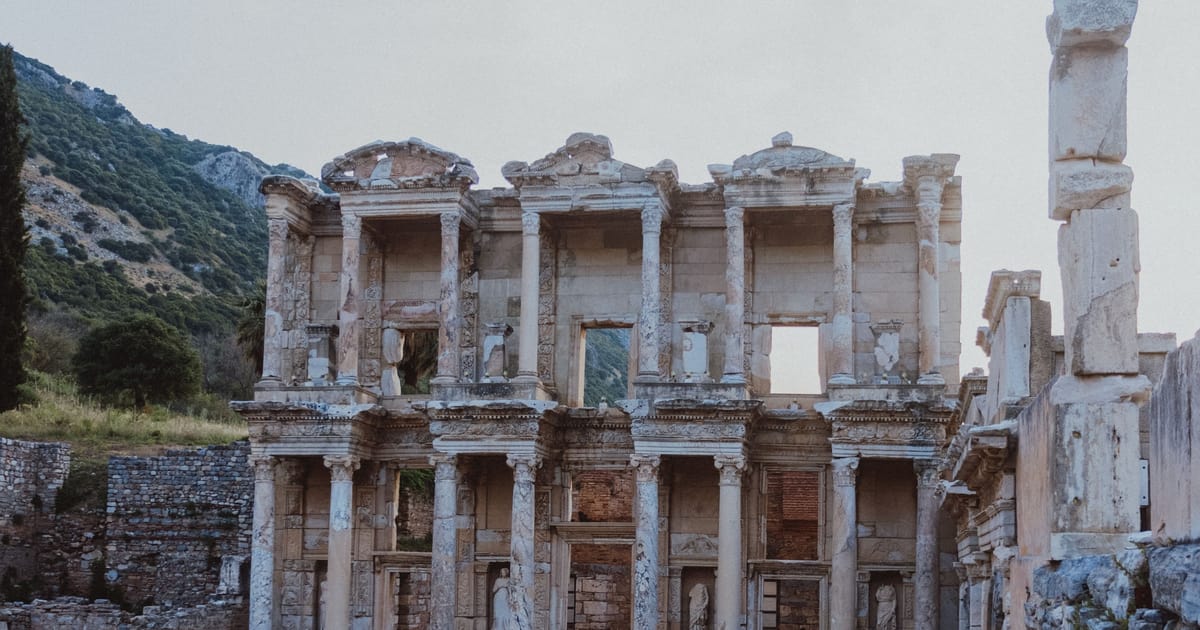
Ephesus holds the Library of Celsus, the Great Theatre, Marble Street, the Temple of Hadrian and the Terrace Houses. Guests walk past them during an Ephesus tour from Izmir. UNESCO placed the ancient city on its World Heritage List in twenty fifteen.
Greek colonists from Attica and Ionia founded Ephesus, and it became one of twelve cities in the Ionian League. A general of Alexander the Great later moved the city to the site where the ruins stand. Once Rome ruled the region, Ephesus served as capital of the province named Asia.
The Library of Celsus stands among the ruins seen during an Ephesus tour from Izmir. Tiberius Julius Aquila Polemaeanus, a consul, commissioned it as a funeral monument for his father, a former governor of Asia. Celsus lies in a decorated marble sarcophagus in a crypt beneath the building.
Ephesus Aphrodisias Tour From Izmir covers Ephesus too.
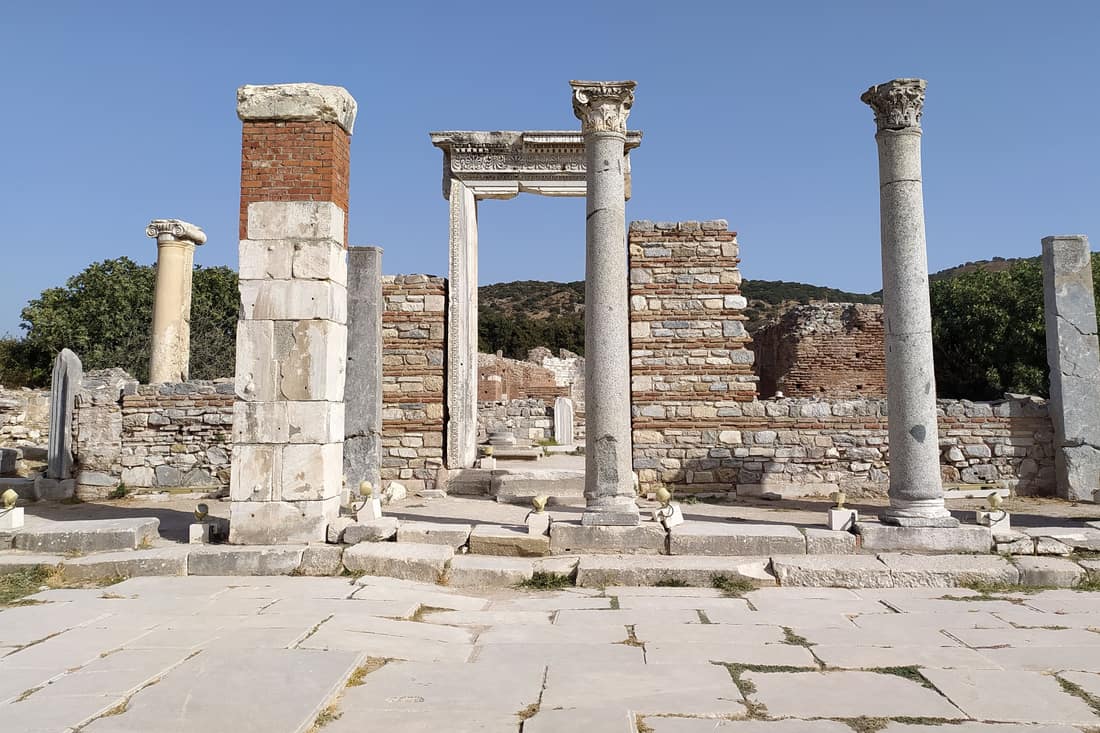
The library is believed to have held about twelve thousand scrolls. Its marble facade faces east, so the reading room caught the morning light. Archaeologists re-erected the facade in the nineteen seventies from fragments found on site and copies of museum pieces. The rest of the building stays in ruin.
The Great Theatre is set into a steep hillside in the middle of the old city. Its marble seats rise in three tiers, split into wedges by fifty-eight staircases. Travellers see the theatre during an Ephesus tour from Izmir. Gladiator fights joined the plays in later Roman times.
Marble Street takes its name from its marble paving. It joined Arcadian Street and the theatre to the square where Curetes Street began. Arcadian Street led to the harbour, so it is also called Harbour Street. Walkers meet both streets during an Ephesus tour from Izmir. Galleries and shops lined both sides.
Curetes Street runs from the State Agora toward the Library of Celsus and passes the Temple of Hadrian. Four columns carry the temple’s arch, with square outer ones and round inner ones. In the arch sits a bust of Tyche, who personified the fortune of Ephesus.
Ephesus comes up again in Ephesus Pamukkale Tour From Izmir.
The Terrace Houses stand on a slope opposite the Temple of Hadrian, and the wealthy of Ephesus lived there. The houses were built around an open courtyard ringed by columns. Guests visit the houses during an Ephesus tour from Izmir. Mosaics cover the floors, marble clads the walls, and frescoes show scenes from myth.
The Odeon is a small roofed theatre built about the middle of the second century. Inscriptions name the city clerk Publius Vedius Antoninus as its builder, and he also built the Temple of Hadrian. The city council met there, and the hall hosted plays, concerts and lectures.
Ephesus had two agoras, one for trade and one for state business. Travellers cross the Commercial Agora during an Ephesus tour from Izmir. Colonnades two storeys high ringed all four sides, presumably holding merchants’ stalls. Across a plaza from the Library stand the public latrines. They form a long bench over a sewer, with no screens between seats.
Why do the Temple of Artemis and the museum belong to an Ephesus tour from Izmir?
Selcuk holds the site of the Temple of Artemis, a wonder of the ancient world. The town also has a museum of finds from the dig at Ephesus. Both come after an Ephesus tour from Izmir covers the city itself.
The Temple of Artemis was a wonder in the ancient list of seven, and it stood near Ephesus. The spot where it stood lies at the edge of modern Selcuk. A stop there fits after an Ephesus tour from Izmir finishes the walk through the city.
A related page on Ephesus: Ephesus Samos Tour From Izmir.
A flood destroyed the earliest temple in the seventh century BC. Chersiphron, an architect from Crete, and his son Metagenes designed the second temple around five hundred and fifty BC. Croesus of Lydia helped to pay for the work. Marble was its building stone, supposedly a first among Greek temples.
Its columns stood in double rows, and Pliny the Elder wrote that thirty-six of them carried carved reliefs. Fire burned it down in the fourth century BC. Alexander offered to pay for the rebuilding. The Ephesians refused and called it improper for one god to build a temple to another.
The ancient writer Antipater of Sidon wrote that the other marvels lost their brilliance beside the house of Artemis. Only foundations and fragments of the last temple remain. A single column, rebuilt from pieces found there, greets those who come after an Ephesus tour from Izmir ends.
Below the fortress on Ayasuluk Hill lie the remains of the Basilica of St John. The church is the work of Justinian, from the sixth century. Five domes rose above a Greek cross plan, and a crypt lay beneath the altar. The ruins fit a stop after an Ephesus tour from Izmir moves on to Selcuk.
Readers interested in Ephesus can open Ephesus Chios Tour From Izmir.
A Syrian architect built the Isa Bey Mosque in honour of Isa Bey of the Aydinid dynasty. It lies on the edge of the Ayasuluk hills and dates to the fourteenth century. Its design is based on the Great Mosque of Damascus. A fountain court lies inside, and two main entrances open east and west.
The Byzantine aqueducts of Selcuk come from the east and reach Ayasuluk Hill. They use tall cut stone and brick joined by round arches. The remains of a branch about 650 metres long served the hill. These arches fit a Selcuk stop after an Ephesus tour from Izmir reaches the hill.
The Ephesus Archaeological Museum in Selcuk holds finds from the dig at Ephesus. Items from the Basilica of St John and the Temple of Artemis are in its collection too. A depot built in Selcuk in nineteen twenty-nine stored later finds, and the museum opened in nineteen sixty-four.
The halls follow the place where each find came out of the ground, not its date. One hall holds medical and cosmetic tools, jewellery and lamps, and another is given to Artemis. Visitors who add the museum after an Ephesus tour from Izmir see two great statues of Artemis there.
More about Ephesus: Ephesus Pergamon Tour From Izmir.
How does the House of the Virgin Mary fit within an Ephesus tour from Izmir?
Bulbul Mountain carries the House of the Virgin Mary, a domed chapel on a cross plan. The all-inclusive format makes it the first stop. Stone marks the hill stops throughout an Ephesus tour from Izmir. Sirince, eight kilometres from Selcuk, adds village time on a small-group format.
Maps give the mountain two names. In Turkish it is Bulbuldagi, which means Mount Nightingale, and in other writing it is Mount Koressos. The house stands there in the vicinity of Ephesus, in Izmir Province. The national culture portal of Turkey lists the site as faith and culture tourism.
The shrine is a modest chapel and not a large building. According to the Selcuk municipality, it has a cross plan and a dome, and it was restored later. Inside, an altar and a statue stand in the middle of one big room. A smaller room opens to the right.
In eighteen ninety-one, Lazarist priests identified the house after the visions of a German nun. A four-walled ruin without a roof stood on the spot. Long before the priests came, villagers from Sirince honoured the ruin. They also celebrated the Dormition feast at the site for centuries.
Two faiths are present at the house throughout an Ephesus tour from Izmir. Muslims hold the house sacred too, says the culture portal. Christians and Muslims both visit as pilgrims. They tie wishes, written on paper or fabric, to the wishing wall. A holy spring lies in the vicinity.
Another page that includes Ephesus is Izmir Ephesus Tour By Flight From Istanbul.
Stops are timed throughout an Ephesus tour from Izmir. Visitors on the all-inclusive format spend forty-five minutes at the house. A local guide shows the sacred fountains and the wishing wall. One small-group format lists two hours for the house and two hours for the village of Sirince.
Services take place at the house each year on the fifteenth of August. The Selcuk municipality ties the custom to the visit of Pope Paul VI in nineteen sixty-seven. That visit fell on the twenty-sixth of July. The municipality adds that the August services draw great interest.
Views open up throughout an Ephesus tour from Izmir. Sirince, a neighbourhood of Selcuk district, sits about 330 metres above sea level. No house there blocks another’s view. Its stone houses, with red tile roofs, line cobblestone streets. The house on Bulbul Mountain looks out toward the Aegean Sea.
From the centre of Selcuk, the road to Sirince heads about eight kilometres east, toward the hill. The culture portal says the village keeps its historic architecture. Two Greek churches also stand there. The village was a Greek town of about eighteen hundred households in the nineteenth century, known for exporting figs.
Ephesus also features in Izmir Ephesus Tour By Flight From Ankara.
Local fruit appears throughout an Ephesus tour from Izmir. Sirince grows vines, olives, peaches, figs, apples and walnuts. Its homemade wines come from fruit such as blackberries, melons and strawberries. One small-group format sets aside free time for wine tasting in the village of Sirince.
When does an Ephesus tour from Izmir run and which rules apply?
Weather sets the main rule. July and August bring a mean daily maximum of 34.6 degrees Celsius in Selcuk, beside the ruins. Pack water, a hat and shoes with tread before an Ephesus tour from Izmir starts, and read the ticket terms.
The calendar matters before an Ephesus tour from Izmir begins, because the region follows a clear wet and dry pattern. Summers in Izmir are long, very hot and dry, while winters are cool and rainy. The vast majority of its rain falls from November through March, and June to September brings very little.
Selcuk, the town beside the ruins, has the same pattern, classed as hot-summer Mediterranean. Its mean daily maximum is 13.6 degrees Celsius in January, 21.9 in April and 31.8 in June. It falls to 30.6 in September and 25.7 in October. Rainfall averages 0.98 millimetres in July and 0.3 in August.
Sun protection needs thought before an Ephesus tour from Izmir departs. The ruins give close to no shade, so a brimmed hat, sunglasses and sunscreen are standard kit. Water matters too, at a litre per person. Light, loose clothing in pale colours beats bare skin for comfort and sunburn.
Another page that includes Ephesus is Ephesus Aphrodisias Pamukkale Tour From Izmir.
Comfortable shoes are part of the packing advice on the all-inclusive format. Closed trainers or strapped sports sandals with real tread suit the polished marble, which turns slippery when dusty or wet. Smooth soles slide on it. On the private format, the visit asks for at least two hours of walking.
Ticket handling differs by format, so check the voucher before an Ephesus tour from Izmir leaves the hotel. On the small-group format, the guide holds pre-paid tickets for the skip-the-line entry. On the all-inclusive format the Ephesus entry is included, while the Terrace Houses entry is separate. On the budget format, entrance fees are not included.
Infant seats are available on the small-group format, though travellers with spinal injuries are advised against it. The all-inclusive format is not wheelchair accessible and is not advised for people with back problems. A private format for wheelchair users offers lift-equipped vehicles and paths that avoid stairs and steep slopes.
The small-group format serves a traditional Turkish lunch with a vegetarian option, requested at the time of booking. On the private format, bottled water is complimentary, while beverages at lunch are not included. On the all-inclusive format, drinks, tips and personal expenses sit outside the booking.
Ephesus Shore Excursion covers Ephesus too.
Pickup details matter before an Ephesus tour from Izmir collects its guests. The private format departs from Izmir port, hotels or Izmir Airport. The budget format meets at Cumhuriyet Square in Izmir. On the all-inclusive format, a hard-to-reach hotel means the guide sends a nearby meeting point the day before.
Cancelling at least a day before the scheduled departure gives a full refund on the small-group, all-inclusive and budget formats. Booking ahead starts with the cards on this page, which show availability for the date you choose. Check the date there before an Ephesus tour from Izmir goes into a plan.