An Izmir Ephesus tour by flight from Ankara reaches the Aegean coast in two days. This route flies to Izmir, drives south to Selcuk for the night and returns the next evening. For island trips, open Greece Tours on the homepage.
Day one covers Konak and the old market quarter of Izmir, then Ephesus. Day two covers Selcuk, the Terrace Houses and the road back to Izmir. Each card below opens a live GetYourGuide booking page.
How did builders shape the Great Theatre of Ephesus on this Izmir Ephesus tour by flight from Ankara?
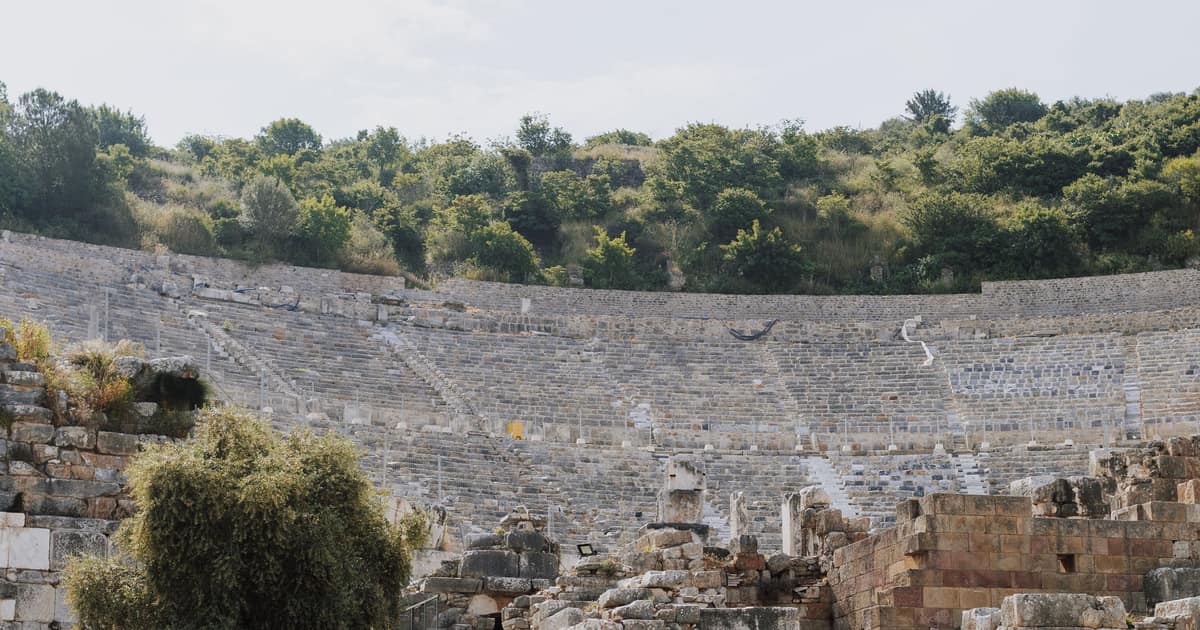
Builders set three marble tiers into a steep hillside, and Romans added staircases and a stage front in three orders. Visitors read that plan on this Izmir Ephesus tour by flight from Ankara. Restorers have since secured the structure.
Tradition credits Lysimachus with the first theatre here, in the years after three hundred BC. The oldest traces, however, point to a later date than the tradition gives. One scholar even questions any theatre before 100 BC. The earliest phase had a lower block of seats, an orchestra and a scene building with rectangular openings.
Looking further? Turkey tours on the homepage reach Istanbul, Cappadocia and the Mediterranean coast.
The lowest tier holds 24 rows of marble seats in 11 wedges, and its front row has continuous stone backs. A walkway called a praecinctio, 1.65 metres wide, divides it from the middle tier. That tier has 22 rows in 22 wedges. Seat-count estimates differ between sources, so the rows give firmer facts.
The top tier followed in the first century, with 21 marble-covered rows and a colonnade behind the highest row. Fifty-eight staircases split the tiers into wedges, twelve for the lowest tier and twenty-three for each of the others. Corridors under the bowl’s edges come out at the walkways on this Izmir Ephesus tour by flight from Ankara.
Rooms, nine in all, opened off a corridor in the Hellenistic scene building, which was 41.70 metres long. The Roman stage front held seven large rectangular openings, called thyromata, beside niches for statues. Scholars suggest that they served as doors or held scenic panels. The Roman stage platform, the pulpitum, measured 25.40 metres by 5.56 metres.
Two rows of round columns carried that platform, which projected into the orchestra. The proscaenium, the wall under its front edge, stood 2.35 metres high with 20 columns between end piers. One scholar calls the columns Doric. A wider central gap held a stairway down to the orchestra on this Izmir Ephesus tour by flight from Ankara.
Decoration of the theatre dates to Trajan’s reign, around the start of the second century. The stage platform grew near the middle of that century, with equipment from P. Vedius Antoninus. The scaenae frons, the stage’s high back wall, gained a third level by the early third century. That wall has suffered more damage than the seating.
The orchestra floor changed twice in the third century. An arena 33.62 metres across, inside a podium 2.40 metres high, came first. Late in that century a water basin 28.34 metres across replaced it, with a paved passage. The floor lies below the seats on this Izmir Ephesus tour by flight from Ankara.
Vitruvius, the Roman architect, describes bronze vessels tuned to musical notes and set in niches between the seats. He says the vessels stand clear of the wall. Their notes run from the fourth up to the double octave. The chance is raised for Ephesus too, a theatre met on this Izmir Ephesus tour by flight from Ankara.
Architects and archaeologists from Austria and Turkey began a restoration project in nineteen ninety-three. Topographers, soil engineers and hydrology experts joined them. Early work secured a structure that had threatened to collapse. Plans called for broken marble parts to be mounted at their original places. That work shaped the ruin met on this Izmir Ephesus tour by flight from Ankara.
Parts of the stage building’s shell lie uncovered as opus caementicium, a Roman concrete of mortar and rubble. The team planned to shield that shell from weather and plants. It also planned tests of the original materials. Austrian studies of the seating, from two thousand three to two thousand eleven, trace nearly 800 years of building history.
What does the Salutaris inscription record beside this Izmir Ephesus tour by flight from Ankara?
Salutaris, a Roman of equestrian rank, gave Ephesus gold and silver images in the early second century. His decree lists each image beside this Izmir Ephesus tour by flight from Ankara. Surviving lines, 568 in all, also give the route and the weights.
C. Vibius Salutaris belonged to the equestrian order of Rome. The decree calls him a man conspicuous by birth and personal worth. Scholars date his donation to the early second century. Outside Ephesus he is unknown, so the text itself gives the only picture of the man. Next come his gifts.
Readers interested in Ephesus can open Izmir Ephesus Tour By Flight From Istanbul.
The gift was a set of images in gold and silver. The text lists nine statues of the goddess, one of gold and the rest silver, plus twenty silver images. Readers meet the list beside this Izmir Ephesus tour by flight from Ankara. Entries name the image, its metal and its weight.
Weights are exact in the text. A golden Artemis weighs three pounds, and a silver Artemis the Torch-bearer weighs seven. A silver image of the equestrian order weighs three pounds, half an ounce and three grammes. Each image has its own line and its own weight. Pounds, ounces and grammes all appear.
The list opens with Trajan and his wife Plotina, shown in silver. It goes on with the Senate, the equestrian order, the Roman people and the tribes of the Ephesians. Rules for the imperial pair are set down beside this Izmir Ephesus tour by flight from Ankara. Care of them rests with Salutaris while he lives.
Named bearers carry the images. Two of the neopoioi, a beadle and the guards attend them. The neopoioi care for the buildings of the sanctuary, so they pick up the images at the temple. The first leg of the walk lies in their hands and ends at the Magnesian Gate.
The walk starts at the porch of the temple. It circles the foot of Panayirdag clockwise to the gate. In the inner court the ephebes, the young men of Ephesus, receive the images. The text fixes four stations beside this Izmir Ephesus tour by flight from Ankara. Temple, gate, theatre and a second gate form the chain.
From the gate the procession follows Magnesian Street. Scholars describe the carriers as passing over or along the Upper Agora. The route then runs down the Embolos, past administrative buildings, monuments and houses. The carriers cross the Lower Agora, which scholars take for the commercial centre, and reach the theatre.
At every regular assembly the decree orders the images placed in the theatre. Read it beside this Izmir Ephesus tour by flight from Ankara. Processions leave by Marble Street, turning east just north of the stadium. The text sends the images on to the Koressian Gate with all due dignity. That gate has not been excavated.
The decree was cut into the marble wall of the south parodos of the theatre. Salutaris asked for a second copy in the temple, in a suitable place, and that copy has not survived. Five blocks, set in six columns, carry 568 surviving lines, and another block is lost. Scholars sort the lines into seven documents.
Pieces of the dossier belong to the British Museum collection, catalogued by column and line. Later work at the theatre added missing parts, as noted beside this Izmir Ephesus tour by flight from Ankara. Statues have not survived. Bases carrying inscriptions have, and twelve have been found in the theatre.
Scholars read more than a gift in these lines. One study finds the gifts and rituals designed to honour the donor. It adds that the foundation advertised the ties of Ephesus to Rome. A review reads the march as a statement to the young men who took part. A Cambridge chapter treats it as an emotional experience.
Which paintings and mosaics decorate the Terrace Houses for this Izmir Ephesus tour by flight from Ankara?
Paintings, mosaics and marble panels fill the Terrace Houses, a stop for this Izmir Ephesus tour by flight from Ankara. Painters framed open fields with pilaster strips. Mosaics show Dionysos and Ariadne in a wall niche.
Scholars once dated the majority of the paintings and mosaics to late antiquity. Austrian research moved the whole house and its paintings back by up to two centuries. The surviving wall paintings fall largely in the third century. The last painting phase dates to the second quarter of that century.
Two painted schemes matter for this Izmir Ephesus tour by flight from Ankara. Panels in three zones sit on a dark surface, such as red. Open fields framed by narrow pilaster strips, called lesenes, form the commonest scheme of Ephesian painters. Scholars call the group unique and post-Pompeian, a reference for sites with simpler finds.
Rooms of higher rank used marble wall systems in three zones, with an architectural frame and rare, expensive coloured stone. Rooms of lower rank had two zones of local marble, divided into fields or by a simple profiled border. Paint and marble share rooms. Marble panelling grew in favour from the second century.
More about Ankara: Izmir Sardes Tour By Flight From Ankara.
Dwelling units three, five and seven add depth for this Izmir Ephesus tour by flight from Ankara. Units three and five have colourful wall paintings, ornate mosaic floors and high-quality marble revetments. The volume on unit seven treats wall and floor marble, wall paintings, stucco and mosaics. Research also covers paintings on floors and ceilings.
Stucco belongs to the decoration as well. The research project on Terrace House 2 lists stucco beside wall paintings, marble and mosaics. Roman stucco and fresco work used the same white lime plaster. Vitruvius and Pliny describe how builders prepared it. Their texts are strong written evidence for Roman wall-painting technique.
Mosaics cover floors, walls and ceilings, a detail for this Izmir Ephesus tour by flight from Ankara. Dionysos and Ariadne appear in a wall niche of Slope House 2, as heads with animals and birds against foliage. An Austrian volume on units one and two describes a glass mosaic of the pair in an exedra.
Roman floor mosaics in opus tessellatum use tesserae larger than about four millimetres. Marble was the only early material, and glass followed by the second century. A floor began with a levelling layer ten to twelve centimetres thick. Coarse mortar of lime and terracotta came next, then a thin bed of mortar before the pattern.
Plaster work lies behind the colours for this Izmir Ephesus tour by flight from Ankara. Pigment in water enters the wet lime plaster, and a chemical reaction fixes it there. A rough arriccio covers the whole area first. A thin intonaco follows on each day’s section, called the giornata. Roman frescoes were painted on still damp plaster.
Egyptian blue was used in the wall paintings of Terrace House 2. Austrian researchers analysed units with portable instruments. They then sampled different building phases to trace the source of the raw materials. The pigment is a calcium copper silicate, made by heating quartz sand, a copper compound, calcium carbonate and an alkali.
Beneath unit six, excavations unearthed an earlier Hellenistic phase with wall paintings. In the fourth building phase of the houses, almost all rooms were redecorated. Scholars read the choice between paint and marble as a sign of the personal taste of the inhabitants. Unit six has decor of high quality.
Frescoes exposed by the excavations lost more substance in the weather. Early treatments used materials that later proved harmful. Conservation aims to secure the frescoes and present them to a consistent concept. Such care matters for this Izmir Ephesus tour by flight from Ankara. Conservators work with students for months each year.
How did masons shape the marble of Ephesus during this Izmir Ephesus tour by flight from Ankara?
Masons cut marble in quarries around Ephesus, sawed thin wall slabs by water power, and raised blocks with cranes. Quarried stone built the city visited during this Izmir Ephesus tour by flight from Ankara. Dowels and clamps set in lead reinforced load-bearing blocks.
A university survey of ancient quarries took 237 samples from the pits around Ephesus. Teams scanned seven Ephesian quarries in three dimensions. Across the surveyed regions, workers left wedge holes, pick marks, spoil heaps and slipways. They left blocks shaped at the quarry before transport. A quarryman splits the rock and lifts out the blocks.
Belevi lies about eleven kilometres north-east of ancient Ephesus, with quarries near the village. Scholars named Belevi as the main source of the decorative stone called bigio antico. They tested eighteen possible quarry sites and twenty-one sculptures, and nineteen pieces matched Belevi. Such tests reveal the stone behind carvings seen during this Izmir Ephesus tour by flight from Ankara.
Greco scritto, a white marble with black markings, came from another quarry about twenty kilometres north-east of Ephesus. Finds in Rome, Sirmium and Selinunte show how widely it was traded. Bigio marbles also came from Mount Panayir. For the council house, builders took bluish-grey marble straight from that hill. Quarries form a conspicuous feature of its landscape.
Greek builders dressed quarried blocks to fit closely, and mortar was hardly ever used. Masons saved labour with anathyrosis: they smoothed only a narrow margin round each joint face and cut the interior back. The margin looks like a doorframe, and thyra is Greek for door. Check block edges during this Izmir Ephesus tour by flight from Ankara.
Iron clamps, dowels and rods of wood, bronze or iron reinforced load-bearing blocks at times. Builders fixed the metal in lead to limit corrosion. Column drums rested without mortar, and a bronze pin occasionally centred them. Roman concrete mixed lime mortar, aggregate, pozzolana ash, water and stones. Walls bonded the mix to a facing of stones or bricks.
Cuttings for lifting tongs and lewis irons first appear on Greek blocks in the late sixth century BC. A three-legged lewis fits a dovetailed hole in the stone and holds by shape, not friction alone. Ashlar blocks were also lifted by sling or devil’s clamp. Watch for such hollows during this Izmir Ephesus tour by flight from Ankara.
Ankara comes up again in Ephesus Sirince Tour by Flight From Ankara.
Cranes of the Roman polyspaston type took their name from a Greek word meaning compound pulley. A four-man winch lifted 3,000 kilograms, and a treadwheel doubled that to 6,000 kilograms with half the crew. Engineers raised a wooden lifting tower for loads up to 100 tonnes. The Haterii tombstone, from the late first century, shows a treadwheel crane.
A second-century villa at Ephesus has green-veined slabs of cipollino verde from the Greek island of Euboea. Saw marks on one slab point to a water-powered sawmill. The block weighed three to four tons and probably reached Ephesus whole. Sawing and polishing left gaps of about eight millimetres. Study the stone during this Izmir Ephesus tour by flight from Ankara.
Ionic capitals carry volutes, the shaft has twenty-four flutes, and a base separates it from the platform. The order began in the mid-sixth century BC in Ionia, broadly the area of Izmir Province. Corinthian capitals carry acanthus leaves. The oldest known Corinthian column stands at Bassae in Arcadia. The Composite order joins the Corinthian leaves to the Ionic scrolls.
Builders reused old stone as well. Spolia means stones taken from an old structure and used again in a later building. Seventh-century builders set spolia into the city walls of Ephesus. Notice such blocks during this Izmir Ephesus tour by flight from Ankara. Marble weathers because acids react with its calcium carbonate, and acid rain damages outdoor marble.
How was the Isa Bey Mosque built near this Izmir Ephesus tour by flight from Ankara?
Isa Bey’s mosque in Selcuk stands near this Izmir Ephesus tour by flight from Ankara. Ali, son of Mushaimish of Damascus, built it for the Aydinid ruler. The inscription over the west door gives March of thirteen seventy-five.
The inscription names the architect as Ali ibn Mushaimish al-Dimashqi, a man of Damascus. It dates the work to the month of Shawwal in the Hijra year 776. Selcuk was then the administrative capital of Isa Bey, who ruled in the later fourteenth century. The deed that endowed the mosque has not survived.
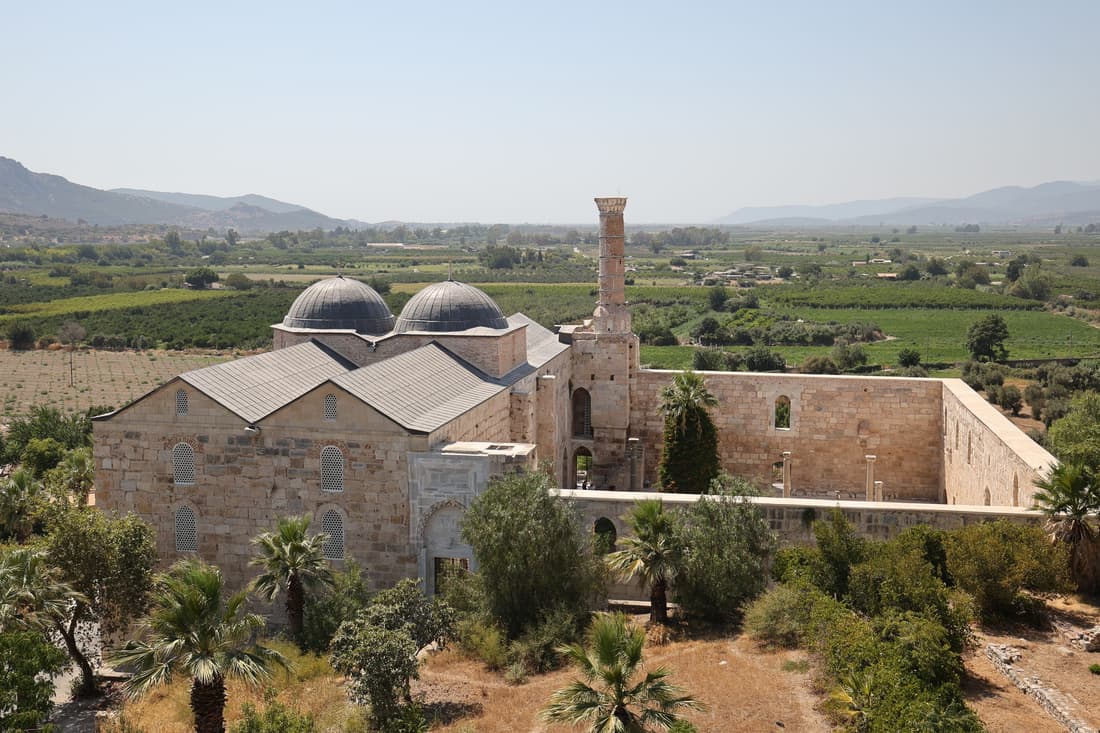
Two main spaces form the mosque near this Izmir Ephesus tour by flight from Ankara. Arcades on three sides enclose a courtyard on the north, with an octagonal pool at its centre. A prayer hall lies on the south. The hall measures about 18 by 48 metres, longer than it is deep.
Columns taken from ancient buildings carry the surviving arcade. Six corbels in the walls mark where brick arches once sprang. Porticoes of two storeys bordered the courtyard, which measures 27 by 35 metres. A three-arched opening, flanked by two-arched openings, leads from the courtyard into the prayer hall.
Four columns carry transverse arches inside the hall near this Izmir Ephesus tour by flight from Ankara. Aisles of equal width run parallel to the qibla wall. A transept crosses them on the line of the mihrab. The courtyard windows match each other, while the windows of the hall vary on purpose.
Four massive granite columns stand in the hall. Three have muqarnas capitals, and the fourth carries a reused Composite capital. Edward Falkener, who drew the mosque in the eighteen-sixties, suggested that the columns came from the great gymnasium at Ephesus. The Turkish encyclopedia of Islam calls that origin highly probable.
Two domes rise near this Izmir Ephesus tour by flight from Ankara. Pendentives carry the second dome, while the first rests on Turkish triangles. Octagonal drums lift both domes. Each dome roofs one square bay of the transept. The larger dome measures 9.4 metres across, and lead covers both of them.
Mosaic tiles in turquoise, brown and dark blue cover the pendentives under the dome in front of the mihrab. Hexagons and six-pointed stars make up the pattern. Green tile panels fill the muqarnas of the drum. In the seventeenth century Evliya Celebi described both domes as covered with blue tiles from Iznik.
Limestone and marble make up the walls near this Izmir Ephesus tour by flight from Ankara. Spoil from Ephesus fills much of the stonework, and other pieces were cut for the mosque itself. The north, east and south walls use roughly dressed masonry. The west wall, the main facade, uses carefully cut stone faced with marble.
Two flights of steps lead up to the west portal, which projects from the wall. A muqarnas hood crowns it. Black and white marble forms a knot pattern in the surface above. The same knotwork frames the windows and runs around the mihrab. A thorough reconstruction in the nineteen-seventies rebuilt the upper part of the portal.
Another page that includes Ankara is Izmir Pamukkale Tour By Flight From Ankara.
The north gate stands walled up near this Izmir Ephesus tour by flight from Ankara. Drawings by Falkener recorded the text of its lost inscription. In the nineteenth century, a door was opened in the south wall where the mihrab stood. The upper part of the mihrab went to Kestanepazari Mosque in Izmir.
An Austrian Archaeological Institute team surveyed the building in the late nineteenth century, during its work at Ephesus. Restoration began in nineteen thirty-four, and later work roofed the open side aisles. A thorough renovation followed in nineteen seventy-five. The courtyard was partly arranged in nineteen eighty-eight, and the lead roof was renewed in two thousand and five.
Why do storks nest on the aqueduct of Selcuk along this Izmir Ephesus tour by flight from Ankara?
Piers that reach 15 metres give white storks a viewpoint. The arches of Selcuk carry their nests along this Izmir Ephesus tour by flight from Ankara. Brick forms the upper arches, and builders reused marble at the foot of the piers.
The culture office of Izmir Province lists the aqueducts of Selcuk as work of the Byzantine period. The municipality traces the surviving arches from east of the Takip Gate. The line continues in the Sirince Gorge and turns north. Remains stand near the train station and on both sides of the asphalt road.
The arches carried drinking water. Springs east of the Pranga locality, between Belevi and Selcuk, supplied it. Day two of the plan reaches Selcuk along this Izmir Ephesus tour by flight from Ankara. Pranga water ran to the Byzantine settlement on Ayasuluk Hill and to the church of St John.
Cut stone and brick form the aqueducts, and round arches join them. The culture office of Izmir Province reports that parts of the line survive in good condition. The municipality adds that brick was used in the upper arches. Around the station the piers survive to a height of 15 metres.
Reused marble blocks stand at the foot of the piers. The municipality says builders brought them from Ephesus and from the Artemision, then shaped them. Day two meets the reused stones along this Izmir Ephesus tour by flight from Ankara. Capitals of the Ionic type, from the Archaic period, are among the reused pieces.
A large cistern lies where the aqueduct reaches Ayasuluk Hill, east of the Takip Gate. It was excavated and restored. Its superstructure is arched and vaulted. Builders used fluted columns brought from Ephesus and composite capitals of the middle of the second century. A cistern is a tank that stores water.
The tourism ministry says the aqueduct and its surroundings have become a breeding and nesting place for storks. Day two of the plan passes the breeding place along this Izmir Ephesus tour by flight from Ankara. Plumage names the species. The white stork is mainly white, with black flight feathers, a red beak and red legs.
A study of nest sites in Hungary proposes that storks prefer viewpoints. That preference lets them breed as near as possible to optimal habitats. Preferred feeding grounds are grassy meadows, farmland and shallow wetlands. Piers that stand 15 metres high offer such a viewpoint. In southern Europe, nests also sit on churches and other buildings.
Males arrive earlier in the season and choose the nests. Over the years the storks bring more material to line them. A nest measures 0.8 to 1.5 metres across. Both parents take turns incubating the eggs, and both feed the young. Males are larger than females on average. Breeding pairs are territorial over the summer.
A normal clutch holds four eggs, though clutches of one to seven have been recorded. Chicks hatch partly covered with short, sparse, whitish down. The first egg starts incubation, so chicks hatch in turn along this Izmir Ephesus tour by flight from Ankara. Hatching begins 33 to 34 days later.
A denser, woolly white coat replaces the down about a week later. The young leave the nest 58 to 64 days after hatching. Parents keep feeding them for a further 7 to 20 days. White storks rely on rising air, called thermals, which do not form over water. The oldest known wild white stork lived 39 years.
Migration shapes the year of a white stork along this Izmir Ephesus tour by flight from Ankara. Flights south begin in August and September, heading for Africa. The birds winter in savannah from Kenya and Uganda south to the Cape Province. They arrive back in Europe around late March and April.
Ankara also features in Ephesus Aphrodisias Pamukkale Tour by Flight From Ankara.
How was Konak Pier built across this Izmir Ephesus tour by flight from Ankara?
Workers raised Konak Pier as a customs building, and one entry dates it between eighteen seventy-five and eighteen ninety. Konak is the first stop of day one across this Izmir Ephesus tour by flight from Ankara. Plaster covers the stone masonry of its old core, and a steel-framed block came later.
Sources disagree on the date of Konak Pier. The English encyclopedia entry gives a span from eighteen seventy-five to eighteen ninety. Its photo caption names eighteen ninety as the design year. The Turkish entry gives eighteen sixty-seven. A municipal history opens the dock and customs building in eighteen eighty, and later customs buildings in eighteen eighty-eight.
A municipal history says a concession of eighteen sixty-seven covered a customs building and warehouses of 900 square metres. French brothers signed a second agreement in eighteen seventy-eight for a modern customs hall. Its inauguration came in eighteen eighty. That hall is among the structures seen across this Izmir Ephesus tour by flight from Ankara. Warehouses opened with it.
A municipal history says the building of eighteen eighty-eight was entirely masonry. It had a small laboratory with double doors that opened onto a central space. An inscription on that building mentions a fountain that has not survived. Arched openings mark the stone walls. The complex also held a stone building and two wood-frame warehouses.
A support system of wood trusses carries the roof of the old hall. That roof crowns the hall met across this Izmir Ephesus tour by flight from Ankara. Trusses stay in view from inside the building. Concrete slabs and brick walls later formed a second floor, as both encyclopedia entries state.
A later addition forms a square block of steel. Its columns are cast iron, and steel-profile trusses sit on top of them. The long rectangular wing beside it is the restored old building. The English entry describes the plan as combined prismatic forms. The Turkish entry gives the same pairing of iron columns and steel-profile trusses.
Customs work filled the hall until the nineteen-fifties, and one municipal history names nineteen fifty-four. The hall stood close to the dock where goods were loaded. The city fish market took it over in the nineteen-sixties and kept it until nineteen eighty-seven. An office of the city used it in the early nineteen-nineties.
Sources link the design of Konak Pier to Gustave Eiffel. The Turkish entry says the plan is thought to be his. A city culture text points to likenesses in the geometry of the steel parts. The link follows the pier across this Izmir Ephesus tour by flight from Ankara. Documents proving it are missing, two municipal pages state.
Buildings of different dates stand along a straight line from the land towards the sea. That line of halls runs across this Izmir Ephesus tour by flight from Ankara. Landfill of the early twentieth century carried a large hall over the filled ground. By nineteen thirteen the site had taken mainly its final form.
Restoration years differ between sources. One municipal page gives nineteen ninety-six to two thousand two. A second says the latest restoration was completed in two thousand three. The English entry names two thousand three to two thousand four. Sources agree that the work ended in the early two-thousands and gave the building its present form.
Two small wooden buildings in the same area served as customs buildings when the port opened in eighteen seventy-six. Their masonry successor appears across this Izmir Ephesus tour by flight from Ankara. Konak Square lies 500 metres from where the hall of eighteen eighty-eight stood by the sea, a municipal page states.
What does the Gate of Mazaeus and Mithridates record around this Izmir Ephesus tour by flight from Ankara?
Freedmen called Mazaeus and Mithridates paid for the gate in the last decade of the first century BC. Their gift is cut in stone around this Izmir Ephesus tour by flight from Ankara. Inscriptions in Latin and Greek honour Augustus, Livia, Agrippa and Julia as the donors’ patrons.
Ancient builders made this arch the monumental entrance to the Commercial Agora of Ephesus. It forms the south gate of the market square, on its south-eastern side, close to the Library of Celsus. A gate called the Triodos stood here in antiquity, and the arch is shaped like a triumphal arch.
Titles for Augustus fix the date at four or three BC. The left Latin text calls him high priest, consul for the twelfth time and tribune for the twentieth. The stone keeps those lines around this Izmir Ephesus tour by flight from Ankara. Livia follows, named as the wife of Caesar Augustus.
The right Latin text honours Marcus Agrippa, consul for the third time and holder of tribunician power for the sixth. Julia stands beside him as the daughter of Caesar Augustus. Agrippa was dead by then, and Julia had married Tiberius. The stone calls her only the emperor’s daughter and names neither husband.
A third text, in Greek, sits between the two Latin ones. Three inscriptions frame the gate around this Izmir Ephesus tour by flight from Ankara. Donors appear in both languages: the Greek line reads Mazaeus and Mithridates, to their patrons and to the people. The Latin lines end with the same names.
For more on Ankara, see Ephesus Pergamon Tour From Ankara.
The letters were first made of gilded bronze, and only their sockets remain. A high block called the attic rose above the three passages. Bronze statues of the imperial family stood on it. The monument was built to honour Augustus and his family. It is a private gift of a public building.
Three arched passages open through the gate, and the central passage is set back by one and a half metres. Floral motifs decorate the front. Style points to separate sculptor teams for each half around this Izmir Ephesus tour by flight from Ankara. Names of the two freedmen mark the halves.
Black marble lines the vault on the library side, and white marble lines the vault opposite. The gate first served wheeled traffic, at the level of the agora. Rain flooded the square, so a drain was added to carry the water to the sea. The floor was raised, and carriages no longer passed.
Later hands added text. Market officials, called agoranomoi, cut inscriptions into the gate in the second and third centuries AD. Those lines are later than the dedication around this Izmir Ephesus tour by flight from Ankara. Edicts on the market and the grain supply fill the lower texts of the gate.
A graffito of the goddess Hecate sits inside one arch, on the left as one enters the agora. A nearby inscription points to the burial of the freedmen in annexes beside the gate. In that reading the gate is also a memorial. Another stone, from Marble Street, reads Mithridates, freedman of Agrippa.
Restorers set the gate up again in the late twentieth century. The southern front used almost exclusively ancient building materials. Excavators had opened a trench there in the late nineteen-seventies. The archive of the Austrian Academy of Sciences keeps their plans around this Izmir Ephesus tour by flight from Ankara.
Pottery and small finds from the south gate fill a volume printed in Vienna in the late twentieth century. Austrian scholars place the gate in the rebuilding that laid the whole agora on one higher level. A later Austrian study of the Commercial Agora also shows the re-erected gate in a picture.
How are gevrek and boyoz baked within this Izmir Ephesus tour by flight from Ankara?
Gevrek rings take a hot grape molasses dip, then sesame, then a bake at 280 to 300 degrees Celsius. Boyoz is oiled, folded and baked at 180 to 200 degrees within this Izmir Ephesus tour by flight from Ankara. Gevrek weighs 95 to 105 grams once baked.
The gevrek starts as a yeast dough. The mix is 1 kilogram of wheat flour and 400 to 500 millilitres of drinking water. Salt adds 6 to 7 grams and fresh yeast adds 10 to 15 grams. Bakers knead the dough for 15 to 20 minutes, then cover it and let it rest for the same time.
Ring shaping sits within this Izmir Ephesus tour by flight from Ankara. Dough pieces of 110 grams are stretched by hand without folding, and the ends are joined. The rings go into thinned grape molasses at 110 to 115 degrees Celsius. Each stays for half a minute to a minute, then rests for 3 to 5 minutes.
Sesame closes the coating within this Izmir Ephesus tour by flight from Ankara. Seeds are roasted and mixed with water, and the rings are submerged until the coat is even. A stone or electric oven bakes them for 12 to 15 minutes. The ring comes out golden, with a slightly sweet aroma and a crisp outer surface.
A food historian from Izmir describes the older method. Until the middle of the twentieth century, he says, Istanbul simit and Izmir gevrek did not differ. In his account, sesame rings in Istanbul, Ankara and Izmir were baked after a dip in boiling molasses. He adds that Izmir’s bakeries carried on the old Ottoman simit tradition.
Boyoz carries a Ladino name. The word is the plural of boyo, which is related to the Spanish bollo, a small round bun. Sephardic Jews reached the Aegean region in the fifteenth century. They introduced the pastry to the urban life of Izmir. The city’s official record calls it a historic local pastry made since Ottoman times.
Boyoz dough carries no yeast within this Izmir Ephesus tour by flight from Ankara. Oil goes in during the folding and makes up 8 to 10 percent of the dough weight. The baker divides the dough into pieces of 250 to 350 grams and rounds each into a ball. Each ball is pressed flat and oiled.
A related page on Ankara: Izmir Cesme Alacati Tour By Flight From Ankara.
The oiled dough is folded over itself. A rolling pin spreads it to an even thickness. Then the baker turns the dough in the air by hand until it is thin. The thin sheet is folded on the bench into a long cylinder. The pastry that follows has a texture like a millefeuille.
The oven stage comes last within this Izmir Ephesus tour by flight from Ankara. Boyoz goes into an oven at 180 to 200 degrees Celsius for about 15 to 25 minutes. Baking runs until the top caramelises. It then cools at room temperature. A finished piece is 7 to 9 centimetres across and 2.5 to 3.5 centimetres thick.
Boyoz has a light caramel colour. The registered standard allows no burnt taste, no foreign smell, no crumbling and no breaks. The pastry is made hollow inside. Spinach and cheese versions also exist. A piece not eaten at once keeps for a day to a day and a half under a clean cloth. Light warming is advised before serving.
One stall type sells both breads within this Izmir Ephesus tour by flight from Ankara. Gevrekci street stalls carry boyoz. The tourism directorate ties boyoz to Izmir, since other cities have not traded or marketed it. The Izmir Chamber of Commerce filed the boyoz registration, and the pide and gevrek makers’ chamber filed the gevrek one.
What stands at ancient Metropolis through this Izmir Ephesus tour by flight from Ankara?
Metropolis, a Hellenistic and Roman city near Torbali, keeps a hill theatre, a council hall and a Roman bath. They stand near the highway through this Izmir Ephesus tour by flight from Ankara. Excavators have lifted sculpture from the council terrace.
The Greek name Metropolis means City of the Mother Goddess. The city lies on a hill above the plain between the villages of Yenikoy and Ozbey. The Izmir to Ephesus highway runs near the site. The ruins lie close to the road through this Izmir Ephesus tour by flight from Ankara.
Meter Gallesia, the mother goddess, gave the city its name, and the city leaned its back against Gallesion Mountain. Because it stood on a slope, deep layers of silt later covered the ruins. Columns and brick shops were found standing in their original places. Excavators also uncovered a drainage system designed against floods.
Stone axes, obsidian and prehistoric pottery lie beneath the Byzantine and Hellenistic ruins. The first settlement traces date to the Neolithic. Greek settlers built on the acropolis after the ninth century BC. That hill adds an Ionian chapter to the history told through this Izmir Ephesus tour by flight from Ankara.
Pergamene rule gave the city its greatest progress in the second century BC. The theatre, the council hall and the colonnaded stoa belong to that period. The city kept growing on the Izmir to Ephesus trade route in the Roman period. The excavators call its marble work unlike that of other cities.
Excavators uncovered the stage building of the Hellenistic theatre, its orchestra floor and sections of the seat rows. A study found two different constructions in the Hellenistic foundation walls. The Roman stage building holds five rooms. That double layer adds theatre history to the account given through this Izmir Ephesus tour by flight from Ankara.
Prohedriai, or seats of honour, stand in place: a study counts five. One has griffin’s feet and differs in form and decoration from the other four. The seating bowl holds a total of 150 lion’s feet, and the study examined 120 of them. It sorts their stonework into eighteen groups. The lower rows hold seventeen groups.
A bouleuterion was a Greek city’s council hall. The one at Metropolis rose in the second century BC, with the theatre and the stoa. Excavators uncovered it on a terrace and found an inscription known as the Apollonios Decree there. A concentration of sculpture on that terrace leads a study to propose that the agora lay there.
Roman builders raised the bath and sports complexes in line with imperial custom. The bath and palaestra complex has a caldarium, a tepidarium and a frigidarium: hot, warm and cold rooms. Marble rooms, mosaic rooms and mosaic porticoes complete it. The bath belongs to the Roman story that runs through this Izmir Ephesus tour by flight from Ankara.
Heat reached the pools through a brick vault that carried hot water to the caldarium. Servants worked in U-shaped service corridors, and bathers did not see them. The western arms of those corridors are 30 metres long and 5.5 metres high. Ash from wood and olive residue shows what heated the baths.
Ephesus Tour From Izmir covers Ephesus too.
Excavators found a glass furnace inside the Roman bath. They think the furnace once heated the bath’s pools. The bath lost its function in the early Byzantine era, and glass production followed. Ceramics from the bath and the sacred area of Zeus Krezimos were made in Ephesus, Knidos, Parion and Athens.
A marble seat of honour with griffins was found in the theatre in the mid-nineteen-nineties. The original is displayed at the Izmir Archaeological Museum, and a replica sits in the theatre. A marble statue of a woman was also found. Dokuz Eylul University teams have dug the city and uncovered its buildings from the silt.
Which Egyptian gods had a temple at Ephesus behind this Izmir Ephesus tour by flight from Ankara?
Sarapis and Isis, gods of Egypt, drew worship at Ephesus. The so-called Serapeion rises on a terrace behind this Izmir Ephesus tour by flight from Ankara. Monolithic in build, the temple dates to the second century, and its dedication remains an open question.
Scholars call the building the Serapeion by tradition. A Vienna thesis on its pottery keeps that name and sets the question of its function aside. The thesis places the complex on an artificial terrace on the north slope of Bulbuldag, beside the Tetragonos Agora. Excavations of the early nineteen-nineties produced the pottery.
The Austrian Academy of Sciences calls the Serapeion an impressive and enigmatic monument. The Academy describes the temple as the largest monolithic one in Asia Minor. Questions remain over which god was worshipped there. Archaeologists rank it among the well preserved structures. The temple stands behind this Izmir Ephesus tour by flight from Ankara.
Magnetic, radar and seismic surveys covered about 50,000 square metres around the building in the early twenty-first century. Austrian archaeologists and a Vienna meteorology institute ran them. The methods read the ground without digging. Capitals of the precinct wall are of the Ephesos type, and the Serapeion is the clearest witness for that type.
Behind this Izmir Ephesus tour by flight from Ankara, stairs climb inside the long outer walls of the temple. They lead from dark corridors up to the sunlit roof. The building study suggests that religious officials used them. So much stone stays in place that a full reconstruction is possible.
Flowing water is said to be typical of the cult of the Egyptian gods. The name Sarapis blends Osiris and the bull Apis. Ptolemy I Soter popularised the god in the third century BC. His cult statue showed him enthroned, with a grain measure on his head and Cerberus at his feet.
Behind this Izmir Ephesus tour by flight from Ankara, Isis won a place in Greek lands beside Sarapis and Harpocrates. Her image carries a sistrum rattle, and her first headdress was the throne sign that spells her name. Greek worshippers credited her with protecting ships, and sailors left inscriptions calling on her.
Two inscriptions from a Terrace House at Ephesus preserve rare double dedications. They honour a royal couple, Ptolemy and Arsinoe, together with Sarapis and Isis. A study in the journal Gephyra assigns the stones to the reign of Ptolemy IV Philopator. That puts them in the late third century BC.
Behind this Izmir Ephesus tour by flight from Ankara, Hadrian’s coinage at Ephesus carries Sarapis seated on the reverse. He wears the kalathos, a basket-shaped headdress, and holds a hand over Cerberus and a long sceptre. The legend reads of the Ephesians. A coin for Marcus Aurelius and Verus shows the same seated god.
An oil lamp from Roman Ephesus bears a bust of Sarapis, flanked by a crescent moon and a star. A relief celebrating friendship with Alexandria shows Artemis and Sarapis. A terracotta incense burner from the Harbour Baths bears Sarapis in relief. An inscription on its back links it to a burner from the Terrace Houses.
Behind this Izmir Ephesus tour by flight from Ankara, Egyptian cults reached Aegean ports. Isis and Sarapis took root in Greek port cities at the close of the fourth century BC. They spread across Greece and Asia Minor in the third and second centuries. Scholars disagree on whether merchants or Ptolemaic policy carried them.
Worshippers of Isis in the Roman world held the Navigium Isidis on the fifth of March. Priests and devotees carried a model ship from the local temple of Isis to the sea. The rite prayed for the safety of seafarers. A second festival, the Isia, fell in late October and early November.
Which springs warm Balcova under this Izmir Ephesus tour by flight from Ankara?
Rain water sinks into cracked rock, warms at depth and rises along the Agamemnon Fault at Balcova. Balcova borders Konak, so its springs fall under this Izmir Ephesus tour by flight from Ankara, Agamemnon’s name attached.
The Izmir Fault is a normal fault, 40 kilometres long and two to four kilometres wide. It runs east to west, and its western part, from Guzelbahce to Konak, is the Balcova-Narlidere segment. The Balcova geothermal field lies on this fault system. Under this Izmir Ephesus tour by flight from Ankara, Balcova neighbours Konak, where that segment ends.
A related page on Ankara: Izmir Ephesus Jewish Heritage Tour From Ankara.
The oldest rock of the field is the Izmir Flysch, from the late Cretaceous. Younger layers are the Miocene Yenikoy Formation, Pliocene volcanic rocks and Quaternary alluvium. The flysch itself is impermeable, so water escapes through faults. A limestone aquifer lies inside it. One study names the Agamemnon-1 fault as the main fault zone cutting that aquifer.
Water from the field leaves the wells at 100 to 140 degrees Celsius. The provincial culture directorate lists sodium bicarbonate and chloride in the spring water. An encyclopedia entry calls the springs sulphurous. The water is low in dissolved solids. Under this Izmir Ephesus tour by flight from Ankara, boreholes reach two reservoirs, one shallow and one deep.
Shallow wells are less than 200 metres deep, and deep production wells run from 400 to 1,100 metres. Fractured zones that carry the water lie at 40 to 100 metres and at 300 to 1,000 metres. Rain water reaches depths of at least 2,000 metres through fractures in the Izmir Flysch. The reservoirs reach up to 140 degrees Celsius.
The Izmir culture directorate says Roman baths and facilities were built on an area of four square kilometres. The same page adds foundation ruins, a water well and a cellar that survive. It lists Persian, Roman and Byzantine settlements in the district. Under this Izmir Ephesus tour by flight from Ankara, Persian settlement is the earliest of the three.
Old names for the baths are the Baths of Agamemnon, the Thermal Springs of Agamemnon and Agamemnoneia. The legend says an oracle sent Agamemnon’s men to the warm springs. The provincial directorate says the springs are named after Agamemnon, king of Mycenae, and cites Homer and Strabo. Pausanias adds that the Clazomenians had baths and worshipped Agamemnon.
An epigram in the Greek Anthology praises the Agamemnon Baths. The orator Aelius Aristides, who wrote in the second century, went to the baths again and again. Under this Izmir Ephesus tour by flight from Ankara, Aristides places the first prophecies of Asclepius at these baths. The baths have been well known since antiquity.
The name Balcova passed through the forms Balchik Havi and Balchik Ova. A large part of the village land was balch, and Ayesefit was the village’s ancient name. George Bean, in his book Aegean Turkey, saw a signpost that spelled Agamemnon as Agamemnun. Literally, in Turkish, that spelling means the agha is contented.
Work on the Balcova district heating network began in nineteen ninety-six. Its capacity is about 160 megawatts, and one paper calls it the biggest such network in Turkey. The heated area is around 2,470,000 square metres. The network has served 38,460 residences. Under this Izmir Ephesus tour by flight from Ankara, heating sets the pace of the field.
At the heating peak the field gives 1,800 cubic metres of water an hour. In summer it gives about 300. On average, 85 percent of the produced water is reinjected after the heating centres take its energy. A geothermal cooling system uses lithium bromide absorption to cool 1,900 square metres of indoor space.
Which physicians of Ephesus wrote medical books alongside this Izmir Ephesus tour by flight from Ankara?
Soranus wrote the Gynaecology and Rufus an anatomy lexicon, and both men were born at Ephesus. Their books belong alongside this Izmir Ephesus tour by flight from Ankara. Latin and Arabic copyists carried the texts to later doctors.
The Gynaecology of Soranus has two halves. Books One and Two treat normal matters, and Books Three and Four abnormal ones. Book One holds a chapter on newborn care, probably the first given wholly to that subject. Its author was born at Ephesus, so it belongs alongside this Izmir Ephesus tour by flight from Ankara.
Midwives were the chief readers of the work. Soranus asks a midwife for a good memory, sound qualification and freedom from superstition. He also asks for literacy and knowledge of medical theory. Experience of giving birth herself is not required, he holds. These lines describe the standards the text sets.
The Greek text was rebuilt from one Paris codex of the fifteenth century. A papyrus preserves parts of Book Three. Dietz first printed the Greek in the nineteenth century, from transcripts made in Paris and Rome. Ilberg then spent nineteen years re-editing Valentin Rose’s edition. Their labour sits alongside this Izmir Ephesus tour by flight from Ankara.
Muscio made a simplified, abbreviated Latin version of the work. Its first part runs as questions and answers. Copies survive from the ninth to the fifteenth century. The Royal Library at Brussels holds one of about the year nine hundred. Roesslin drew on Muscio for his Rosengarten in the early sixteenth century.
A related page on Ankara: Izmir Ephesus Biblical Cities Tour From Ankara.
Caelius Aurelianus of Sicca put Soranus’s work on acute and chronic diseases into Latin; the Greek survives in fragments. The chronic part runs to five books and the acute part to three. Where it can be checked, his Latin is literal but abridged. His translations stand alongside this Izmir Ephesus tour by flight from Ankara.
Fractures and bandages fill other titles by Soranus, and parts survive. The Life of Hippocrates probably belonged to his set of medical lives. He stood as chief representative of the Methodist school of medicine. Augustine called him a very noble author on medicine, and his views lived on in translations for about fifteen centuries.
Rufus of Ephesus wrote an anatomy lexicon for his pupils. Visible parts were shown on a demonstrator, and inner parts on a dissected monkey. Rufus stressed exact names, to prevent misunderstandings. Later anatomists cited or paraphrased Rufus in their own works. His pages open alongside this Izmir Ephesus tour by flight from Ankara.
Questions put to patients fill a second work, Medical Questions. Its author advocates interrogating the patient to recognise the case more accurately. It is described as the first Greek medical treatise devoted wholly to the art of questioning. It notes non-verbal signs, such as stammering, lisping and the pitch of the voice.
Rufus’s surviving titles span three languages. The bladder and kidney treatise survives in Greek, with an edition printed in the later twentieth century. The book on gout survives in Latin, and the book on jaundice in Latin and Arabic. The list sits alongside this Izmir Ephesus tour by flight from Ankara.
Rufus wrote a two-book monograph on melancholy, translated into Arabic during the ninth century. Neither the Greek text nor the Arabic version survives complete. Both live on in quotations by authors such as Aetius of Amida and al-Razi. A modern edition gathers the Greek, Latin and Arabic fragments in English translation.
Galen cited Rufus with and without quotation, and called him an outstanding physician. He called Rufus a diligent student of Hippocrates who tried to keep the ancient readings of the text. The encyclopaedia of Oribasius preserves remnants of Rufus’s teaching. Daremberg and Ruelle printed the Oeuvres de Rufus d’Ephese in the late nineteenth century.