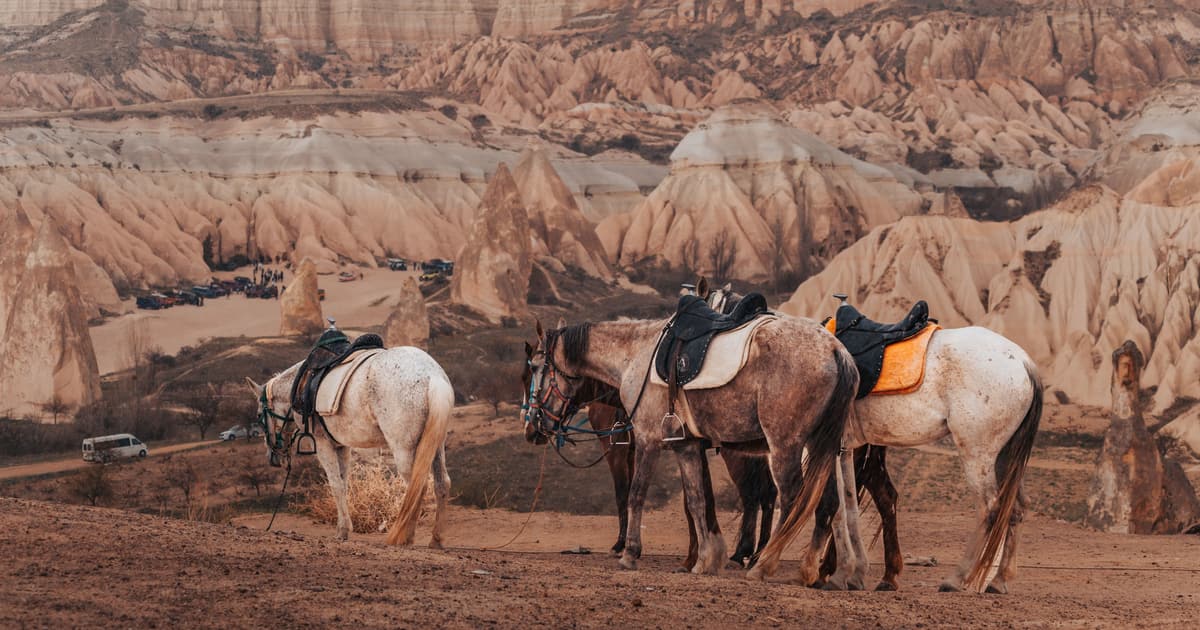
Cappadocia horse riding takes a rider through valleys of soft volcanic rock at dawn or dusk. This post covers the ride, the valleys, the rock, the horses, the seasons and the booking rules. The homepage lists more Greece Tours for the Greek islands.
Every tour card below opens a live GetYourGuide booking. Pickup points and group sizes are shown on each card.
What happens on a Cappadocia horse riding tour from the stable to the trail?
The guide meets riders at the stable and gives a short safety briefing. Helmets are provided, and each person meets a horse. On one format the sunrise and sunset rides on a Cappadocia horse riding route last two hours.
The outing starts before the stable. One format begins the tour with a hotel pickup in Goreme, Avanos, Cavusin or Uchisar. The pickup town depends on the option chosen. Another two-hour format names the centre of Goreme town as its meeting point. The map link arrives after booking. Riders are asked to arrive ten minutes early.
After the ride, the homepage lists Turkey tours for Cappadocia, Istanbul and the coast.
On arrival the instructor introduces the activity and explains the main details of the route. Riders then meet their horse and the guide at the starting point. The first minutes on a Cappadocia horse riding outing are talk, not riding. One format adds time to get comfortable with the horse.
Helmets and a short safety briefing come before the ride on the two-hour format that meets in Goreme. Another format lists disposable caps and helmets among its safety measures. The guide explains how to control the horse before the group sets off. A third format adds a demonstration of horse handling, safety gear and basic riding techniques.
No riding experience is needed for the two-hour ride that starts in Goreme town. The team keeps the pace comfortable and beginner-friendly. Another format describes a calm and steady pace through the landscape. A third format has the guide demonstrate how to ride properly and make sure everyone feels comfortable and safe.
Time in the saddle on a Cappadocia horse riding format depends on the option. The sunrise ride lasts two hours on one format, and the daytime ride varies. Another format sells a one-hour ride at a chosen daytime. The listing with sunrise and sunset options gives a range from one hour to two and a half hours.
One format counts about seventy minutes in the saddle. That time sits inside a total of two to three hours, which includes the transfers and the stops. On this format the day starts with a hotel pickup, and vehicles take riders to the stable. So saddle time and outing time are two different numbers.
The group on a Cappadocia horse riding departure is small on one format, and the setting allows personal attention. Another format requires a minimum number of travellers. English is offered on the two-hour formats, and the guides on another format speak Turkish and English. The guidance on a third format comes from a professional horse rider.
One format covers a guide, the ride itself and hotel transfers when the rider chooses them. Safety equipment is included on another, and a third adds insurance. Helmets, caps and mouth masks are handed out as equipment on one format. One format leaves out food and drinks, and another leaves out personal expenses and tips.
Couples and solo travellers share a day on a Cappadocia horse riding trail with first-time riders. That is how one format describes its riders. A second format names beginners and families with children. A third calls the outing ideal for families and friends. One more describes it as a relaxed way to see the landscape.
On the formats that include transfers, the outing finishes with a ride back to the hotel. One format gives pickups and drop-offs in Goreme, Avanos, Cavusin and Uchisar. That format runs only inside its listed pickup areas. Another lists the drop back to the hotel next to the guidance service and the equipment.
Which valleys lie along a Cappadocia horse riding route?
Rose Valley and Red Valley appear on the outlines of the sunrise and sunset ride formats. Sword Valley or Love Valley join them on certain formats. Rose Valley lies between Goreme and Cavusin, a stop along a Cappadocia horse riding trail on one format.
The village of Goreme sits at the centre of a network of valleys. Around the village lies a national park of 9,884 hectares in Nevsehir Province. Certain valley stretches admit no vehicles, so walkers and riders on horseback reach them alone. Horseback routes there pass valley footpaths, fairy chimneys and village vineyards.
More about Cappadocia: Cappadocia Tour From Istanbul.
The shorter outline of the sunrise and sunset ride passes through Rose Valley and Red Valley and includes Sword Valley. Love Valley and White or Honey Valley are added depending on route and timing. The valley list differs from one format to the next along a Cappadocia horse riding tour.
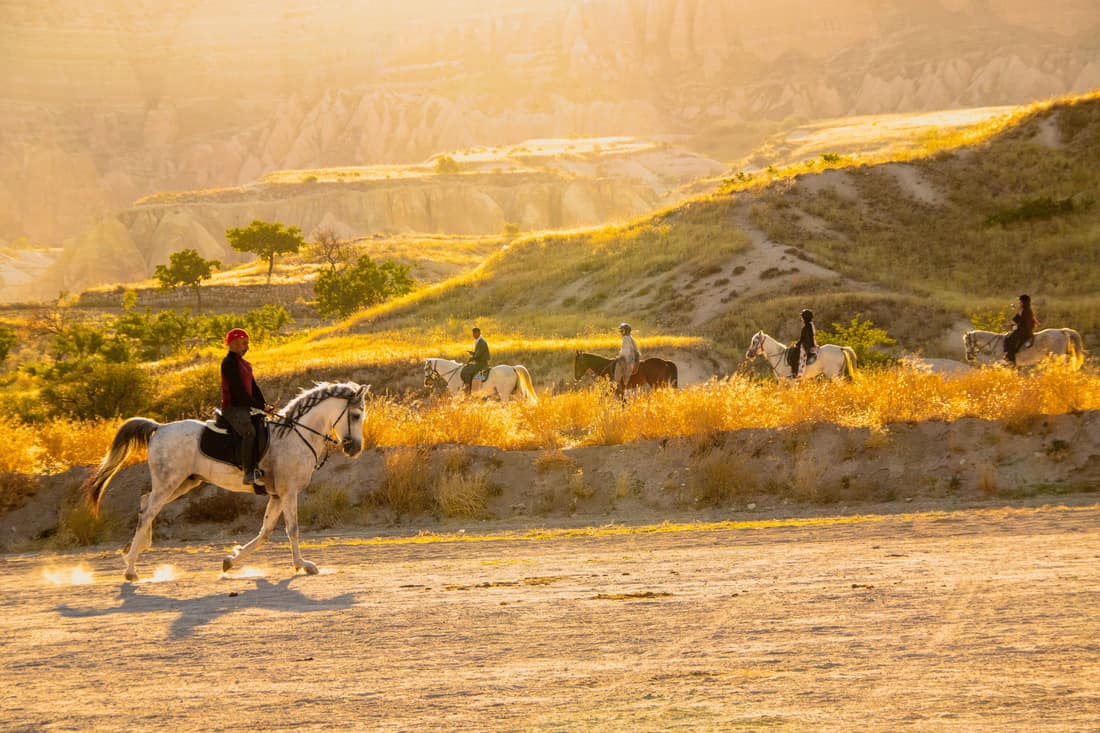
A longer outline of the same ride lists valley stops. Love Valley, Rose Valley and Red Valley each get a half-hour stop, and Cavusin village is named as well. Another safari outline mainly covers Rose Valley, Red Valley, Love Valley and Sword Valley along a Cappadocia horse riding circuit. That safari’s return leg passes apricot trees and small vineyards.
Rose Valley is called Gulludere in Turkish, and its walking trails cover about four kilometres. A legend ties the name to rocks that turn rose-coloured in sunlight. After a certain point the valley splits in two. Horseback tours pass through Gulludere and neighbouring Meskendir along a Cappadocia horse riding path.
Red Valley, called Kizilcukur in Turkish, lies near Cavusin village and Ortahisar. Red tuff makes rare formations there. A touring route between Goreme and Ihlara Valley names Kizilcukur too. One trekking route names Ak Valley at Uchisar, Love Valley, Gulludere, Kizilcukur, Meskendir, Gomeda Valley and Uzengi Valley.
Meskendir Valley measures four thousand metres, a walk of about three hours on foot. Wildflowers line its trails, which run through tunnels and passages towards Cavusin. The valley joins Red Valley and Gulludere. Birds such as nightingales and rock nuthatches live among its lush plants, and butterflies are plentiful in June.
Love Valley runs from Orencik on the Goreme-Uchisar road to the Goreme-Avanos road. It is 4,900 metres long, and a walking route there covers about five kilometres. It lies inside Goreme Historical National Park and also goes by Asiklar Vadisi and Ask Vadisi. Love Valley is a named stop along a Cappadocia horse riding track on the longer outline.
Sword Valley takes its name from the fairy chimneys that look like swords. Kiliclar Vadisi is its Turkish name. A tunnel more than 250 metres long runs through it. Walking tours and safaris both cross the valley. The shorter outline includes the valley along a Cappadocia horse riding excursion.
Zemi Valley takes its name from the Zemi Creek that flows through it. The valley is 5,600 metres long, and a relaxed pace takes about four hours. It runs from the Urgup-Nevsehir road to the Goreme-Ortahisar road. Fruit trees grow there: plum, mulberry, cherry, pear, apricot, sour cherry and seasonal hazelnut.
Pigeon Valley runs from Uchisar to Goreme and measures about four kilometres. A walk through it takes around two hours. Its name comes from the pigeon nests carved into the rock. A waterfall flows from fifteen metres up inside the valley. One safari outline treats Pigeon Valley as a separate sightseeing choice.
What lies beneath a Cappadocia horse riding trail?
Volcanic ash thrown out in ancient eruptions by Erciyes, Hasan and Gollu Dag hardened into a soft rock called tuff. The ground beneath a Cappadocia horse riding route is that tuff, carved by wind and water into cones and valleys.
Tuff is stone made of volcanic ash that a vent threw out during an eruption. Once the ash had settled, it turned into solid rock. The name sounds hard, yet tuff is a relatively soft stone. The pinnacles near Goreme are carved from a plateau of lava-covered tuff, a fine grained rock of consolidated ash.
Ignimbrite forms from a pyroclastic flow, a fast rush of hot ash and gas that runs down from a volcano. If the ash is hot enough when it lands, the grains weld into much tougher stone. Unwelded ignimbrite can stay fairly loose. Ignimbrites of Miocene age lie in the layers beneath a Cappadocia horse riding track.
The eruption deposits piled up on a high plateau. That plateau lies more than one thousand metres above the sea, and volcanic peaks pierce it. One of the sheets, the Valibaba Tepe ignimbrite, has been linked to Erciyes. That mountain is a stratovolcano. The final eruptions there took place in the early Holocene.
Repeated eruptions laid down a sequence of ignimbrite layers, one above the other. The hardened ash forms rock tens of metres thick. Only parts of the harder top layer remain. The ground beneath a Cappadocia horse riding landscape is therefore a stack of separate eruption sheets, not one solid block.
A related page on Cappadocia: Cappadocia Red Green Tour.
Ignimbrite is not one uniform stone. The Kavak ignimbrite is made of pumice with large crystals of biotite, plagioclase and quartz. In the region, a basal pumice layer called Esbelli Stone is valued as building stone because it resists erosion well. Softer layers give way to weather sooner.
Layers wear away at different speeds. Harder volcanic layers resist erosion, while softer deposits give way. A thin cap of hard rock shields the soft column under it. If the cap is undercut and falls, the column wears down quickly. Chimneys of this kind can stand as tall as a person or rise above a ten-storey building.
The ignimbrite plateau was cut apart, starting from cooling fractures. Channels in the surface deepened until they reached the softer strata below. Over millions of years, wind and water did this work. The ignimbrite beneath a Cappadocia horse riding path therefore ends in mushroom-like cones. The shape of each cone depends on the ignimbrite it was cut from.
Ignimbrite is grey to bluish grey overall, but weathering can turn it pale pink through iron oxidation. Minerals in different rock types can also colour one column in bands. In the Goreme and Zelve chimneys, the paler layers are the softer ones. The thick, colourful layers beneath a Cappadocia horse riding trip make the cliffs look multi-coloured.
River systems, old and modern, opened up valleys and deep gorges in that high ground. Green vegetation lines the waterways, and crops add more green against the earth tones of the rock. The tuff itself is ash from volcanoes that erupted millions of years ago. Over the millennia, weather eroded it into cliffs, rock towers and pillars.
Soft rock explains the carved rooms. Ancient populations used the ignimbrites to carve houses, churches and even underground cities. In the tuff, people cut windows, doors and curving stairways. The stone beneath a Cappadocia horse riding adventure is soft enough to hollow. Rock-carved spaces stay warm in winter and cool in summer.
Which horses come with a Cappadocia horse riding tour?
Beginner rides pair each rider with a calm, well-trained horse. A helmet comes with a Cappadocia horse riding booking on those rides. Turkey has more Anadolu horses than any other breed, and they range from 124 to 142 centimetres at the withers.
The horses on the beginner ride are gentle, well trained and suitable for beginners. The leaders adjust the pace as the group needs. A second ride, open to every level, matches each horse to the rider’s experience. A third picks calm, gentle horses and fits them to the rider’s temperament and size.
The locally bred horses on one valley ride are trained for its routes. They respond to gentle cues and know the trails. They also adjust their pace to each rider’s comfort without being pushed. Anyone who sets out with a Cappadocia horse riding party of that kind rides a horse that knows the path.
The Anadolu is a small Turkish breed of horse. Its jobs are riding, carrying packs and pulling light vehicles. One stable that runs valley rides pairs riders with an Anatolian or an Arabian horse. The Karacabey, bred from racing Arabians and native Anadolu stock, is listed as extinct.
Horse height is counted in hands, and one hand is four inches. The measure runs from the ground to the withers, the highest fixed point of the skeleton. A height of fifteen-two means fifteen hands and two inches. A pony is a horse of up to fourteen hands two inches, which is fifty-eight inches.
A gait is a pattern of leg movement. The walk has four beats, and the horse keeps two or three feet on the ground. At the trot the legs move in diagonal pairs, which makes two beats. The canter has three beats and stays controlled. A gentle pace comes with a Cappadocia horse riding route for beginners.
The ride built only for experienced riders adds trotting, cantering and galloping. Ambling gaits are smooth-riding four-beat patterns that appear naturally in certain horses. They run faster than a walk, and one foot bears full weight at any moment. In the Turkish horse game of jereed, rahvan is the normal four-beat walking gait.
Cappadocia also features in Cappadocia Hot Air Balloon.
A saddle is the rider’s seat, held on the horse’s back by a girth. Inside it, a solid tree spreads the rider’s weight along both sides of the spine. Every saddle that comes with a Cappadocia horse riding outing has to fit both horse and rider. A poor fit leaves the horse with uneven muscle.
Stirrups hang down on either side of the saddle and support the rider’s feet. They give the rider greater balance. A bridle is the gear that directs a horse. Its headstall holds a bit, which sits in the horse’s mouth. The reins are the rider’s link to the horse.
A horse’s eyes sit on the sides of its head, so it sees a range of about 350 degrees. It has two blind spots. One is a cone in front of the face that narrows to a point 90 to 120 centimetres away. The other lies right behind the head. Its eyes also work well in low light.
Horses are social herd animals and prefer to live in a group. Each ear can rotate up to 180 degrees, so a horse can listen all round without turning its head. Anyone who rides with a Cappadocia horse riding trail can watch the ears. Both ears forward mean the horse is concentrating on something ahead.
Which skills count for a Cappadocia horse riding tour?
Mounting, dismounting, a correct position, halting, walking, trotting and turning are the skills in the British Horse Society’s introductory award. The same skills count for a Cappadocia horse riding outing, and the format sets which of them a rider needs.
Rider level changes with the format, so the first choice for a Cappadocia horse riding departure is the pace. One format is designed specifically for beginners and first-time riders and keeps a gentle pace. A fast-paced two-hour format is exclusively for experienced riders and allows trotting, cantering and galloping.
The British Horse Society tells riders to avoid the labels novice, amateur, intermediate and experienced, because people read them differently. The same page speaks of being honest and truthful about your own ability. On a private two-hour format the horse is matched to the rider’s experience, so an honest answer at booking counts.
On one format a first-time rider is considered after the stable assesses whether the person can ride safely. The society’s first lesson has the instructor demonstrate the checks before mounting: the girth and stirrup length. The girth is checked a second time once the rider is in the saddle.
Horses used for novice riders are good-natured and quiet, according to the society. In a first lesson the horse is led round an arena on a lead rein and can stay in walk. The beginner format begins at a calm walking pace, a gentle opening for a Cappadocia horse riding trail.
The rider holds both reins in the left hand above the withers, then sets the left foot into the stirrup. The lesson plans stress landing gently in the saddle. Dismounting is the reverse of mounting, and the rider stays in control of the horse on the way down.
The lesson plans spend time on a balanced position. Equal weight sits on both seat bones, the shoulders stay level and the legs stay relaxed. A lower leg that swings too far forward or back changes the rider’s balance. That balance counts for a Cappadocia horse riding group too.
The legs and the seat are the main aids, and the hands speak to the horse through the reins. In the hunt seat style the rider keeps weight in the heels, soft hands and eyes up. The inside rein guides the horse into a turn, and the outside rein keeps the shoulders straight.
Halting is practised from the first lesson, and at that stage the rider uses the voice rather than the reins. Later the rider learns the rein aid for halt. It asks for a gentle hand and a gentle increase of pressure down the rein. Once the horse stops, the rider returns to a neutral rein.
On one format the ground for a Cappadocia horse riding route runs from flat paths to gentle inclines. On a steep climb the rider leans forward, which moves the horse’s centre of gravity forward. Coming downhill can be more challenging, so a rider can choose to get off and lead.
Horse comes up again in Naxos Horse Riding.
Fitness counts for a Cappadocia horse riding day, because a fit rider keeps balance and position more easily. Such a rider also gets less out of breath, says the society. One two-hour format suits all physical fitness levels. The fast-paced two-hour format asks for a high level of fitness.
Confidence is part of the skill set. A lesson plan of the society has the instructor check whether the rider feels in control and safe. The society also tells first-timers to listen, not rush, and take everything one step at a time. A rider can ask the instructor questions or report any problem.
What do you see at a Cappadocia horse riding sunrise start?
On one format riders see hot air balloons rise above the fairy chimneys as the sun comes up. The daily temperature low falls around dawn, so a ride at a Cappadocia horse riding departure starts in cool air.
The Sun is seen to rise in the east, an effect of the Earth’s spin. Sunrise is the moment when the upper rim of the Sun, not its centre, appears on the horizon. Atmospheric refraction lets people see the Sun while it is still below the horizon.
Dawn is the time that marks the beginning of twilight before sunrise. It starts with the first sight of lightness in the morning. Astronomical dawn begins when the centre of the Sun is eighteen degrees below the horizon. Clouds or haze can add bronze, orange and yellow tones to dawn.
Morning twilight lasts a little over seventy minutes at the Equator. The blue hour before sunrise lasts about twenty to thirty minutes at middle latitudes. Goreme town has been photographed during the blue hour just before sunrise. The horses at a Cappadocia horse riding stable on one format set off as the first light appears.
Sunrise rides differ in length. One format runs ninety minutes, and another runs two hours. A third gives a range of around one to two hours. Riders at a Cappadocia horse riding trail on the ninety-minute format watch the sunrise from the saddle. Another format times the ride for sunrise or sunset to catch the light and the views.
In temperate latitudes sunrise arrives earlier each day from late winter until shortly before midsummer. It then drifts later until shortly after midwinter. The tilt of the Earth’s axis and the shape of its orbit explain these shifts. Riders at a Cappadocia horse riding tour see the Sun rise earlier or later as the seasons turn.
On the sunrise rides of one format the guide stops at scenic viewpoints for photographs. That format keeps the focus on riding, not on long sightseeing breaks. Another format lists photo stops along the way. On a third format riders watch the sun climb over the valleys.
The daily peak comes after noon, and the coldest hour comes substantially after midnight. Long-term figures from the Turkish State Meteorological Service cover Nevsehir. They give a mean lowest temperature of 11.7 degrees Celsius for June, 13.6 for August and 10.5 for September. Riders at a Cappadocia horse riding session that starts at dawn meet air near those lows.
A cold-air pool is an accumulation of cold air in low ground such as a valley or basin. Cold air forms on slopes at night, flows downhill and collects in the low ground. Cold-air pools form on clear nights with calm winds. Daytime heating breaks them up.
One format describes the sunrise ride as peaceful. On another format the pace at a Cappadocia horse riding outing is slow, a walk rather than a fast gallop. A walking horse averages about seven kilometres per hour. On yet another format the terrain varies from flat paths to gentle inclines.
Horses are not particularly vocal, but they have four basic calls. A neigh is a loud call that can be heard from a great distance. Horses use it mainly to call other horses they cannot see. Horses also nicker around people they like, a sign of contentment. They make sighing, grunting or groaning noises at times.
What changes during a Cappadocia horse riding sunset ride?
The low Sun shines through a thicker layer of air, so the sky turns orange and red. Shadows grow longer during a Cappadocia horse riding outing at sunset. On one format the light fades as riders head back.
Sunset is the end of the Sun’s daily path, when it drops below the horizon because Earth rotates. At the spring and autumn equinoxes it sets due west. One sunset format sets off in time to reach the viewpoints before sunset, and another is timed for golden-hour light. Both are built around the Sun during a Cappadocia horse riding route.
Readers interested in Cappadocia can open Fethiye to Cappadocia Tour.
The hour before sunset has a name, the golden hour. Daylight in that hour has a redder, softer tone than the light of a high Sun. The low Sun also stretches shadows, and the lower contrast keeps them less dark. Longer shadows lie across the valley floors during a Cappadocia horse riding trail that runs in this light.
One sunset format builds golden-hour photography into the pace of the ride. Another gives time to capture the changing light and the rock shapes before riders move on along the trail. On the first format the sky shifts through oranges, reds and purples. A third paints it in orange, pink and red as the Sun dips below the horizon.
The colours come from the path the light takes. Low sunlight crosses a thicker layer of air. Air molecules scatter the shorter blue and green wavelengths away almost completely. Red and orange reach the eye, and clouds can catch that reddened light and light up the horizon. That is the sky above riders during a Cappadocia horse riding evening.
Red Valley is named as the standout sunset spot, where the sky takes on crimson tones. On one ranch-based format the same route shifts to cooler pinks and deep shadow at sunset. Two other formats describe warm rock hues that change with the light, and valleys that flush pink and red.
Once the Sun is gone, a broad arch of pinkish light called the afterglow hangs in the twilight sky. Opposite it lies the belt of Venus, a pinkish glow that reaches roughly ten to twenty degrees above the horizon. A dark band, the shadow of Earth, separates that glow from the horizon.
Twilight is the light the sky itself scatters while the Sun is below the horizon. Its length depends on latitude and the time of year. The faintest stars the naked eye can see appear at astronomical dusk. On one format, stars begin to show at twilight while Goreme and Uchisar Castle stand as dark outlines.
One sunset format says evening temperatures can drop quickly after sunset. It advises a light jacket or fleece that comes off easily while riding. The same format is timed to arrive at its key viewpoints during sunset. Riders meet that drop during a Cappadocia horse riding tour on that format.
One format calls the sunset ride a peaceful close to the day. On another, the ride starts at sunset. Riders return to the starting point as the last rays of sunlight fade from the sky. The light keeps shifting during a Cappadocia horse riding trip of that kind.
On a ranch-based format riders dismount and rest briefly before the vehicle leaves for the hotel. Another format returns riders to the starting point or to a pre-arranged place. The British Horse Society does not recommend going out at night or in poor visibility. It recommends hi-vis clothing and lights whatever the time of day.
Which sights stand near a Cappadocia horse riding route?
Fairy chimneys, rock-cut churches, dovecotes and the sixty-metre rock of Uchisar all stand near a Cappadocia horse riding trail. People carved rooms into the cliffs, so chapels, houses and bird houses sit inside the rock beside the valley paths.
Fairy chimneys are the first sight in the valleys around Goreme. Another name for them is hoodoo. They range from the height of a tall person to more than a ten-storey building. In Cappadocia, people carved houses into these formations. Devrent has three adjacent chimneys named father, mother and child.
Rock-cut churches are the next sight near a Cappadocia horse riding track. Byzantine church building shaped them all. A cross-shaped plan with one or more domes or barrel vaults is one standard layout. UNESCO describes the rock-hewn sanctuaries of the Goreme area as unique evidence of Byzantine art.
Underground churches in the Goreme area were richly decorated with coloured paintings. The simpler cave churches around Goreme village include examples from the sixth and seventh centuries. Cave homes in the same area go back even further, to at least the third century.
Cappadocia Tour From Antalya covers Cappadocia too.
Dovecotes are bird rooms carved into the cliff walls near a Cappadocia horse riding path. They are designed like rooms, made by carving the rock. Pigeon Valley, between Uchisar and Goreme, has them in its sides. In places, painted entrance holes added colour, and the colour attracted birds that then nested inside.
Pigeons were kept for their eggs and dung, and dovecotes are also found in ancient Iran and Anatolia. Farmers used the droppings as fertiliser, and the guano went on fields into the nineteen-seventies. Keepers reached the cliff rooms once a year, by difficult climbing. Old holes became dovecotes when people cut nest niches and walled up the entrances.
Homes cut from rock and homes built of stone both stand in the villages near a Cappadocia horse riding stop. Ground-level caverns in the castle rocks were built into the houses in front of them. The caverns served as stables and storerooms. In Uchisar, the old stone houses include ones with carvings on their facades.
Uchisar village borders Goreme National Park and lies near a Cappadocia horse riding trek through the valleys. A castle-like rock formation, sixty metres high, dominates the village and can be seen from far away. Its summit is the highest lookout for a panoramic view of Cappadocia, with Goreme, Ortahisar and Pigeon Valley in sight.
Zelve is the largest of the cave settlements. It lies ten kilometres from Goreme on the Avanos road, near a Cappadocia horse riding tour area. Two of its three valleys are joined by a tunnel. The valleys hold houses, dovecotes, a mill without sails and pointed fairy chimneys. Balikli and Uzumlu are the important churches there.
Cappadocia has three main castles: Uchisar Castle, Ortahisar Castle and the Urgup Kadikalesi, also called Temenni Tepe. Uchisar and Ortahisar are described as castle-mountains. Ortahisar means middle fortress, and the name comes from the rock fortress rising at the centre of the settlement.
Rock-cut houses were lived in during the twentieth century. Zelve was lived in until the nineteen-fifties, when villagers moved to nearby Aktepe because of safety concerns. The town of Goreme is the centre of a network of valleys with rock formations. In nineteen eighty-five UNESCO placed the park and its rock sites on its World Heritage List.
What can you add after a Cappadocia horse riding tour?
Add Goreme, the Goreme Open Air Museum, Uchisar Castle, Cavusin, Avanos or Urgup after a Cappadocia horse riding route ends. Uchisar Castle is a rock formation sixty metres high. Cavusin lies about five kilometres north of Goreme on the road to Avanos.
Goreme belongs to Nevsehir District in Central Anatolia. The village stands within Goreme National Park, a site UNESCO inscribed in nineteen eighty-five. Residents have cut homes into the rock here from at least the third century. Goreme also holds more painted churches, hermitages and monasteries than any other place in Cappadocia.
The Goreme Open Air Museum is a monastic complex cut into the rock. Monastic life filled Goreme from the fourth century AD to the thirteenth. Nearly every block of rock held a church, a chapel, a refectory or a sitting area. The museum stands in Goreme itself, which suits a stop after a Cappadocia horse riding session.
Painters worked on these churches in two ways: straight onto the bare rock, and in fresco-secco, a tempera method. Their subjects come from the Bible and the life of Jesus Christ. Frescoes of the Dark Church rank among the finest in the whole museum. The Serpent Church and the Elmali Church also stand there.
Uchisar Castle is a rock formation sixty metres high, and it is visible over a wide distance. The name Uchisar means outer citadel in Turkish. Passages and rooms run through the rock below, and Byzantine residents lived in them. The summit offers views, a stop to add after a Cappadocia horse riding outing.
Uchisar lies seven kilometres east of Nevsehir, twelve kilometres west of Urgup and ten kilometres south of Avanos. An old village huddles around the base of the rock cone. A second village lies closer to the road from Nevsehir town to Goreme. Ortahisar Castle and Urgup Kadikalesi on Temenni Tepe are the other two main castles of Cappadocia.
Avanos lies beside the Kizilirmak, which is Turkish for Red River, eighteen kilometres north of Nevsehir. Pottery leads the town’s trade, and its clay comes from red silt of the same river. The Kizilirmak is the longest river flowing entirely within Turkey. A pottery visit suits a break after a Cappadocia horse riding day.
For more on Horse, see Santorini Horse Riding.
Cavusin is a village in Avanos District, on the road between Avanos and Goreme. The old quarter stands on a broad rock ridge, and villagers were rehoused in the early nineteen sixties. Two rock-cut churches there are named after St John the Baptist. Both churches suit a stop after a Cappadocia horse riding trail.
Pasabag, also called Monk’s Vineyard, lies about one kilometre off the Goreme-Avanos road to Zelve. The chimneys there end in sharp points and rise on thick trunks. Zelve spreads across three valleys, and a tunnel links two of them. Monks used the valleys as a retreat from about the ninth to the thirteenth century.
Urgup lies in Nevsehir Province and has a wine-growing industry beside its tourism. The town centre clusters around a rock formation called Temenni Tepesi, or Wish Hill. The Three Beauties formation stands on the outskirts, towards Goreme. Visitors use the town as a base for rock-cut churches, a plan that works after a Cappadocia horse riding excursion.
Testi kebabi, the earthenware-jug kebab, is cooked in a jug called a testi instead of a casserole. The dish is found in Central Anatolia. Turkish tea is served in tulip-shaped glasses with small cubes of beet sugar. Milk is almost never added. The tea comes from Rize Province on the Eastern Black Sea coast.
How does the weather change across a Cappadocia horse riding season?
The plateau stands over 1,000 metres high, so summers are hot and dry while winters bring cold and snow. The weather swings widely across a Cappadocia horse riding year. At Nevsehir the mean daily high is 28.7 degrees Celsius in August and 4.0 in January.
An inland position and that height give Cappadocia a markedly continental climate. Nevsehir town stands at 1,224 metres. Rain is sparse, so the region counts as largely semi-arid. Every monthly figure below comes from the Turkish State Meteorological Service and its long record for the Nevsehir station.
Winter holds the cold end of the range across a Cappadocia horse riding route. The mean daily low is minus 3.6 degrees Celsius in January, minus 2.6 in February and minus 1.3 in December. March sits just above zero, at 0.7. The coldest reading on record is minus 23.6, taken in February.
Snow falls on the plateau in winter, and the highest snow record at the Nevsehir station is 64 centimetres. Snow brings its own horse problem: it can clump and freeze under the hooves into large balls of ice. The RSPCA gives that warning for horses in general. December records 48.4 millimetres of precipitation.
Freezing weather also hardens the ground. The British Horse Society advises a softer surface and a slower pace, mostly walking, to avoid concussion. It adds that ice and frost cause hazards and warns against riding out in slippery conditions. That advice fits a frozen morning across a Cappadocia horse riding day.
Spring warms the plateau slowly. The mean daily temperature is 5.0 degrees Celsius in March, 10.2 in April and 14.5 in late spring. The late spring month is also the wettest of the year, with 57.9 millimetres of rain. April brings 50.2 millimetres, and March has about thirteen rainy days.
One riding operator names April, late spring, September and October as the months with mild temperatures. Across a Cappadocia horse riding trail, the mean daily high is 16.0 degrees in April and 20.6 in late spring. It is 24.5 in September and 18.3 in October. The April mean low is 5.1.
Summer is the warm, dry end of the range. The mean daily high is 28.5 degrees Celsius in July and 28.7 in August. The hottest reading on record is 39.5. Rain is scarce, with 9.4 millimetres in July and 8.4 in August. August has fewer than two rainy days.
Summer light lasts long, with 11.9 hours of sunshine a day in July, against 3.1 in January. The British Horse Society suggests keeping horses in a cool, well-ventilated stable through the hottest part of the day. It also recommends shade. Exercise in hot weather also raises the water a horse needs across a Cappadocia horse riding tour.
Autumn cools the plateau fast. The mean daily temperature falls from 17.3 degrees Celsius in September to 12.1 in October and 6.7 in November. Rain returns, with 28.0 millimetres in October and 34.3 in November. Two single-day records stand out. The station logged a fastest wind of 34.8 metres per second and a heaviest daily rain of 40.7 millimetres.
Another page that includes Cappadocia is Cesme to Cappadocia Tour.
Clothes follow the season. For cold months the NHS advises layers, a hat, gloves, a scarf and sturdy footwear against slips. For strong sun it advises a wide-brimmed hat and close-weave trousers. One riding format lists its season as all year round, so both wardrobes fit across a Cappadocia horse riding outing.
Which safety steps come before a Cappadocia horse riding tour?
A fastened helmet, shoes with a small heel, sun and water care and a health check come first. Falling from the horse is the commonest injury, so these steps matter before a Cappadocia horse riding outing starts.
Riding helmets substantially lower both the likelihood and the severity of head injuries. A helmet works by crushing on impact, which lengthens the time the head takes to stop moving. Kicks, trampling and bites rank after falls on the injury list. That is why the helmet goes on before a Cappadocia horse riding departure.
A helmet has a hard shell on the outside. Beneath it sit materials that absorb the impact of a fall or blow. A hat must fit properly and be fastened every time a person rides. Each drop or knock can lessen the protection, so a hat is replaced after a fall.
Riding boots preferably have an unbroken smooth sole from heel to toe, plus a small heel. That way nothing catches on the stirrup. Without it, a falling rider can be dragged along. Wellies and trainers are unsuitable for riding. Pack shoes of that kind before a Cappadocia horse riding day.
Strong trousers without a seam on the inside leg suit beginners, because seams can pinch the leg in the saddle. A jacket is fastened so it does not flap. Long hair is tied back, and jewellery is kept to a minimum. Gloves help a rider keep a grip on the reins.
Avoid approaching a horse from behind. An angry horse gives warnings first, such as ears laid flat against the neck or a lifted hind leg. A horse whose warnings are ignored can kick. Approach from the side, walk towards the horse and talk gently. Keep these habits in mind before a Cappadocia horse riding group sets off.
Tack is checked for safety and comfort before anyone mounts: saddle, bridle, girth and stirrups. Riders mount from a block, land gently in the saddle and keep their feet in the stirrups during adjustments. At the end, riders dismount safely, run up the stirrups and loosen the girth.
Look for a sun protection factor of at least thirty against UVB and at least four-star protection against UVA. Reapply sunscreen every two hours, because the sun can dry it off the skin. Sunscreen alone is not enough, so clothing and shade matter as well. Apply the first layer before a Cappadocia horse riding trek begins.
Sweating in hot weather or during exercise raises the risk of dehydration. Heat exhaustion brings heavy sweating, pale clammy skin, cramps and thirst. The first aid is a cool place and water. Heatstroke brings a very high temperature, hot skin without sweating and confusion, and needs immediate medical help.
Hay fever is an allergy to pollen that causes sneezing, coughing and itchy eyes. Symptoms tend to be worse between late March and September, especially when the air is warm, humid and windy. Wraparound sunglasses, a mask or petroleum jelly around the nostrils help keep pollen out.
On the sunrise or sunset format, riding is not recommended in pregnancy or with back problems. In pregnancy, activities with a risk of falling are avoided, and a midwife can advise. Back or knee pain that does not improve calls for a GP visit. If any of this applies, ask a doctor before a Cappadocia horse riding excursion.
Travel insurance covers unexpected losses on a journey, and it can spare a traveller large medical bills in an emergency. Policies differ by destination and insurer, so check that yours covers horse riding. Hazardous sports can fall outside cover. Providers can cover declared health conditions, so tell the insurer about them.
Crete Horse Riding covers Horse too.
How is a horse looked after around a Cappadocia horse riding stable?
A looked-after horse gets forage, fresh water and daily grooming. World Horse Welfare puts the average gap between farrier visits at six to eight weeks. Riders can ask about these routines around a Cappadocia horse riding yard before booking.
Food and water come first. Forage forms the base of a horse’s diet, says the British Horse Society. Horses evolved to eat small amounts at short intervals. Forage keeps the gut healthy and lowers the risk of colic. A constant supply of fresh, clean water matters too, since water is the main nutrient for the body.
Feed follows the work a horse does. The same advice is to feed by bodyweight and workload, keep a steady routine and change feeds gradually. The advice is to wait one hour after a cereal-based meal before exercise. A rider can ask how feeding and ride times fit together around a Cappadocia horse riding outing.
Grooming is a daily health check as well as a clean-up. The handler looks for cuts, heat, swelling and lameness while the brushes work. The currycomb is the first tool, and a soft body brush removes finer dust and adds shine. Hooves are picked out before and after a ride, which also reveals a nail prick.
Hooves need steady attention. The hoof wall grows about one centimetre a month. A domestic horse does not wear it down enough, so people trim it. The RSPCA advises a daily look at each hoof, including picking out the underside of the foot. Overgrown or unbalanced hooves cause severe discomfort. Domestic horses do not always need shoes.
The stable itself is part of the care. A stable is big enough when the horse can turn round, lie down and get up comfortably. Good ventilation helps reduce dust and stops ammonia building up, and bedding is clean, absorbent and low in dust. A rider can look at these points around a Cappadocia horse riding barn.
Time out of the stable counts as much as time in it. World Horse Welfare questions exercising a horse for one hour and leaving it to stand in for the other twenty-three. Stabled horses also need daily turnout and social contact, says the British Horse Society. A view of other horses helps.
A poorly fitting or poorly maintained saddle can cause injury and welfare problems, says World Horse Welfare. A good fit lowers the risk of back pain. The fit is checked through the year, for the horse and for the rider. Visitors can ask about saddle checks around a Cappadocia horse riding base.
World Horse Welfare lists spooking, swishing the tail and tilting the head on its pain checklist for ridden horses. Biting or kicking as the girth is done up can be a sign. Lameness, back pain and poor saddle fit link to such behaviour. A rider can watch the horses around a Cappadocia horse riding route.
Rider weight is a welfare question for any horse, including one around a Cappadocia horse riding tour. In a pilot study of six horses and four riders, the tests with heavy and very heavy riders were abandoned. The main cause was temporary lameness. Rider skill, balance and saddle fit count too.
World Horse Welfare advises against using a horse that is obviously not up to the job. Poor body condition and lameness are its examples. It also advises against asking one horse to carry two people. The RSPCA adds that a lame horse is not worked and a vet is consulted.
When can you book and which rules sit behind a Cappadocia horse riding booking?
Sunrise and sunset slots can fill up quickly in peak seasons on the private horse tour format, so book ahead. The rules behind a Cappadocia horse riding ticket cover cancellation, age, weight and weather, and each format sets its own.
Booking starts with a check of open dates for the chosen day. One format emails a voucher. Riders display it on a mobile phone and carry valid photo ID to the starting point. A second format sends confirmation by email or text message. A third confirms at the time of booking.
Timing options come next. One listing names sunrise, daytime and sunset as its three ride options, so one page covers every start. Another listing accepts bookings up to six hours before the ride begins. A third offers a mobile ticket, and further details follow the reservation.
The cancellation terms behind a Cappadocia horse riding reservation differ between listings. Each format names a deadline in hours before departure, and the window is not the same everywhere. One format accepts no changes inside its window. Free cancellation before that deadline brings a full refund on the formats that state it.
More about Cappadocia: Marmaris to Cappadocia Tour.
A minimum-rider rule sits behind a Cappadocia horse riding departure on the formats that state it. On one valleys format the sunrise ride needs at least two riders to operate. Other formats ask for a minimum number of travellers. A ride cancelled for missing that minimum leads to a refund in full, or to another date or another experience.
Weather is the rule behind a Cappadocia horse riding day that can still change the plan. On one valleys format, routes can change on the day because of weather or operational conditions. A private three-day format states that the ride needs good weather. If poor weather cancels the ride, the rider can take another date or a refund in full.
The age line behind a Cappadocia horse riding seat is not the same on every format. One format asks riders to be fifteen or older, and another sets eleven. A third admits children aged ten and over. One bars children under six for safety reasons, and a further listing asks for seven years.
Weight limits differ too. One format sets a top rider weight of 90 kilograms. Another says guests over 130 kilograms cannot join the ride. A third does not allow travellers of 110 kilograms or more. One listing states no specific weight restriction. On the formats with a limit, a rider above it cannot join, so check the limit before booking.
Group rides and private rides are sold as separate options. One listing is titled a private guided tour. Its page invites riders to contact the operator about a private option. A three-day private horseback tour is a listing of its own. One booking site sorts experiences by private tour, guided tour and smaller group size.
A short packing list sits behind a Cappadocia horse riding plan. Comfortable clothing suited to riding and the weather comes first, with closed-toe shoes or sneakers. Sun cream and sunglasses protect against the sun on the listings that name them, and one list adds a camera. A phone with the voucher and a photo ID completes the kit.
Access is a booking rule too. One listing states that its tours are not wheelchair accessible, while service animals are allowed. The same listing asks riders to be in good physical health. Each of these limits belongs to a single format, so the terms on the page of the chosen ride decide.