Crete horse riding is a guided outing on horseback on the island. You ride with a guide on trails, tracks or sand. This post covers the formats, the routes, the rules for riders, the season and the booking rules. The homepage lists more Greece Tours like this one.
Each tour card below opens a live GetYourGuide booking. Dates, start times and group sizes are shown there.
What is Crete horse riding?
Crete horse riding takes you across the island on horseback, with a guide or an instructor in charge. The format fixes the length. Lengths run from a short lesson to a mountain ride that ends with a Cretan meal.
Crete horse riding covers a range of outings, not one tour. Length, rider level and group size change from one outing to the next. The formats include countryside trails, mountain rides, beach rides, a coastline ride, a private lake ride and lessons. The paragraphs below take them in turn.
If you plan to cross into Turkey as well, the homepage also lists Turkey tours.
Crete horse riding includes a one-hour countryside trail on gentle, well-kept paths. The trail is open to riders of all levels, from a novice to an experienced rider. Guides give a short orientation and check that every rider feels comfortable and safe. The pace is set for the least experienced rider in the group.
The mountain ride lasts two hours and welcomes beginners, medium riders and advanced riders. A short break at a scenic spot splits the ride in two. Crete horse riding in the mountains begins at the farm. There the guide runs a basic training session so you feel safe on the horse.
A longer mountain format adds a meal. The ride takes about two hours in the saddle. It climbs to a break at the top, then returns to the stables. A Cretan lunch with homemade wine follows at the farm. The outing is sold as lunch or dinner, and one version is a full-day adventure.
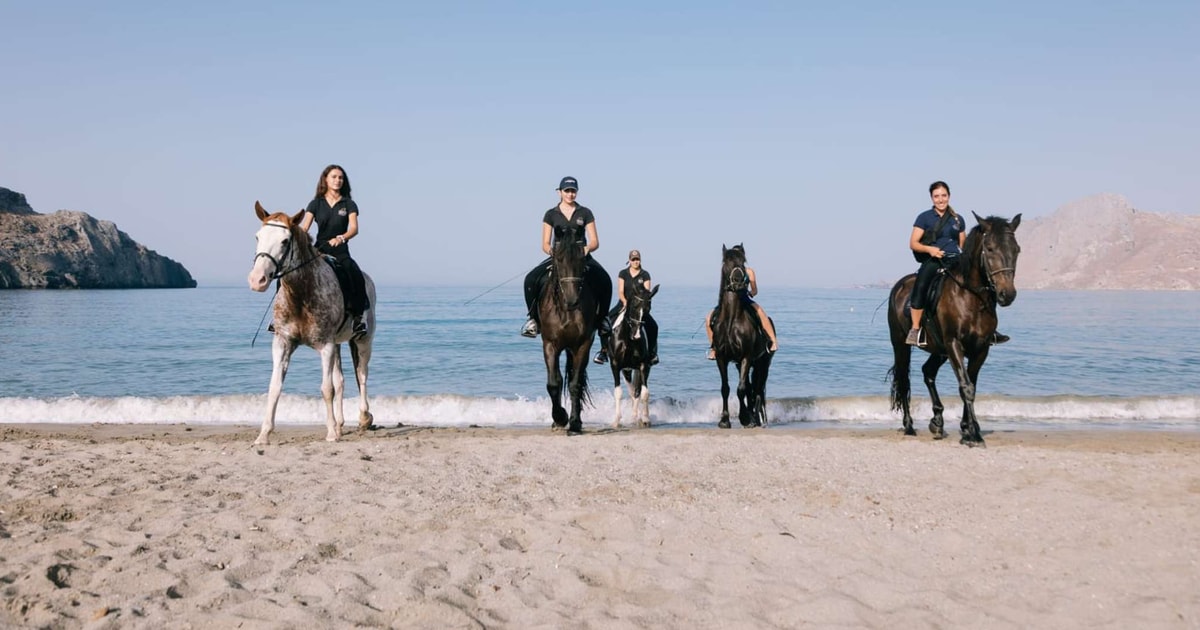
Crete horse riding also includes a two-hour beach ride that runs only in the early morning. The group is limited to six riders, for personal attention and safety. The ride suits beginners and intermediate riders. The guide speaks Greek and English, and the pace follows each rider’s skill.
The coastline ride is shorter, at about an hour and a half. The group is capped at six riders. Beginners and experienced riders both join it, and safety gear comes with the ride. The guides speak English and Greek and add local insights along the way.
Crete horse riding can also be private. On the ride to a lake, the outing belongs to your own party. Before you mount, you meet your horse and learn basic riding techniques, with time to build trust. During the ride you can step down to rest or take photos.
The riding lesson comes in two lengths, 30 or 45 minutes. You pick the one that fits your day. It suits all levels, and families are a good fit. The instructor adjusts the session to your skill and covers a brief safety briefing, basic riding techniques and practical tips.
On the day, the guide takes care of the horse, the briefing and the helmet. On the two-hour panorama ride, instructors assign each horse by rider experience, height and weight. The beach ride makes a helmet mandatory, and the mountain rides include helmets. Lesson horses are matched to your ability.
In Crete horse riding, the format fixes the length, and you pick the format. Riding pace depends on the rider’s skill or preference. On the panorama ride, the levels offered are novice, intermediate and advanced. Families can choose the lesson or the mountain ride with a meal.
Where does Crete horse riding go across the island?
Crete horse riding runs through the Finikia hills near Heraklion and the olive groves around Plakias on the south coast. A private ride follows the shore of Lake Kournas. Trails climb to hilltops with views of mountains and sea.
Near Heraklion, the Finikia mountains form the main riding ground. Riders set out from a farm, follow mountain paths up to a summit and stop there for a break. They return to the farm by a scenic descent. Heraklion is the largest city on the island and its capital.
The Finikia trek is gentle in pace and rugged in setting. It passes olive groves and mountain paths, with shaded groves along the way. Narrow tracks and quiet trails reach places that a car cannot. The summit stop is the main rest point of the ride.

From the summit, the view runs toward Archanes. The mountain ride adds Mount Juktas and Agios Silas village to its views. Juktas rises 811 metres above Archanes and lies south of Heraklion. The break on the lunch ride brings a soft drink or fruit, and the mountain ride adds photo stops.
Crete horse riding on the Heraklion side meets at the Finikia farm. The lunch or dinner ride adds group transfers from points in Heraklion, Malia and nearby areas. Another lunch ride lists hotel pickup in Analipsi, Anissara, Hersonissos, Gournes, Gouves, Kokkini Chani, Malia and Stalis. The mountain ride does not include pickup, so guests meet at the farm.
Plakias lies on the south coast of Crete, in the Rethymno regional unit. Mountains stand to its north, and the Libyan Sea opens to the south. Crete horse riding here starts at a riding centre in Damnoni. Transfers to the centre are not included on the panorama and coastline rides.
The beach ride heads west from the centre through olive groves toward the sandy beach of Plakias. As soon as riders reach the coast, they canter along the shoreline. On this ride the pace depends on the rider’s skills or preference.
The panorama ride turns north-west, toward the hillside between Myrthios village and Plakias beach. Crete horse riding on it includes a canter along an old water channel through olive groves. Riders reach the hilltop above Plakias. From there they see Plakias, the surrounding villages and mountains, and the Libyan Sea.
The coastline ride starts at the same centre and leads eastward along the coast. Crete horse riding on this route passes olive groves to Damnoni beach. It then goes past the small beaches of Ammoudaki and Klissidi. The pace is relaxed, and the views take in the coast and the Libyan Sea.
Lake Kournas has its own private ride. Crete horse riding there follows trails and the shoreline, and the group is your own party. The pace follows the route. Riders trek gently on the Finikia paths and canter beside the water channel above Plakias. They also canter along the Plakias shore.
What do riders need to know before Crete horse riding?
Crete horse riding sets its own limits on each ride: a minimum age, a weight cap and health rules. Riders wear long trousers and closed shoes, and an instructor matches each horse to the rider. Read the terms of the ride you book.
Crete horse riding has no single age rule. The countryside, panorama and ride-and-swim outings take riders from six years. The east-coast ride turns away children under 110 centimetres in height. One mountain ride takes children from six years. The countryside ride with lunch lists no age figure, but children must come with an adult.
Weight limits differ by ride. The countryside ride with lunch and the Cretan mountain ride set the limit at 110 kilograms. The east-coast ride, the one-hour countryside ride and the riding lesson stop at 120 kilograms. The mountain ride that takes children from six years caps riders at 90 kilograms.
Experience needs vary by ride. The countryside ride with lunch needs no prior riding, and basic riding training comes first. The east-coast ride suits all levels, including beginners. The lesson format of Crete horse riding teaches novices the basics and helps experienced riders refine their technique.
Clothing rules are plain. The one-hour countryside ride, the ride-and-swim outing and the lesson require long trousers and closed-toe shoes. The Cretan mountain ride asks for the same and bans high heels. The countryside ride with lunch asks for comfortable shoes and clothes suited to riding.
Health rules are set ride by ride. Pregnancy rules out the Cretan mountain ride, the east-coast ride, the one-hour countryside ride and the lesson. It is not recommended on the countryside ride with lunch either. Back problems rule out the lesson. On the ride-and-swim outing, riders must disclose medical conditions, injuries or limits.
Instructors match each horse to its rider. On the countryside, panorama and ride-and-swim outings, riders give honest figures for height, weight and experience when they book. Instructors then assign each horse from those three points. On the countryside ride with lunch, guides pair each rider with a horse suited to that rider’s experience.
A briefing comes before the first step. On the countryside ride with lunch, riders fill in a safety form. They have their weight checked on site and take a basic riding lesson. On the 90-kilogram mountain ride, riders first receive a brief explanation and their equipment. Riders must follow every instruction from instructors and staff.
Inclusions differ from ride to ride in Crete horse riding. The countryside ride with lunch includes riding helmets and insurance, and riders are greeted with coffee or tea. The Cretan mountain ride includes helmets, insurance, orange juice and fruit. The lesson includes helmets and riding gear.
Booking terms for Crete horse riding differ too. On the countryside, panorama and ride-and-swim outings, free changes and cancellations end three days before the start. A fee applies after that. On the 90-kilogram mountain ride, a full refund needs a cancellation at least one day ahead. If the riding centre cancels a trip, it offers another date.
Welfare guidance for riding horses in hot weather applies to Crete horse riding too. Horses need plenty of clean drinking water and access to shade. Hot weather calls for short rides with frequent water breaks. Above 25 degrees Celsius, horses risk heat stress. One riding centre can change or cancel an activity to protect horses from heat and fatigue.
How does the season shape Crete horse riding, and what do you pack?
Crete horse riding is possible all year. Coast and mountain rides are particularly worthwhile from late March to early November. Summer rides move to cool morning or evening hours, and weather can reschedule a ride, so pack for sun.
Winter rain draws the line around the season. Heraklion gets rain on about ten days in both December and January, while almost none falls from June to August. Crete horse riding in summer meets dry weather and clear skies.
Air temperature changes a great deal across the months. Daily highs in Heraklion sit near 15 degrees Celsius in January and close to 20 in April. October stays above 23, and July and August sit around 28 to 30. The sea stays under 18 degrees from January to April.
The sun is strong long before midsummer. Heraklion gets about eight hours of bright sunshine a day in April and about twelve in July. The UV index is rated high in April and very high in September. Crete horse riding in July meets a rating of very high or extreme.
The meltemi is the wind to know. Over the Cretan Sea it comes from the north-west. Its season covers late spring, summer and the first half of September. Afternoons bring the strongest gusts, and nights are calmer. It makes the summer heat easier to bear and can roughen the sea. The southern coast is more sheltered.
Morning and evening slots split the day. One lunch ride near Heraklion starts at nine o’clock in the morning or at six in the evening. The Plakias beach ride runs only in the early morning, away from heat and crowds. A multi-day trail programme on Crete rides in the cool morning or evening in hot summer months.
Crete horse riding at sunset follows the light. One sunset ride is set around the sunset, with the golden hour for photos. In Mália the latest sunset falls around twenty to nine in the evening in late June. The earliest comes around five past five in early December. The clocks go back in late October.
Weather can move a Crete horse riding slot. On the lunch ride near Heraklion, slot, pace and length can change for the horses’ welfare and the guests’ safety. The mountain ride from the farm can be rescheduled. The Plakias beach ride depends heavily on the weather, and the provider sends updates by email or message.
Book early for the lunch rides near Heraklion. Weekends, public holidays and the high season call for early booking. One lunch ride is booked about a month ahead on average. Live availability sits in the booking cards on this page. A morning start and an evening start are easy to compare there.
Getting to Crete horse riding needs a plan. On the lunch-or-dinner ride, hotel pickup is optional and you ask the provider a day ahead. Pickup is limited and not guaranteed for last-minute requests. On the mountain ride and the Plakias rides, transfers are not included. You travel to the farm or the riding centre yourself.
Pack for the sun, the saddle and a cool evening:
- sunscreen and a sun hat
- sunglasses
- water and a camera
- long trousers and closed-toe shoes
- a light jacket for the evening