
A Pamukkale tour from Antalya is a one-day trip inland to the white terraces and the ruins of Hierapolis. This post covers the day, the terraces, the ruins, the Antique Pool, the road and the booking rules. The homepage lists more Greece Tours for the Greek islands.
Every tour card below opens a live GetYourGuide booking. Pickup points and group sizes are shown on each card.
What is a Pamukkale tour from Antalya and how is the day built?
A long one-day run by coach or minibus takes guests from Antalya hotels to the white terraces and Hierapolis. A day on a Pamukkale tour from Antalya fills twelve hours on the small-group bus format. The drive takes about three hours each way.
Passengers on a Pamukkale tour from Antalya begin the day at their hotel. The private format collects guests between six and half past six in the morning. They reach the meeting point ten minutes early. The full-day group format picks up at quarter past six, and the exact hour shifts with the hotel area.
For more days in Turkey, the homepage lists Turkey tours across the old cities and the coast.
Day length differs from format to format. One small-group format fills a full twelve-hour day, with an early start and a late return. Another runs fourteen hours, with round-trip transport from Antalya. A fifteen-hour format brings guests back to their hotels between eight and ten in the evening.
Travellers on a Pamukkale tour from Antalya ride in an air-conditioned bus on the shared coach format. Its drive also runs around three hours each way. On the full-day group format, the return drive starts at four in the afternoon. Arrival in Antalya comes around eight in the evening.
On the private format, a scenic drive leads from the hotel to the travertine terraces. Hierapolis comes next, with the theatre and the cathedral in its stop list. Lunch follows the ruins, and the vehicle heads back to Antalya. The full-day group format names the necropolis and the Temple of Apollon.
Time on site is set on the small-group bus format. Guests on a Pamukkale tour from Antalya spend about an hour at the thermal pools. The Hierapolis ruins take approximately three hours. A buffet lunch is served in Denizli. The bus reaches Antalya around nine in the evening.
Entrance tickets on a Pamukkale tour from Antalya depend on the format. The private format, the full-day group format and one twelve-hour format include the entry fees. The small-group bus format and the shared coach format sell tickets separately, at the site. The Cleopatra Pool entrance is excluded on the private and twelve-hour formats.
The full-day group format serves lunch at a local restaurant, and drinks are not included. The shared coach format offers an open buffet, with drinks paid separately. One twelve-hour format adds a short onyx shop visit before the meal. A fifteen-hour format lists a textile factory and an onyx workshop.
For more on Pamukkale, see Pamukkale Hot Air Balloon.
Group size is set by the format. A private group on a Pamukkale tour from Antalya counts two to ten people. The small-group bus takes up to fifteen travellers, and the shared coach is limited to twenty-eight. English is the guide language on the private, group, fourteen-hour and fifteen-hour formats.
The shared coach format covers transport, guidance and meals. It fits guests who stay in Antalya and prefer an organised trip. The small-group bus format suits travellers who enjoy history and accept a long bus ride. That format fits less well for guests who want more time at each site.
What do the white terraces add to a Pamukkale tour from Antalya?
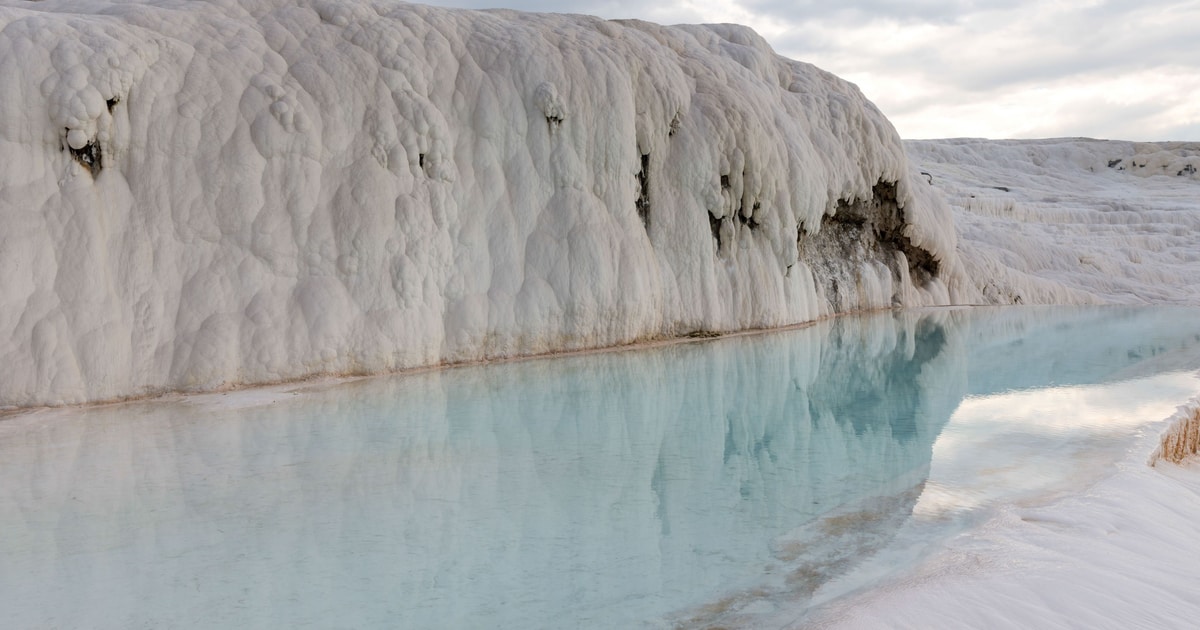
The terraces add a white staircase of pools that warm spring water built from calcium carbonate. Walkers reach those pools during a Pamukkale tour from Antalya. Spring water leaves the spring at 35.6 degrees Celsius, as the culture ministry records.
Pamukkale means cotton castle in Turkish, and UNESCO says the name comes from the white landscape itself. Hot springs in a cliff above the Curuksu plain feed that landscape in Denizli province. The Turkish culture ministry describes the white limestone as resembling piles of cotton.
Water from the spring carries a high amount of calcium bicarbonate. Once it meets the open air, calcium carbonate settles out of it. The deposit starts as a soft gel and hardens with time into travertine, a sedimentary rock. The word travertine comes from Tivertino, the Roman-era name of Tivoli in Italy, where large travertine deposits lie.
Walkers meet the finished stone during a Pamukkale tour from Antalya. Water first flows through a 320-metre channel and reaches the head of the terraces. It then spills down the stepped layers, and the stone settles along a stretch of 60 to 70 metres. The water travels an average of 240 to 300 metres.
Pamukkale Tour From Istanbul covers Pamukkale too.
Analyses made on site measure what the water loses on its way down. Carbon dioxide at the spring head averages 725 milligrams per litre. It falls to 145 where the water leaves the terraces. Calcium bicarbonate drops from twelve hundred to four hundred milligrams per litre.
UNESCO notes that fresh deposits of calcium carbonate give the terraces a dazzling white coating. Walkers see that coating during a Pamukkale tour from Antalya. Weather, heat loss, and how widely and how long the water flows all shape the whiteness. Iron and sulphur in the water, with other minerals, shift the colour from white to cream or yellow.
UNESCO describes petrified waterfalls, stalactites and pools with step-like terraces. The steps range from less than one metre high to as high as six metres. The culture ministry also notes that the terraces are not always in contact with water. Photographs show them full because filled pools look better, so people assume they always hold water.
Thermal water reaches the terraces on a controlled programme. Too much water in one place for too long brings algae and an unpleasant look. To stop that and to harden the gel, terrace areas have to be dried at set times. Local authorities control the water flow and shut certain sections for a while, letting the formations regenerate.
Visitors must remove both shoes and socks to enter the terraces during a Pamukkale tour from Antalya. Preservation is the reason, since walking or playing on the layers crushes calcium carbonate that is still soft. Free walking is open in certain regions that hold small terrace-shaped pools.
Readers interested in Pamukkale can open Ephesus Pamukkale Tour From Ankara.
UNESCO inscribed Hierapolis-Pamukkale in nineteen eighty-eight under three criteria. Criterion seven covers the white pools that walkers visit during a Pamukkale tour from Antalya. Hotel buildings on site were removed, and the road across the south-eastern terraces has been closed. A nineteen eighty decision by the Supreme Council for Antiquities and Monuments classed the area as a first degree site.
Which Hierapolis ruins sit inside a Pamukkale tour from Antalya?
Hierapolis holds a Roman theatre, a triple gate and a gas cave. A tomb field lies outside the gate, and a Roman bath houses the museum. Visitors meet all of it after a Pamukkale tour from Antalya reaches this old city of the Pergamon kings.
Hierapolis is Greek for holy city. Eumenes of Pergamon gave the town the rank of a polis in the second century before Christ. Rome inherited it when the last Pergamon king died. The city reached its high point in the second and third centuries of the Roman era.
Earthquakes decided what survives. Two quakes in the first century, in the years seventeen and sixty, wrecked the city. A seventh-century quake ended its days as an important town. Italian archaeologists have dug there since nineteen fifty-seven. Walkers see their work after a Pamukkale tour from Antalya enters the site.
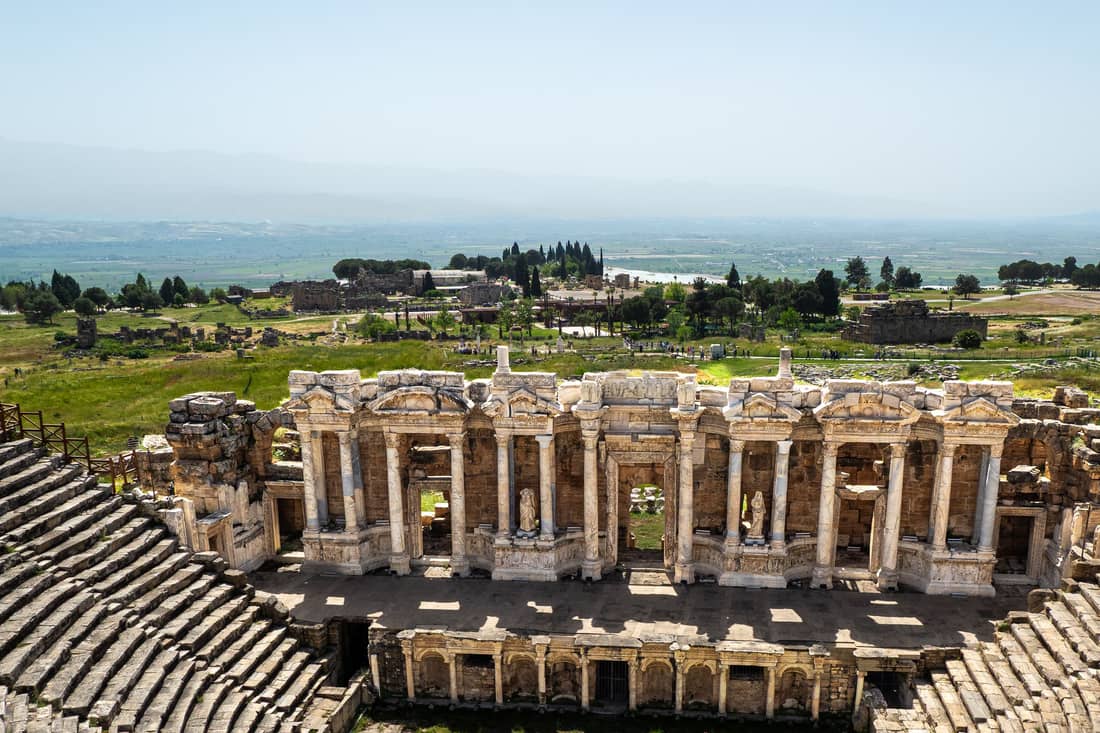
The Roman theatre went up under the emperor Hadrian in the second century. Septimius Severus later had the old stage front replaced, at the start of the third century. That front had five doors, and its friezes survive intact. A main aisle split the seating in two.
Pamukkale comes up again in Pamukkale Ephesus Tour From Bodrum.
The orchestra had two later lives. Builders altered it for water shows, and in the late empire it became a cellar. Restorers have worked on the theatre since nineteen seventy-seven, rebuilding arches and part of the stage floor. Their repairs greet visitors after a Pamukkale tour from Antalya reaches the seating.
The main street of Hierapolis divided the city in two and was about fourteen metres wide. An arcade lined each side. The Domitian Gate leads onto the street, a triple arch flanked by two round towers. Julius Frontinus, proconsul of Asia, put up the gate, and its front bears a dedication to the emperor Domitian.
The Plutonium, a small cave beside the Temple of Apollo, was once taken for an entrance to the underworld. Carbon dioxide from the fault under the temple fills it and kills small animals. Strabo wrote that sparrows he threw in dropped dead at once. Visitors meet its nickname, Gate of Hell, after a Pamukkale tour from Antalya arrives.
The necropolis lies outside the Domitian Gate and runs for roughly two kilometres. It holds about twelve hundred tombs, and scholars have read more than three hundred tombstone inscriptions. Builders used local limestone, with marble in places. Tombs with double-pitched roofs stand beside burial mounds, each with a narrow passage to a vaulted chamber.
A hill outside the north-eastern walls carries the Martyrium of Saint Philip. Eight rooms ring its central octagon, which is about twenty metres across. Four rooms served as entrances and four as chapels. It dates from the fifth century, and fire later left marks on its columns.
Another page that includes Pamukkale is Aphrodisias Pamukkale Tour From Ankara.
The museum fills a Roman bath that Hadrian began and Septimius Severus finished. One hall holds sarcophagi and statues, and another sets out small finds in time order. A third hall shows reliefs and statues from the theatre stage. Visitors walk these halls after a Pamukkale tour from Antalya stops at the ruins.
How does the Antique Pool fit into a Pamukkale tour from Antalya?
Water in the Antique Pool at Hierapolis stays at 36 degrees Celsius all year, above fallen marble columns. Swimmers meet that same warmth throughout a Pamukkale tour from Antalya, winter or summer, beside the ancient ruins.
On one small-group format from Antalya, the pool stop is described as free time. Guests relax or swim in the warm, mineral-rich water of the ancient pool. Swimmers can look forward to that break throughout a Pamukkale tour from Antalya. Itinerary order puts the pool after the ruins and before the museum stop.
The Antique Pool dates back to the second century BC. It lies inside the ancient city of Hierapolis, right next to the Pamukkale travertines. Thermal water feeds the pool. Official Turkish museum records count an antique pool and baths among the buildings of the ancient city.
The pool took its shape in a quake of the seventh century. During that quake, a marble portico in the Ionic order fell into the spring. Marble columns lie scattered beneath the surface of the water. Bathing is allowed in this designated thermal pool, where the submerged columns lie. Antique columns and marble surround anyone who swims there.
The Cleopatra name clings to the pool throughout a Pamukkale tour from Antalya. Tourism authorities word the link with care. Cleopatra, ruler of Ptolemaic Egypt, is alleged to have bathed in it. Antique Pool and Cleopatra’s Pool are two names for one warm, spring-fed place inside Hierapolis.
A related page on Pamukkale: Pamukkale Hierapolis Tour From Bodrum.
Hot water is the common thread throughout a Pamukkale tour from Antalya. Hierapolis was a health centre in the Roman period, and thousands of people used its baths. More than fifteen baths served the city. Visitors from different parts of Anatolia came to the hot springs in search of health.
Hotel buildings among the ruins once damaged parts of the ancient city. Builders later cleared them away, yet the hot water pool of one hotel stayed. Swimmers can float there among ancient stone remains. That mix of bathing and ruins runs throughout a Pamukkale tour from Antalya.
Hierapolis is not the only thermal place worth a look throughout a Pamukkale tour from Antalya. Karahayit is a source of thermal tourism in Denizli. Two rivers, the Buyuk Menderes and the Curuksu, give life to the fertile lands there. Red healing water and thermal mud reaching 60 degrees Celsius mark the place.
Laodicea is a separate ancient city, set south of Hierapolis on the long spur of a hill. The narrow valleys of the small Asopus and Caprus rivers flank that hill. Both rivers discharge their waters into the Lycus. The city stood on a major trade route.
The west agora of Laodicea, also called the central agora, covers 35,000 square metres. Much of it has been restored, with a number of its columns standing 10.8 metres tall. Its back wall is 100 metres long and 11 metres high. Frescoes cover that wall, and the wall is considered important for world archaeology.
More about Pamukkale: Sardis and Pamukkale Tour From Izmir.
Which road does a Pamukkale tour from Antalya take across the mountains?
One road from Antalya to Denizli runs north-west through Korkuteli, Sogut, Acipayam and Honaz. Another goes through Burdur. Vehicles climb into high country before a Pamukkale tour from Antalya descends toward Denizli.
Three numbered state roads share the route between Antalya and Denizli. The D350 runs from Antalya through Korkuteli to Sogut. The D585 carries on through Acipayam to Honaz. The D320 completes the route to Denizli. Denizli, the end of that road, lies in the Aegean region.
Korkuteli sits in the Bey Mountains, the western range of the Taurus. The town lies 56 kilometres north-west of Antalya. It stands just over a thousand metres above sea level. Small plains and hills fill the district around it. Pine forest covers the high country, while the lowland is farmed.
On the small-group format, a rest stop in Korkuteli comes after about an hour on the road. The halt is quick and works as a short rest. It also helps to break up a long drive. Travellers stretch their legs before a Pamukkale tour from Antalya continues inland.
Fruit growing is a thriving trade on the lowland around Korkuteli. Investment in irrigation and machinery from the nineteen-sixties onward built that industry. Roadside stalls in the district sell fruit to travellers on the way to the Mediterranean coast. The district has hot, dry summers. Its winters are chilly and damp, with occasional snow.
Acipayam stands on high ground between the Aegean and Mediterranean regions. A plain watered by two reservoirs surrounds the town and is known for melons and watermelons. The town stands on the road between Denizli and Antalya. It sits between Sogut and Honaz, so travellers pass it before a Pamukkale tour from Antalya reaches Honaz.
Pamukkale also features in Pamukkale Calcium Terraces and Aphrodisias Tour by Night Bus From Ankara.
Honaz follows Acipayam on the same road. The town lies on the slopes of Mount Honaz, the highest mountain in the Aegean Region. A stream just north of the town carried the ancient name Lycus. The road goes through Honaz before a Pamukkale tour from Antalya enters Denizli.
Denizli is the gateway to the inner regions of the coastal area. The continental climate of those inner regions is felt there. The city centre stands on the foothill of Mount Karci. Its lowest district, Saraykoy, lies around 170 metres above sea level. Hierapolis and Pamukkale lie 20 kilometres to the north.
A second road runs through Burdur. The town stands on the shore of Lake Burdur, a salty and highly alkaline lake that never freezes. On the Antalya road, Bucak lies 81 kilometres out and Burdur 125 kilometres. Both roads lead to Denizli before a Pamukkale tour from Antalya turns north.
The distance from Antalya to Pamukkale is well over 200 kilometres by road. Parts of the road run through mountains. Hours pass on this road before a Pamukkale tour from Antalya reaches Hierapolis.
When can a Pamukkale tour from Antalya run and which rules apply?
Denizli, near the terraces, has a July mean daily maximum of 35.7 °C and an April figure of 21.3 °C. Weigh that gap, then check age, access and refund terms for a Pamukkale tour from Antalya. Formats differ on each.
Antalya belongs to the hot-summer Mediterranean climate type, and rain is common in winter. The July mean daily maximum is 34.9 °C, and the record high is 46.1 °C. The sun shines for nearly three thousand hours a year. Keep those figures beside the calendar when you choose a month for a Pamukkale tour from Antalya.
Pamukkale comes up again in Ephesus Pamukkale Tour From Izmir.
The terraces lie in Denizli Province, and the record high in the town of Denizli is 44.4 °C. January highs average 10.7 °C. July brings 16.3 mm of rain, while December brings 81.1 mm. Winter is occasionally very cold there, with snow on the surrounding mountains.
One coach format operates daily and sets no minimum number of participants. Another format takes bookings up to eight hours before the start. A small-group format gives confirmation at booking, unless the trip begins within four hours. Use the cards on this page to see open dates for a Pamukkale tour from Antalya.
Sun cover leads the packing advice. One coach format asks for a hat, sunscreen and sunglasses. A small-group format lists a towel and swimwear for the pools. A different small-group format advises a light jacket, as the weather can be cooler at Pamukkale. Pack that kit for a Pamukkale tour from Antalya.
Shoes and papers get short rules. One format asks for walking shoes suited to uneven terrain. Another asks for comfortable walking shoes. A further format asks guests to show the voucher on a phone, with valid photo ID, at pickup. A different format does not allow pets.
Child rules differ by format. A large-group coach format lets children under twelve join with an adult. Another format asks that an adult accompany each child throughout the day. A small-group format asks parents to consider whether a child can handle a full day. Infants ride on a lap where infant seats are not available.
More about Antalya: Cappadocia Tour From Antalya.
Access also follows the format. One day trip is not accessible for wheelchair users, and another states that guests must be able to walk unassisted. A further format is not recommended for travellers with mobility issues, because of uneven surfaces. A small-group format advises raising specific needs at booking.
Meals follow the format, so dietary requests start at booking. One small-group format serves a vegetarian option at lunch. A coach format asks guests to tell the team their dietary needs in advance. Raise any food request when you reserve a seat for a Pamukkale tour from Antalya.
Cancellation terms agree on the main point. On small-group and large-group formats alike, a cancellation a day before the start brings a full refund. One small-group format refunds nothing for a no-show or a last-minute cancellation. Read the cancellation terms on the booking page for a Pamukkale tour from Antalya.