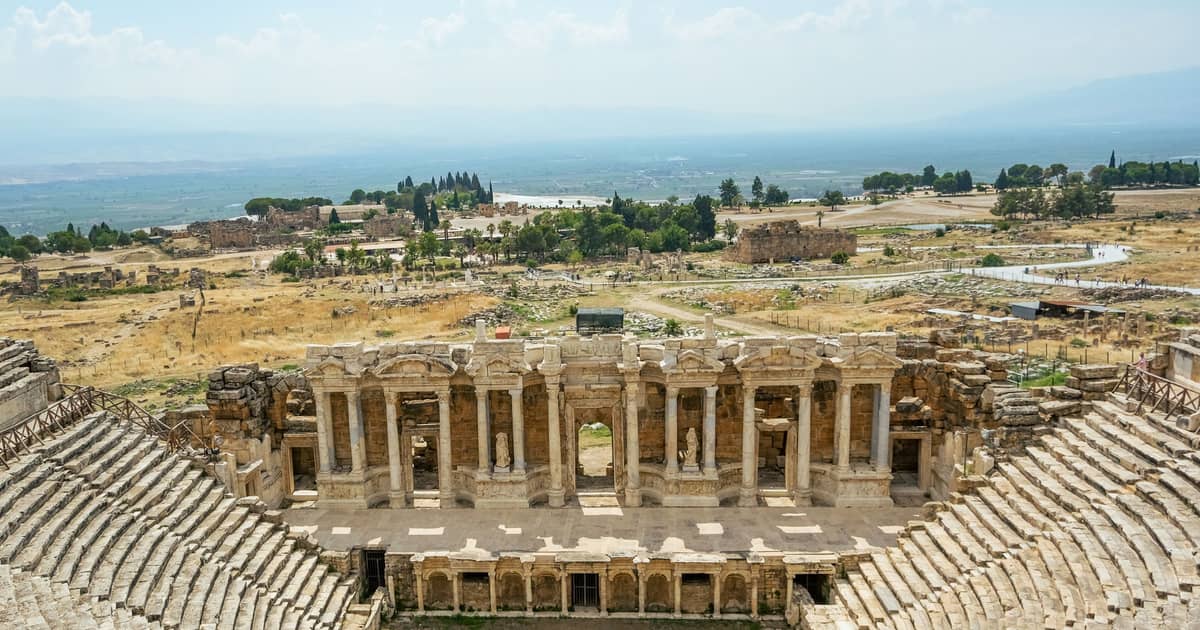
An Ephesus Pamukkale tour from Ankara swaps the high plateau for the Aegean coast in one flight. This route spends day one among the ruins of Ephesus and sleeps near Denizli before the white terraces. For island trips, open Greece Tours on the homepage.
Tap a card below to look up live dates on GetYourGuide.
How do two airports serve an Ephesus Pamukkale tour from Ankara?
Ankara Esenboga lies northeast of the capital, in Cubuk district. Izmir Adnan Menderes lies in Gaziemir district, south of the Aegean city. One flight each way joins them and frames an Ephesus Pamukkale tour from Ankara across two days.
Ankara Esenboga serves the capital from the northeast, on the flat Cubuk plain. Cubuk is a municipality and a district of Ankara Province, and the airport lies within it. This route begins there on the morning of day one. A traveller on an Ephesus Pamukkale tour from Ankara checks in there and boards the Izmir flight.
Flying home through the capital? Turkey tours on the homepage also cover Cappadocia, the south coast and Istanbul.
The airport takes its name from the nearby village of Esenboga. Road traffic reaches it along Ozal Boulevard, also called Esenboga Yolu. A General Aviation Terminal of 469 square metres stands beside the main building. It handles private and business flights. The State Airports Authority owns the airport that starts an Ephesus Pamukkale tour from Ankara.
Turkey signed the Chicago Convention on Civil Aviation of nineteen forty-four. A decision followed to build an international airport in Ankara, alongside the one at Yesilkoy in Istanbul. Construction began in nineteen fifty-one, and the airport opened in nineteen fifty-five. A Turkish encyclopedia calls it the second fully equipped international airport in the country at that date.
The present terminal went into service in October of the year two thousand and six. One building handles both domestic and international flights, and builders raised it under a build-operate-transfer model. Its capacity is ten million passengers a year. A domestic flight on an Ephesus Pamukkale tour from Ankara therefore starts in the main building.
The terminal has 18 air bridges, 105 check-in counters and 34 passport counters. A car park beside it covers 123,000 square metres and takes 4,000 vehicles. NASA designated Esenboga as one of the emergency landing sites for the Space Shuttle. The road to the Ankara ring road was expanded in the summer of the year two thousand and six.
Izmir Adnan Menderes Airport is the international airport for Izmir and its surrounding province. It stands inside the boundaries of Gaziemir district, which lies south of central Izmir on the road into town. Landing at this airport, an Ephesus Pamukkale tour from Ankara meets the Aegean coast. This route touches down here on the morning of day one.
The district of Gaziemir was founded in the fourteenth century by Umur Beg. Gaziemir covers 70 square kilometres and forms both a municipality and a district within Izmir Province. Its earlier name was Seydikoy, after a chief. Seydikoy became a municipality in nineteen twenty-six. In nineteen sixty-five it took the name Gaziemir, in honour of its founder, Gazi Umur Bey.
The airport carries the name of Adnan Menderes, a former prime minister of Turkey. Construction began in nineteen eighty-four, and the airport opened in nineteen eighty-seven. It replaced the airfield at Cigli, north of Izmir, which kept only military use. An apron of 280,000 square metres later raised the remote aircraft parking spaces from 35 to 61.
The international terminal opened in the year two thousand and six. It stands north of the domestic terminal, and a link joins the two buildings. The two runways carry the numbers 16R/34L and 16L/34R, one of concrete and one of composite surface. Commuter trains stop at Airport Station, and intercity trains stop there as well.
The flight between the two airports takes a little more than an hour. On day one this route flies from Esenboga in the morning and lands at Adnan Menderes. On day two the evening flight reverses the leg. In total, an Ephesus Pamukkale tour from Ankara uses each airport twice, once to land and once to take off.
Where did Ephesus race and train, as met on an Ephesus Pamukkale tour from Ankara?
Ephesus held its contests in the Stadium and trained in two gymnasia, the Vedius and the Harbour. For an Ephesus Pamukkale tour from Ankara, the Stadium is a horseshoe track about 230 metres long. Each gymnasium was built around a court for exercise.
The Stadium of Ephesus has the plan of a horseshoe. Its track runs about 230 metres from end to end and roughly 30 metres across. The rounded end, called the sphendone, lies at the eastern end of the building. The entrance opens in the west. Boxing, wrestling and similar contests took place inside it.
The Stadium lies at the foot of Panayir Dagi, once called Pion Hill. On the hill side, the seats were cut as steps from the natural rock. The slope itself served as the grandstand for the spectators. The rock steps invite an Ephesus Pamukkale tour from Ankara to compare them with the vaulted side opposite.
On the other side, builders raised long vaulted galleries and set the seats on top of them. These galleries resemble long rooms, and small openings every seven to eight metres lead into them. Spectators entered the north side by two outer staircases. A vaulted internal corridor, 85 metres long, led them inside.
Earthquakes and later use changed the Stadium. An earthquake in the third century damaged it severely. More earthquakes around the middle of the fourth century added to the damage. In the fifth century a church was built over it. The south-western gate stands in good condition and anchors the plan for an Ephesus Pamukkale tour from Ankara.
A gymnasium was a training place for athletes who competed in public games. The word comes from the Greek gymnos, meaning naked. Its palaestra was the part given to wrestling, boxing and ball games. The Greek gymnasia also held lectures and talks on philosophy, literature and music. Exercise there went together with communal bathing.
The Vedius Gymnasium stands in the north of Ephesus. It covers almost 13,000 square metres. The plan joins Roman baths to a Greek gymnasium. Scholars call that combination a bath-gymnasium, a type found mainly in Asia Minor. This pairing lets an Ephesus Pamukkale tour from Ankara read the Vedius Gymnasium as baths and exercise ground.
The Vedius complex served more than athletes. It was a meeting point for clubs and a venue for events. Education, exercise, body care and recreation all had a place there. The plan adds a palaestra and a richly decorated hall known as the Kaisersaal, the emperor’s hall. It was a ceremonial room for imperial visits.
The Kaisersaal, the richly decorated hall of the Vedius complex, went through more than one phase. Excavators found a second phase of decoration in the fifth century. A levelling layer under the later floor held 373 fragments of broken sculpture. This layering gives an Ephesus Pamukkale tour from Ankara one gymnasium with two phases of decoration.
The Harbour Gymnasium was a building of two storeys. A palaestra lay at its centre, and rooms with different functions surrounded it. A Roman copy of a Greek bronze statue of an athlete was found in the palaestra. A marble statue of a child playing with a duck was found too. Fire destroyed the propylaea, the entrance to the gymnasium.
In the smaller palaestra, an apsidal hall in the north was dedicated to the imperial cult. The southern part held lectures and meetings. A small church was later inserted into a corner of the Marble Hall. Taken together, the Harbour Gymnasium gives an Ephesus Pamukkale tour from Ankara sport, teaching and worship in one plan.
Which trade and coins made Ephesus rich, in the story behind an Ephesus Pamukkale tour from Ankara?
Ephesus grew rich from its port, inland roads, deposits in the temple treasury and silver coins stamped with a bee. Money is one thread of what an Ephesus Pamukkale tour from Ankara covers on day one.
The harbour came first. In the Archaic period, the port of Ephesus gave landlocked Lydia a way into sea trade. The ruins that an Ephesus Pamukkale tour from Ankara visits belong to a city whose harbour served an inland kingdom.
Strabo, the Greek geographer, left a plain verdict on the city’s market. In his Geography he calls Ephesus the largest emporium, or trading centre, in Asia this side of the Taurus. He adds that the city grows from day to day.
Roads carried goods to that market. Strabo names the road that leads from Ephesus towards Antioch and the river Maeander. The first city after Ephesus, he says, is Magnesia. This route also turns inland after Ephesus, as an Ephesus Pamukkale tour from Ankara ends day one at Denizli.
Rome made Ephesus a seat of power as well as a market. After Augustus became emperor in 27 BC, the provincial capital of Asia moved to the city. It then flourished as the seat of the governor and as a major centre of commerce. Government and trade shared one place.
Treasure also flowed into the Temple of Artemis. Dio Chrysostom says private citizens, foreigners and kings left money there, a habit tied to the sanctuary’s safety. The temple seems to have worked as a bank as well as a shrine. Lysimachus later moved control of that wealth from the priests to the gerousia, a council of elders.
The temple fed a trade in keepsakes too. The sale of dedications to visitors became an income source for the sanctuary. In Acts, a maker of silver shrines brings plenty of business to the artisans. The workers say their wealth comes from it.
Coins began early at Ephesus. Early coins were struck in electrum, a natural alloy of gold and silver. East Greek electrum coins turned up under the temple site at Ephesus. A silver drachm of the fifth century BC already shows a bee with curved wings.
Three emblems stood for Ephesus on its silver coins: the bee, the stag and the palm. A Getty Museum coin of the fourth century BC shows a bee in a dotted border. The letters epsilon and phi flank it, short for Ephesos. In the money story of an Ephesus Pamukkale tour from Ankara, the bee is the city’s badge.
The other face shows a stag kneeling and looking back towards a palm. The name Karnops belongs to a magistrate who supervised the Ephesian mint. Nearly a thousand different bee-and-stag coin types are known from Ephesus. The city is the main source of bees on ancient coins.
The cistophoric coin came from the Attalid kingdom, shortly before 190 BC. Its face value was four drachmas, yet it weighed only as much as three Attic drachmas. Rome kept it in circulation, with different types and legends, down to the time of Septimius Severus.
Ephesus struck cistophoric coins of its own. One of the second century BC shows a half-open sacred chest with a snake on the front. Two snakes circle a bow case on the back, beside the letters for Ephesus. An Ephesus Pamukkale tour from Ankara spends day one in the city that struck it.
Market officials watched over trade. An agoranomos was an elected official responsible for order in the marketplace. This official certified weights and scales and controlled money exchange. A lead weight of the second or third century AD, attributed to Ephesus, names three such officials.
What do the tombs of Hierapolis add to an Ephesus Pamukkale tour from Ankara?
Tombs of every size line the old road north of Hierapolis, about 1,200 in all. Sarcophagi, burial mounds and house-shaped graves give an Ephesus Pamukkale tour from Ankara a quiet, stone-built side. Greek epitaphs are cut into the rock.
The north necropolis lies beyond the main ruins, beside the modern road. The old route reaches it past the city wall and meadow, along the colonnaded road and the outer baths. Placed at the end of that road, the graves close the Hierapolis chapter of an Ephesus Pamukkale tour from Ankara.
Over two kilometres of graves flank the old road that led to Phrygian Tripolis and Sardis. The north necropolis is the largest in Anatolia. It also counts among the well-preserved cemeteries of Turkey. Graves also fill the eastern and southern sections of the old city. Sarcophagi and mausolea cover the hillsides outside it.
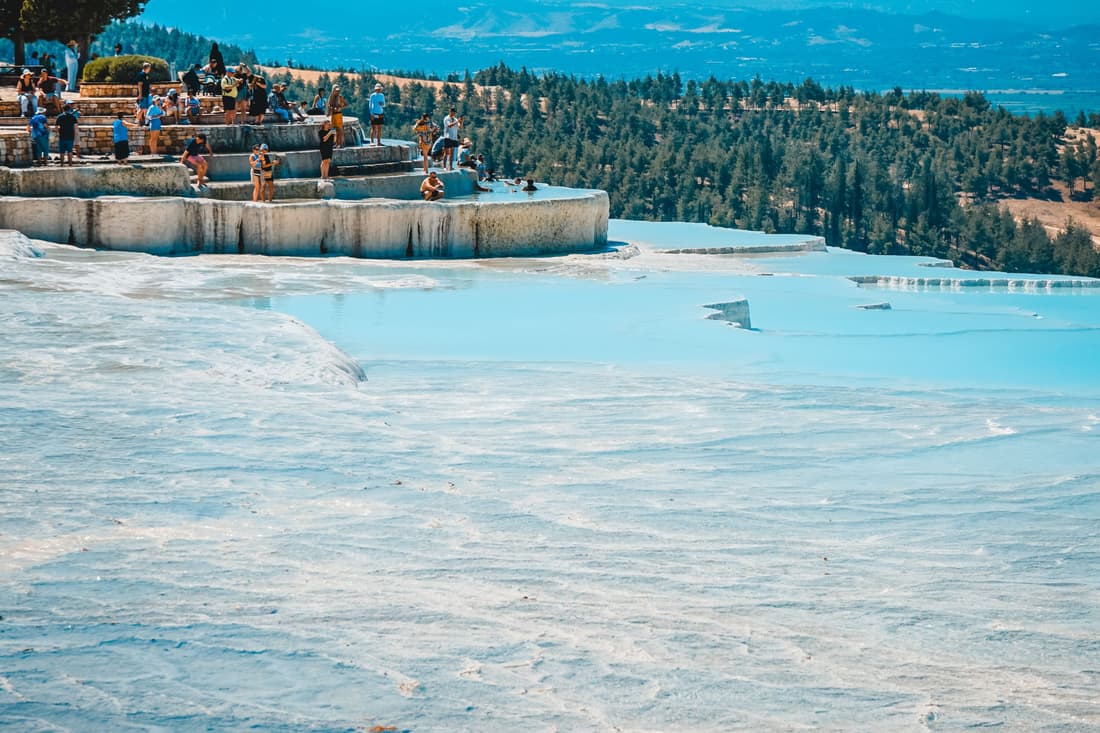
About 1,200 tombs stand along it. The larger share were built of local limestone, with marble used as well. The dates run from the late Hellenic period through Roman times into the early Christian age. That span gives an Ephesus Pamukkale tour from Ankara a long record of burial in one stretch of road.
Simple graves served common people. A sarcophagus is a coffin carved from stone and set above ground. At Hierapolis a number stand raised on a base, and others were hollowed out of the rock. Roofs with two slopes cover a good share of them. The larger share have been plundered.
A tumulus is a mound of earth and stones raised over a grave. The round ones at Hierapolis are sometimes hard to pick out. Each has a narrow passage leading to a vaulted chamber. The oldest graves here are tumuli of the second and first centuries BC, on the east side of the foothill.
Larger family graves stand beside them, at times monumental and shaped like small temples. Others are house-shaped. Along the road to Laodicea and Colossae, one grave draws the eye because its facade resembles a home. Rich families built the monumental tombs, while poor families cut simple graves into the rock.
Pamukkale and Ephesus Tour by Night Bus From Ankara covers Pamukkale too.
Walled graves on the north side had gardens with flowers and cypress trees. In the south, a grave roofed with cob brick and tiles has coloured paintings on its inner walls. Gardens and painted rooms show the care families gave their dead. Details of this kind lend an Ephesus Pamukkale tour from Ankara a human scale.
Travertine graves in the north carry Greek epitaphs, and these texts have taught scholars much about the population. One sarcophagus bears the Greek word bomas, meaning altar. In the south, experts from the Denizli Museum found a grave with long inscriptions. Christian inscriptions begin to appear in the fourth century.
Tomb texts also name trades. In one text, Glycon leaves money to the purple-dyers’ guild to decorate his grave at a feast. He leaves a second gift to the carpet-weavers’ guild for another feast. His text also consecrates a family tomb.
Other texts forbid burying a stranger in a family tomb and name a fine for it. One such text sits on a tomb outside the city gate, on the road to Tripolis. Written warnings like these let an Ephesus Pamukkale tour from Ankara read how a family guarded its plot.
Readers interested in Pamukkale can open Ephesus Aphrodisias Pamukkale Tour by Flight From Ankara.
The springs explain the crowd of graves. Doctors at Hierapolis used the thermal water to treat patients, and thousands of people came for its medicinal qualities. Visitors who arrived for treatment buried their dead here, beside the townspeople. The cemetery shows the health springs behind an Ephesus Pamukkale tour from Ankara at work in stone.
Why does the Martyrium of St Philip matter on an Ephesus Pamukkale tour from Ankara?
The Martyrium of St Philip is an eight-sided shrine on a hill at Hierapolis, built to honour the apostle Philip. Day two of this route spends the morning at Hierapolis, where an Ephesus Pamukkale tour from Ankara touches pilgrim history.
The Gospel of John tells that Jesus called Philip, a man of Bethsaida, to follow him. The lists of the twelve apostles place him fifth. Eusebius, quoting an earlier writer, records that Philip was buried at Hierapolis with two of his daughters. The Acts of Philip, a text outside the Bible, also places his death there.
A martyrium is a church built on or near the place where a martyr died. The hilltop building honours Philip that way, within the Hierapolis part of an Ephesus Pamukkale tour from Ankara. Its builders made it for pilgrims who came to worship at this important place. The shrine stayed a centre of pilgrimage and worship for centuries.
Excavators date the building to the late fourth and early fifth centuries. A marble architrave, the beam above a row of columns, helped them fix that date. The shrine rose centuries after Philip’s death. It crowns a hill north-east of the city, outside the walls, on the highest part of that slope.
The outer walls form a square, and the octagon stands inside it. The central space has eight sides. Eight rectangular rooms ring the central space and open into it. Four triangular courtyards fill the corners where the square meets the octagon. That layout is what an Ephesus Pamukkale tour from Ankara reads in the surviving walls.
For more on Pamukkale, see Aphrodisias Pamukkale Tour From Ankara.
The excavation director calls the octagonal church the centre of a large devotional complex. The square portico held 28 small rooms for visiting pilgrims. A small plain lay in front of the Martyrium, with traces of buildings. On the square beside the shrine, a fountain gave pilgrims water for their ritual washing.
The whole hill formed a course of pilgrimage, with stages along the way. A great processional street carried the city’s pilgrims up to the octagonal church. Bridge remains show where pilgrims crossed a valley in which a torrent flowed. At the foot of the hill, wide travertine steps rose towards the summit.
Excavators found a second flight of steps that led straight to the Martyrion. Satellite photographs revealed another octagonal building that the surface hid, and the dig showed that it was a bath complex. Such finds reveal the scale of the pilgrim site to an Ephesus Pamukkale tour from Ankara.
The walk to the shrine leaves the main level of Hierapolis and follows the ancient Processional Way. Byzantine pilgrims climbed the same approach to reach the hill linked with Philip. The surface changes between worn paving, steps and loose rubble along the climb. Halfway up, the view back takes in the Lycus Valley and the lower plateau.
The geometry of the octagon stays clear when seen from the ridge. Strong walls and surviving arches frame the central space. Inside the arches, open sky replaces the missing roof. Beside the octagon, the ridge opens towards the plain. The ruin shows no complete church interior, so the plan carries the story for an Ephesus Pamukkale tour from Ankara.
Pamukkale comes up again in Pamukkale Ephesus Tour From Bodrum.
People long expected to find Philip’s tomb at the centre of the octagon. No tomb came to light in the central chamber. Paolo Verzone, founder of the Italian Archaeological Mission to Hierapolis, dug the monument known as the church of St Philip. His work gave an Ephesus Pamukkale tour from Ankara its clear picture of the shrine.
What does the Hierapolis museum hold for an Ephesus Pamukkale tour from Ankara?
Inside a restored Roman bath, the Hierapolis Archaeology Museum holds sarcophagi, statues, stage reliefs and small finds. Its pieces come from Hierapolis, Laodicea and other ruins. An Ephesus Pamukkale tour from Ankara meets these roofed rooms among the open ruins.
Restorers worked on the Roman bath in the nineteen seventies. Then the artefacts from the Hierapolis digs, and from other sites, were arranged inside. The museum opened to visitors on 1 February in nineteen eighty-four. An Ephesus Pamukkale tour from Ankara therefore enters a restored building, not a bare ruin.
The museum stands on 14,000 square metres inside the ancient city. It belongs to the Pamukkale district of Denizli Province. After the entrance, a large courtyard comes first. A rectangular hall follows, flanked by two large halls. These two halls were devoted to the emperor and to ceremonies. The structure attached to the large hall houses the museum itself.
Three enclosed rooms of the bath hold the indoor displays. Open areas on the east side hold architectural fragments of marble and stone. Excavators cleared more areas of the bath in the nineteen nineties. They cleared another area in the year two thousand and one, where the western vault and portals are found.
Pamukkale also features in Pamukkale Laodicea Tour From Ankara.
The ministry plan of the bath marks a palaestra, a colonnaded gallery and two fresco areas. This route gives Hierapolis the morning of day two, and the museum lies inside that ancient city. After Hierapolis, this route turns back to Izmir for the evening flight to Ankara.
The Hall of Sarcophagi and Statues holds statues of Tyche, Dionysus, Pan, Asklepios, Isis and Demeter. Roman sculptors made them, yet the Hellenistic tradition inspired the style. Statues of Artemis, Leto and Apollo are on view as well. In this line-up, an Ephesus Pamukkale tour from Ankara sees carved gods of the Roman period at close range.
Baked-earth sarcophagi belong to this area, and the hall shows examples of them. Scenes of local custom on family tombs hold particular interest. The sarcophagus of a man named Arhom counts among the prized works of the room. A marble statue of a priestess of Isis is dated to about AD 200.
The Hall of Small Artefacts lets an Ephesus Pamukkale tour from Ankara follow its objects in time order. The earliest date is the fourth millennium BC. Gold, silver and bronze objects run on to Seljuk and Ottoman times.
Among the items on display are terracotta pots, idols and stone artefacts from Beycesultan Mound. Terracotta oil lamps, glassware, necklaces and metal jewellery are on show as well. Objects from Caria, Pisidia and Lydia are shown too. A Lydian vase from Iconium is one of the pieces that come from elsewhere in Turkey.
A related page on Pamukkale: Ephesus Pamukkale Tour From Istanbul.
The Theatre Finds Hall shows reliefs that once decorated the stage building of the Hierapolis theatre. They include the birth of Apollo and Artemis and the abduction of Persephone by Hades. The battle of Heracles and Antaios appears as well. Restorers treated these pieces before display.
Further panels show the procession of Dionysus and the coronation ceremony of Hierapolis. An Ephesus Pamukkale tour from Ankara also finds inscriptions with resolutions of the theatre council.
The legend of Marsyas appears among the stage reliefs. Marsyas challenged Apollo to a music contest and lost. A relief in the museum shows Apollo crowned with laurel. He holds a victory palm, and two nymphs stand with him.
The grounds hold a cafe, a shop, restrooms and a car park. These facilities suit a pause on an Ephesus Pamukkale tour from Ankara between the halls and the open ruins.
How did earthquakes shape Hierapolis within an Ephesus Pamukkale tour from Ankara?
A strong quake in the reign of Nero ruined Hierapolis, and builders then raised the city again. Later shocks damaged its gate and baths and brought down its theatre. Stones met along an Ephesus Pamukkale tour from Ankara record each break and each repair.
Hierapolis is the inland city of an Ephesus Pamukkale tour from Ankara, and it stands on an active fault zone. It lies on the north-eastern edge of the Denizli basin. At Hierapolis, a link between an active fault zone and damaged buildings can be shown. Cracks, tilted walls and fallen blocks serve as a record of past shocks.
The worst shock of Classical times struck in the reign of Nero, in the first century. A study of the ruins thinks it destroyed the greater part of the city. Another study finds surface faulting at Hierapolis from that same quake. Walkers in Hierapolis during an Ephesus Pamukkale tour from Ankara tread the rebuilding that followed.
More about Pamukkale: Pamukkale and Ephesus Tour From Istanbul.
Two books on the site record that Hierapolis was rebuilt after that shock. Builders rebuilt the town after more than one major quake. The standing remains belong to the second and third centuries. The Temple of Apollo and the Roman theatre were among the buildings rebuilt after it. A seventh-century earthquake later brought the whole theatre down.
For readers planning an Ephesus Pamukkale tour from Ankara, the Frontinus Gate carries marks of repeated harm. It stands at the northern edge of the city and was rebuilt after a devastating quake. Later quakes in the fourth and seventh centuries damaged it again. One tower is in good condition, while the other has largely collapsed.
Two walls show how researchers read stone. Vertical fissures cut the Northern Baths, a third-century building of travertine blocks. In dry masonry, such cracks are a sign of shaking. A wall beside the colonnaded street toppled whole to the north-east, probably in a quake. A water channel later hardened into stone along its length, so the wall is the older.
The fault itself shows in offsets. Walls and stone-hardened irrigation channels in the city are offset along one line, and that line marks the fault zone. The offsets show a normal fault with a small drop to the south-west. One channel, about 90 metres south-south-east of the north wall, is dropped about 7 centimetres to the west.
The damaged ground forms a strip about 1,250 metres long and 100 metres wide. Inside it, the walls of certain Classical buildings are shifted by centimetres or split by cracks. Tilted walls, toppled walls and rotated blocks lie in the same strip. That strip ties the fault to the harm seen on an Ephesus Pamukkale tour from Ankara.
Another page that includes Ankara is Ephesus Pergamon Tour From Ankara.
A kilometre north of the city, a carving of three figures is cut into a fault face. That face is thought to have moved in the quake of Nero’s reign. It sits about 3 metres above the ground at the foot of the scarp. A carver is unlikely to have climbed the smooth face, so later fault movement lifted it.
Catalogues of ancient quakes list destructive shocks at Hierapolis in the first, third, fourth and fifth centuries. Another came early in the seventh. Less damaging quakes followed in the fourteenth and eighteenth centuries. The head of the dig says residents stayed on and kept raising monuments made to resist quakes in the region.
The three-storey monumental fountain shows that effort. Builders set an arched structure beneath it to soften the force of a quake. The pool in front of the fountain still collapsed in an earthquake. That fountain sums up the quake record that an Ephesus Pamukkale tour from Ankara meets here.
Where does the antique pool fit into an Ephesus Pamukkale tour from Ankara?
The Antique Pool lies inside Hierapolis, which fills part of the last morning of an Ephesus Pamukkale tour from Ankara. Warm mineral water fills the basin, and fallen Roman columns lie on its floor. Its water holds 36 degrees Celsius all year. Bathing is allowed inside the paid area.
This route spends day two’s morning at Pamukkale and Hierapolis, then takes the road back to Izmir. The Antique Pool lies inside the Hierapolis site. In Roman times Hierapolis served as a health centre with more than fifteen baths. A swim in these waters links an Ephesus Pamukkale tour from Ankara to that old bathing habit.
Fluted column drums, plinths and the occasional capital lie on the pool bed. Flutes are the grooves that run up the shaft of a column. Swimmers float above these marble pieces in warm water. They are genuine Roman remains. The portico they belonged to dropped into the spring in an earthquake. The water has covered them ever since.
Another page that includes Pamukkale is 6 Day Istanbul Ephesus Pamukkale Tour Package.
The pool has a second name, Cleopatra’s Pool. The tale that Mark Antony gave the pool to Cleopatra is a popular legend that historians have not verified. The pool began when an earthquake opened a break in the rock, and spring water gathered there. It lies just behind the Hierapolis museum. Visitors have come to these springs since classical times.
Spring water holds the pool at 36 degrees Celsius, summer and winter alike. Swimmers have bathed in it while snow fell and the air stood at 2 degrees Celsius. The warmth feels comfortable rather than hot. The season changes nothing for an Ephesus Pamukkale tour from Ankara, since the water keeps one temperature all year.
The depth changes from place to place. Over much of the pool an adult stands with the head above water. Wide shallow areas suit children, who can wade there. One section is deeper, and it is deep enough for floating. A swimmer can therefore wade, stand or float within a single basin.
Hot, calcium-rich mineral water flows into the pool all the time. The water carries calcium, bicarbonate, sulphate, carbon dioxide and iron. Tests give it a pH of 5.8, which is slightly acid. A swim on an Ephesus Pamukkale tour from Ankara is a mineral bath as well as a dip among stones.
Ephesus Pamukkale Pergamon Tour From Bodrum covers Pamukkale too.
The spa water holds 2,430 milligrams of dissolved minerals in each litre. The same water suits showers, baths and drinking cures. Local belief credits it with easing rheumatism, heart trouble and skin complaints. Drinking it is believed to help stomach and bowel complaints. The warmth alone relaxes the body, apart from any cure.
Bathing is allowed in the designated thermal pools of the site, and this one lies inside the paid area. The pool has its own entry on top of the site entry. Swimmers on an Ephesus Pamukkale tour from Ankara need a swimsuit, because the pool requires one. The columns are not for climbing, sitting or moving.
Swims are daytime ones. The pool opens at eight in the morning and shuts by evening. Last entry comes one hour before closing. Midday in summer brings the largest crowd, while early morning and late afternoon are calmer. Photography is allowed in and around the pool. Food and drink stay out of the water.
Basics for bathers on an Ephesus Pamukkale tour from Ankara share the enclosure around the pool:
- Men’s and women’s changing rooms serve the pool.
- Lockers are available for valuables.
- Towels are not provided, but a shop sells swimsuits and towels.
- Toilets and souvenir shops share the enclosure.
- A restaurant operates inside the enclosure.