An Ephesus Pamukkale tour from Istanbul starts with an early flight to the Aegean coast. This route walks Ephesus on day one, sleeps near Denizli, then crosses the white terraces before the flight home. For island trips, open Greece Tours on the homepage.
Choose a card below to check live dates on GetYourGuide.
How do Istanbul’s two airports start an Ephesus Pamukkale tour from Istanbul?
Istanbul Airport lies on the European side, and Sabiha Gokcen lies on the Asian side. Each stands at least 32 kilometres from the city centre. This route flies from one of them to Izmir. The air time on an Ephesus Pamukkale tour from Istanbul comes to about an hour.
The district of Arnavutkoy holds Istanbul Airport, on the European side of the city. On the map it lies north-west of the centre, on the Black Sea coast. The distance from the centre is at least 35 kilometres. A start here gives an Ephesus Pamukkale tour from Istanbul its flight to Izmir on day one.
Staying longer in the country? The homepage lists Turkey tours for Cappadocia, the south coast and the east.
The opening ceremony took place on 29 October in the year two thousand and eighteen. All passenger flights moved over from Ataturk Airport on 6 April in the year two thousand and nineteen. The code IST passed from the old airport to this one on that date. The old airport also lay on the European side.
The control tower is shaped like a tulip, the national flower of Turkey. The site stands 99 metres above sea level. The metro link to the city is line M11, which stops at the airport. With that line, the ground leg of an Ephesus Pamukkale tour from Istanbul can begin on the rails.
Pendik, a district on the Asian side, is the home of Sabiha Gokcen Airport. It lies south-east of the centre, at least 32 kilometres out. The town of Gebze lies 26 kilometres from it. The metro link to the city is line M4. A flight from Pendik is the other way to open an Ephesus Pamukkale tour from Istanbul.
The foundation of the airport was laid in February of the year nineteen ninety-eight. It opened on 8 January in the year two thousand and one. Ataturk Airport was not large enough for the rising passenger demand. In June of the year two thousand and seven, a consortium won the contract to upgrade and maintain the airport.
The international terminal began with a capacity of 3 million passengers a year. The domestic terminal began with half a million. Work to lift the figure to 25 million began in the year two thousand and eight. The upgraded terminal was inaugurated on 31 October in the year two thousand and nine.
The airport takes the name of Sabiha Gokcen, who was born in Bursa in the year nineteen thirteen. Ataturk met her on a visit to Bursa, when she was twelve, and adopted her. On an Ephesus Pamukkale tour from Istanbul, a flight from Pendik leaves an airport named for a Bursa native.
In Turkish, gok means sky, and Gokcen means belonging to the sky. Ataturk gave her that surname on 19 December in the year nineteen thirty-four. Her flight training began at the Turkkusu school, a school of civil aviation. She attended its opening ceremony in late spring of the year nineteen thirty-five.
She took the controls of a motorised aircraft for the first time on 25 February in the year nineteen thirty-six. A special programme of eleven months followed at the aviation school in Eskisehir. She died on 22 March in the year two thousand and one, on her eighty-eighth birthday. The airport had opened about two months earlier.
The flight between Istanbul and Izmir takes about an hour. Day one begins with that flight. On day two the road leads to Izmir again, and the evening flight carries this route home to Istanbul. An Ephesus Pamukkale tour from Istanbul therefore touches an Istanbul airport twice, once to leave and once to land.
What do the hills and plain around Ephesus add to an Ephesus Pamukkale tour from Istanbul?
Ephesus lies in a gap between two hills, Panayir and Bulbul, beside a plain built by the Kucuk Menderes river. Mud has pushed the coast west for seven thousand years, so an Ephesus Pamukkale tour from Istanbul meets Ephesus inland.
Panayir is the main hill of Ephesus, and its summits step down from 155 to 105 metres above sea level. Its ancient name was Pion, and Pliny the Elder links Ephesus with that mount. The Byzantine name was Cheileton. Bulbul, the Turkish name of Mount Koressos, stands opposite it on the other side of the city.
The old city lay in the gap between the two hills, and the slope of Bulbul is steep. Ground surveys that measure electrical resistance put the shoreline of early Hellenistic times roughly parallel to the foot of Bulbul. In those days the sea met the ground that an Ephesus Pamukkale tour from Istanbul covers on day one.
The Kucuk Menderes means Little Meander. The Greek name was Kaystros, spelled Cayster in English. The river rises in Beydag, and its namesake, the Buyuk Menderes or Great Meander, runs just to the south. Both rivers have shifted their courses. The tributaries of the Kucuk Menderes include the Fertek, the Ilica, the Degirmen and the Keles.
About seven thousand years ago the sea stood at its highest. It filled the valley of the Kucuk Menderes up to 20 kilometres inland. The coast then moved west as the river and its tributaries pushed out their deltas. That retreat explains why an Ephesus Pamukkale tour from Istanbul finds ruins on a plain, not on a shore.
The bay of Ephesus was about 8 kilometres deep. Every historic settlement of the past seven thousand years lies on its south side. Since the Middle Ages the bay has been silted up. A survey map of the late nineteenth century marks the river north of the Artemision. There it lies only 2 to 3 metres above the sea.
Boreholes at the hill of Syrie, modern Koruda, trace the retreat of the sea. Syrie lies 1.8 kilometres north-west of the Artemision. The water there was up to 30 metres deep in the sixth millennium BC. It stood over 15 metres deep in the seventh and sixth centuries BC, and about 12 metres around 400 BC.
Water of that depth once stood close to Ephesus, the first sight of an Ephesus Pamukkale tour from Istanbul. Boreholes also confirm Pliny’s account that Syrie was once an island. Mud from the river reached the hill in the early second century BC. By the middle of the first century BC the whole area around it was land.
Strabo names two lakes beyond the outlet of the Cayster. The first, Selinusia, ran inland from the sea, and a second lake joined it. Geologists reconstruct such lagoons beside the north flank of Panayir. Marshes on the silted ground carried malaria. This wet ground lies in the past of the land beneath an Ephesus Pamukkale tour from Istanbul.
More than 200 sediment cores show how fast the plain grew. Between the fifth and the first millennium BC the mud gathered at up to 1 millimetre a year. Later the rate ran from 4 to 30 millimetres a year. Human use of the river basin set the load: felled woodland, goat herds, erosion and worn soil.
Upstream, the lake and swamps of Belevi built up mud in a near-natural way. Even there, pollen shows settlement from the seventh millennium BC. Bare ridges and maquis shrubland frame the plain. The setting of an Ephesus Pamukkale tour from Istanbul is two ridges, one river and a plain of mud.
How is the main street of Hierapolis laid out on an Ephesus Pamukkale tour from Istanbul?
Hierapolis stands on a grid around one main street. The street runs north to south, is about 14 metres wide and has a gate at each end. After the night in Denizli, an Ephesus Pamukkale tour from Istanbul walks this plan.
Side streets ran parallel or at right angles to the main thoroughfare. They were about 3 metres wide, far narrower than the main street. The blocks between them are regular and rather long. The morning of day two lets an Ephesus Pamukkale tour from Istanbul read this grid on the ground.
The main street ran from north to south, close to the cliff that carries the travertine terraces. Arcades bordered both sides of it. Public buildings, shops and workshops stood on both sides as well. This one street divided the city into two parts, and every other street was set against it.
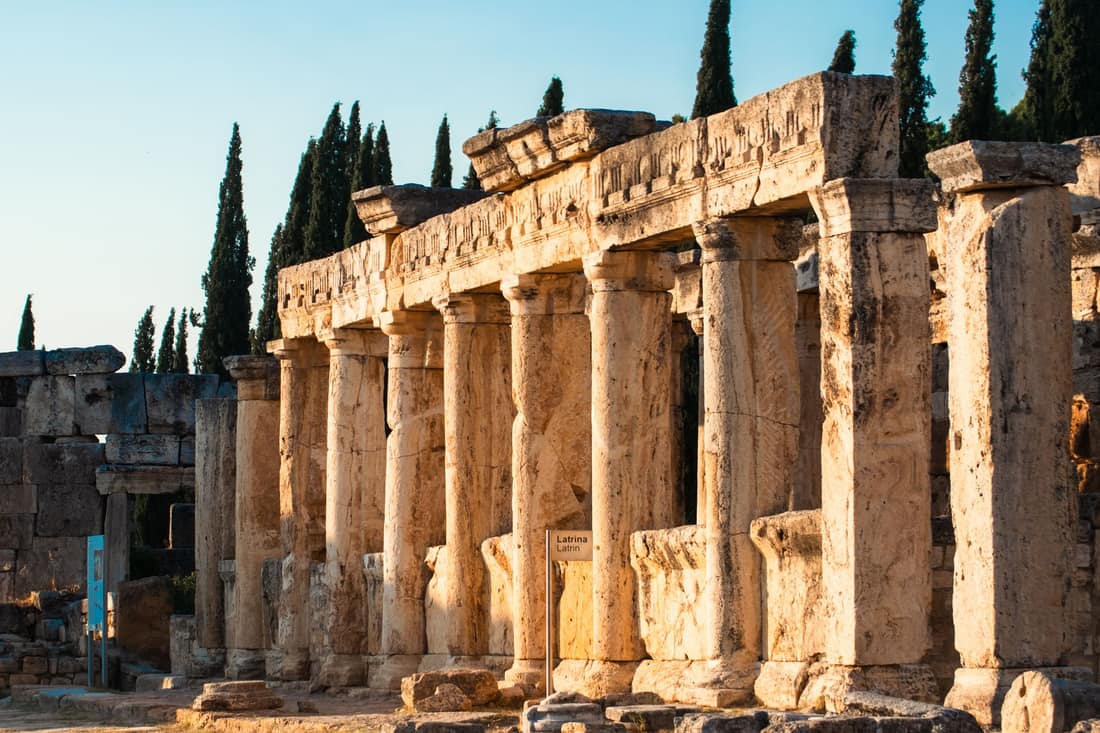
Excavators call the main street the plateia. It crosses the whole settlement and leaves by a gate on the far side. There it joins the road to Laodicea on the Lykos and then Colossae. Neither town is a stop on this route. The buildings beside the street follow the Doric order in their capitals and in the frieze above.
Frontinus Street was the main street of the city in the first century. Shops, stores and houses lined both sides along a stretch of 170 metres. In the late period, the fifth and sixth centuries, the street was reduced to 8 metres in width. Both widths belong to the story an Ephesus Pamukkale tour from Istanbul follows along the street.
The Domitian Gate stands near the north end of the street. The proconsul Julius Frontinus built it in the first century, so it also carries his name. Three arches of squared travertine blocks open between two round towers. A dedication to the emperor Domitian, in Latin and Greek, is cut on its front.
Another page that includes Pamukkale is Pamukkale and Ephesus Tour From Istanbul.
The north gate of the Byzantine wall lies close to the Domitian Gate but belongs to another age. It dates from the late fourth century, in Theodosian times. Two square towers flank it, and its blocks came from the demolished agora. For an Ephesus Pamukkale tour from Istanbul, it marks the limit of the smaller, later city.
The south end of the street has its own gate in the same Byzantine wall. It matches the north gate in plan. Reused travertine and marble blocks make up its walls, and two towers support it. A relieving arch sits above its one-piece lintel. The south end of the street opens towards the slope that falls to the Lykos river.
The wall of the late fourth century made the city smaller. It left the northern part, with the commercial agora, outside the urban perimeter. Builders then used that ground as a quarry for blocks to reuse. Churches rose along the main road axis in the same period.
The agora lay between Frontinus Street and the eastern slope of the hill. It measured about 280 metres in length and 170 metres in width. That size ranks it among the largest agoras of Asia Minor. Little of it stands. An Ephesus Pamukkale tour from Istanbul finds a wide field with a lone column and a flight of steps.
6 Day Istanbul Ephesus Pamukkale Tour Package covers Pamukkale too.
The plan has two monumental gates, one at each end of the street, and the street links them. Hierapolis fills the morning of day two on this route. After Pamukkale and Hierapolis, an Ephesus Pamukkale tour from Istanbul takes the road back to Izmir. The evening flight to Istanbul ends day two.
How big is the Hierapolis theatre met on an Ephesus Pamukkale tour from Istanbul?
The Hierapolis theatre held about 10,000 spectators or more in a seating bowl about 103 metres wide. It climbs a hillside above the other ruins. The morning of day two takes an Ephesus Pamukkale tour from Istanbul up to it.
The design follows the Greek idea of a theatre, with the audience supported by the natural slope of the hill. Added substructures carry the parts that reach past the rock. It stands above the rest of the ruins. Old stone paths climb steeply, and an Ephesus Pamukkale tour from Istanbul walks them to reach the seats.
On plan, the seating bowl spans about 103 metres and runs about 72 metres from front to back. It reaches past a half circle. Estimates of the crowd differ between studies, yet none falls below about 10,000 spectators. Counts of the rows differ too, so no row total is given here.
A wide walkway, called a diazoma, crosses the seating bowl, and two vaulted passages lead onto it. Below the first rows, a podium wall about 1.8 metres high rings the orchestra. The orchestra is a little over 21 metres across. In the fourth century the orchestra floor was altered to hold water for aquatic shows, which had become fashionable.
For more on Pamukkale, see Pamukkale Aphrodisias and Ephesus Tour From Istanbul.
At the centre of the lower rows stands a marble box of honour, semicircular in plan. The spectators of highest rank sat there, on seats with carved lion paws. Inscriptions on the seats list the tribes that formed the population of the city. Four arched entrances serve the upper sections of the bowl.
Septimius Severus ruled at the start of the third century. In his reign, builders replaced the old stage front with a grander one. They rebuilt the auditorium as well, and marble seats replaced the older limestone ones. That rebuild leaves an Ephesus Pamukkale tour from Istanbul a stage wall that still stands on the hill.
The stage runs about 40 metres long and under 10 metres deep. Its front stands more than 3 metres high, and a series of stone arches carries the platform. The wall behind it has five doorways, and the central three sit in curved podia. Above the platform, the wall rose in storeys. The stage grew larger in the same rebuild.
Pamukkale comes up again in 8 Day Istanbul Cappadocia Ephesus Pamukkale Tour.
Carved panels fill the podia of that wall, storey by storey. The podia are the low base courses under the columns of each storey. The lowest storey shows Apollo and Artemis, and the highest shows the ceremonies of Dionysos. Those panels are the sculpture that an Ephesus Pamukkale tour from Istanbul meets at the theatre.
The carvers worked in a local style that grew from Dokimeion marble and its workshops. That style differs from the mixed Classical and Hellenistic style seen elsewhere. The union of weavers held such weight in city life that its money helped pay for the building. Work on the stage front finished early in the third century.
An earthquake in the seventh century damaged the building. From the eighteenth century, European travellers described and engraved the ruined theatre. The ruin became a recurrent theme in their accounts. An Ephesus Pamukkale tour from Istanbul meets it on the morning of day two. This route spends the night before near Denizli.
From the upper rows the eye runs over the stage and the ruins of Hierapolis to the valley. The town of Pamukkale and the mountains lie beyond. Large parts of the seating and the stage wall still stand. This outlook closes the climb for an Ephesus Pamukkale tour from Istanbul.
Pamukkale also features in Ephesus Aphrodisias Pamukkale Tour by Flight From Istanbul.
Where do the red springs of Karahayit lie beside an Ephesus Pamukkale tour from Istanbul?
Karahayit lies about five kilometres north of Pamukkale, where iron in the spring water stains the stone and soil red. It is a neighbour of an Ephesus Pamukkale tour from Istanbul, not a stop. This route turns from Pamukkale back towards Izmir.
Karahayit and the white terraces of Pamukkale lie about five kilometres apart, with the village to the north. Spa hotels stand there, and their pools use red thermal water. The village lies off the line of an Ephesus Pamukkale tour from Istanbul, so this route passes it by. This route reaches Pamukkale from Denizli.
Karahayit is a neighbourhood in the Pamukkale district of Denizli Province. It was once a separate municipality, until a national law made it part of the district. The village stands on gently sloping ground that falls toward the Curuksu valley. Its thermal springs are the reason travellers go there.
The red comes from iron oxide in the spring water. As the hot water meets the air, the iron reacts in much the same way as rusting. The oxidised iron stains the ground around the springs a reddish brown. The water also carries calcium, magnesium and sulphur, and it wells up from beneath calcite rock.
A related page on Pamukkale: Ephesus and Pamukkale Tour From Alanya.
The travertine formed at the springs shares that colour. It builds up layer by layer around the hot water, in bands of different colours, red among them. The thermal pool holds water of an unusual red. That makes a second travertine site close to an Ephesus Pamukkale tour from Istanbul, apart from the white terraces.
The water leaves the ground at between 56 and 60 degrees Celsius, and its heat holds through the year. Temperatures are highest at the active spring outlets, so wading is limited to shallow channels further downstream. Open pools cool as the water spreads across the rock surface. Small public pools give a place to soak the feet.
People have turned to the water and the mud for healing for centuries. Local belief links the red water to relief from rheumatism, asthma, bronchitis and skin disease. That spa tradition sets the village apart from the ruins that fill an Ephesus Pamukkale tour from Istanbul. The district is also called a city of thermal cures.
Cooled water from the springs is drunk under the Turkish name icmece. Local belief ties the drink to easier digestion, and Turkish tradition adds metabolic complaints to the list of ailments. Its mix of minerals allows both bathing and drinking. The village runs a managed thermal pool and a mud pool, where visitors apply the mud to themselves.
Readers interested in Pamukkale can open Ephesus Pamukkale Tour From Ankara.
Tourism in Karahayit began with guesthouses in family homes. Large hotels were built in later decades, and their pools hold the same red water as the springs. The village has grown into a strip of spa hotels. Travertine is used in the landscaping around buildings in the village. The stone has become a defining feature of the neighbourhood.
The Denizli area, in south-western Turkey, also holds the Kizildere geothermal field, in Saraykoy district. The field was the first in Turkey explored for power. Its heat also warms greenhouses and homes in the villages around the power plant. Denizli, the overnight stop of an Ephesus Pamukkale tour from Istanbul, lies in the same province.
Neither the red springs nor the geothermal field is a stop. Both lie near the route, which keeps to Pamukkale and Hierapolis in the morning and then returns to Izmir. The night before is spent at Denizli. They belong to the map around an Ephesus Pamukkale tour from Istanbul, not to the plan it follows.
What did the Temple of Apollo and the Plutonion mean within an Ephesus Pamukkale tour from Istanbul?
The temple honoured Apollo, principal god of Hierapolis. A cave south of it was held to be a gate to the underworld. Both lie in the ancient city that an Ephesus Pamukkale tour from Istanbul reaches on the morning of day two.
A Doric temple of the late Hellenistic period honoured Apollo Lairbenos, the town’s leading god. Lairbenos was an Anatolian sun god, and Apollo was also linked to Kareios, a god of oracles. Fragments of Ionic and Corinthian capitals lead archaeologists to suppose that an earlier temple stood on the site.
More about Pamukkale: Pamukkale Ephesus Tour From Fethiye.
Builders of the third century reconstructed the temple in the Roman manner, reusing blocks of the older one. The later building was smaller. Little survives of either: the foundations of the Hellenistic temple and the marble floor of the later one. An Ephesus Pamukkale tour from Istanbul meets foundations and a floor, not standing walls.
In the fourth century Christianity gained official primacy, and the temple’s role changed. Part of its enclosure wall, the peribolos, was taken down to make room for a large nymphaeum. A nymphaeum is a monumental fountain. Early Christians also built a retaining wall from elements of the temple. That wall blocked the view of the temple.
South of the Apollo sanctuary, an Italian archaeological mission dug the central area of Hierapolis. Its team found a complex built along a seismic fault in the first half of the first century. A dedication inscription names the site as the Plutonion. For an Ephesus Pamukkale tour from Istanbul, that inscription is the proof behind the name.
For more on Pamukkale, see Pamukkale Ephesus Tour From Bodrum.
Strabo, the Greek geographer, describes the cave in his Geography. The opening, he writes, is of moderate size but reaches a considerable depth. A four-sided rail encloses it. The enclosed space is full of a vapour so misty and dense that the ground is hard to see. Excavators found the entrance just as he described it.
Bulls led into the enclosure fall and are dragged out dead, Strabo reports. Outside the rail the air is free of vapour in calm weather, so people there come to no harm. Strabo writes in the first person, which gives an Ephesus Pamukkale tour from Istanbul an eyewitness text for the cave.
Modern measurements explain the old reports. Researchers found that sunlight disperses the gas during the day. In the cool of the night it collects on the arena floor. The risk peaks at dawn, after a night of gathering. These findings give an Ephesus Pamukkale tour from Istanbul a measured basis for the ancient account.
The team also measured the gas in layers. At the very bottom of the arena it passed 50 percent, and at ten centimetres it stood near 35 percent. The researchers suggest that priests led animals in during the morning. The animals’ heads stayed inside the gas, while the priests’ heads stood above it.
For more on Pamukkale, see Pamukkale Laodicea Tour From Istanbul.
The Galli, priests of Cybele, pass inside unharmed in Strabo’s account. They bend over the opening and go down to a certain depth, holding their breath. Strabo gives divine providence as one possible reason. The sanctuary also held an oracle of Pluto. Visitors asked it questions for a fee, and the fees brought the temple a considerable income.
The complex includes a cave decorated with an arch. In the early Byzantine period it was turned into a nymphaeum and later destroyed. Worship lasted until the fourth century, and visits went on rarely for two more centuries. Temple and cave belong to Hierapolis, where an Ephesus Pamukkale tour from Istanbul spends the morning of day two.