A Pamukkale Colossae and Laodicea biblical cities tour from Istanbul covers two days in the Lycus valley. The plan flies to Denizli, then visits Colossae and Laodicea before a night near Pamukkale. Boat days in the islands live under Greece Tours on the homepage.
Day two climbs the Pamukkale terraces and walks Hierapolis and the ancient pool. The cards below lead to live GetYourGuide booking pages.
Where does the Maeander river begin, as read in a Pamukkale Colossae and Laodicea biblical cities tour from Istanbul?
Spring water near the town of Dinar, at about eight hundred and eighty metres above the sea, starts the Maeander. Read in a Pamukkale Colossae and Laodicea biblical cities tour from Istanbul, Maeander flows west to the sea.
Dinar is a town in Afyonkarahisar Province, in the Aegean region of Turkey. It stands among the ruins of Celaenae-Apamea, close to the springs of the river. Ancient writers placed the sources near Celaenae, in the land of Phrygia. Dinar is the modern name of that place.
For more of the country, open Turkey tours on the homepage for Istanbul, the coast and Cappadocia.
Summers at Dinar are hot and dry, and winters are chilly and frequently snowy. The town has a hot-summer Mediterranean climate. Set in a Pamukkale Colossae and Laodicea biblical cities tour from Istanbul, Maeander starts in that climate. From the spring the river runs to Lake Isikli, a freshwater lake.
The lake lies at eight hundred and twenty-one metres on the Civril Plain and covers seventy-three square kilometres. Streams feed it, and its water irrigates the surrounding farmland. It is also a regional centre for fishing and fish farming. Waterbirds breed at the lake, and large flocks of wildfowl winter there.
Past the lake the river reaches the towns of the lower valley. It flows past Nazilli, Aydin and Soke before it drains into the Aegean Sea. Followed in a Pamukkale Colossae and Laodicea biblical cities tour from Istanbul, Maeander meets them in that order. Each town stands in the Menderes valley or at its edge.
Aydin sits in the middle of the lower valley of the river. Farmland near the city was rich and productive in ancient times. Figs and olive oil were the traditional crops here, and figs remain its signature crop. Placed in a Pamukkale Colossae and Laodicea biblical cities tour from Istanbul, Maeander crosses that fertile land.
Soke is the largest district of Aydin Province by area. The district sits between the Aegean coast and the rim of the river’s fertile alluvial plain. The plain is one of the largest cotton-growing areas in Turkey. Lake Bafa lies south of the district, and the ruins of Priene lie fifteen kilometres from the town.
The ancient town of Priene was a port at the old mouth of the river. In the fourth century BC it had two deep-water harbours on the Bay of Miletus. Silt from the river filled the bay, and the site lies inland. Seen in a Pamukkale Colossae and Laodicea biblical cities tour from Istanbul, Maeander caused that change.
Miletus stood near the mouth of the Maeander. In antiquity the city had a harbour at the southern entry of a large bay. The small island of Lade gave that harbour extra protection. Alluvium carried by the river silted up the gulf over the centuries. The ruins of Miletus lie about ten kilometres from the sea.
Silt began to settle in the harbour of Miletus about one thousand BC. By AD three hundred Lake Bafa had formed. Miletus itself became an inland town in the early Christian era. Mapped in a Pamukkale Colossae and Laodicea biblical cities tour from Istanbul, Maeander is the river of that silt.
The Buyuk Menderes Delta is a wetland protected by agreements such as the Ramsar Convention. It lies in a national park in the Kusadasi district of Aydin Province. The park covers twenty-seven thousand five hundred and ninety-eight hectares. It hosts about eight hundred and four plant species and two hundred and fifty-six bird species.
What do the winds and mountains of Denizli province do to its climate, as read near a Pamukkale Colossae and Laodicea biblical cities tour from Istanbul?
Denizli lies open to sea air, as read near a Pamukkale Colossae and Laodicea biblical cities tour from Istanbul. Winds from the sea reach open land, because the mountains lie at right angles to the coastline. Inland districts stand higher and run cooler than the seaside west.
Denizli is coded Csa on the Koppen scale, which marks a hot-summer Mediterranean climate. For that code, the warmest month averages above twenty-two degrees Celsius. The coldest month averages between eighteen degrees and three below zero. Summers in the city are hot and dry. Winters are mild to cool and rainy. Springs and autumns are rainy and mildly warm.
Another page that includes Colossae is Pamukkale Colossae and Laodicea Biblical Cities Tour From Ankara.
The provincial culture office calls Denizli a gate between regions. It links the coast and the interior, seen near a Pamukkale Colossae and Laodicea biblical cities tour from Istanbul. Winds apart, a slight continental touch is felt there. Its climate is not fully Aegean, and temperatures differ a little from the Aegean norm.
The inland districts include Cardak, Bozkurt, Civril and Cal. Bozkurt sits in high country, inland from both the Aegean and the Mediterranean. Dry, hot summers and wet, cold winters mark it. Civril grows apples, read near a Pamukkale Colossae and Laodicea biblical cities tour from Istanbul. Winds aside, Civril is dry and hot in summer and cold in winter.
Mountains cover forty-seven percent of the province, and plains cover about twenty-eight percent. The rest is plateau and highland, noted near a Pamukkale Colossae and Laodicea biblical cities tour from Istanbul. Winds reach a province set on high ground over the Aegean coast. Aydin and Manisa lie to the west, Mugla to the south, and Usak to the north.
The mountains around the city carry snow, and winter can turn very cold. In certain years, snow is seen in the city itself. The high mountains of the province are snowy in winter. The highest snowfall at the station was thirty-eight centimetres, in January two thousand and two.
At the Denizli station, the mean for July is twenty-seven point five degrees Celsius, the highest of the year. The mean daily high is thirty-four point eight in July. January is the coldest month, with a mean of six degrees and a mean low of two point five.
Rain follows the Mediterranean pattern of wet winters and dry summers. January brings eighty-nine point eight millimetres and December eighty-nine point zero. July gets fourteen point seven and August eleven point two. April gets fifty-one point six millimetres and October thirty-four point nine. About twelve days of rain fall in January and about two in July.
The weather service lists wind for Denizli, read near a Pamukkale Colossae and Laodicea biblical cities tour from Istanbul. Winds reached thirty-six point nine metres a second on the fastest day, in December nineteen sixty-seven. The wettest single day brought a hundred and five point six millimetres, in July nineteen ninety-five.
Cameli stands in wooded highland where the Taurus Mountains end in the west. Its summers are cool, and its winters are cold and wet. Snow covers the area in winter. High on Cicekbaba, at about nineteen hundred metres, the Kartal lake fills a glacial valley behind a moraine.
The Dalaman stream, fed by karst springs, runs through the Gireniz gorge to the Mediterranean in Mugla. The Akcay stream rises in the Bozdag and Sardraz mountains. It waters the Eskere and Bozdogan plains. Beylerli lake is eight hundred and fifty metres above sea level, with a greatest depth of four metres.
Which local foods grow in Honaz, as seen beside a Pamukkale Colossae and Laodicea biblical cities tour from Istanbul?
Tomatoes, other fruits and vegetables, and a local kind of oleaster grow in Honaz, a district of Denizli Province. Seen beside a Pamukkale Colossae and Laodicea biblical cities tour from Istanbul, Pehlivans are oil wrestlers of Honaz.
Honaz ranks as a district and as a municipality in Denizli Province. It covers four hundred and forty-nine square kilometres. Twenty-two neighbourhoods make up the district. Afsinbey, Kaklik, Karateke and Yokusbasi sit on the list. So do Dereciftlik, Hisar, Mentese and Ovacik. Cumhuriyet and Hurriyet appear there as well.
Tomato plants are vines, largely annual, and frost harms them. Bush varieties grow to no more than a hundred centimetres. Set beside a Pamukkale Colossae and Laodicea biblical cities tour from Istanbul, Pehlivans share Honaz with its tomato growers. The fruit is an edible berry, and people eat it as a vegetable.
Oleaster is a common name that more than one plant carries. One of them, Elaeagnus angustifolia, is a thorny tree that reaches eleven metres. Silvery to rusty scales cover its stems, buds and leaves. It starts to flower and fruit from three years old. Its fruits are about one centimetre wide and sweet, with a dryish, mealy texture.
Oil wrestling is called yagli gures in Turkish, and its wrestlers are pehlivans. Honaz is the homeland of a number of them. Told beside a Pamukkale Colossae and Laodicea biblical cities tour from Istanbul, Pehlivans wear leather trousers called kispet. A rope ties the kispet at the waist and cuff.
Wrestlers are covered in olive oil before they compete on grass. They oil one another before a match, as a sign of balance and mutual respect. Until the nineteen sixties, kispets were made of buffalo skin. Such a kispet weighed between twelve and thirteen kilograms. UNESCO describes them as thick trousers of water buffalo or cow leather.
Laodicea comes up again in Ephesus Pamukkale Laodicea Biblical Cities Tour From Istanbul.
The Kirkpinar festival of Edirne is on the UNESCO list of intangible heritage, added in two thousand and ten. It was born in the fourteenth century in Rumeli. The contests take place on a field at Sarayici, in Edirne. Placed beside a Pamukkale Colossae and Laodicea biblical cities tour from Istanbul, Pehlivans train as apprentices to masters.
The pesrev is a ritual of oil wrestling. It is a theatrical introduction, a prayer and a warm-up at the same time. At the Edirne festival, a master of ceremonies introduces the wrestlers to the audience. Read beside a Pamukkale Colossae and Laodicea biblical cities tour from Istanbul, Pehlivans hear their names in verse.
Honaz has a Seljuk fortress and the Murat Mosque. The mosque goes back to the reign of Sultan Murat the second. The accepted date of its building is the fifteenth century. The ruin lies outside the town centre, on sloping ground. The larger part of its walls and its roof has collapsed.
The prayer hall of the mosque has a square plan. Part of the squinch, the corner piece under a dome, and of the dome drum survives in its north-west corner. They show that a dome once roofed the hall. Viewed beside a Pamukkale Colossae and Laodicea biblical cities tour from Istanbul, Pehlivans share their district with this ruin.
Builders used rough-cut stone, rubble stone and brick in the walls. Brick forms the squinches, while the drum and dome alternate courses of stone and brick. Traces on the north-west walls show plaster and whitewash. The mihrab in the middle of the south wall is built of rough-cut stone. A pointed-arch hood covers its five-sided niche.
What kind of city is Istanbul, the departure city, as read past a Pamukkale Colossae and Laodicea biblical cities tour from Istanbul?
Istanbul is the largest city in Turkey, as read past a Pamukkale Colossae and Laodicea biblical cities tour from Istanbul. Population there is over fifteen million, in a megacity that holds eighteen percent of everyone in Turkey.
Istanbul is the economic, cultural and historical centre of Turkey. Its area is the same as that of Istanbul Province. The route begins in the city, as set down past a Pamukkale Colossae and Laodicea biblical cities tour from Istanbul. Population ranks it among the largest cities in Europe and in the world.
Istanbul is the industrial centre of Turkey, with major manufacturing plants in the city. The area from Istanbul to Izmit is one of the main industrial regions of the country. Food processing, textiles, rubber, leather, chemicals and electronics are among its industries. Levent, Maslak and Sisli are financial districts with the headquarters of the largest companies and banks.
The city has the Sea of Marmara on one side and the Black Sea on the other. Marmara is a small inland sea joining the Black Sea to the Aegean. Both seas are on the map, as seen past a Pamukkale Colossae and Laodicea biblical cities tour from Istanbul. Population splits by continent: Europe holds about two-thirds, Asia the remainder.
The natural plant cover of the province is mixed broadleaf forest and pseudo-maquis. Belgrad Forest, next to the city, lies between the districts of Sariyer and Eyup. Sessile oak is the leading tree there. The forest was one of the water sources of Constantinople, and it is under protection as a recreation area.
The climate is temperate, with strong maritime features. Summer days run warm to hot, and the air is moderately dry, near twenty-eight degrees Celsius. Winter days run at five to ten degrees, noted past a Pamukkale Colossae and Laodicea biblical cities tour from Istanbul. Population is densest to the north-west, west and south-west of the centre.
The early first millennium BC saw a Thracian settlement on the site. Byzantium was founded by Greek colonists on the headland called Sarayburnu. The settlers built an acropolis next to the Golden Horn. The earliest name on record for the city is Byzantium. The name Constantinople comes from the Latin Constantinus, after Constantine the Great.
Constantinople stayed the common name for the city in the West until the nineteen thirties. The name Istanbul is commonly held to come from a Medieval Greek phrase. Another view is that Istanbul evolved straight from Constantinople, with the first and third syllables dropped. Modern Turkish writes the name with a dotted capital I.
Istanbul has almost a third of all the universities in Turkey. Istanbul University is the oldest institute of higher education in the nation. Turkish media has its primary hub here, listed past a Pamukkale Colossae and Laodicea biblical cities tour from Istanbul. Population growth was largely fuelled by migrants from eastern Turkey who sought work.
A related page on Laodicea: Ephesus Pamukkale Laodicea Biblical Cities Tour From Ankara.
The Princes’ Islands form a group of nine in the Sea of Marmara. Almost no motor traffic runs there, and the only transport is bicycles and horse and cart. Industrial waste once polluted the Golden Horn heavily. It has since been cleaned, and the fish, wildlife and flora have largely returned.
The Historic Areas of Istanbul joined the UNESCO list in nineteen eighty-five. The site covers four zones: the Archaeological Park, the Suleymaniye quarter, the Zeyrek quarter and the ramparts. Read the full list past a Pamukkale Colossae and Laodicea biblical cities tour from Istanbul. Population grew tenfold between nineteen fifty and two thousand.
How did Chonae, the Byzantine name of the town, serve the church, as told along a Pamukkale Colossae and Laodicea biblical cities tour from Istanbul?
Chonae gained metropolitan rank in the ninth century. The Byzantines built the Church of Archangel Michael near it. Chonae became a suffragan diocese of Laodicea, noted along a Pamukkale Colossae and Laodicea biblical cities tour from Istanbul. Diocese status came in the Komnenian period.
Honaz carried the name Chonae in the Byzantine period. Medieval writers identified Colossae with Chonae, though modern researchers treat the two as separate places. The mound lies north of Honaz, read along a Pamukkale Colossae and Laodicea biblical cities tour from Istanbul. Diocese rank in the sources goes to Chonae by name.
In the ninth century the town was distinguished as a metropolitan see. Metropolitan first meant the bishop of a Roman province’s chief city. Chonae held it, as told along a Pamukkale Colossae and Laodicea biblical cities tour from Istanbul. Diocese sees under a metropolitan formed the rest of the province.
A Pamukkale University paper describes Khonai as a settlement on the slopes of Mount Cadmus. The Byzantines added the Church of Archangel Michael to the district around Chonae. The town recovered soon after and gained a key place in economy and religion. In later times Colossae was notable for veneration of the Archangel Michael.
The Komnenian period brought a slight recovery to the town. In that time it became a suffragan diocese of Laodicea in Phrygia Pacatiana. Laodicea stood above it, noted along a Pamukkale Colossae and Laodicea biblical cities tour from Istanbul. Diocese status placed Chonae in the church province of Laodicea.
Under Manuel I Komnenos, the town prospered as a frontier town. Both Christians and Muslims used the town for trade and for pilgrimage. On the theme map, the Thracesian Theme bordered the Anatolic Theme somewhere east of Chonae and Laodicea. The Thracesian Theme lay in western Asia Minor.
In the late fourteenth century, the metropolitanate of Chonae passed to Kytaion. Later in that century, Laodicea took it over. Both handovers followed a fall in the Christian population of the town. These handovers are read along a Pamukkale Colossae and Laodicea biblical cities tour from Istanbul. Diocese oversight thus left Chonae in two steps.
Laodicea was the metropolis of Phrygia Pacatiana, the chief city above Chonae. The name Pacatiana has no known origin, though sources translate it as peaceful. The last known bishop of Laodicea held the see in the fifteenth century. Since then the bishopric has been a titular see in the Catholic Church.
Two brothers, Niketas and Michael Choniates, were natives of the town. Niketas was born in the city of Chonae, near Honaz. Their father had enough money to send both sons to Constantinople for schooling. The brothers are met along a Pamukkale Colossae and Laodicea biblical cities tour from Istanbul. Diocese service took Michael to Athens as its archbishop.
Michael Choniates studied at Constantinople as a pupil of Eustathius of Thessalonica. He composed homilies, speeches and poems. He also wrote monodies on his brother Niketas. His letters are read as a source on Athens and Attica. The Honaz article calls him Saint Michael Choniates. Learning and church office both grew from this one town.
Niketas Choniates wrote a chronicle titled the Chronike diegesis. Its English title is O City of Byzantium. The work records the history of the Eastern Roman Empire from the early twelfth century to the early thirteenth. Niketas also served as governor of Thrace, then as a judge of the Velum, late in the twelfth century.
Who was the first bishop of Colossae in the records, as seen at a Pamukkale Colossae and Laodicea biblical cities tour from Istanbul?
Epiphanius is the earliest bishop of Colossae that history can document by name. Heard at a Pamukkale Colossae and Laodicea biblical cities tour from Istanbul, Epiphanius appears in a council record. Nunechius of Laodicea signed that record for him.
The list of bishops for Colossae opens with two names from tradition. Epaphras is called the first bishop, and Philemon the second. The Colossae article marks neither of them as a documented bishop. Epiphanius enters later, as the first bishop whom a record places in history.
The record that names Epiphanius comes from the Council of Chalcedon. Chalcedon was a city of Bithynia, and its site lies in the modern Kadikoy district of Istanbul. Read at a Pamukkale Colossae and Laodicea biblical cities tour from Istanbul, Epiphanius links Colossae to the departure city.
4 Biblical Cities Tour From Istanbul covers Cities too.
The council sat from the eighth of October to the first of November in AD four hundred and fifty-one. More than five hundred bishops or their representatives attended. Epiphanius was not there in person. Nunechius, the bishop of Laodicea and his metropolitan, put a signature to the acts in his place.
Laodicea held the higher rank in that part of Phrygia. When Phrygia was divided, Laodicea became the metropolis of Phrygia Pacatiana, one of the two provinces. The Notitiae Episcopatuum list it under that title every time. Told at a Pamukkale Colossae and Laodicea biblical cities tour from Istanbul, Epiphanius served a see inside that province.
The record for Laodicea shows the same pattern. The first three bishops credited to its see are very uncertain. The Apostolic Constitutions, from the last quarter of the fourth century, name Nymphas as a bishop of Laodicea. About twenty more bishops are known by name, and the last held the see in the fifteenth century.
The Apostolic Constitutions also list Philemon as a bishop of Colossae. The Catholic Encyclopedia considers that doubtful. One article on Philemon calls him a minister and leaves open whether he was a bishop. Placed at a Pamukkale Colossae and Laodicea biblical cities tour from Istanbul, Epiphanius has the firmer record.
The church of Colossae also has a letter addressed to it. The Epistle to the Colossians speaks to the Christian community in a small city of Phrygia. It mentions believers in three places: Colossae, Laodicea and Hierapolis. Colossae lies in the same region as the seven churches of the Book of Revelation.
Epaphras has a plainer record in the letters. His name appears twice in Colossians and once in the letter to Philemon. One commentary says little is known of him but infers he was a native of Colossae. Counted at a Pamukkale Colossae and Laodicea biblical cities tour from Istanbul, Epiphanius belongs to a later age than his.
The Colossians letter falls into two parts. The first two chapters hold the teaching, and the last two give advice on conduct. A prayer, instructions and greetings close it. The letter to Philemon is the shortest of Paul’s surviving letters, with only three hundred and thirty-five Greek words. Philemon is taken to have lived in Colossae.
Colossae lies along the road through the Lycus valley. Laodicea stands in the middle of that valley, where Phrygia, Lydia and Caria meet. Archaeologists have given the larger share of their attention to Laodicea and Hierapolis. At a Pamukkale Colossae and Laodicea biblical cities tour from Istanbul, Epiphanius belongs to the less studied town.
What remains of the Colossae site show Roman streets, as seen by a Pamukkale Colossae and Laodicea biblical cities tour from Istanbul?
Sections of columns outside the Colossae mound hint at a street line, a processional way or the cardo. Those stones are seen by a Pamukkale Colossae and Laodicea biblical cities tour from Istanbul. Columns are among the remains the source names.
A cardo was a north-south street in an ancient Roman city. The cardo maximus was the main or central one. The decumanus maximus ran east to west as a secondary main street. The forum normally stood at or close to the point where the two streets crossed. Hippodamus of Miletus, a Greek architect, invented the grid plan.
An agora was a central public space in a Greek city-state. At Colossae an agora is placed beside the cardo maximus, the city’s main north-south road, in tentative wording. That road lies on a site visited by a Pamukkale Colossae and Laodicea biblical cities tour from Istanbul. Columns formed the colonnades of an agora, each a long row.
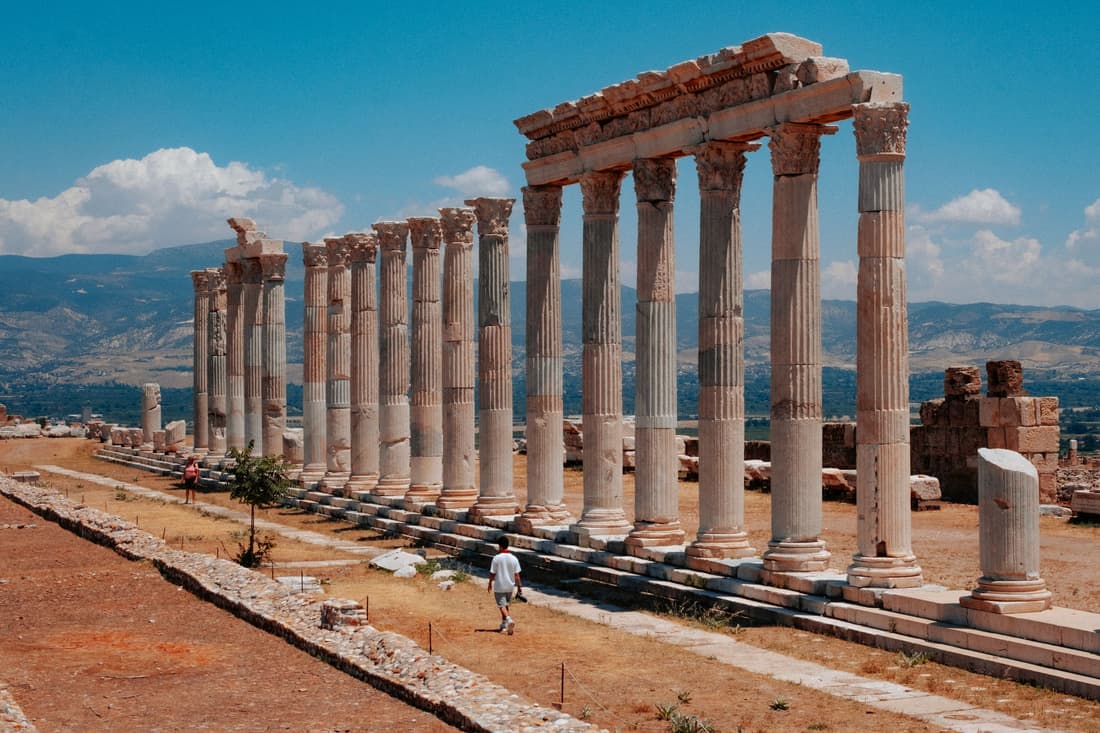
Locals believe a church once stood at the spot that the remains of one column mark. The source names Archangel Michael as the possible dedication. That spot is passed by a Pamukkale Colossae and Laodicea biblical cities tour from Istanbul. Columns are the marker the source names there, with no church wall.
On the eastern slope sits a theatre that probably seated around five thousand people. The theatre was probably built in the Roman period. The slope is reached by a Pamukkale Colossae and Laodicea biblical cities tour from Istanbul. Columns held up the scaenae frons, the high wall behind the stage of a Roman theatre.
A Roman theatre had a stage and a seating section, the cavea. The cavea was sometimes built on a slope, where stacked seating was easy to make. Roman theatres hosted events such as plays, pantomimes, choral events, orations and commerce. Ceramic finds around the Colossae theatre confirm early occupation in the third and second millennia BC.
Readers interested in Laodicea can open Pamukkale Laodicea Tour From Istanbul.
A tell is an artificial mound made of the stratified debris of consecutive settlements at one site. A classic tell looks like a low, truncated cone with sloping sides and a flat top. The Turkish word for such a town-mound is hoyuk. At Colossae the site has a biconical acropolis almost thirty metres high and spreads over almost nine hectares.
Colossae lay southeast of Laodicea along the Lycus Valley road, below Mt Cadmus. The ancient roads from Ephesus and Sardis joined there, an Ege University paper says. The hill was defensible and well watered, a strategic point in antiquity. The archaic city stood on the shore of Aksu Brook.
Surface pottery was studied to date the habitation of Colossae and its local pottery forms. The material obtained places the settlement between the Late Chalcolithic and the Byzantine periods. The first years of the Pamukkale University project are surface surveys of pottery and landscape. The greater part of archaeological attention has centred on nearby Laodicea and Hierapolis.
Jerash, in Jordan, keeps the original road surface of its Roman cardo. Colossae has column sections for its street line. That contrast is met by a Pamukkale Colossae and Laodicea biblical cities tour from Istanbul. Columns at Jerash make a colonnaded cardo the main feature of the city.
Hellenistic tombs lie northeast of the tell, probably outside the city walls. One style joins a front room to an inner chamber. The other is an underground chamber reached by stairs. Ancient Colossae lies north of medieval Chonae, and the two sites are separate. The Honaz entry says that little of the ancient city survives.
What did a marble block with the water law of Laodicea record, as read with a Pamukkale Colossae and Laodicea biblical cities tour from Istanbul?
Marble carries the water law of Laodicea, issued in AD one hundred and fourteen. The block was found at the Trajan fountain. Follow its story with a Pamukkale Colossae and Laodicea biblical cities tour from Istanbul. Marble held the rules of a hill without water.
A rare marble block came out of the ground at Laodicea in two thousand and fifteen. It carries the inscription of the water law. That law deals with water that flowed into the city from the mountains. Archaeologists made the find while they dug along Stadium Street.
The Trajan fountain stands at the south end of the west portico of Stadium Street. The law came to light on the east wing of its front, the side facing the square. Look for that spot with a Pamukkale Colossae and Laodicea biblical cities tour from Istanbul. Marble is the stone of the block itself.
The fountain was built in the reign of Trajan, between AD one hundred and thirteen and one hundred and fourteen. Its front carried four granite columns and eight marble columns. Inside stood a pool with an apse and a gallery of columns. Water came to the fountain from its north side.
The inscription deals with water use, cleanliness, protection of the supply line and the sharing out of the flow. It also sets the duties of the officials in charge and the penalties for offenders. Read about those rules with a Pamukkale Colossae and Laodicea biblical cities tour from Istanbul. Marble holds them all.
The city stood on a hill spur between the narrow valleys of two small rivers, the Asopus and the Caprus. The platform held no water of its own. The main supply came from the Baspinar spring in Denizli. Remains of the aqueduct that carried it begin there, kilometres from the town.
The line crossed a valley by an inverted siphon, a double pipeline under pressure. Its pipes were large carved stones. Lime in the water built a thick crust, and certain pipes choked up completely. See that stone with a Pamukkale Colossae and Laodicea biblical cities tour from Istanbul. Marble held the law, while travertine held the water.
Four fountains can be seen in the city of Laodicea. The line ends at a terminal tank, a distribution tank for the water. Clay pipes of different widths lead out of it. A small fountain stands west of the tank, next to a vaulted gate. A second terminal, with a settling tank, lies farther north.
The Trajan fountain stayed in use for a while after AD three hundred and thirteen. An earthquake in AD four hundred and ninety-four dropped its rear colonnade into the building. The fountain then lost its function. Trace that history with a Pamukkale Colossae and Laodicea biblical cities tour from Istanbul. Marble is also the stone of eight front columns.
A paper by two authors studies how Laodicea got its water. They link the decline of the city in the seventh century AD to the breakdown of that system. The travertine pipes have stayed in place and are known as symbols of the water supply of Laodicea. The aqueduct itself seems to have fallen in an earthquake.
More about Laodicea: Pamukkale Laodicea Tour From Ankara.
Pamukkale University excavates the site, and restoration follows the digging. The site entered the tentative list of World Heritage sites in Turkey in two thousand and thirteen. Place the law block in that setting with a Pamukkale Colossae and Laodicea biblical cities tour from Istanbul. Marble is the rare find of the digs.
What does the West theatre of Laodicea hold, as read for a Pamukkale Colossae and Laodicea biblical cities tour from Istanbul?
Eight thousand spectators sat in the West theatre of Laodicea, a Hellenistic bowl dug into a hillside. The ruins of Laodicea are on the plan for a Pamukkale Colossae and Laodicea biblical cities tour from Istanbul. Seats there stayed in use until the early seventh century AD.
The West theatre stands at the western end of the city centre, on the east-facing slope of Asopos Hill. It was not raised on flat ground. Builders dug it out of the natural ground in the Hellenistic way, so the rows climb steeply from the orchestra.
Excavators date the West theatre to the second century BC, the Hellenistic period. Alterations followed in the time of Augustus and Tiberius, and again in the Severan period. Laodicea follows Colossae on day one, as planned for a Pamukkale Colossae and Laodicea biblical cities tour from Istanbul. Seats form virtually complete banks of stone in the restored bowl.
The outer analemma wall wraps the bowl, making the full width ninety-four and a half metres. A walkway six point four metres wide runs between the last row and that wall. These figures are worth keeping for a Pamukkale Colossae and Laodicea biblical cities tour from Istanbul. Seats alone form a bowl, the cavea, eighty-five metres across.
Seven stairways divide the bowl into nine sections, called kerkides. The theatre also faces west, toward the breezes that start in the city in the afternoon. That layout helps a reader prepare for a Pamukkale Colossae and Laodicea biblical cities tour from Istanbul. Seats at the top end have railing channels behind them, with square sockets for bases.
Excavators classified two hundred and fourteen travertine seat steps, eighty-three travertine diazoma blocks and forty-five marble seat steps. The diazoma is the walkway that crosses the seating bowl. That tally adds detail for a Pamukkale Colossae and Laodicea biblical cities tour from Istanbul. Seats came in two stones, travertine and marble.
The stage building of the West theatre held seven boxes, the excavation team found. In the reign of Valens, an earthquake collapsed the stage building, and builders repaired it again. In the early fifth century AD, it became part of the city walls, which circled half the city.
The theatre has a lodge of honour. The lower bank also holds a protocol box, set five steps above the orchestra. These details matter for a Pamukkale Colossae and Laodicea biblical cities tour from Istanbul. Seats carry letters on the front of the steps, and excavators link them to a ticketed seating plan.
The orchestra is the flat ground below the seats. Its floor was once covered with opus sectile, a paving laid from shaped pieces of stone. The larger part of that paving was destroyed or taken away. The orchestra is also filled with fragments of travertine and marble building blocks.
The West theatre stayed in use without a break until an earthquake in the reign of Phocas. The North theatre belongs to the second century AD and is made entirely of marble. It was added when the West theatre no longer met the needs of a growing population. At one hundred and ten metres across, it is the larger.
Restoration of the West theatre follows one aim, minimal intervention. Missing parts are to be completed with old small travertine blocks and stones found on the site. Around the theatres, the city also had a stadium, baths, temples, a gymnasium and a bouleuterion, the Senate House.
What do the colonnaded streets of Laodicea look like, as read on a Pamukkale Colossae and Laodicea biblical cities tour from Istanbul?
Colonnades and pedestals stand beside the streets of Laodicea. Syria Street is seven metres and thirty centimetres wide in the excavated parts. Seen on a Pamukkale Colossae and Laodicea biblical cities tour from Istanbul, Streets here have shop doors behind each portico.
The article on Laodicea states that streets cross the town beside colonnades and pedestals. Day one of this route reaches these ruins on a Pamukkale Colossae and Laodicea biblical cities tour from Istanbul. Streets such as Syria Street run from east to west, and Stadium Street cuts across it from north to south.
The Pamukkale University excavation team gives exact sizes for Syria Street in the dug parts. The street itself is seven metres and thirty centimetres wide. A portico runs along each side, four metres and thirty centimetres wide. Two steps lead up to each portico, and shop doors open behind it.
Pamukkale also features in Pamukkale Calcium Terraces and Aphrodisias Tour From Istanbul.
A main sewer runs down the middle of Syria Street. It is one metre and twenty centimetres wide and one metre and eighty-five centimetres high. Read about that channel on a Pamukkale Colossae and Laodicea biblical cities tour from Istanbul. Streets here follow the land, and Syria Street slopes down towards the east.
A probe in Stadium Street exposed a central sewer sixty centimetres wide and one metre and sixty centimetres deep. Its floor is made of travertine blocks, which also form the floor of the road. Because the street rises from north to south, waste water from the buildings beside it flows north.
Three pedestal bases from the Early Byzantine period were found on the north portico of Syria Street. Read about them on a Pamukkale Colossae and Laodicea biblical cities tour from Istanbul. Streets also yielded coins of the fourth to the sixth century, which date the last use of the road.
The north portico floor of Syria Street was covered with rectangular marble slabs. The slabs are damaged, but part of the floor remains in place. About fifty metres of street paving came to light in front of the Septimius Severus fountain and Temple A. There the street is about seven and a half metres wide.
Stadium Street was laid out with a Doric front in the reign of Domitian, between AD eighty-one and ninety-six. The excavators link it to the proconsul Frontinus, in AD eighty-four and eighty-five. Note those dates on a Pamukkale Colossae and Laodicea biblical cities tour from Istanbul. Streets here stayed in use for centuries.
In its first phase Stadium Street was four metres and ninety centimetres wide. A rebuilding in the third century widened it by narrowing the porticoes. After that the width varies from six metres and ten centimetres to seven metres and fifty centimetres. The result is close to the width of Syria Street.
Only the west portico of Stadium Street still shows its supports. Rectangular piers stand on travertine blocks beside the street, with three columns between each pair. Read about that plan on a Pamukkale Colossae and Laodicea biblical cities tour from Istanbul. Streets here carry columns three metres and eighty to ninety centimetres high, base and capital included.
Shop doors open behind both porticoes of Stadium Street. In places, steps lift a shop door above the portico floor. A vaulted storeroom lies behind a shop on the east portico, south of the Caracalla Nymphaeum. The article on Laodicea adds that a bishop’s seat and a Christian centre grew in the town from early on.
What was the agora of Hierapolis built from, as told around a Pamukkale Colossae and Laodicea biblical cities tour from Istanbul?
Travertine and marble blocks are the stones the Denizli culture office names. It says the North Agora of Hierapolis became a quarry for those blocks. Read around a Pamukkale Colossae and Laodicea biblical cities tour from Istanbul, Agora stone went into later walls.
The agora was laid out on ground with an older story. The culture office says the area lay outside the settlement and served as a necropolis and a workshop zone. Diggers found kilns with round firing chambers there. They also found Megarian bowls with relief decoration, dated from the second century BC to the first century AD.
The trade agora was planned after the earthquake of AD sixty, the culture office says. It filled the wide ground between Frontinus Street and the slopes of the eastern hill. Told around a Pamukkale Colossae and Laodicea biblical cities tour from Istanbul, Agora lies east of the street. The text names the result the Hierapolis trade agora.
The finished agora was one of the largest in Asia Minor, the office writes. It was a hundred and seventy metres wide and two hundred and eighty long. The text dates it to the second century AD. Systematic research began in nineteen seventy-nine. Excavations defined the plan, and the marble blocks found were arranged.
The culture office also names a monumental North Agora. It was built in the second century AD, in the time of the emperor Antoninus Pius. The office says it was levelled and rebuilding was not possible. Met around a Pamukkale Colossae and Laodicea biblical cities tour from Istanbul, Agora stone moved elsewhere.
A city wall was built that left the North Agora outside it. The agora itself turned into a quarry. Marble and travertine blocks were taken from it for later construction. Pictured around a Pamukkale Colossae and Laodicea biblical cities tour from Istanbul, Agora marble served twice.
The article on Hierapolis links the agora to a gate. It says the north gate rose from reused stone taken when the Agora was pulled down. The Denizli text dates that gate to the late fourth century. The south gate used travertine blocks and reused material, marble among it.
For more on Cities, see Izmir Ephesus Biblical Cities Tour From Istanbul.
A study of the city walls adds detail. The abstract dates the walls late in the fourth century, or right at the beginning of the fifth. Builders recycled blocks from public buildings of the imperial age and from burial buildings. Seen around a Pamukkale Colossae and Laodicea biblical cities tour from Istanbul, Agora blocks were one source.
Stone for the northern stretch of wall came from burial grounds and shops along the main street. The North Theatre and the North Agora supplied blocks too. The Gymnasium and other central buildings gave blocks, especially for the eastern and southern sectors. The position of the recycled blocks let researchers rebuild the routes that carried stone to the wall.
Hierapolis had great baths among its biggest buildings, built around the natural thermal pools. The remains of the great bath complex date to the second century AD. Read around a Pamukkale Colossae and Laodicea biblical cities tour from Istanbul, Agora and baths share that century. Traces show that the inner rooms were lined with marble.
The great bath follows the plan of other typical Roman baths. A large courtyard lies at the entrance, then a closed rectangular area with a large hall on each side. Then comes the main bath building. Its solid walls and parts of its vaults have survived.
What makes the necropolis of Hierapolis notable, as seen over a Pamukkale Colossae and Laodicea biblical cities tour from Istanbul?
Hierapolis keeps a burial ground ranked among the well preserved in Turkey. Seen over a Pamukkale Colossae and Laodicea biblical cities tour from Istanbul, Necropolis tombs line an old road. Graves stand on both sides of that road for more than two kilometres.
Hierapolis put its dead outside the city walls. The way there ran along the colonnaded main road, past the outer baths. Graves stood on both sides of the old road to Phrygian Tripolis and Sardis. Pictured over a Pamukkale Colossae and Laodicea biblical cities tour from Istanbul, Necropolis graves reach round the old town.
The sources give about twelve hundred tombs for the burial ground. Excavators have opened the larger share of them. Builders worked mainly in local limestone, and marble appears in places. The bulk date from the late Hellenic period. Roman and early Christian graves stand there too, in good number.
By the second century BC, the warm springs served as a spa. Guests who retired or died in the town help explain the large necropolis. Visitors seeking medical care and the native people both buried their dead here. Viewed over a Pamukkale Colossae and Laodicea biblical cities tour from Istanbul, Necropolis tombs followed custom and social standing.
The sources sort the tombs and funeral monuments into four types. The first type is the simple grave for common people. Poor families cut their tombs into the rock, and these stay plain. The second type is the sarcophagus. A number stand on a base, while others are hollowed out of the rock.
A good number of the sarcophagi carry a double-pitched roof. Marble examples bear reliefs and epitaphs. These name the dead, give their trades and praise their good deeds. Robbers have emptied the larger part of them over the years. Taken over a Pamukkale Colossae and Laodicea biblical cities tour from Istanbul, Necropolis epitaphs still reveal much about the townspeople.
The third type is the circular tumulus. It is a round mound that is sometimes hard to pick out. A narrow passage leads inside to a vaulted chamber. The oldest graves in the burial ground belong to this type. They date to the first and second centuries BC and lie on the east side of the foothill.
Those mound tombs belonged to rich families. The fourth type is the larger family grave. Such graves are at times monumental and look like small temples. On the north side, walls surround the graves, and gardens hold flowers and trees. Drawn over a Pamukkale Colossae and Laodicea biblical cities tour from Istanbul, Necropolis gardens favoured cypress above all.
One grave tied to the necropolis stands on the way to Laodicea and Colossae. A long epigraph gives the name of its owner, Talamos. Seen over a Pamukkale Colossae and Laodicea biblical cities tour from Istanbul, Necropolis tomb fronts here resemble a home. The sources note that this front draws the eye.
One sarcophagus in the north necropolis shows a raised relief of a mill. Its owner, Marcus Aurelius Ammianos, was a local miller. On the pediment, a waterwheel fed by a mill race turns a gear train. The gears move two frame saws. Scholars read the scene as a water-powered sawmill.
For more on Pamukkale, see Ephesus Pamukkale Tour From Istanbul.
The Greek inscription beside the relief credits the machine to the owner’s skill with wheels. The sources call the carving the earliest known case of a crank and rod at work. The ministry of culture rates the full burial ground as the largest in south-west Anatolia.
What restorations has the theatre of Hierapolis seen, as reached beyond a Pamukkale Colossae and Laodicea biblical cities tour from Istanbul?
Important restorations of the Hierapolis theatre stretched from two thousand and four until two thousand and fourteen. Their story reaches beyond a Pamukkale Colossae and Laodicea biblical cities tour from Istanbul. Restoration of the first storey of the stage wall fell to Italian architects.
The theatre was probably built under the emperor Hadrian, after the earthquake of AD sixty. The front of its stage building is ninety-one metres long, and the whole length still stands. The stage itself is three point seven metres high. The wall behind it had five doors and six niches for statues.
Septimius Severus later renovated the theatre and decorated its stage wall. A study of the Severan building site follows the work from an early to a late period. The wall’s record goes beyond a Pamukkale Colossae and Laodicea biblical cities tour from Istanbul. Restoration since nineteen seventy-seven has recovered arches and part of the stage floor.
A marble study sampled the stone of the stage wall in a systematic way. The marble of its three orders, or levels, came mainly from the Marmar Tepe and Thiounta quarries. White and coloured marbles, local and imported, stress the middle section. A dedicatory inscription names Dokimeian marble. Craftsmen from Aphrodisias are assumed to have joined the decoration.
Sculptural reliefs with mythological subjects were placed on the different storeys of the stage wall. In the Theatre Gallery, decorative works from the theatre are on display. The carvings carry the story beyond a Pamukkale Colossae and Laodicea biblical cities tour from Istanbul. Restoration has treated the larger share of those works.
Eight stairways run up through the seating and cut it into sections. A walkway called the diazoma divides the seating into two parts. Two vaulted passages, the vomitoria, lead onto that walkway. An imperial loge sits at the middle of the seating. A wall about one point eight metres high rings the orchestra.
The building has a history that stretches beyond a Pamukkale Colossae and Laodicea biblical cities tour from Istanbul. Restoration is not the only change: marble seats replaced limestone ones. The orchestra was probably changed into an arena for water shows, a fashion of the time. A seventh-century earthquake caused the whole building to collapse.
The stage rested on stone arches that formed a corridor beneath it. Ten Corinthian columns, decorated with seashell motifs, supported the entablature. The proscenium had two storeys, with ornate niches at the sides. An inscription at the first diazoma calls Hierapolis “mistress of the Nymphs”. The text adds that streams of water adorned the city.
A nymphaeum was a monument consecrated to the nymphs, especially those of springs. The Nymphaeum at Hierapolis lies inside the sacred area, set in front of the temple of Apollo. Its history extends beyond a Pamukkale Colossae and Laodicea biblical cities tour from Istanbul. Restoration is not only modern: the fountain was repaired in the fifth century.
As a monumental fountain, it distributed water to the houses of the city through a network of pipes. The plan is U-shaped, and the building stands on the continuation of the main colonnaded road. The surviving parts are the rear wall and a side wall on each flank.
Part of the peribolos, the enclosure of the Apollo temple, was dismantled for the large fountain. A retaining wall was built with elements of that enclosure. The temple’s story reaches beyond a Pamukkale Colossae and Laodicea biblical cities tour from Istanbul. Restoration also marks the temple, rebuilt in the third century from the blocks of the older one.
What did Papias of Hierapolis write, as read below a Pamukkale Colossae and Laodicea biblical cities tour from Istanbul?
Papias, bishop of Hierapolis, wrote the Exposition of the Sayings of the Lord in five volumes. Irenaeus and Eusebius quote brief excerpts. Below a Pamukkale Colossae and Laodicea biblical cities tour from Istanbul, Exposition survives only in those quotations.
Papias gave his book a Greek title, logion kyriakon exegesis. Below a Pamukkale Colossae and Laodicea biblical cities tour from Istanbul, Exposition renders the last Greek word of that title. Outside Christian writing, the Greek word logia carried the ordinary meaning of oracles. Since the nineteenth century, readers have taken it as sayings.
Papias lived in Hierapolis, in Phrygia in Asia Minor, and flourished in the early second century. His name was common in the region, which points toward a local man. His exact dates are unknown, though tradition puts his birth between sixty and seventy AD. Hierapolis itself lay close to Laodicea and Colossae in the valley of the Lycus.
Much of what is known about him comes from later writers and from clues in his own book. Irenaeus, a disciple of Polycarp of Smyrna, calls him an ancient man, John’s hearer and Polycarp’s companion. Below a Pamukkale Colossae and Laodicea biblical cities tour from Istanbul, Exposition is the only work Irenaeus names.
More about Pamukkale: Pamukkale Aphrodisias and Ephesus Tour From Istanbul.
Eusebius records five books of Papias as extant in his day. Irenaeus quotes the fourth book and states that five were written. A scholarly consensus dates the work to around one hundred and ten AD. The range runs from one hundred to a hundred and twenty, with later dates also cited.
In the preface he promises to put down, beside his interpretations, what he learned with care from the elders. Below a Pamukkale Colossae and Laodicea biblical cities tour from Istanbul, Exposition is a commentary with oral reports added. Those reports fall into two kinds. One came straight from the elders, the other second-hand from followers who visited Hierapolis.
Two named informants stand out in the preface, Aristion and the presbyter John. Aristion was probably bishop of nearby Smyrna. John the Elder lived in nearby Ephesus. Both cities stood not far from Hierapolis. Eusebius adds that Papias frequently names both and gives their traditions in his writings.
The passage ends with a remark about books and the living and abiding voice. Readers take it in two ways. One view holds that spoken sources outranked written ones in his day. The other treats living voice as a set phrase for personal teaching, so Papias preferred direct instruction to books alone.
Eusebius keeps a passage from Papias about Mark, Peter’s interpreter. In it, Mark wrote from memory, in no fixed order, and took care to omit nothing he had heard. No earlier account of the Gospel writers has come down to us. Below a Pamukkale Colossae and Laodicea biblical cities tour from Istanbul, Exposition is the book it came from.
The second passage kept by Eusebius concerns Matthew. Matthew set the logia in order in the Hebrew language, and each person gave his own interpretation. The Greek word for Hebrew stood for either Hebrew or Aramaic. Eusebius adds that Papias used testimonies from the first letter of John and from that of Peter.
Extracts appear in other writings, a number of them citing a book number. Once the comments of Eusebius are set aside, a reliable core remains. That core holds the title, a preface excerpt and the passages on Mark and Matthew. Below a Pamukkale Colossae and Laodicea biblical cities tour from Istanbul, Exposition is an early source on oral tradition.