A Pamukkale calcium terraces and Aphrodisias tour from Istanbul fills two days around Denizli. The plan flies from Istanbul to Denizli, visits Aphrodisias and its museum, then spends the night near Pamukkale. Boat days in the islands live under Greece Tours on the homepage.
Day two climbs the white terraces of Pamukkale and walks the ruins of Hierapolis beside the thermal pools. The cards below lead to live GetYourGuide booking pages.
What names did the city carry before it was called Aphrodisias, seen in a Pamukkale calcium terraces and Aphrodisias tour from Istanbul?
Ninoe, Lelegon Polis and Megale Polis were the city’s three Greek names before it became Aphrodisias, as the Suda records. The list is worth knowing before a stop in a Pamukkale calcium terraces and Aphrodisias tour from Istanbul. Ninoe is the third name on it.
The later name comes from Aphrodite, the Greek goddess of love. Excavators describe the city as known above all for the sanctuary of its patron goddess and its marble sculptors. The city also had schools of sculpture and of philosophy. Three other Greek names came before the one built on her name.
For routes beyond Denizli, see Turkey tours from Istanbul to Cappadocia and the south coast.
The Suda is a large Byzantine encyclopedia, written in Greek, with about thirty thousand entries. Its compiler probably lived in the second half of the tenth century. Its list serves anyone planning a day in a Pamukkale calcium terraces and Aphrodisias tour from Istanbul. Ninoe is one of the three names the book hands down.
Lelegon Polis heads the list, and its Greek words point to the Leleges. They were an old people of the Aegean region, there before the Greeks arrived. Greek authors link the Leleges with the Carians of south-west Anatolia. Strabo attributes to them a group of deserted forts and tombs in Caria.
The second name, Megale Polis, means Great City in Greek. Such names belong to the story told in a Pamukkale calcium terraces and Aphrodisias tour from Istanbul. Ninoe belongs to a smaller place, an original village with a cult of Zeus Nineudius. The same scholarly source says it later became a real city.
The excavation project reports a small settlement on the Theatre hill from the end of the Bronze Age. It lasted until the city was founded. The ground there gave up large amounts of Lydian and Carian pottery from the later seventh century and the sixth. The older sanctuary of Aphrodite then made the spot an obvious choice for the town.
The elite of Aphrodisias linked their founding to an Assyrian ruler, known in Greek as Ninus. Ninus is also named as the eponymous founder of Nineveh. Before she was known as Aphrodite, the sanctuary served a local goddess. She was identified with Aphrodite in the Hellenistic period.
Later the city was renamed Stauropolis, Greek for City of the Cross. The change aimed to remove pagan connotations from the old name. Both naming layers matter to anyone with an interest in a Pamukkale calcium terraces and Aphrodisias tour from Istanbul. Ninoe sits in the older layer, beside the other two Greek names.
Later still the city was known as Caria, after the surrounding region. That name gave rise to its modern Turkish name, Geyre. The excavation project says a Turkish village called Caria, equal to Geyre, grew up on the site. The one site thus holds Greek, Christian and Turkish names.
Aphrodisias was the provincial capital, the metropolis, of the Roman province of Caria. Caria itself was a region of western Anatolia, with Lycia to the south and Phrygia to the east. The word Caria thus names a region, a province and, later, the city itself.
In Byzantine times the city was the seat of a fiscal administrative unit, a dioikesis. The excavation project calls Aphrodisias a medium-sized town in ancient terms. It covered seventy-two hectares, with an estimated population near ten thousand. The project also describes the ruins as remarkably preserved.
Karacasu, the district that holds the ruins, was formerly called Yenisehir. The town of Karacasu is thought to stand on the lost city of Gordiouteichos. Any of these names can appear in a Pamukkale calcium terraces and Aphrodisias tour from Istanbul. Ninoe ends the list of earlier names.
What makes the village of Geyre stand where it does, near a Pamukkale calcium terraces and Aphrodisias tour from Istanbul?
Geyre is a village in Karacasu district, Aydin Province, built by the Turkish government around nineteen sixty. Near a Pamukkale calcium terraces and Aphrodisias tour from Istanbul, Geyre replaced an older village that stood over the ruins.
Geyre is a neighbourhood of Karacasu, a district in the south-east of Aydin Province. Before the reorganisation of two thousand and thirteen, it was a town, called a belde in Turkish. It lies about two hundred and thirty kilometres south-east of Izmir. It stands about a hundred kilometres inland from the Aegean coast.
Near a Pamukkale calcium terraces and Aphrodisias tour from Istanbul, Geyre has a name from Caria. Caria was the historic cultural region in which the city stood. The name is commonly accepted as a Turkish form linked to Caria. The relocated village also goes by the name Yeni koy.
The first village grew up on and around the ruins of the ancient Greek city. Settlers came for the fertile soil and plentiful water. For a long time the villagers lived side by side with the ancient remains. Carved stones, columns and inscribed blocks became part of everyday village life.
A photojournalist, Ara Guler, stopped at Geyre while returning from the opening of the Kemer Dam in Aydin. He noticed ancient remains in use as part of village life. He photographed the area the next day. The pictures drew national and international attention back to Aphrodisias.
Readers interested in Aphrodisias can open Aphrodisias Pamukkale Tour From Istanbul.
The ancient city and the village share one valley, in the interior of the Buyuk Menderes Basin. The Dandalaz River, called the Morsynus in antiquity, formed that valley. Fertile soil, water and tree cover on the valley floor gave the city favourable conditions. Geyre itself stands at an average height of around six hundred metres.
Karacasu district covers seven hundred and twenty-seven square kilometres and lies eighty-seven kilometres from the city of Aydin. The road in turns south-east off the Aydin to Denizli road at Kuyucak. It heads upstream along the Dandalaz River into the hills. Olives and citrus fruits grow beside the winding road, with pines higher up.
The ruins of Aphrodisias lie inside the district. Near a Pamukkale calcium terraces and Aphrodisias tour from Istanbul, Geyre is the small town beside them. People first settled the area in the Bronze Age. Marble working there reached its peak in Roman and Byzantine times.
Near a Pamukkale calcium terraces and Aphrodisias tour from Istanbul, Geyre stands where it does for two reasons. Earthquakes threatened the stone houses of the first village. The rediscovered site also needed protection, with its Bronze Age settlement, its Greek and Roman city and its Byzantine remains.
Major earthquakes had struck the old village, but it did not suffer extensive destruction. The authorities still decided to move it. Building at the second site started in the early nineteen sixties. The move came as digging resumed on the ruins. It was a gradual change, not a single step.
Houses of the old village stood on and around the city’s key buildings. The move made it possible to dig out the theatre, temple, agora and other large monuments more systematically. Expropriation and relocation went on until the late nineteen seventies. Near a Pamukkale calcium terraces and Aphrodisias tour from Istanbul, Geyre was rebuilt a short distance away.
Cottages were removed in the twentieth century to reveal the older city. The area of the old village is identified with the museum and the archaeological site. Near a Pamukkale calcium terraces and Aphrodisias tour from Istanbul, Geyre is the neighbourhood that holds the museum. Settlement, farming and tourism in Geyre are assessed in line with the site’s status.
What did the museum keep from the earliest periods, beside a Pamukkale calcium terraces and Aphrodisias tour from Istanbul?
Mounds called Acropolis Hill and Pekmez Hill supplied the museum’s prehistoric finds from the Chalcolithic and Bronze Age. The museum sits inside the site, beside a Pamukkale calcium terraces and Aphrodisias tour from Istanbul. Mounds gave it its oldest finds.
The Chalcolithic is also called the Copper Age, a period marked by growing use of smelted copper. The museum shows finds from that age and from the Bronze Age. Its marble pieces were made between the first century BC and the fifth century AD. The prehistoric finds are far older than that marble.
An article in the journal Belleten describes two conical rises on the plateau where the city stands. It calls them not very prominent, yet both carry prehistoric settlement. The Acropolis rise is twenty-four metres high, with the theatre remains on its east side. Pekmez Hill is thirteen metres high. The article measures both against the surrounding ground.
Two old names deserve a note beside a Pamukkale calcium terraces and Aphrodisias tour from Istanbul. Mounds got them in different ways. Villagers pressed grapes in ancient sarcophagi to make pekmez, a grape syrup. Kenan Erim named the second hill for it. An early excavator wrongly called the first hill the Acropolis, which is not a true acropolis.
A season report by Kenan Erim, who led the digs until his death, covers Pekmez. It says the analysis of the Chalcolithic and Early Bronze Age finds from the mound was completed. Those finds came from the digs of nineteen sixty-seven to nineteen seventy. The report is about the season of nineteen seventy-seven.
About thirty-six thousand pottery fragments from the early levels of Pekmez were sorted into a type series. The record covers shape, fabric, colour, inclusions, hardness and decoration. These numbers are set beside a Pamukkale calcium terraces and Aphrodisias tour from Istanbul. Mounds such as Pekmez supplied the pottery. Over a thousand distinctive pieces were drawn and described.
Stone tools got a study of their own. The chipped stone industry was analysed, with a descriptive catalogue and drawings. Small finds were documented as well. They include idols, pyramidal spindle whorls, ceramic disks, whetstones, and hammer and burnishing stones. Pyramidal here means shaped like a pyramid. The same season report lists them.
Chalcolithic sites were once taken to be one-settlement sites. That idea did not hold for Aphrodisias. The result is told beside a Pamukkale calcium terraces and Aphrodisias tour from Istanbul. Mounds like Pekmez showed overlapping cultures in their early levels, with continuous development. One Pekmez trench was also re-examined and described level by level, with plans and sections.
Aphrodisias lies in the Karacasu tectonic trough. A paper in the Aegean Geographical Journal says plenty of water reaches the surface there. It ties the early settlements to that water. The setting matters beside a Pamukkale calcium terraces and Aphrodisias tour from Istanbul. Mounds rose from fertile soil, where water sources are ample.
A project funded by the Institute for Aegean Prehistory assessed the Bronze Age material from the old excavations. More than a thousand boxes were examined and compared with prehistoric material in the main museum depots. Three Early Bronze Age contexts from the Acropolis Mound were singled out for close study. They were houses lost in great fires.
The project’s reading list on prehistory names a study of Late Chalcolithic figurines from Aphrodisias. Another covers chance finds of the Anatolian Early Bronze Age in the Aphrodisias Museum. The titles stand beside a Pamukkale calcium terraces and Aphrodisias tour from Istanbul. Mounds fill a monograph titled Prehistoric Aphrodisias, an account of the excavations and the artefact studies.
Whose carved tomb reliefs stand in the museum, past a Pamukkale calcium terraces and Aphrodisias tour from Istanbul?
Zolios, a freedman of Octavian, is honoured by marble tomb reliefs in the Aphrodisias Museum. No trace of the tomb building has turned up. Past a Pamukkale calcium terraces and Aphrodisias tour from Istanbul, Zolios is still named in labels beside the figures.
The museum article writes the name Zolios, while the research database writes Zoilos. Both mean the same man, a slave who became a freedman of Octavian, later called Augustus. He came home to Aphrodisias and became a major benefactor. The reliefs come from a funerary monument, or heroon, that honoured him.
Where the monument stood is unknown. Past a Pamukkale calcium terraces and Aphrodisias tour from Istanbul, Zolios appears on panels of Aphrodisian marble. The database lists a Zoilos Panel, a Demos Panel, an Aion Panel and a Polis Panel. The stone was identified by eye.
The excavation team describes the main frieze as two groups of three figures. Inscriptions identify every figure. The frieze, the team deduces, covered the sides of a square mausoleum; none of that building has been found. The frieze presents an allegorical account of the life and virtues of Zolios.
Past a Pamukkale calcium terraces and Aphrodisias tour from Istanbul, Zolios shows how the carvers dealt with block joins. Figures stay clear of those joins, except for projecting arms. The right hand of Zolios projects out of the right-hand block instead. One reading is that the carving came before the blocks went into the monument.
Surface work is on record too. Deep folds in the drapery were probably cut with a channelling tool after drill work. The carvers took care that no tool marks survived. The very smooth surface suggests polishing with abrasives. Other blocks carry labels such as Eternity, Memory, Virtue and Faith.
For more on Aphrodisias, see Pamukkale Calcium Terraces and Aphrodisias Tour by Night Bus From Ankara.
The panels were found piece by piece. A drainage channel beside the north-east gate in the city wall gave up reliefs in nineteen fifty-six. Past a Pamukkale calcium terraces and Aphrodisias tour from Istanbul, Zolios panels kept coming to light in later seasons. A full study of the monument was printed at Mainz in nineteen ninety-three.
One scene shows Zolios in a long travelling cloak and cap. The excavators read it as an elevated picture of his return home from Rome. Other panels name Minos, the judge in the underworld, and Roma, whose label has not survived. They call the frieze the earliest figured marble monument in the city.
The portrait statue of Dometeinos shows a mature man with a full beard and a book roll. Past a Pamukkale calcium terraces and Aphrodisias tour from Istanbul, Zolios has company among the city’s portrait statues. The statue of his niece Claudia Tatiane Antonia bears the signature of its maker, Alexander son of Zenon.
Full-length statues were found in the region of the agora. Pilasters carry peopled scrolls, in which human figures, birds and animals twist through acanthus leaves. Counting whole chests, lids and fragments, the excavators list about seven hundred pieces of sarcophagus. Chests worked on three sides stood in tomb buildings; chests worked on all sides stood on open platforms.
Past a Pamukkale calcium terraces and Aphrodisias tour from Istanbul, Zolios gives way to an unfinished statue. It shows a mature man in three garments: a long-sleeved tunic, a short-sleeved tunic and a toga. That dress marks a late Roman senator, probably a provincial governor. The head was never finished and looks too large for the body.
The statue was found in a sculptor’s workshop. The workshop took over two rooms in a stoa, north of the Council House. Carving tools, apprentices’ practice pieces and part-finished statues lay inside. It stayed active until about the year four hundred AD. Another reading treats the space as a place for storing and altering statues.
Why did the city never regain its earlier prosperity after one quake, along a Pamukkale calcium terraces and Aphrodisias tour from Istanbul?
Ruin came to Aphrodisias with a quake of the early seventh century, and the city never regained its former prosperity. Along a Pamukkale calcium terraces and Aphrodisias tour from Istanbul, Ruin means roofless colonnades with marble columns left standing.
Aphrodisias stands in an earthquake zone, and quakes have damaged it heavily at different times. The sources name two severe spells of tremors, in the fourth and the seventh centuries. Both belong to the story told along a Pamukkale calcium terraces and Aphrodisias tour from Istanbul. Ruin in the seventh century was the second of those named spells.
One of the fourth-century quakes altered the water table, leaving parts of the town prone to flooding. Evidence of emergency plumbing, put in to fight the problem, survives. The plumbing is a detail of the site visited along a Pamukkale calcium terraces and Aphrodisias tour from Istanbul. Ruin of the earlier kind meant a fight against flooding.
From the fourth to the sixth century, Aphrodisias kept its classical life. That state lasted until the urban collapse of the early seventh century, the project’s history page says. Buildings were repaired after periodic earthquakes and kept as they were. The Tetrapylon, a monument of the second century, was dismantled, restored and set up again in the late fifth century.
The city prospered under the early and middle Roman empire, in the first and second centuries AD. In that time it built the complete set of marble buildings, the excavation project states. The Antonine years brought the greatest economic prosperity in the provinces, and grand marble building went on without a break.
White and blue-grey Carian marble was cut from slopes beside the city in Hellenistic and Roman times. Sculptors working this stone became known across the Roman world. The ministry says the sculpture school worked from the late Hellenistic to the early Byzantine period. Marble sarcophagi surged in production and use in the early third century.
Aphrodisias served as the capital, or metropolis, of the Roman province of Caria, the Oxford history page says. By the end of the third century it was among the largest cities of the Carian province, the ministry says. In Byzantine times the city was also the seat of a fiscal unit, called a dioikesis.
The city fell into disrepair after the early seventh century quake, the encyclopedia states. Public buildings fell into ruin, the excavation project writes. Along a Pamukkale calcium terraces and Aphrodisias tour from Istanbul, Ruin means an urban centre that was largely abandoned. The project says the life of the classical city was over by about AD six hundred.
The stadium dates from the first century AD, and it first served athletic events. A seventh-century earthquake then badly damaged the theatre. Part of the stadium was converted for the events once held in the theatre. Along a Pamukkale calcium terraces and Aphrodisias tour from Istanbul, Ruin in the theatre sent its events to the stadium.
Middle Byzantine Aphrodisias returned to a pattern of life like that of pre-Roman times, the excavation project says. It survived as a small cathedral town, the residence of a bishop. Along a Pamukkale calcium terraces and Aphrodisias tour from Istanbul, Ruin was followed by life on a smaller scale.
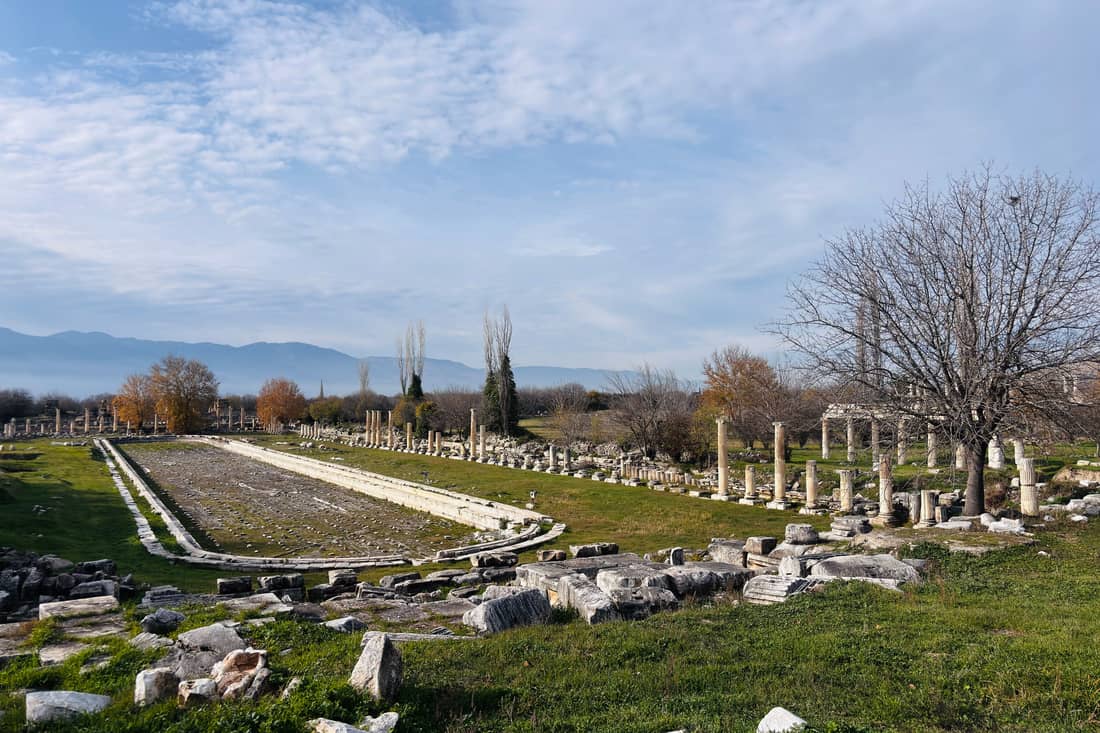
The Karacasu entry names a stadium, a temple, a theatre, an agora and a bath with a visible heating system. The upper twelve rows of seats in the council house have collapsed with their supporting vaults. Drones made a 3D map of the above-ground ruins in September of the year two thousand and fourteen.
What kind of goddess did the city’s cult image show, at a Pamukkale calcium terraces and Aphrodisias tour from Istanbul?
Image of a local Carian goddess lay behind the city’s cult, dating to the Archaic period or earlier. Greeks later matched her with Aphrodite, as told at a Pamukkale calcium terraces and Aphrodisias tour from Istanbul. Image of her follows an Anatolian pattern.
Her story starts with a local goddess. Scholars trace the Aphrodite of Aphrodisias to the Archaic period or earlier and call her Carian. She was a distinctive deity of this region. By interpretatio graeca, she came to be identified with the Greek Aphrodite. Her cult image is described as unique to Aphrodisias.
Her standard image fits an Anatolian pattern. Specialists link her to the Lady of Ephesus, a goddess honoured by Greeks and Romans as Artemis of Ephesus. The city is a day-one stop of this route, reached at a Pamukkale calcium terraces and Aphrodisias tour from Istanbul. Image panels on her thick tunic fall into four registers of standard scenes.
Every surviving image dates to the late phase of the cult, in Hellenistic and Roman times. Their settings must have been more civic than ritual. The style is lifelike, as in the culture around them, and it gave the local goddess a wider appeal. Images of her also survive from other parts of the Roman world.
Her feet stand close together and her forearms reach forward, to receive and to give. Necklaces adorn her, and a long veil frames her face down to the ground. Her pose is part of the figure met at a Pamukkale calcium terraces and Aphrodisias tour from Istanbul. Image of the goddess includes a floor-length chiton beneath the overtunic.
Carved bands on the tunic evoke the powers of the goddess over the cosmos. One band shows the heads of a married pair, the woman veiled. A scholar reads them as Gaia and Uranos, Earth and the Heavens. Another band shows Helios and Selene, parted by a pillar. At the base, a group of Erotes performs cult rituals.
The Temple of Aphrodite was a focal point of the town. Her cult image was once housed in the temple. The building was altered when it became a Christian basilica. Both stages belong to the site covered at a Pamukkale calcium terraces and Aphrodisias tour from Istanbul. Image of the goddess marks the earlier stage.
Pamukkale Aphrodisias and Ephesus Tour From Istanbul covers Aphrodisias too.
A pediment from the city shows the goddess at sea. In high relief, she sits on a half-shell within an arched frame. She is nude, and her legs are crossed. Her arms are raised to hold her long, wet hair. A marine Triton on each side carries the shell. Horizontal wavy lines show the sea.
The Tritons have long fish legs and horns. The younger one, on the right, is beardless and holds a ship’s steering oar. The older one is bearded and holds an anchor. This Atrium House find belongs to the city seen at a Pamukkale calcium terraces and Aphrodisias tour from Istanbul. Image of Aphrodite draws the admiring looks of both Tritons.
The pediment presents Aphrodite as goddess of the sea, in majesty, carried in procession by her marine attendants. The bands on the cult image hold a related figure, the marine Aphrodite riding a sea-goat. The sea therefore features on both works. A relief of the birth of Aphrodite, called Aphrodite Anadyomene, is kept in the Aphrodisias Museum.
Plentiful marble nearby helped the city’s sculptors to become renowned. Carian marble, white and blue-grey, came from the adjacent slopes. Trial pieces and unfinished works show a true school of sculpture. Their work belongs to the city visited at a Pamukkale calcium terraces and Aphrodisias tour from Istanbul. Image subjects ran from gods and heroes to emperors and athletes.
Who dug the first formal trenches at Aphrodisias, by a Pamukkale calcium terraces and Aphrodisias tour from Istanbul?
Gaudin, a French railway engineer, led the first formal excavations at Aphrodisias in nineteen hundred and four and five. The site is reached by a Pamukkale calcium terraces and Aphrodisias tour from Istanbul. Gaudin found friezes, pilasters and capitals there, and part of that haul sits in the British Museum.
European travellers knew the site from the eighteenth century, when expeditions recorded inscriptions built into the city walls. A visit by William Sherard in seventeen hundred and five heads the list. The Society of Dilettanti drew the monuments in eighteen hundred and twelve. Charles Texier came in eighteen thirty-five and published them in his Description de l’Asie Mineure.
The French team worked in the Temple of Aphrodite and, above all, in the Hadrianic Baths. Well-preserved portrait statues came to light there. The city is visited by a Pamukkale calcium terraces and Aphrodisias tour from Istanbul. Gaudin directed the work together with a colleague, and the dig covered two campaigns.
The two campaigns ended differently for the finds. Those of nineteen hundred and four were removed and sold in Izmir and in Europe. Those of nineteen hundred and five were brought to Istanbul under the leadership of Osman Hamdi Bey. Another French campaign, led by Andre Boulanger, lasted one season in nineteen thirteen.
The excavated city is entered by a Pamukkale calcium terraces and Aphrodisias tour from Istanbul. Gaudin located a building in its south-east quarter in nineteen hundred and four. It proved to be a Corinthian tetrastyle facade, re-used as a fountain. The front began as a temple facade that was dismantled, moved and re-erected here.
The fountain was built from re-used parts. Reliefs from another context filled the spaces between the column pedestals and formed the walls of the basin. Each of the four pedestals joins two column pedestals set one on top of the other. In its late antique position the building stood at a crossroads of the city grid.
Part of the building itself was excavated in nineteen eighty-nine. Two of the great monolithic columns have been raised again with their capitals. The complete entablature and pediment were rebuilt on the ground south of the trench. The project calls the high imperial architecture of the facade extremely well preserved.
A hall lies immediately south of the Theatre Baths. The city around it is reached by a Pamukkale calcium terraces and Aphrodisias tour from Istanbul. Gaudin excavated the hall in nineteen hundred and four and called it a gymnasium without good reason. The project proposes that it is part of a grand town residence of the high imperial age.
The Hadrianic Baths date to the early second century AD and were dedicated to the emperor Hadrian. The complex joins a great colonnaded forecourt to a series of vaulted bathing chambers. Together they fill two city blocks and meet the west colonnade of the Urban Park. Massive limestone blocks, covered with marble, form the chambers.
Kenan Erim was born in Istanbul in nineteen twenty-nine and died in Ankara in nineteen ninety. The ruins are visited by a Pamukkale calcium terraces and Aphrodisias tour from Istanbul. Gaudin led two campaigns of digging, while Erim directed the New York University project until his death. Erim excavated the main monuments over thirty years.
A grave memorial to Erim stands near the reconstructed Tetrapylon. Since his death the project has been based at the Institute of Fine Arts, New York University. Oxford University has joined it since nineteen ninety-five. Finds of importance from these excavations are on display in the museum, built on the site in nineteen seventy-nine.
Which four criteria did UNESCO use for Aphrodisias, with a Pamukkale calcium terraces and Aphrodisias tour from Istanbul?
Criterion ii, iii, iv and vi are the four cultural criteria UNESCO named for Aphrodisias in two thousand and seventeen. They frame a visit with a Pamukkale calcium terraces and Aphrodisias tour from Istanbul. Criterion numbers one to six are cultural; seven to ten are natural.
The World Heritage Committee added Aphrodisias to the list at its forty-first session. The excavation project places that decision in Krakow on the ninth of July. A Turkish ministry release names the same session and the same city. The release calls the place the Aphrodisias Archaeological Site.
This route holds two listed places, and each has its own entry. The Turkish tourism portal dates the Hierapolis-Pamukkale entry to nineteen eighty-eight. A visitor can check each criterion against the ruins with a Pamukkale calcium terraces and Aphrodisias tour from Istanbul. Criterion by criterion, the ruins answer the wording.
The World Heritage Convention was adopted by the UNESCO General Conference on the sixteenth of November, nineteen seventy-two. Turkey accepted it on the sixteenth of March, nineteen eighty-three. The first Turkish entries came at the ninth session, in nineteen eighty-five. Every nomination must show outstanding universal value and meet at least one of the ten criteria.
Criterion ii looks for an exchange of human values across time or within a cultural area. The ministry text cites sculpture that merged the local Aphrodite cult and Roman art. That work can be seen on site by visitors with a Pamukkale calcium terraces and Aphrodisias tour from Istanbul. Criterion ii names a blend of local, Greek and Roman traditions.
Criterion iii calls for unique, or at least exceptional, evidence of a cultural tradition or civilisation, living or vanished. The sculpture school stayed active from the late Hellenistic period to the early Byzantine period. Statues of gods, heroes, emperors, philosophers and athletes survive. The UNESCO summary adds that excavators dug a sculpture workshop in a systematic way.
Criterion iv wants an outstanding building type, ensemble or landscape that marks a stage in human history. The ministry text counts the stadium among the ancient world’s finest in condition. The stadium forms part of the visit with a Pamukkale calcium terraces and Aphrodisias tour from Istanbul. Criterion iv points to the Greco-Roman city as a built environment.
Criterion vi concerns a direct or tangible link to events, living traditions, ideas or beliefs. The UNESCO summary ties it to the cult of Aphrodite. The ministry text calls the Aphrodite of Aphrodisias a mix of two figures. One was a local Anatolian fertility goddess, the other the Hellenic goddess of love and beauty.
More about Aphrodisias: Ephesus Aphrodisias Pamukkale Tour by Flight From Istanbul.
The entry covers the city and the ancient marble quarries nearby. The core area is just over a hundred and fifty-two hectares, inside a larger buffer zone. The city is the part of the entry reached with a Pamukkale calcium terraces and Aphrodisias tour from Istanbul. Criterion ii, iii, iv and vi belong to that one entry.
A country first names its sites on a Tentative List and then files a nomination. ICOMOS, founded in Warsaw in nineteen sixty-five, evaluates every cultural nomination. Twenty-one states parties sit on the Committee. It meets once a year and decides which nominated properties join the list. IUCN, ICOMOS and ICCROM aid its deliberations.
The current project focuses on recording and conserving monuments dug earlier. It works under permissions from the Ministry of Culture and Tourism. That work keeps the ruins readable on any visit with a Pamukkale calcium terraces and Aphrodisias tour from Istanbul. Criterion ii, iii, iv and vi together brought the Turkish total on the list to seventeen.
What number of inscriptions have excavators recorded at the site, for a Pamukkale calcium terraces and Aphrodisias tour from Istanbul?
Upwards of two thousand inscriptions have been recorded at Aphrodisias by excavators working under New York University. That is the key figure for a Pamukkale calcium terraces and Aphrodisias tour from Istanbul. Upwards of two hundred and fifty inscribed bases once carried portrait statues.
The marble explains the count. That quality is the reason the city kept an unusually large number of inscribed items. The excavation project calls the body well preserved. The texts run chiefly from about two hundred BC to about AD six hundred. Public inscriptions are densest in the early and middle imperial period.
Honorific texts on statue bases are abundant at Aphrodisias. The bases honoured local citizens, and a public statue was the highest honour on offer. They belong chiefly to the first and second centuries AD. The project adds that the texts set out the ideas and cultural values of local society with great clarity.
One base at the entrance of the Council House honours a woman named Tatiane. The base remains in place, and its lettering is of the finest quality. It is worth reading for a Pamukkale calcium terraces and Aphrodisias tour from Istanbul. Upwards of four metres of base and statue rose there, four and a half in all.
The texts are gathered in an online corpus, the first edition of the Inscriptions of Aphrodisias. It covers inscriptions recorded up to nineteen ninety-four. Its aim is to present every inscription found on the site or in its civic territory. The texts are marked up with EpiDoc conventions, and King’s College London built the website.
An important Jewish inscription is a pillar listing members of the local community. It dates to the late fourth century AD and was found north-west of the museum. It is a text to know for a Pamukkale calcium terraces and Aphrodisias tour from Istanbul. Upwards of two and a half metres tall, the pillar carries lists on two adjacent faces.
The pillar probably stood outside the local synagogue. Its lists name men who belonged to that synagogue or had given to it. Keep that record in mind for a Pamukkale calcium terraces and Aphrodisias tour from Istanbul. Upwards of twenty names stand on the left side.
The front face carries the longer list. The first part gives men with distinctly Biblical names or names favoured by Jews. A second part, headed theosebeis, names gentiles with a strong chosen affiliation with Judaism. Mark that heading for a Pamukkale calcium terraces and Aphrodisias tour from Istanbul. Upwards of a hundred names stand on this face.
Ten of the Jews and seventeen of the Godfearers on the pillar list their trades. The trades run from food-providers to painters and leather-workers. Councillors stand at the head of the Godfearers’ list. The text is in Greek and lists donations. The spread of the evidence points to Godfearers across Asia Minor in Roman times.
Late texts form a smaller group. About two hundred and fifty inscriptions date from after AD two hundred and fifty. The number of texts cut fell sharply in the later third century. Verse appears on funerary inscriptions in all periods. Roman funerary material survives, particularly through reuse in the fourth-century city wall.
Lettering changed over time. Public texts of the Hellenistic age used square letters. By the second century AD the script was fully standardised and elegant. In the early fourth century the classical forms of sigma and omega disappeared. The box form of monogram stayed standard until the middle or late sixth century.
What stone was reused in the late antique walls, on a Pamukkale calcium terraces and Aphrodisias tour from Istanbul?
Reused marble fills almost all of the outer face of the late antique walls at Aphrodisias. The walls are a sight on a Pamukkale calcium terraces and Aphrodisias tour from Istanbul. Blocks from tombs and older buildings supplied it.
Pieces of monumental quarried stone were reused in the late antique city walls. Because of this, inscriptions can be read there without any excavation. Look for the lettered stones on a Pamukkale calcium terraces and Aphrodisias tour from Istanbul. Blocks with letters cut in them stay in plain view.
The west gate carries a large white marble lintel. Its text is cut on the outer, western face, in elongated and decorated letters. A considerable amount of reused relief sculpture decorates the gate. Editors date the text to the years three hundred and fifty-five to three hundred and sixty AD.
The wall is about three and a half kilometres long. It stands at least ten metres high and two and a half to three and a half metres thick. Judge the height on a Pamukkale calcium terraces and Aphrodisias tour from Istanbul. Blocks were set with care, in a consistent style of coursing.
The excavation team calls the wall extensive, well preserved and securely dated. Texts cut over two of the gates name the governors who funded them. These give the wall a date in the middle of the fourth century. Before it went up, the city seems to have been entirely unfortified.
Its inner face is built in regular courses of mortared masonry. Large reused marble blocks make up almost all of the outer face, laid to look like a megalithic wall. Compare the two sides on a Pamukkale calcium terraces and Aphrodisias tour from Istanbul. Blocks on the outside came from older buildings and tombs.
The bulk of the reused blocks came from monumental tombs that stood near the route of the wall. Stone also came from buildings and monuments inside the city. The cemeteries were stripped of stone to supply it. One large tomb in the south-east was built into the wall as a bastion.
Reused stone helps to date the wall. It includes inscriptions of the middle of the third century. One more text dates from the reign of Diocletian or shortly after. Read the dates on a Pamukkale calcium terraces and Aphrodisias tour from Istanbul. Blocks like these give the earliest date for the building, after about three hundred and eleven AD.
The excavation team places the late antique period in the fourth to sixth centuries. The circuit seems to follow the ancient city boundary. No sign of an earlier wall has been found. Burial grounds of the Roman period lie immediately outside it. A study of late antique Aphrodisias calls it a full circuit for an unwalled city.
The excavation team judges that the wall changed the city’s look and its traffic patterns. The builders did not treat any area of the city as spare. Follow its line on a Pamukkale calcium terraces and Aphrodisias tour from Istanbul. Blocks of the wall seem to intrude on a private house at one point.
Another page that includes Aphrodisias is Aphrodisias Pamukkale Tour From Ankara.
The west gate was rebuilt from reused material around the middle of the fourth century. It matches the other gates in basic construction, and its design is closest to the east gate but more elaborate. The gate was taken down in nineteen ninety, studied, and restored in nineteen ninety-eight.
A gate text honouring Constantius is the only direct written evidence for the building of the wall. The text runs along the architrave of the north-east gate. The study of late antique Aphrodisias suggests that the walls went up from material already available. It names Constantius as builder or finisher, probably in the middle or late three-sixties.
Which periods do the museum’s objects cover, around a Pamukkale calcium terraces and Aphrodisias tour from Istanbul?
Periods from Lydian ceramics to Early Islamic objects are listed for the Aphrodisias Museum. Its halls suit a plan built around a Pamukkale calcium terraces and Aphrodisias tour from Istanbul. Periods of late antiquity appear in shield portraits, a governor’s statue and a church.
The museum opened to visitors in nineteen seventy-nine and mainly shows finds dug up at the ancient city. Its halls hold sculptures, reliefs, sarcophagi, portraits, inscriptions, coins and architectural fragments. The museum is a stop fitted around a Pamukkale calcium terraces and Aphrodisias tour from Istanbul. Periods in the collection run from prehistoric times to the Byzantine era.
The collection also holds Lydian ceramics and artifacts from the Archaic, Classical and Hellenistic periods. Roman, Byzantine and Early Islamic artifacts follow them. The marble works are crafted from white and blue-gray stone. They date from the first century BC to the fifth century AD.
Portraits, tondo busts, imperial statues and sarcophagi fill the entrance area and the first halls. These rooms come first in a visit planned around a Pamukkale calcium terraces and Aphrodisias tour from Istanbul. Periods of the Roman city show in the portrait statues, which record hairstyles, clothing and inscribed bases.
About twelve late Roman shield portraits come from the Atrium House, a large private residence directly north of the Sebasteion. Excavators found them in nineteen eighty-one. The house adds late antiquity to a day shaped around a Pamukkale calcium terraces and Aphrodisias tour from Istanbul. Periods in its life ran from the early Roman age to late antiquity.
The portraits formed part of the decoration of a rich apsidal court, faced in grey and white marble. They are late Roman versions of classical works from the fifth and fourth centuries BC. Pythagoras, Sokrates and Pindar appear, with Alkibiades and Alexander the Great. Only one, still unidentified, shows a thinker of the carver’s own age.
A statue of the governor Flavius Palmatus, found in nineteen seventy-two, is kept in the museum. The text on its base names him renewer and founder of the metropolis and benefactor of all Caria. Flavius Atheneus set the statue up in gratitude. Its titles point to a date between the late fifth and the early sixth century.
Builders turned the Temple of Aphrodite into the Cathedral of St Michael, a church of basilical plan. It measured twenty-eight metres by sixty, far larger than the columnar temple. The church sits on a route centred around a Pamukkale calcium terraces and Aphrodisias tour from Istanbul. Periods of the temple and the church meet in the same columns.
The cella walls were taken down and set up again outside the columns as exterior walls. The side columns stayed in place as the nave, while the end columns moved to lengthen it. The entrance shifted to the west, and an apse rose at the east end.
Colonnades of the sanctuary were reused for a narthex and forecourt. Excavators say no other known temple-to-church conversion followed this method. Fourteen columns still stand, with the apse and large stretches of the outer walls. The church stayed in use throughout the Middle Ages after its conversion.
A large complex south of the Odeon is traditionally called the Bishop’s Palace. In the late Roman period it was probably an elite residence or an administrative building. Later phases link it to the bishopric. Its other name, the Triconch House, comes from a large three-apsed hall.
Before AD six hundred and forty, the city was renamed Stauropolis. By the eighth century it was known as Caria, after the region, and that name led to Geyre. Later names appear in reading lists built around a Pamukkale calcium terraces and Aphrodisias tour from Istanbul. Periods in the church lists show twenty-eight suffragan bishops in the seventh century.
What did the UNESCO listing add to a Pamukkale calcium terraces and Aphrodisias tour from Istanbul?
Hierapolis and Pamukkale share one UNESCO entry, made in nineteen eighty-eight and marked as both cultural and natural. Over a Pamukkale calcium terraces and Aphrodisias tour from Istanbul, Listing joins terraces and ancient city under one name.
The official name of the entry is Hierapolis-Pamukkale, so neither place stands alone on the list. Hierapolis means Holy City in Greek. Pamukkale is Turkish for cotton castle, a name UNESCO ties to the look of the white landscape. Day two of this route visits both halves of that single entry.
Hierapolis-Pamukkale is a mixed site, a term for entries listed for both cultural and natural values. The Turkish culture and tourism ministry gives its type as mixed, cultural and natural. The official tourism portal of Turkey calls the pair natural and archaeological sites on the UNESCO list.
Three criteria support the entry, written as (iii), (iv) and (vii). The whole list uses ten criteria, and a site must meet at least one of them. Over a Pamukkale calcium terraces and Aphrodisias tour from Istanbul, Listing holds two cultural criteria and one natural criterion.
Criterion (iii) asks for a unique or exceptional witness to a cultural tradition or to a lost civilization. Criterion (iv) asks for an outstanding building type or ensemble that shows a stage in human history. Criterion (vii) is for superlative natural phenomena or exceptional natural beauty.
UNESCO’s cultural wording points to a thermal installation of Greco-Roman date, called exceptional, set on an extraordinary natural site. Christian monuments built between the fourth and sixth centuries make up the second cultural point. Over a Pamukkale calcium terraces and Aphrodisias tour from Istanbul, Listing treats them as an outstanding early Christian ensemble.
On the natural side, UNESCO describes calcite-laden spring water that emerges from a high cliff above the plain. That water built a visually striking landscape of white terraces. Fresh deposits of calcium carbonate give the formations a white coating. The springs also fed a canal system that stretched seventy kilometres northwest to Alasehir.
UNESCO describes a strong and tight link between landscape and culture. The landscape means the white terraces and the thermal springs. The culture means the ruined city of the Greco-Roman and Byzantine periods. That link is the reason for one joint entry over a Pamukkale calcium terraces and Aphrodisias tour from Istanbul. Listing covers both layers.
The committee held its twelfth session in Brasilia, Brazil, from the fifth to the ninth of December. It meets once a year in ordinary session and selects the sites for the list. Over a Pamukkale calcium terraces and Aphrodisias tour from Istanbul, Listing is the result of one yearly committee choice.
Aphrodisias comes up again in Ephesus Aphrodisias Pamukkale Tour by Flight From Ankara.
The committee accepted the ICOMOS proposal to add a natural criterion to the cultural ones. Until two thousand and four, culture and nature had separate criteria, six and four. In two thousand and five UNESCO reworked them into one set of ten. Later lists write the natural criterion as (vii).
Aphrodisias, the other main stop of this route, has a separate entry of its own. It is a cultural site, inscribed in two thousand and seventeen. Its official listing name is Archaeological Site of Aphrodisias and Ancient Marble Quarries. Over a Pamukkale calcium terraces and Aphrodisias tour from Istanbul, Listing therefore covers only one of the two stops.
The status and the natural beauty together make Pamukkale a tourist attraction. Visitors have come to its thermal springs since classical antiquity, long before the listing. The listed area covers one thousand and seventy-seven hectares. UNESCO calls the property largely intact and says it holds every attribute needed to show its value.
Why does the water flow over Pamukkale get regulated, seen under a Pamukkale calcium terraces and Aphrodisias tour from Istanbul?
Protection of the terraces depends on a set water schedule, the Denizli culture and tourism directorate says. Water left too long on one spot grows algae. Seen under a Pamukkale calcium terraces and Aphrodisias tour from Istanbul, Protection also needs dry periods.
Thermal water goes to the travertines in a controlled way, on a set programme. The provincial directorate states this rule in plain words. It also names the risk of too much water. Water poured for a long time over one spot leads to algae. Algae then bring unpleasant pollution to the white areas.
Dry periods are the second half of the rule. The travertine areas must be dried for set periods, the directorate says. Drying stops the pollution and hardens the deposit, which starts as a gel. That pattern applies under a Pamukkale calcium terraces and Aphrodisias tour from Istanbul. Protection works by turns, wet and dry.
The deposit starts out soft. The directorate calls its first stage a gel. Soft gel is crushed and broken when people walk on it, so entry to the main areas is banned. Visitors keep to the major paths. The ministry adds that footwear comes off to stand on the calcium deposits.
The ministry says hotels went up from the nineteen seventies to serve the influx of tourists. By the nineteen nineties the state of the calcium pools had suffered, and limits were placed on the terraces. Hotels were knocked down. These steps are visible under a Pamukkale calcium terraces and Aphrodisias tour from Istanbul. Protection grew out of that damage.
The ministry reports a result. The water supply serves preservation, and parts of the damaged calcium deposits have been strengthened. UNESCO and local authorities use two tools. One is control of the water flow. The other is a closed section, which gives the formations time to regenerate naturally. The stated aim is to keep the landscape for future generations.
A channel three hundred and twenty metres long carries the water from the spring to the travertine head. It then pours onto terraces where the stone forms along a stretch of sixty to seventy metres. Those distances are told under a Pamukkale calcium terraces and Aphrodisias tour from Istanbul. Protection follows the water along that path.
Postcards show one state of the terraces. The directorate notes that the terraces are not always wet, although cards and brochures show them so. Photos are taken while the terraces hold water. Whiteness depends on weather, loss of heat, and the spread and length of the flow. The flow, then, shapes the colour of the stone.
Studies of the terraces began in nineteen ninety-three, run by UKAM and the Ministry of Culture. Algae caused the discolouration, helped by open channels that carried water to swimming pools. Covered concrete channels were built in answer. That record appears under a Pamukkale calcium terraces and Aphrodisias tour from Istanbul. Protection followed the science.
A karst study of nineteen ninety-seven aimed to find pollution sources, mark protection areas and set a conservation strategy. Dye tracing and a pumping test were among its methods. A concrete canal system for spreading hot water over the travertine area was built from its results. A road across the terraces was closed as well.
Travellers rediscovered the ancient city of Hierapolis, but hotels built there partly destroyed it. Excavation began in earnest in nineteen fifty-seven. Restoration work on the site started in two thousand and eight. That care is read under a Pamukkale calcium terraces and Aphrodisias tour from Istanbul. Protection covers the ruins and the terraces alike.
Where can visitors bathe on the terraces, read through a Pamukkale calcium terraces and Aphrodisias tour from Istanbul?
Pools inside the archaeological site take bathers, because visitors can bathe in designated thermal pools there. Reading through a Pamukkale calcium terraces and Aphrodisias tour from Istanbul, Pools mark where visitors meet the warm thermal water.
Mineral-rich water drips slowly down the mountainside, collects in the terraces and cascades into pools below. Before that, spring water runs three hundred and twenty metres along a channel to where the terraces begin. That slope water threads through a Pamukkale calcium terraces and Aphrodisias tour from Istanbul. Pools below take what the upper terraces pass on.
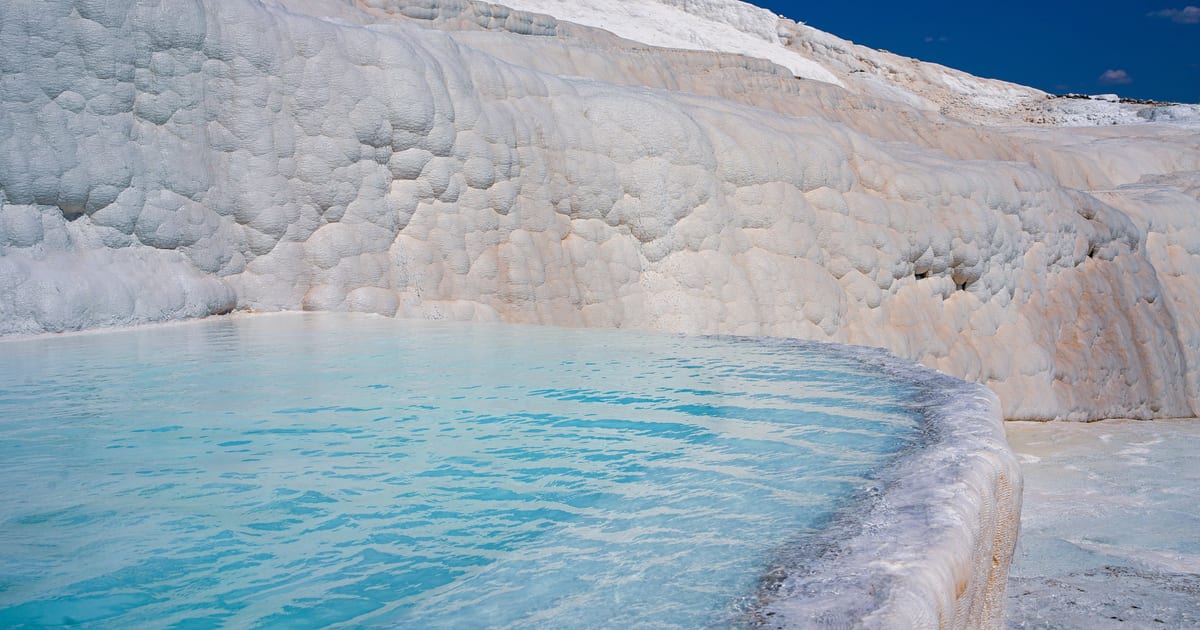
The calcium carbonate settles on a section sixty to seventy metres long, covering an expanse of twenty-four to thirty metres. In total, the travertine formation is about two thousand seven hundred metres long and six hundred metres wide. The Turkish name Pamukkale, meaning cotton castle, describes the limestone, whose surface shimmers snow-white.
The white travertine forms shapes like frozen waterfalls, with small pools that resemble terraces. Thermal water rich in calcium carbonate makes them when it meets the oxygen at the surface. That image of terraced pools runs through a Pamukkale calcium terraces and Aphrodisias tour from Istanbul. Pools in terrace form step down the white slope.
Water reaches the travertines in a controlled way, following a set programme. Water left too long on the same spot feeds algae and spoils the white. Seen through a Pamukkale calcium terraces and Aphrodisias tour from Istanbul, Pools sit on the travertines that follow that programme. Areas are dried for set periods, which also hardens the soft deposit.
The area is known for a carbonate mineral left by the flowing thermal spring water. Pure, fine travertine is white, while impurities turn it brown to yellow. Postcards and brochures show the terraces wet, yet travertines are not always in contact with water. The formation took thousands of years to build, and it is fragile.
One section is set aside for visitors to touch the water. It holds small artificial pools beside the old vehicle road. Moving through a Pamukkale calcium terraces and Aphrodisias tour from Istanbul, Pools of this kind are made by people. A travertine area of five thousand square metres, added later at the South Gate side, is open too.
Walkers are not allowed on the main travertine areas, since fresh travertine is a soft gel that breaks underfoot. Entry to the water is limited to certain parts of the slope, where the pools open to visitors. From the pools, visitors look out over the travertine landscape. The ruins of Hierapolis lie beside the formation.
A buildup of travertine can hold a pond or lake behind it. Cascades of such lakes can be seen at Pamukkale. Lakes of that kind show up through a Pamukkale calcium terraces and Aphrodisias tour from Istanbul. Pools formed by the white travertine have drawn swimmers for thousands of years.
The thermal springs of this area have been drawing visitors since classical antiquity. The hot springs were a major draw to Hierapolis. The natural thermal pools were the centre of its great baths. The white limestone formations of the hot springs were turned into a tourist attraction named Cotton Castle. Pamukkale is a main tourism attraction of Denizli Province.
A related page on Aphrodisias: Aphrodisias Tour From Bodrum.
The thermal water sources of the Curuksu valley give the area around Pamukkale a special character. Those waters built the travertines and gave Pamukkale a unique place in thermal tourism. The same setting runs all the way through a Pamukkale calcium terraces and Aphrodisias tour from Istanbul. Pools of calcite travertine on the slope hold warm, mineral-rich water.
What is the city of Denizli, seen across a Pamukkale calcium terraces and Aphrodisias tour from Istanbul?
Urban Denizli is the seat of Denizli Province, about twenty kilometres south of the terraces. The city is described across a Pamukkale calcium terraces and Aphrodisias tour from Istanbul. Urban land of the city belongs to two districts, Merkezefendi and Pamukkale.
Denizli is a city of Aegean Turkey, and its province lies on high ground above the coast. From the hills of the town, the terraces can be seen across the valley, twenty kilometres away. The same view is set out across a Pamukkale calcium terraces and Aphrodisias tour from Istanbul. Urban Denizli faces that slope from the south.
The national tourism site places Denizli at the crossroads of the Aegean, Central Anatolia and Mediterranean regions. The provincial directorate states that Denizli forms a gate between neighbouring regions. The centre of Pamukkale district shares a plain with the city centre. The tourism site also lists Hittite, Phrygian, Lydian, Roman and Byzantine traces.
The national tourism site sets Denizli in the fertile Lykos valley, also named Curuksu. Limy water gave the Curuksu river its name, and its flow falls in summer. The valley opens out across a Pamukkale calcium terraces and Aphrodisias tour from Istanbul. Urban Denizli stands in that valley, at the foot of Mount Karci.
Evliya Celebi, who wrote in the seventeenth century, said that rivers and lakes lie around the city. He added that the sea is a four-day trip away. His account calls the fortress square and says it stands on flat ground. The main town lay outside the fortress. He recorded its layout, its mosques and its schools.
The same traveller counted forty-four districts and thirty-six hundred houses in the main town. He listed fifty-seven mosques of all sizes and six baths. He also named seven madrasahs and seven children’s schools. These counts are retold across a Pamukkale calcium terraces and Aphrodisias tour from Istanbul. Urban Denizli, in his pages, held homes, schools and baths.
Ibn Battuta wrote of Denizli as a place with gardens, streams that never dry and gushing springs. Both travellers wrote of water. The directorate places the first Denizli near Eskihisar village, six kilometres to the north. Its page on Laodikeia says people moved south to Kaleici and Hisarkoy, nearer to water sources.
Summers in Denizli are hot and dry, while winters run mild to cool with rain. Spring and autumn bring rain too, with a mild warm climate. Snow can lie on the surrounding mountains in winter, the article states. In a cold year, snow can also be seen in the urban areas.
Local stone such as Denizli travertine and marble clads buildings in the city. The national tourism site says the Denizli cable car takes visitors up to fourteen hundred metres. The City Museum has nine exhibition halls. These features are listed across a Pamukkale calcium terraces and Aphrodisias tour from Istanbul. Urban Denizli also has a railway station.
Beyond the built-up area lies Laodicea, six kilometres north near Eskihisar village. The article calls it a trading city known for woollen and cotton cloths. These facts are placed across a Pamukkale calcium terraces and Aphrodisias tour from Istanbul. Urban Denizli lies six kilometres from Akhan, a caravanserai of the thirteenth century.
The national tourism site names Colossae, Tripolis, Herakleia and Attuda among the old cities of the province. The same sentence adds Hierapolis, which sits on the UNESCO World Cultural Heritage List. It adds that the location made Denizli a centre of communication and trade in ancient times. The province has nineteen districts, and two of them hold the city.
How warm is the water of the springs, read toward a Pamukkale calcium terraces and Aphrodisias tour from Istanbul?
Springs number seventeen around Pamukkale, and their water leaves the ground at thirty-five to one hundred degrees Celsius. That heat is the first number to carry toward a Pamukkale calcium terraces and Aphrodisias tour from Istanbul. Springs of that heat laid the white stone.
The spring water is carried three hundred and twenty metres to the head of the terraces. There it deposits calcium carbonate along a section sixty to seventy metres long. Its width runs from twenty-four to thirty metres. Such figures suit anyone looking toward a Pamukkale calcium terraces and Aphrodisias tour from Istanbul. Springs begin it.
Visitors have come to these thermal springs since classical antiquity. Hierapolis began as a thermal spa early in the second century BC. Doctors used the springs with their patients. The spa past is worth reading toward a Pamukkale calcium terraces and Aphrodisias tour from Istanbul. Springs set the purpose of the city.
Pools among the ruins hold water of measured make-up. In one thermal pool at Hierapolis the pH value is five point eight. Its water carries bicarbonate, sulphate and carbon dioxide, along with iron. The great baths were centred upon the natural thermal pools, and they counted among the biggest buildings of the city.
One spring rich in dissolved calcium bicarbonate ran over the edge of a cliff. The water cooled and hardened, and it left calcium deposits behind. Natural pools, shelves and ridges took shape from those deposits. That cliff story belongs to anyone leaning toward a Pamukkale calcium terraces and Aphrodisias tour from Istanbul. Springs fed these shapes.
The Turkish name Pamukkale means cotton castle. The name points to the shimmering, snow-white surface of the limestone. Calcite-rich springs shaped that surface over thousands of years. White calcium pools cling to the side of a ridge. The ruins of Hierapolis lie next to this white slope.
Spring water also reached the broad street of Roman Hierapolis. A layer of limestone from the springs covered the whole street surface. Excavators used a compressor to free the ancient road from it. That layer is a clue for anyone reading toward a Pamukkale calcium terraces and Aphrodisias tour from Istanbul. Springs left their mark.
Springs were not the only warmth in a Hierapolis bath. The Octagonal Bath had a changing room with pools for a first cold bath. Its other rooms stood on raised floors held up by brick piers. Hot air from a furnace on the west side circulated beneath those floors. The heated rooms held niches with pools for bathing.
Two aqueducts, built as channels on the hills around, supplied the city’s drinking water. A fountain in an open space let pilgrims wash before entering the sacred area. An aqueduct brought its water from the plateau to the north-east. Such routes suit anyone heading toward a Pamukkale calcium terraces and Aphrodisias tour from Istanbul. Springs were one source.
Pools also turn up near the tomb of Philip. In the central nave, on the right side of the tomb, excavators uncovered two pools for individual use. Those two date to the fourth and fifth century. Two more pools there were lined with marble slabs.
Travertine is the rock laid down around mineral springs, especially hot springs. Heat decides which mineral forms in the deposit. Aragonite is favoured when temperatures are high, while calcite dominates when they are lower. Natural lakes collect behind travertine dams, and cascades of them can be seen at Pamukkale.
A fountain stood at the hot spring in Roman Hierapolis. The stone that the springs laid down served for building too. The large bridge named for Philip is built of rectangular travertine blocks. The staircase of the fourth and fifth century has steps of irregular travertine blocks.
Pamukkale also features in Pamukkale and Ephesus Tour From Istanbul.
What did the monumental entrance to Hierapolis look like, after a Pamukkale calcium terraces and Aphrodisias tour from Istanbul?
Three arches between two round towers form the Frontinus Gate, the monumental entrance to the Roman city of Hierapolis. After a Pamukkale calcium terraces and Aphrodisias tour from Istanbul, Entrance to the old city came through this gate.
Phrygia was home to Hierapolis, a Hellenistic Greek city founded in the third century BC. Its terrace rose three hundred feet over the Lycus river. Across the valley lay ancient Laodicea and the site of modern Denizli. Hierapolis stood on the main road linking Iconium and Ephesus, so trade with the Aegean region was easier.
The gate stands at the northern entrance of the old city, and the structure is well preserved. An inscription in Latin and Greek is on the gate, dedicated to a Roman emperor. This route reaches the ruins on day two, beside the white terraces of Pamukkale.
Each of the three openings is built of carefully squared travertine blocks. A simple cornice moulding decorates the arches. Hot springs lay down travertine from the minerals in their water. After a Pamukkale calcium terraces and Aphrodisias tour from Istanbul, Entrance stone is the same travertine as the terraces.
The round towers recall Hellenistic city gates, such as that of Perge. Hellenistic walls at Perge, from the third century BC, had three gates. The south gate of Perge has two towers, three storeys high, with conical roofs. After a Pamukkale calcium terraces and Aphrodisias tour from Istanbul, Entrance towers at Perge lie beyond this route, near Antalya.
Behind the gate, a large plateia crosses the whole settlement. After a Pamukkale calcium terraces and Aphrodisias tour from Istanbul, Entrance leads onto a plateia fourteen metres wide. This broad street was the city’s main thoroughfare in the first century. It divides the city into two parts.
In an ancient Greek city, a plateia was a main street. Narrower streets, called stenopoi, ran between the wide ones and framed rectangular blocks. The modern Greek word platia means a town square. Hierapolis followed a grid plan, and its streets ran alongside the main street or across it.
When the street layout was altered, the width fell to eight metres. A limestone layer from spring water had covered the whole street surface, reaching two metres in height. A drain ran along the middle of the street, covered with single stone slabs. Shops, storerooms and houses lined both sides for one hundred and seventy metres.
At the far side, the plateia leaves through a second gate. A road from that gate goes on to Laodicea on the Lycus and then to Colossae. After a Pamukkale calcium terraces and Aphrodisias tour from Istanbul, Entrance and exit gates stand at the plateia’s two ends. The ruins of Laodicea sit ten kilometres south of Hierapolis.
The main street ran north to south, close to the cliff of travertine terraces. Columns and paving stones mark much of the colonnaded road. Stone blocks covered the base of the road. After a Pamukkale calcium terraces and Aphrodisias tour from Istanbul, Entrance columns along the main street were raised again.
A dig at the northern necropolis, beside the park entrance, uncovered the first Iron Age structures at Hierapolis. Round huts there belong to a large settlement, believed to cover the side of Mount Cokelez. A cult area of Cybele around a cave formed the centre of the early settlement, ahead of the Greek colony.
The German archaeologist Carl Humann first excavated Hierapolis in June and July of the year eighteen eighty-seven. His notes appeared in a book called Altertumer von Hierapolis. Serious digging began in nineteen fifty-seven with a team of Italian scientists. An Italian mission has worked at the site since that year.
What did the North Byzantine Gate hold up, seen before a Pamukkale calcium terraces and Aphrodisias tour from Istanbul?
Brackets of marble, four large ones, were found fallen in front of the north gate of Hierapolis. Their carved heads show lions, a panther and a Gorgon. Read about them before a Pamukkale calcium terraces and Aphrodisias tour from Istanbul. Brackets like these were reused.
The north gate forms part of a fortification system built at Hierapolis in Theodosian times, the late fourth century. The text calls it the city’s monumental entrance. A symmetrical gate on the south side matches it. The emperor Theodosius the First ruled from three hundred and seventy-nine to three hundred and ninety-five.
A study by the Italian archaeological mission dates the city walls to the second half of the fourth century. The start of the fifth century is the later limit. Builders recycled architectural blocks on purpose, taking them from public monuments and tombs of the imperial age.
The surviving wall remains enclose the city on its northern, eastern and southern sides. Researchers surveyed the remains and built a database of the reused blocks. Pause at this gate before a Pamukkale calcium terraces and Aphrodisias tour from Istanbul. Brackets were among the reused pieces here.
The north gate is made of material reused when the Agora was demolished. The study follows the wall work from the north. Builders mainly reused blocks from the necropolises, the North Theatre, the North Agora and the shops along the plateia. Material from the Gymnasium went especially into the eastern and southern sectors.
Two square towers flank the gate. The text compares it with other nearby cities, such as Blaundus, where the towers have the same shape. Hold that picture before a Pamukkale calcium terraces and Aphrodisias tour from Istanbul. Brackets and towers are the details the text gives for this gate.
Blaundus was a Greek city founded during the Hellenistic period. It lay between Lydia and Phrygia in the Seleucid Empire. Its ruins are at Sulumenli, near the town of Ulubey in Usak Province. Greek coins write the city name as Mlaundus. Ulubey is a town in the inner Aegean Region of Turkey.
A corbel is a piece of stone, wood or metal fixed into a wall and jutting out to carry weight. The article on corbels calls it a type of bracket. Compare the word before a Pamukkale calcium terraces and Aphrodisias tour from Istanbul. Brackets of classical buildings include the modillions under a Corinthian cornice.
The carved heads are quite expressive. The brackets first belonged to antique buildings, and builders reused them on the two sides of the gate. The aim was to ward off evil influence. View the gate that way before a Pamukkale calcium terraces and Aphrodisias tour from Istanbul. Brackets from older buildings were not carved for this gate.
People believed that doorways and windows were particularly open to evil. No image against evil was used more widely than the Gorgon. On the oldest remaining Greek temple, a Gorgon figure fills the apex between two lionesses. In ancient Greece, grotesque faces were carved over the doors of ovens and kilns to protect the work.
A gorgoneion is the Gorgon face alone, thought to have had a protective function. It appears on temple pediments and on roof ornaments called antefixes and acroteria. Remember the term before a Pamukkale calcium terraces and Aphrodisias tour from Istanbul. Brackets with a Gorgon head belong to that long line.
Another page that includes Pamukkale is 6 Day Istanbul Ephesus Pamukkale Tour Package.
Spolia, Latin for spoils, are stones taken from an old structure and reused in building or decoration. The practice was common in late antiquity. Entire structures were sometimes demolished so that other buildings rose in their place. The Arch of Constantine in Rome reuses earlier imperial reliefs.
What is in the Hierapolis Archaeology Museum, seen during a Pamukkale calcium terraces and Aphrodisias tour from Istanbul?
Gallery rooms in a restored Roman bath hold sarcophagi, statues, theatre reliefs and small finds. The museum opened in the year nineteen eighty-four. Visible during a Pamukkale calcium terraces and Aphrodisias tour from Istanbul, Gallery cases carry finds from Laodicea, Colossae and Attuda.
Restoration of the old Roman bath began in the nineteen seventies, after an Italian team began excavations at Hierapolis. The bath covers fourteen thousand square metres. Its construction began under the emperor Hadrian and was finished under Septimius Severus. A second name for the museum is the Pamukkale Archaeological Museum.
Three closed areas of the bath serve as the indoor rooms. Open areas on the eastern side are known to have been a library and a gymnasium. The pieces set out in that open space are marble and stone. During a Pamukkale calcium terraces and Aphrodisias tour from Istanbul, Gallery space splits into closed halls and open ground.
The Tombs and Statues Gallery holds finds from digs at Hierapolis and Laodicea. Gravestones, pedestals, pillars and inscriptions share the room. Statues there show Tyche, Dionysus, Pan, Asklepios, Isis and Demeter. Family tombs also carry scenes of local customs. The finest baked earth sarcophagi are particular to this area.
The Small Artifacts Gallery shows works from sites in and around Denizli in date order. Idols, baked earth bowls, libation cups and seals sit beside glass cups and terracotta oil lamps. Coins follow in a chronological row. The room reads like a timeline during a Pamukkale calcium terraces and Aphrodisias tour from Istanbul. Gallery order follows the centuries.
The hall of statues and sarcophagi includes reliefs of gladiators and bull-leaping scenes. Another relief shows Marsyas, who entered a music contest with the god Apollo. A marble statue of a priestess dates from about the year two hundred AD. Statues of Hades, Artemis, Leto and Apollo are listed too.
The Theatre Gallery displays decorative works from the theatre of Hierapolis, and the greater part has been restored. Part of the stage-building reliefs remains in place at the theatre, with copies standing in for the rest. Shown during a Pamukkale calcium terraces and Aphrodisias tour from Istanbul, Gallery halls hold works from the stage building.
The reliefs deal with the myth of Apollo and Artemis and with the delights of Dionysos. Other scenes show the myth of Persephone and Hades, and sculpted sphinxes are on show. Inscriptions describe the coronation of the goddess Hierapolis. Further inscriptions record decisions of the assembly about the theatre.
The ruins of Laodicea lie near Denizli, on the river Lycus. Colonnades and pedestals flank its streets, and sarcophagi lie north of the town. Its finds reach visitors during a Pamukkale calcium terraces and Aphrodisias tour from Istanbul. Gallery sections speak for towns beyond the route.
Colossae was a city of Phrygia, fifteen kilometres southeast of Laodicea on the valley road. Ceramic finds around its theatre show that people lived there in the third and second millennia BC. Attuda was a Hellenistic city of ancient Caria, at Hisarkoy in Denizli Province.
A large section of the museum is devoted to Beycesultan Hoyuk, a mound in Denizli Province. People lived there from the Late Chalcolithic period onwards. The British Institute of Archaeology excavated it for six seasons, from the year nineteen fifty-four to nineteen fifty-nine. Seals are among the finds from the mound.
Artefacts from Caria, Pisidia and Lydia are on display as well. Caria was a region of western Anatolia, running from Mycale south to Lycia. Pisidia lay north of Pamphylia and south of Phrygia. Lydia lay east of ancient Ionia. Met during a Pamukkale calcium terraces and Aphrodisias tour from Istanbul, Gallery pieces from those regions join Lycus valley finds.
How was the Hellenistic city of Hierapolis laid out, within a Pamukkale calcium terraces and Aphrodisias tour from Istanbul?
Grid planning shaped Hellenistic Hierapolis, with streets running parallel to the main thoroughfare or across it. A gate flanked by square towers stood at each end. Within a Pamukkale calcium terraces and Aphrodisias tour from Istanbul, Grid plans joined two monumental gates with perpendicular streets.
Running north to south, the main street lay beside the cliff of the travertine terraces. An arcade bordered it on both sides. Side streets were about three metres wide. These lanes join the main street within a Pamukkale calcium terraces and Aphrodisias tour from Istanbul. Grid lanes ran beside it or met it at right angles.
The ministry’s text states that the main street divided the city into two parts. Arcades, public buildings, shops and workshops stood along both of its sides. The buildings that survive were constructed after the great earthquake of AD sixty. Earthquakes destroyed and rebuilt the city repeatedly throughout antiquity.
The gate at each end of the main street had square towers of massive stone blocks. Both gates stand in the plan within a Pamukkale calcium terraces and Aphrodisias tour from Istanbul. Grid gates in the north and south opened onto the street itself. Two small gates joined the monumental pair to make four entrances.
A second arch, the Domitian Gate, stood close to the northern gate. Large columns along the main street near it were raised again. The southern gate stands on lower ground than the northern one. Roman building projects came after the great earthquake. They added two baths, a gymnasium and temples, plus a colonnaded main street and a hot-spring fountain.
Shops, storerooms and houses stood on both edges of the main street. A sewer covered by one-piece stone slabs ran down its middle. The latrine, built in the first century AD, had a floor channel for waste water. That channel fed the street sewer within a Pamukkale calcium terraces and Aphrodisias tour from Istanbul. Grid planning reached underground.
An agora was laid out east of the main street after the earthquake of AD sixty. It filled the ground between the street and the eastern hill. In the second century AD it measured a hundred and seventy metres by two hundred and eighty. Before the quake, that ground lay outside the settlement as a necropolis and workshop area.
The nymphaeum has a U-shaped plan and sits where the main colonnaded road carries on. The Basilica Baths date from the early third century AD. They stand outside the north gate within a Pamukkale calcium terraces and Aphrodisias tour from Istanbul. Grid rebuilding after the quake made the city resemble a typical Roman one.
Outside the walls, burial grounds lay to the north, south and east of the city. The necropolis follows the main colonnaded road past the outer baths. Graves line the old road for more than two kilometres, on either side. The Martyrium sits on top of a hill outside the north-eastern walls.
Hierapolis sits on a terrace over the Lycus river within a Pamukkale calcium terraces and Aphrodisias tour from Istanbul. Grid streets were laid on top of the travertine formation. The great baths were built around the natural thermal pools and ranked as one of the largest buildings in town.
The Temple of Apollo lies within a sacred area about seventy metres long. The temple stood within an enclosure fifteen by twenty metres in the Doric style. Its back was built against the hill, and a marble portico lines the other three sides. The Nymphaeum stands inside the sacred area, in front of the temple.
Ephesus Aphrodisias Pamukkale Tour From Izmir covers Aphrodisias too.
What lies on the route’s start city, read amid a Pamukkale calcium terraces and Aphrodisias tour from Istanbul?
Continents meet at Istanbul, where about two-thirds of the people live in Europe and the rest in Asia. The city straddles the Bosphorus, a start point set amid a Pamukkale calcium terraces and Aphrodisias tour from Istanbul. Continents on either shore belong to one city.
The name Bosphorus comes from Ancient Greek and can be rendered as cattle-passage. It connects two seas, Marmara and the Black Sea. It is also one of the lines that divide Asia from Europe. Keep that line in mind amid a Pamukkale calcium terraces and Aphrodisias tour from Istanbul. Continents face each other across it.
The Bosphorus holds a record: it is the narrowest strait in the world used for international navigation. The shores are heavily settled, apart from the northern stretch. Fresh water runs south at the surface, while salt water runs north near the bottom. An estuary called the Golden Horn branches off the strait inside Istanbul.
Three bridges cross the strait, two of them suspension bridges and one cable-stayed. The Bosphorus Bridge connects the European and Asian parts of the city. It opened in nineteen seventy-three. Facts about the departure city fit amid a Pamukkale calcium terraces and Aphrodisias tour from Istanbul. Continents touch on that span, and the strait runs beneath it.
Byzantium is the first known name of the city. Greek colonists founded it on the Sarayburnu promontory in the seventh century BC. Istanbul is known above all for its Byzantine and Ottoman architecture. The dome of Hagia Sophia is thirty-one metres across. The Basilica Cistern is a sixth-century work of Justinian the Great.
Aydos is the tallest hill in Istanbul and stands five hundred and thirty-seven metres high. A myth says seven hills make up the city, yet more than fifty lie within its limits. Hills are part of the setting amid a Pamukkale calcium terraces and Aphrodisias tour from Istanbul. Continents, seas and hills all belong to that setting.
Summers in Istanbul are warm to hot and moderately dry. Winter daytime highs run from five to ten degrees Celsius (forty-one to fifty degrees Fahrenheit), with frequent precipitation. Snowfall is sporadic, yet it settles virtually every winter. Winters are cloudy, with sunshine on about one day in five.
Istanbul has no primary urban park. Gulhane Park and Yildiz Park began as palace grounds before they became public parks. Green spaces like these belong amid a Pamukkale calcium terraces and Aphrodisias tour from Istanbul. Continents and parks alike fall within the city that begins the route.
Belgrad Forest is a mixed deciduous forest beside Istanbul. Sessile oak grows there in greater numbers than any other tree. The forest takes its name from the village next to it. Its surviving water works are mainly Ottoman dams, in two supply systems called Kircesme and Taksim. The Mahmud I Kemer aqueduct dates from seventeen thirty-two.
Nine islands called the Princes’ Islands lie off the coast of Istanbul, in the Sea of Marmara. Buyukada is the largest. Motorised vehicles, apart from service vehicles, are forbidden there. Islands belong amid a Pamukkale calcium terraces and Aphrodisias tour from Istanbul. Continents and islands share one city.
The name Princes’ Islands means Islands of the Princes. Kinaliada, one of the nine, has reddish ground from the iron and copper mined there. It is also one of the least forested islands. Buyukada and Heybeliada, two others, are part of the city of Istanbul.
The Sea of Marmara is a small inland sea lying entirely within Turkey. Two island groups sit in it, the Princes’ Islands in the north and the Marmara Islands in the south. The sea takes its name from the largest southern island, whose marble-rich rock gave the name. In classical antiquity it was known as the Propontis.