
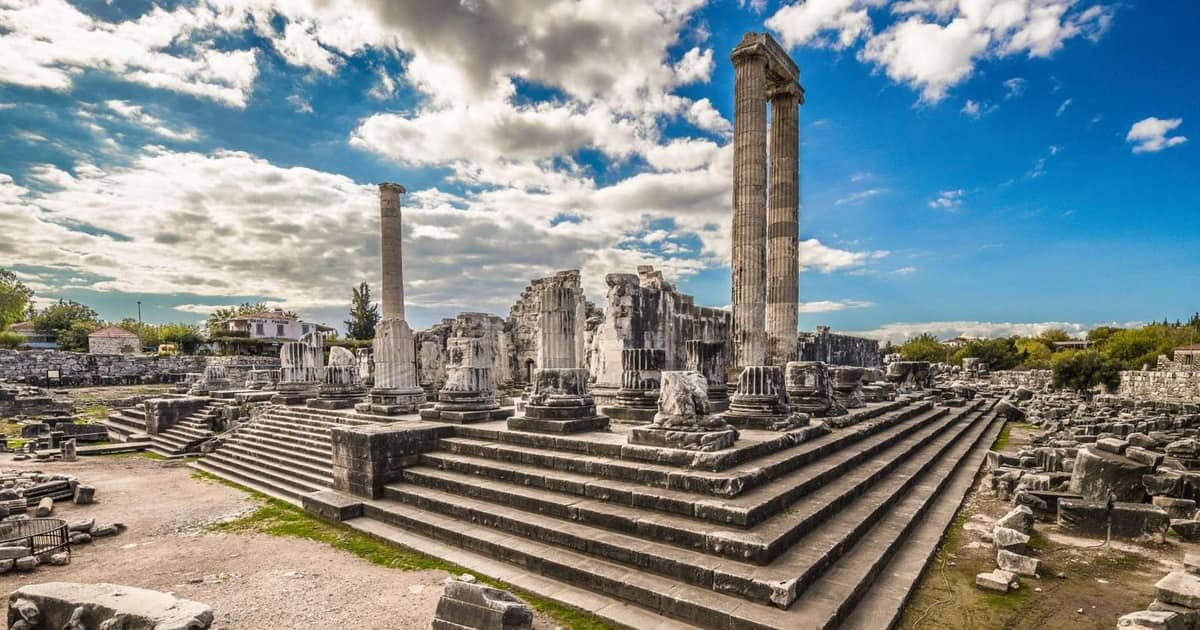
An Ephesus Priene Miletus Didyma tour by flight from Istanbul spreads the Ionian coast over two days. This route flies to Izmir, walks Ephesus, sleeps at Kusadasi and ends at Didyma. For island trips, open Greece Tours on the homepage.
The cards below show live dates on GetYourGuide.
How was the Great Theatre of Ephesus built on an Ephesus Priene Miletus Didyma tour by flight from Istanbul?
Hellenistic builders used the slope of Mount Pion for the first seats, and Roman builders enlarged the bowl on vaults. Day one of this route reaches that theatre on an Ephesus Priene Miletus Didyma tour by flight from Istanbul. Marble seats survive.
The theatre faces east-northeast and leans against the western slope of Mount Pion, which Turkish speakers call Panayir. Its cavea, the seating bowl, is larger than a semicircle in plan. Hellenistic builders let the natural hillside carry the first seats. Studies differ on the century of that first theatre.
Planning more days? Turkey tours on the homepage run from Istanbul to Cappadocia and the Aegean shore.
The first theatre had a single tier of seats, an orchestra with a drainage channel and a one-storey stage building. A marble stage followed in the late Hellenistic phase. Roman builders reused parts of the older stage building. A visitor on an Ephesus Priene Miletus Didyma tour by flight from Istanbul meets both ages in one structure.
Roman work began in the reign of Claudius, when the stage platform was widened. The stage building grew again under Nero, and its first Roman front of columns was dedicated in AD 66. Later work raised that front to three storeys, with niches for statues.
Three tiers of marble seats climb the slope. The lowest tier holds 11 wedge-shaped seating blocks, and the middle tier holds 22 rows. Rows grow steeper above each walkway, called a diazoma, for a clear view from the back. A visitor on an Ephesus Priene Miletus Didyma tour by flight from Istanbul notices the change in pitch.
The larger Roman bowl needed heavy substructures. Vaults and outer retaining walls, called analemmata, carry the upper tier and the side wings. The north wing dates to AD 92, and the south wing to the early second century. Domitian’s builders closed the open side passages into covered entrances.
The first orchestra was a semicircle with a drain around its rim. Roman builders paved it with marble slabs, including green ones. An iron railing once divided it from the seats, until a wall replaced it in the fourth century. The orchestra lies below the seats on an Ephesus Priene Miletus Didyma tour by flight from Istanbul.
Seats stayed open to the sky. The Romans added an awning, the velum, in the middle of the second century. It shielded the seats from the weather. Repairs are recorded in AD 205 and 240. Fallen pieces of the stage front were found in the orchestra.
More about Priene: Ephesus Priene Miletus Didyma Tour From Izmir.
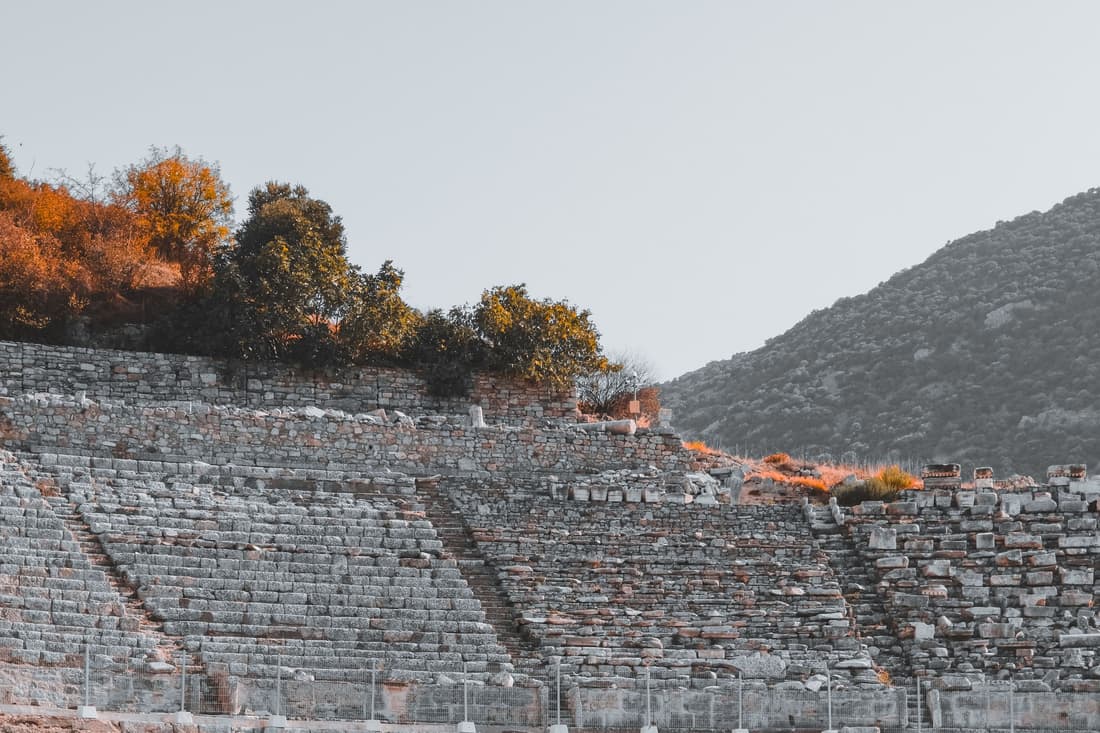
Earthquakes between AD 359 and 366 brought down the upper seats. Repairs to the northern retaining walls followed in the reign of Arcadius. A short poem celebrates the proconsul Messalinus, who oversaw the work. That damaged tier belongs to the story told on an Ephesus Priene Miletus Didyma tour by flight from Istanbul.
Builders turned the orchestra into a water basin, a kolymbethra, in the late third century. Late conversions show efforts to keep the damaged theatre in use until the early seventh century. By the eighth century it formed part of the city defences. Visitors on an Ephesus Priene Miletus Didyma tour by flight from Istanbul meet what is left.
Which sanctuaries of Priene stand near an Ephesus Priene Miletus Didyma tour by flight from Istanbul?
Priene holds a walled sanctuary of Demeter and Kore, a terrace of the Egyptian gods and a small Asklepios precinct. Near an Ephesus Priene Miletus Didyma tour by flight from Istanbul, Alexander left a dedication on the Athena temple.
The Demeter and Kore sanctuary lies near an Ephesus Priene Miletus Didyma tour by flight from Istanbul. Walls enclose a court north of the town centre, at the foot of the acropolis. The court runs east to west, 45.05 metres long inside and 17.75 wide. Its doorway opens in the east wall.
Builders began the sanctuary in the late fourth century BC. A temple backs onto the west wall, and its porch faces east. A sacrificial pit lies south of the temple, and a door leads to it from the porch. Altars of Roman date stood near the entrance and the north wall.
Two statue bases lay outside the entrance, near an Ephesus Priene Miletus Didyma tour by flight from Istanbul. Bronze stood on one base and marble on the other. The marble statue shows a priestess. Her base calls her priestess of Demeter and Kore, daughter of Hipposthenes and wife of Eukritos.
The Staatliche Museen zu Berlin hold the statue, 173 centimetres tall, with head and right arm lost. The inner room held podia for dedications and marble tables for offerings. Terracotta figurines of the fourth century BC show draped women, sows and grotesque figures. A figurine type named after Priene dates from the third to the second century BC.
Another page that includes Priene is Priene Miletus Didyma Tour From Bodrum.
This route reaches Priene on day two. The sanctuary of the Egyptian gods lies near an Ephesus Priene Miletus Didyma tour by flight from Istanbul. Eastern Priene holds its rectangular court, set on a massive terrace wall. The court measures 47 metres by 31 metres, and a gateway stood in the north wall.
A colonnade ran along the west side of the court, and a large rectangular altar stood inside. Two altars and a wall end carry inscriptions. One altar names Isis, Serapis and Anubis. A round altar adds Harpocrates and Herakles the Unconquerable. The letters date to the third century BC.
The Asklepios sanctuary lies east of the agora, near an Ephesus Priene Miletus Didyma tour by flight from Istanbul. Visitors entered from the east, into a court ringed by Doric colonnades. A small temple stood inside, with Ionic capitals like those of the Athena temple. An inscription found near the court named the Asklepieion.
King Alexander dedicated the temple of Athena Polias near an Ephesus Priene Miletus Didyma tour by flight from Istanbul. Greek letters in three lines, cut high on a porch wall end, state the gift in the Ionic dialect. Alexander stayed at Priene in the summer of 334 BC, during the siege of Miletus.
The block is marble, 120 centimetres wide and 49.5 high, and it carries writing on both faces. The British Museum in London keeps it. A tradition holds that Ephesus refused Alexander’s offer to dedicate its temple, and Priene accepted it instead. The historian Arrian does not mention the dedication.
Which civic buildings of Miletus rise beside an Ephesus Priene Miletus Didyma tour by flight from Istanbul?
Miletus kept a Roman gate, a three-storey fountain, two market squares and a sanctuary of Apollo. Beside an Ephesus Priene Miletus Didyma tour by flight from Istanbul, Berlin holds the gate’s marble front. The rest lie in ruins.
The Market Gate was a monumental Roman gate of two storeys. It had one wide central passage and two small side entrances. Merchants used it as a sales area, and it led into the South Market. Scholars date it to the turn of the first century into the second.
Ephesus comes up again in Izmir Ephesus Tour By Flight From Istanbul.
Columns standing on pedestals divided the front, and two colossal statues probably flanked the central passage. Marble came from quarries near Heraclea at Latmus, and ancient pigment suggests strong colour. Marble steps and a limestone base mark the footing beside an Ephesus Priene Miletus Didyma tour by flight from Istanbul.
Byzantine builders set the gate into a fortification wall, and earthquakes later brought it down. After excavation, its segments went to Berlin with permission from the Ottoman government, within the official division of finds. The reconstruction in the Pergamon Museum is nearly 29 metres wide.
The Nymphaeum, a monumental city fountain, stood between the Ionian Hall, the Market Gate and the Great Church. Its marble front, about 20 metres wide, rose in three storeys. Niches alternated with aediculae, framed openings for statues of gods and mythological figures. Ruins of the facade lie beside an Ephesus Priene Miletus Didyma tour by flight from Istanbul.
Spring water from a limestone plateau south of the city reached the fountain by aqueduct. Clay pipes led it to storage tanks. A Latin inscription names Marcus Ulpius Traianus, father of the later emperor Trajan, as patron. The fountain dates to the reign of Titus. A Greek inscription records an extension under Gordian III.
Beside an Ephesus Priene Miletus Didyma tour by flight from Istanbul, Miletus keeps its central avenue. Processions of Apollo’s annual festival set out from the Delphinion at the avenue’s northern end. The North Agora, 87 by 50 metres, had colonnades on all four sides. The eastern colonnade, added last, faced the avenue with large columns.
Ephesus also features in Ephesus Sirince Tour by Flight From Istanbul.
The South Agora lies beside an Ephesus Priene Miletus Didyma tour by flight from Istanbul. Excavators call it the South Market, the largest public square of Miletus. Its eastern hall is Hellenistic, and its southern hall belongs to the later second century BCE. The southern hall had 19 rear rooms for trade and storage.
The Delphinion, the sanctuary of Apollo Delphinios, lies beside an Ephesus Priene Miletus Didyma tour by flight from Istanbul. Monumental building began there at the end of the sixth century BCE. The Classical sanctuary filled a whole city block. The Hellenistic sanctuary grew eastward to cover two blocks.
More than 150 inscriptions came from inside the sanctuary. Resolutions and contracts were published there, and the state archive was kept there. The prytaneion, the seat of city government, stood there too. A round building joined the courtyard in the early first century BCE. Altar elements are exhibited in the Altes Museum in Berlin.
Why do the people of Miletus matter for an Ephesus Priene Miletus Didyma tour by flight from Istanbul?
Milesians such as Hecataeus, Aspasia and Isidore add stories for an Ephesus Priene Miletus Didyma tour by flight from Istanbul. Hecataeus wrote a survey of the known world. Aspasia became the companion of Pericles. Isidore edited commentaries on Archimedes.
On this route, day two runs south by road to Priene, Miletus and Didyma. Scholars use the phrase “Milesian school” for the early thinkers of the city. Writers, poets and an engineer of Miletus join them. These lives add depth for an Ephesus Priene Miletus Didyma tour by flight from Istanbul.
Hecataeus, son of Hegesander, lived in the sixth and fifth centuries BC. His Periodos Ges, a survey of the known world, had two books, Europe and Asia, and Asia held Africa. A map probably went with it. Hecataeus opens the list for an Ephesus Priene Miletus Didyma tour by flight from Istanbul.
Aspasia was born in Miletus and came to Athens in the middle of the fifth century BC. She stayed a foreigner, since official marriage needed Athenian parents. She became the companion of Pericles, and they had a son. In Plato’s Menexenus, Socrates claims she taught him rhetoric, and scholars read that as irony.
For more on Ephesus, see Ephesus Aphrodisias Pamukkale Tour by Flight From Istanbul.
Eutocius wrote commentaries on Archimedes, and one note calls an edition “revised by Isidore of Miletus, the engineer”. Isidore also invented an instrument for drawing a parabola, described in his commentary on Hero’s book on vaulting. The engineer is the link with Istanbul for an Ephesus Priene Miletus Didyma tour by flight from Istanbul.
Isidore was also one of the two architects of Hagia Sophia in Istanbul. An earthquake later destroyed part of its dome, and the restoration fell to his nephew, called Isidore the Younger. The rebuilt dome followed a modified design. The writer Procopius calls him a Milesian by birth.
One ancient tradition ranks Cadmus of Miletus as the oldest Greek writer of chronicles. Scholars who accept this date him to the sixth century BC, while others hold him purely mythical. Cadmus is the least certain name for an Ephesus Priene Miletus Didyma tour by flight from Istanbul.
Timotheus of Miletus was a poet and musician of the fifth and fourth centuries BC. Parts of his poem The Persians survive on a papyrus roll that excavators found at Abusir in Egypt. The roll, dated to the fourth century BC, ranks among the oldest Greek papyri.
Phocylides, a poet of the sixth century BC, was born in Miletus. His gnomic verses, which are short moral sayings, survive only in fragments. The anthology of Stobaeus preserves them mainly. Phocylides adds verse to the list for an Ephesus Priene Miletus Didyma tour by flight from Istanbul.
Hesychius of Miletus lived under Justinian I and wrote the Roman and Universal History in six books. It ran from Belus, the reputed founder of the Assyrian empire, to Anastasius I. His Onomatologos sorted notable writers into poets, philosophers, historians, orators and grammarians, medical men and other authors.
6 Day Istanbul Ephesus Pamukkale Tour Package covers Ephesus too.
How was the Temple of Apollo at Didyma planned during an Ephesus Priene Miletus Didyma tour by flight from Istanbul?
Paionios of Ephesus and Daphnis of Miletus planned the Hellenistic temple of Apollo, as the Roman writer Vitruvius records. During an Ephesus Priene Miletus Didyma tour by flight from Istanbul, travellers reach walls scratched with full-size plans.
Planning of the Hellenistic temple started in the later fourth century BC, once Persian rule ended. Paionios is also credited with rebuilding the temple of Artemis at Ephesus. That stop fills day one of this route. Day two reaches Didyma during an Ephesus Priene Miletus Didyma tour by flight from Istanbul, after Priene and Miletus.
Lothar Haselberger found faint lines on the high walls of the inner court in nineteen seventy-nine. They are life-size drawings scratched into the marble. During an Ephesus Priene Miletus Didyma tour by flight from Istanbul, sightseers find them barely visible. They survive because the walls were never polished.
On the northern wall, a column draft shows entasis, the slight swelling of a shaft that offsets optical effects. An early model column, a paradeigma, matches that drawing. Vitruvius describes a method of entasis and points to a drawing, yet all drawings from his book are lost. Scholars rebuild that part of his text from the Didyma wall.
During an Ephesus Priene Miletus Didyma tour by flight from Istanbul, Didyma’s western wall shows a pediment drawing. The drawn pediment of a small temple is over two metres wider than the real pediment of the naiskos. Haselberger and other scholars saw in it a possible design for that small inner shrine.
The column base has a blueprint on the far-left wall. Four horizontal lines cross one vertical line, one, three and fourteen dactyls apart. A dactyl is a thumb’s width. A quarter circle shapes the lower torus, the rounded ring. The plan then changed, and the moulding was set back. Its lines are scarcely visible until photographs are enhanced.
White marble clothed the visible parts of the temple. Milesian marble, cut at Lake Bafa, the former Latmian Gulf, was used more widely than any other. Thasos marble was imported and mixed unsystematically into the column drums to speed the work. Herakleian marble from Lake Bafa replaced it later, and Marmara Island marble came in Roman times.
A related page on Ephesus: Ephesus Pamukkale Tour From Istanbul.
Blocks went from the quarries to Didyma’s harbour, once Panormos, modern Mavisehir. From there the road leads to the sanctuary, and unfinished pieces are visible at every stage. During an Ephesus Priene Miletus Didyma tour by flight from Istanbul, Didyma’s stairs and tunnel carry builders’ marks. No two big stones were identical, so each place was marked.
The inner shrine, the naiskos, rose as the fourth century BC closed. The main body of the temple was complete near the close of the second century BC. During an Ephesus Priene Miletus Didyma tour by flight from Istanbul, Hadrian’s eastern columns show a late stage. A standing column left unfinished, its shaft bottle-shaped, records a planning failure.
Which statues lined the Sacred Way along an Ephesus Priene Miletus Didyma tour by flight from Istanbul?
Seated men and women, a marble lion and beast figures lined the Sacred Way in the sixth century BC. Along an Ephesus Priene Miletus Didyma tour by flight from Istanbul, Chares is named on one chair leg.
The Sacred Way joined Miletus to the shrine of Apollo at Didyma. The Holy Gate marks where it leaves the city. Day two takes in Miletus before Didyma, along an Ephesus Priene Miletus Didyma tour by flight from Istanbul. Pilgrims came ashore at Panormos, about three kilometres from the shrine, and joined the road.
Ritual waystations stood along the route, and excavators have found part of that chain. Inside the sanctuary, the road was wide and plastered, with Archaic buildings beside it. Wells, basins and water channels lie west of that stretch. Offerings were made at fixed stations along the way.
Seated figures stood at intervals beside the road. Wealthy citizens, among them local rulers, set up statues of themselves as offerings along it or inside the sanctuary. Miletus Museum shows statues of Branchids, the priestly family of the shrine. Along an Ephesus Priene Miletus Didyma tour by flight from Istanbul, sphinx statues from the road are there too.
Readers interested in Ephesus can open Izmir Ephesus Tour By Flight From Ankara.
A seated man speaks through his chair. Its right front leg carries a Greek text in the first person. It reads: “I am Chares, ruler of Teichioussa, and the statue belongs to Apollo”. Chares is unknown from any record other than this statue. The figure is 1.49 metres high, and its head and hands are lost.
The seated men and women sit on chairs that differ in detail. Along an Ephesus Priene Miletus Didyma tour by flight from Istanbul, Eudemos is named as maker on one chair. One cushion has a zigzag pattern, and two chairs have legs with a design that comes from the lotus. A veiled woman shows the series’ greatest naturalism.
A recumbent marble lion also lined the road. Its head is missing, and its right fore-paw lies in front of its body. The flank carries a dedication: five sons of Orion gave these statues to Apollo as a tithe. The lines of the text run in alternating directions.
Inscriptions in Latin and Greek show that Trajan had the road rebuilt, terraced and paved. A second threshold stone at the Holy Gate was laid over the first, because the ground had risen. Along an Ephesus Priene Miletus Didyma tour by flight from Istanbul, Trajan’s repairs to the gate carry an inscription.
Inside the sanctuary, a stoa lined the road in the Roman period. A stoa is a covered walkway or portico for public use. It flanked the passage to a bath building of the second century AD. The baths stayed in use until the sixth or seventh century, and mosaics were found in the entrance hall.
Along an Ephesus Priene Miletus Didyma tour by flight from Istanbul, Archaic pottery dates the oldest road surface. It came from two deep soundings in the north-western section of the road at Didyma. Later road surfaces lie above it. The find shows a route there before the Hellenistic age.
Ephesus comes up again in Pamukkale Aphrodisias and Ephesus Tour From Istanbul.
Which excavators uncovered the ruins behind an Ephesus Priene Miletus Didyma tour by flight from Istanbul?
Dilettanti expeditions came first, then French diggers and German teams. Theodor Wiegand’s teams uncovered the ruins behind an Ephesus Priene Miletus Didyma tour by flight from Istanbul. Wiegand worked at Priene from eighteen ninety-five, at Miletus from eighteen ninety-nine and at Didyma until nineteen thirteen.
The Society of Dilettanti sent two expeditions to explore Didyma. Richard Chandler led the first in seventeen sixty-four, and Sir William Gell led the second in eighteen twelve. At Priene the Society sent Richard Pullan in eighteen sixty-eight. He excavated the temple and the city, and his finds went to London.
Charles Newton dug along the Sacred Way of Didyma in the eighteen fifties. His spade opened the road behind an Ephesus Priene Miletus Didyma tour by flight from Istanbul. Newton sent ten statues from that road to the British Museum. The museum’s records name him as the excavator.
French teams followed the British. The Rothschild Expedition of eighteen seventy-three, under Rayet and Thomas, sent architectural sculpture to the Louvre. Pontremoli and Haussoullier came in eighteen ninety-five for the French Schools of Rome and Athens. They cleared the western facade and the pronaos but left other parts buried.
Theodor Wiegand bought the site, then began a thorough clearance. He dug at Didyma for the Royal Prussian Museums of Berlin until nineteen thirteen, with the architect Hubert Knackfuss. Wiegand’s clearing exposed the temple behind an Ephesus Priene Miletus Didyma tour by flight from Istanbul. Apollo’s temple at Didyma was never quite finished.
The Berlin Museums sent Carl Humann to dig at Priene in eighteen ninety-five. Wiegand joined him as assistant that September. Humann died on 12 April eighteen ninety-six, and Wiegand became director. Hans Schrader worked beside Wiegand until eighteen ninety-nine. Their dig laid open the town behind an Ephesus Priene Miletus Didyma tour by flight from Istanbul.
Wiegand and Schrader published the results as Priene in Berlin in nineteen hundred and four. A Frankfurt team has done restoration, excavation and research work at Priene since nineteen ninety-eight. The Culture Ministry gave permission, and a professor from Uludag University in Bursa served as assistant director.
More about Ephesus: Ephesus Aphrodisias Tour From Istanbul.
A French team first dug at Miletus in eighteen seventy-three. It focused on the theatre and sent six statues to the Louvre. Wiegand’s dig of eighteen ninety-nine uncovered the city behind an Ephesus Priene Miletus Didyma tour by flight from Istanbul. Berlin’s State Museums received half of the finds under contract.
The First World War ended the project. Archaeologists returned to Miletus in nineteen fifty-five under Gerhard Kleiner. An earthquake that year destroyed the village of Balat and the storehouses of the old dig. Kiel University mapped the city area with geophysics in the nineteen nineties. Hamburg University took over the excavation under Christof Berns.
The German Archaeological Institute has worked at Didyma since nineteen sixty-two. Its teams have studied the ruins behind an Ephesus Priene Miletus Didyma tour by flight from Istanbul. Project records for the archaic temple list about 600 fragments of the building and its altar. The fragments lie in storerooms at Didyma and in the Antikensammlung in Berlin.