A Priene Miletus Didyma tour from Bodrum links three Ionian sites on the Aegean coast. They are an oracle temple, a harbour city and a hillside town. Below you find the road, each site, the season and the entry rules. The homepage lists Greece Tours if you want the islands instead of the mainland.
Each card below leads to a live GetYourGuide page with open dates.
Why does a Priene Miletus Didyma tour from Bodrum follow the Ionian coast?
Priene, Miletus and Didyma all lay in Ionia, the central stretch of the western Anatolian coast settled by Greeks. A Priene Miletus Didyma tour from Bodrum follows the Milas highway and crosses into Aydin Province to reach all three.
Ionia was an ancient region on the central western coast of Anatolia. It was never one state, only a band of Greek cities between sea and mountains. Twelve cities formed the Ionian League, with a shared sanctuary and festival. Miletus and Priene were both members. That is why a Priene Miletus Didyma tour from Bodrum counts as an Ionian trip.
After the ruins, Turkey tours on the homepage lead inland to Pamukkale, Cappadocia and Istanbul.
Didyma was a sanctuary of Apollo on the coast, in the territory of Miletus. In antiquity people knew it for its oracle. The ruins lie a short distance north-west of Didim. This seaside resort town in Aydin Province takes its name from the site.
Silt changed this coast. The Buyuk Menderes river, called the Meander in antiquity, carried silt into a narrow gulf named Latmus. The silt closed the gulf’s mouth, and Lake Bafa formed behind it. Priene once overlooked that gulf and is an inland site today. The inlet north of Didim filled too, tying its headland to the mainland.
The road north from Bodrum passes through Milas, the first capital of ancient Caria. Bodrum belongs to Mugla Province, while Didim and Soke lie in Aydin Province. Hence the Priene Miletus Didyma tour from Bodrum crosses a provincial border on day 1.
Lake Bafa lies beside the highway that links Bodrum and Milas with Soke. Its shores are split between Milas district in Mugla Province and Soke district in Aydin Province. The lake area is a nature park, and its shores rank among the important bird sanctuaries in Turkey.
The Besparmak range rises along the northern shore of the old gulf and runs from east to west. In antiquity it was called Latmus. Soke, the district that holds Priene, is the largest in Aydin Province by area.
For the Priene Miletus Didyma tour from Bodrum, the road to Didim covers roughly 97 kilometres. That drive takes about an hour and a half. Didyma and Miletus stand about 16 kilometres apart in a straight line. Allow at least four hours for the three sites, meals aside, when starting from Selcuk or Kusadasi.
This route turns the Priene Miletus Didyma tour from Bodrum into two days. Day 1 holds the drive from Bodrum and the three sites. Fitting it into one day means two long drives, four hours or more at the ruins, and Ephesus. Day 2 is left for Ephesus.
The night falls near Selcuk or Kusadasi. Selcuk belongs to Izmir Province and lies 2 kilometres north-east of ancient Ephesus. Kusadasi is a resort town of Aydin Province, set on the Aegean shore.
Day 2 stays around Ephesus. Near the ancient city stood the Temple of Artemis, which Greek writers counted among their seven great marvels. Its site lies on the edge of Selcuk, where one column, built from fragments found there, marks the spot. The Priene Miletus Didyma tour from Bodrum then ends with the road back.
What does Didyma add to a Priene Miletus Didyma tour from Bodrum?
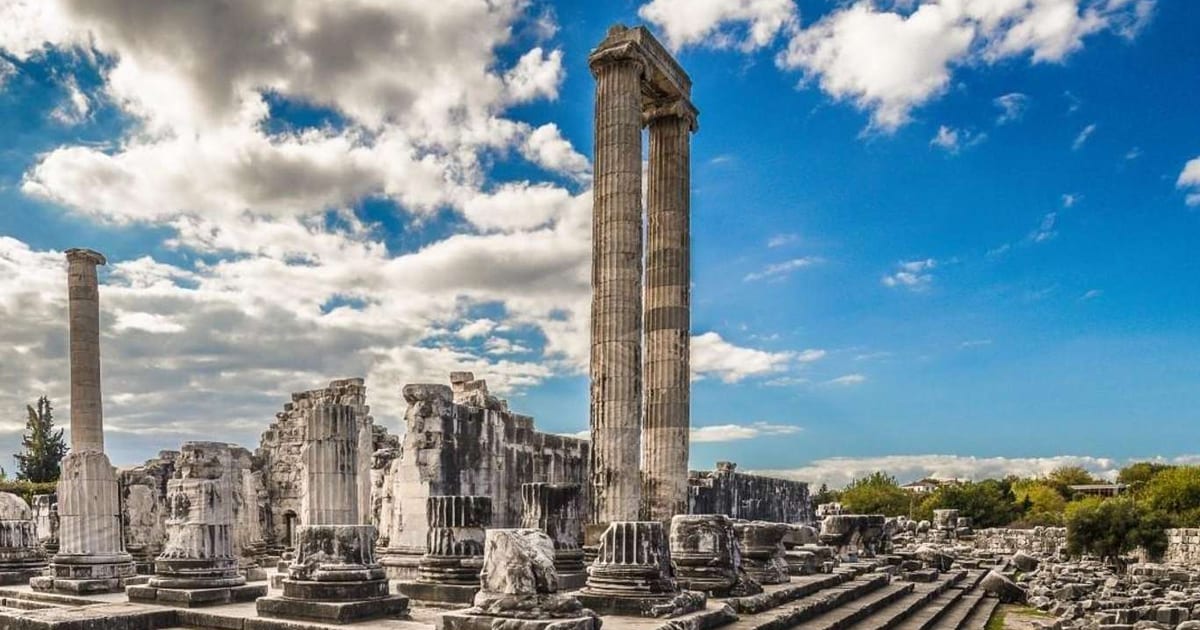
Didyma adds the oracle shrine of Apollo, an unfinished temple on a platform 51 metres wide and 109 metres long. A Priene Miletus Didyma tour from Bodrum stops for Ionic columns, Medusa heads and a court open to the sky.
Didyma was an oracle shrine of Apollo. A priestess sat above the oracle spring and was inspired by the god. The Greek word didyma means “twins”. The ruins lie a short distance northwest of the modern town of Didim. The town took its name from the ruins.
Royal gifts reached this shrine. The Egyptian pharaoh Necho II sent presents, and half a century later Croesus of Lydia did the same. After Alexander defeated the Persians, the oracle spoke again. Those gifts were carried to the very ground that a Priene Miletus Didyma tour from Bodrum crosses today.
The Branchidae were the priests of Didyma. Their family ran the sanctuary until the Persians destroyed it. The temple on view belongs to the rebuilding that started after Persian rule ended. Work lasted more than 600 years, yet the temple was never completed.
The temple rises on a base of seven steps. The platform on top measures 51 metres by 109 metres. A double file of Ionic columns surrounded the building, and each column stood close to 20 metres high. Beside the surviving columns, a Priene Miletus Didyma tour from Bodrum lets you judge that height yourself.
The front hall, the pronaos, has three rows of four columns. Beyond it, a monumental staircase climbs to three openings. Two long sloping tunnels run inside the thickness of the walls. Their exits lie on either side of the staircase.
Behind the front hall lay the inner court, called the sekos. Its walls rose 25 metres, and pilasters shaped the inner faces. The court never had a roof, so it stayed open to the sky.
The oracle spring, a laurel tree and the naiskos stood in that court. The naiskos was a small shrine that held the cult statue of Apollo. This Priene Miletus Didyma tour from Bodrum arrives at the part with no ceiling at all.
The monumental heads of Medusa are the carving this temple is known for. The unfinished state shows in other places too. The roof was never entirely completed, the pediments are missing and the inner walls stayed unpolished.
A Sacred Way ran between the sanctuary and Miletus. It was built in the sixth century BC for festival processions. Waystations stood along it, beside statues of noblemen and noblewomen and figures of animals and mythical beasts. Both ends of that procession road belong to this Priene Miletus Didyma tour from Bodrum.
The oracle ended when the temples were closed under the emperor Theodosius I. Later, a Christian church stood in the inner court of the temple. An earthquake then destroyed the temple, and the village around it was abandoned.
About 300 years later Greeks resettled the village and used the broken ancient buildings as quarries. Ancient, Christian and village periods all left traces at Didyma. A Priene Miletus Didyma tour from Bodrum therefore covers more than one era at this single stop.
What does Miletus show on a Priene Miletus Didyma tour from Bodrum?
Miletus holds a theatre for about 15,000 people, a council hall, a Roman bath complex and a temple of Serapis. Thales, a founder of Western philosophy, belonged to this city. It is the philosophers’ stop within any Priene Miletus Didyma tour from Bodrum.
Three Milesian thinkers of the sixth century before Christ each named a different starting point for everything. Thales chose water. His pupil Anaximander chose the apeiron, the infinite. Anaximenes chose air. A Priene Miletus Didyma tour from Bodrum brings you to the city these three called home.
The theatre is the largest ruin at Miletus. It stands on the southern slope of Kaletepe, the “castle hill”. Walls of a Byzantine fortress tower above the seats and gave the hill its name.
The first theatre went up in the fourth century before Christ and held 5,300 people on two galleries. In the later first century, builders took the seating down and rebuilt it with three galleries. The rebuilt theatre held about 15,000 people and ranked among the largest theatres in western Turkey.
The Harbour Gate stood beside the Lion Harbour, at the northern end of the main avenue. The larger harbour monument nearby has a round foundation nearly 12 metres wide. It is thought to celebrate a naval victory. Walking here during a Priene Miletus Didyma tour from Bodrum shows where the sea once met the city.
The Bouleuterion was the town hall, where the citizens’ council met. An inscription names the Seleucid king Antiochus IV Epiphanes as its donor, in the second century before Christ. The hall had 18 rows of seats for up to 1,200 people. Four columns held up its roof.
More about Priene: Ephesus Priene Miletus Didyma Tour From Izmir.
The Faustina Baths are the largest bath complex in the city and date to the second century. They carry the name of Faustina the Younger, wife of Emperor Marcus Aurelius. A hall inside was sixty metres long, with 13 chambers on each side. The Muses’ Room next to it is named after the statues of Muses found there.
The Serapeion, a temple of the Greco-Egyptian god Serapis, stands beside the baths. Its main room measures about 22 by 12 metres. Two rows of five marble columns split it into three aisles. The porch gable carries a bust of Serapis. A Priene Miletus Didyma tour from Bodrum meets a Roman place of worship here.
Priene also features in Ephesus Priene Miletus Didyma Tour by Flight From Istanbul.
The Ilyas Bey Mosque stands inside the archaeological site. Ilyas Bey, ruler of the Menteshe emirate, built it in the early fifteenth century. It belongs to a complex with a madrasah and a hammam. A brick dome 14 metres across covers the prayer hall.
The museum stands on the access road, so visitors pass it before the ruins. Its rooms cover around 600 square metres and hold pottery, coins, jewellery, tools, figurines and large statues. Its finds come from Miletus, Priene and Didyma, which suits a Priene Miletus Didyma tour from Bodrum. A garden south of the building shows more sculptures and inscriptions.
Silt closed the harbours, and the sea no longer reaches the ruins. Miletus once founded more colonies than any other Greek city. Sinope on the southern Black Sea coast and Olbia on the north-western coast were two of them. Seeing the home city of those settlements is part of a Priene Miletus Didyma tour from Bodrum.
Bodrum comes up again in Bodrum to Ephesus Tour.
What does Priene give a Priene Miletus Didyma tour from Bodrum?
Priene stands at the foot of a Mount Mycale cliff, on a street grid laid across steep terraces. Five Ionic columns of its Athena temple stand again, and its theatre keeps marble seats of honour. This hillside town completes a Priene Miletus Didyma tour from Bodrum.
Priene first stood as a port at the mouth of the Maeander river. Halfway through the fourth century BC, the town was rebuilt on the slope below Mount Mycale. River silt later pushed the shoreline away, and Priene lost its power at sea. A Priene Miletus Didyma tour from Bodrum visits the slope town, not the first port.
The street plan is called Hippodamian, after Hippodamus of Miletus. He did not invent the idea, because Greek builders had used rectangular plans before him. At Priene the grid runs up a steep slope, and a system of channels drained it. Along the way, a Priene Miletus Didyma tour from Bodrum climbs streets that meet at right angles.
Aphrodisias Tour From Bodrum covers Bodrum too.
Six main streets, each about six metres wide, run east and west. Narrower streets, about three metres wide, cross them at right angles. Together the streets cut the town into about 80 blocks. Private houses were shared out eight to a block.
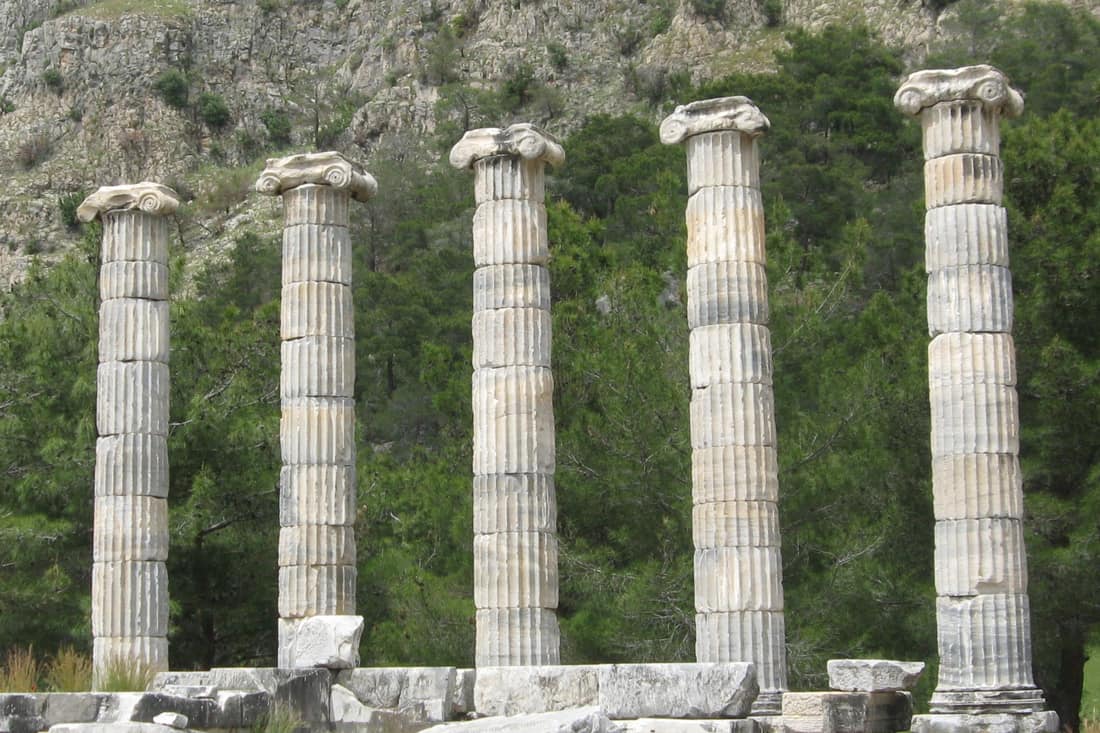
Pytheos designed the Temple of Athena Polias. The same architect shared in the design of the Mausoleum at Halicarnassus, in present-day Bodrum. The temple is Ionic, with eleven columns along its length and six across its width. Five of those columns stand again, raised from rubble.
Readers interested in Bodrum can open Pamukkale Ephesus Tour From Bodrum.
The temple stood on a high terrace north of the main street, and a stairway led up to it. The ruin sits at the foot of the escarpment. Against that rock, a Priene Miletus Didyma tour from Bodrum reaches the columns in their setting. They are about three metres shorter than the calculated original height.
Behind the town, a narrow path leads to the acropolis, which rises nearly 200 metres. A sanctuary of Demeter lay on the lower slopes of that acropolis. Stairways, paved streets, walls and terraces show across the whole site. The stadium lay at the lowest point of the town, inside the south wall.
The theatre is horseshoe-shaped, well preserved and one of the earliest Hellenistic theatres. Marble armchairs ring the edge of the orchestra as seats for distinguished guests. Lions’ claws decorate them, and inscriptions say Nysios, son of Diphilos, dedicated the seats to Dionysus. Inside the theatre, a Priene Miletus Didyma tour from Bodrum finds them at the foot of the seating.
Another page that includes Bodrum is Bodrum Day Trip From Kos.
The agora was the main square, crossed by the main street, with a series of halls around it. The municipal buildings, the council house and the prytaneion, lie north of the agora. The council house was a hall like a small theatre, with a wooden roof. The Upper Gymnasium, north of the agora, had Roman baths.
The houses along the streets date from the late Classical and Hellenistic periods and are well-preserved examples of their type. The site carries the nickname Pompeii of Anatolia. A Priene Miletus Didyma tour from Bodrum passes the ground plans of these houses. Bias of Priene, active in the sixth century BC, is counted among the Seven Sages of Greece.
A related page on Bodrum: Turkey Tour With Bodrum and Marmaris.
Which months, clothes and entry rules suit a Priene Miletus Didyma tour from Bodrum?
Aydin averages 37.0 degrees Celsius in July but 23.2 in April, so April and October suit walkers better. A Priene Miletus Didyma tour from Bodrum needs walking shoes, a hat, water and a valid passport. An e-visa is needed only if your nationality requires one.
Aydin has a hot-summer Mediterranean climate. The average daily high is 36.6 degrees Celsius in August and 13.5 in January. Rain totals 6.1 millimetres in August and 110.3 in December. Kusadasi, on the coast, logs 379.9 hours of sunshine in July and 130.6 in December. July there brings 0.85 millimetres of rain, and August 0.08.
Spring and autumn treat a Priene Miletus Didyma tour from Bodrum more kindly than midsummer does. April averages 23.2 degrees Celsius at Aydin and 20.6 at Kusadasi. October averages 27.0 at Aydin and 24.1 at Kusadasi. Late spring is already warmer, with 28.9 at Aydin. Rain is lighter in October than in November: 45.2 millimetres against 86.5.
Heat builds through the day. The average July low at Aydin is 21.5 degrees Celsius, while the average high reaches 37.0. Arrive at opening time, and a Priene Miletus Didyma tour from Bodrum covers the open ruins while it is cool.
For more on Bodrum, see Bodrum Kos Tour From Istanbul.
At Priene, the Soke municipality advises comfortable walking shoes, because the terrain is wide and uneven. It adds a wide-brimmed hat, sunscreen and enough water for the whole visit. Pack that kit once and carry it through every stop of the day.
The same municipality asks visitors to allow at least two hours at Priene and to walk at an easy pace. Parking, toilets, a cafe and a gift shop are on site. The Ministry of Culture and Tourism divides the year into a summer season and a winter season for Miletus. Confirm the times on the day you travel.
A related page on Bodrum: Pamukkale Hierapolis Tour From Bodrum.
The Ministry’s Aegean museum pass covers more than 40 museums and ruins across Izmir, Aydin, Mugla and Denizli provinces. Priene accepts it, and it also opens Didyma and Miletus. Its seven days start at first use, so one pass serves a Priene Miletus Didyma tour from Bodrum.
Boats cross from Bodrum to the Greek island of Kos over a stretch of sea 20 kilometres wide. Passengers arriving from Kos go through Turkish passport control, so keep travel documents ready. Guests staying on Kos can therefore join a Priene Miletus Didyma tour from Bodrum after the crossing.
Istanbul Cappadocia Ephesus Bodrum Tour covers Bodrum too.
Visa rules depend on nationality, so check your passport country before booking. You can get an e-visa online at any hour, in about three minutes. It is valid only for tourism or commerce, while work or study needs a visa from an embassy. The foreign ministry recommends a passport with at least six months of validity left on arrival.
Dial 112 for any emergency in Turkey. Alternative lines exist for fire (110), police (155) and gendarmerie (156). Wall outlets accept plug types C and F, and the voltage is 230 at 50 hertz.
Each tour sets its own cancellation terms in its description, so read them before you pay. Choose your date first, then open the cards below to check places for a Priene Miletus Didyma tour from Bodrum.