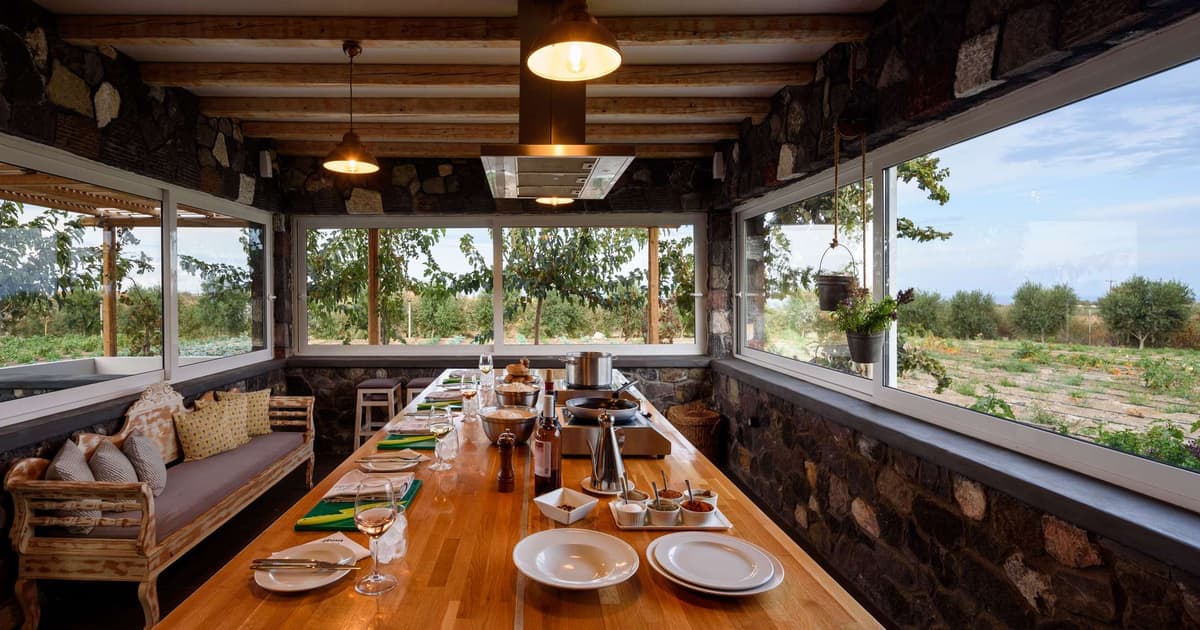
A Santorini cooking class teaches you to cook local dishes with a chef or a host. You cook, then sit down to eat the meal together. This post covers how the lesson runs, the island ingredients and dishes, and the booking rules. The homepage lists more Greece Tours like this one.
Each tour card below opens a live GetYourGuide booking. Dates, start times and group sizes are shown there.
How does a Santorini cooking class work from start to finish?
A Santorini cooking class begins with a welcome from the chef and moves to hands-on cooking. It ends at the table, where the group eats the dishes it prepared. Formats with wine add a tasting or a pairing.
Venues differ from one format to the next. The small-group class with a wine pairing is hosted at a local restaurant and winery. The farm-to-table format starts on a private organic farm. The studio format uses a cooking studio and restaurant, not a home. The Oia grandmother class is held in a private residence.
If you plan to cross into Turkey as well, the homepage also lists Turkey tours.
Group size follows the format. A Santorini cooking class on the wine-and-food format keeps the group to 8 people or fewer. The farm-to-table format caps it at 10, as does the small-group class in English that overlooks Kamari Beach. The studio format takes 2 to 12 guests, and the cooking group on the hike format holds 8 to 12.
Length depends on the format. The studio format has a hands-on class of 1.5 hours. The restaurant-and-winery class takes about three hours, and so does the Oia home class. The private hands-on class runs four hours. The wine-and-food format and the farm-to-table format fill five hours each, because both add a winery stop.
A chef or a local host leads the lesson. On the wine-and-food format, a local chef greets the group at the restaurant. On a three-hour class with an in-house chef, guests join every step, from preparation through to plating. A professional chef leads the private Santorini cooking class. A local host coaches the Oia class.
The hike format starts outdoors. Guests are collected at their accommodation and driven toward Akrotiri. The one-hour hike passes old vineyards, deserted chapels and caldera views. A swim stop at Mesa Pigadia follows, then time to change. The Santorini cooking class and lunch come next, and a drop-off ends the day.
Wine enters a Santorini cooking class in two ways. The wine-and-food format opens at a winery, where a wine expert explains the island’s viticulture. Its tasting covers eight wines, including Assyrtiko. The restaurant-and-winery class pairs wine from the winery’s own selection with the meal. The private class pours Assyrtiko white wine with the dishes.
Two formats start before the kitchen. On the farm-to-table format, guests gather produce on a family farm. They then cook hands-on and sit down to a feast. That Santorini cooking class pairs local wines with the dishes. The studio format opens with a garden stroll, moves into the studio to cook, and closes with a Greek dessert.
Different formats suit different guests. The studio format is aimed at couples, families, groups of friends, cruise passengers and food lovers. The wine-and-food format suits all ages. The hike format asks for good basic fitness.
Menus adapt to diets. The studio format accommodates vegetarian, vegan, gluten-free and lactose-free guests with advance notice. The Oia class caters for vegetarian, vegan and gluten-free diets when told at booking. The wine-and-food menu adjusts for dietary limits and allergies. The hike format accommodates vegetarian and vegan guests.
Hotel pickup and drop-off is included on the hike format, the farm-to-table format and the private hands-on class. On the wine-and-food format, a driver collects guests at their hotel. The restaurant-and-winery class runs a transfer from and to a designated point. The farm-to-table operator needs the hotel details in advance to arrange it.
Which local ingredients and dishes does a Santorini cooking class feature?
A Santorini cooking class cooks with island produce: small cherry tomatoes, fava, white aubergine and capers. Tomato fritters and fava feature on the menus of the three-hour, four-hour and wine-or-beach classes. Volcanic ash soil and scarce water shape the produce behind them.
Volcanic ash soil and a dry climate give the island its own produce, and the cherry tomato leads it. Growers have traditionally raised this small-fruited tomato without irrigation. A deep root system lets the plant draw moisture from the air.
A Santorini cooking class uses a fruit that the dry land has shaped. Because the plant gets little water, its tomatoes stay small and hold more sugars, acids and aroma compounds. Rare rain and wind thicken the skin. The EU register lists the name Tomataki Santorinis as a protected designation of origin.

The tomato reaches the plate as fritters. The class with a wine tasting or beach visit makes them from ripe tomatoes and herbs. Its Santorini salad holds cherry tomatoes, local cucumber and goat cheese. The four-hour class with lunch calls the fritters tomato balls.
Fava comes from the seeds of a flowering plant called Lathyrus clymenum. The final product is small golden discs. Once cooked, the seeds turn sweet and smooth. The plant survives arid, almost desert-like conditions in poor soil that lacks organic matter. It takes up moisture from humid sea air.
A Santorini cooking class turns fava into a creamy puree. On the three-hour class with a local menu, onions, garlic and olive oil flavour it. The all-inclusive class with a chef changes its menu with the day of the week. One day’s plate pairs fava with shrimp tartar.
A Santorini cooking class also cooks the white aubergine. The vegetable grows in the island’s waterless gardens, and its flesh is sweet. On the all-inclusive class, one day’s menu stuffs it with oxtail and bechamel sauce. Its colour is white, and its taste is fruity and mild.
Capers grow on a wild bush, and the bush hangs from the caldera cliffs. The all-inclusive class lists white aubergine, capers and caper leaves among its indigenous herbs and vegetables. The same class makes a spoon sweet of tomato and capers, served with melitinia, a cheese sweet.
Beyond fritters and fava, the menu of a Santorini cooking class changes with the format. The wine-or-beach class cooks pork fillets in a Vinsanto wine sauce. The four-hour class with lunch adds a spinach pie and a vegetable ratatouille with chicken. The three-hour class fills tomatoes or peppers with a rice and herb mixture.
Desserts differ from class to class. The three-hour class ends with baklava or galaktoboureko. The all-inclusive class serves panna cotta with mini tomato confit on one menu, so the tomato even reaches dessert. The four-hour class with lunch lists a ready-made dessert.
A Santorini cooking class serves its meal in a way that depends on the format. The class in a private home serves four courses: appetizers, a fresh seasonal salad, a main course and a dessert. Local white wine comes with the meal. On the four-hour class, lunch comes with unlimited Assyrtiko white wine.
Which season, start times and booking rules apply to a Santorini cooking class?
A Santorini cooking class starts at a fixed time, set by the format. The home lesson in Oia has a bookable slot at 10:00 am. A small-group class with wine starts at 11:00 am. Cancel at least one day ahead for a full refund where the format states it.
On the small-group class with eight wines, the driver collects you at your hotel at 9:30 am. Your Santorini cooking class day therefore begins before the 11:00 am start. Round-trip transport returns you to the hotel afterwards.
Days differ by format. The class with eight wines runs on Monday, Wednesday, Friday and Saturday only. It does not run on Tuesday, Thursday or Sunday. A second small-group class runs daily. Check availability for your date, because the Oia home lesson runs on specific start times.
A Santorini cooking class can also start in the afternoon. On the small-group class that meets at a designated point, the welcome letter confirms the exact time. That time can be updated locally on arrival. The class ends at the meeting point, and the transfer to and from it is included.
The home lesson with a local grandmother meets outside a restaurant in Oia. The cooking takes place in a private residence across the street. This Santorini cooking class does not include private transport. Plan your route and parking in advance.
English is the language of the six-hour class, the wine-estate class and the Oia home lesson. The Oia home lesson is also offered in French.
The six-hour class combines a market tour, a cooking lesson and a wine tasting. If your hotel is not reachable by vehicle, pickup is arranged from the nearest accessible location. Wear comfortable clothes and closed-toe shoes for the market tour and the lesson. Bring a reusable water bottle. The tasting on that class needs valid ID.
Age rules in a Santorini cooking class follow the format. The small-group class with a four-course meal and wine tasting does not admit children under 10. Another small-group class admits children who stay with a supervising adult over 18 at all times. The wine-estate class serves alcohol to guests over 18 only.
Access rules differ by format. The small-group class with a four-course meal is not wheelchair accessible. The Oia home lesson rates its activity level as light and its skill level as beginner. Message the host about mobility needs for that lesson.
A full refund on a Santorini cooking class ends one day before the start on the Oia home lesson. The six-hour class and the wine-estate class set the same limit. The wine-estate class refunds nothing inside it. When the group does not fill, the home lesson offers another date, another experience or a full refund.
Summer on the island is dry. National Observatory of Athens data put average rainfall at 2.5 millimetres in August, 3.0 in September and 3.6 in June. The record high is 38.7 degrees Celsius in June and 38.6 in August. Nights stay warm, with a mean daily low of 23.3 in July and 23.5 in August.
- Pick a day the format runs, and check live availability.
- Read the start time and meeting point in your welcome letter.
- Carry valid ID, a reusable water bottle and closed-toe shoes.
- Cancel at least one day before the start if plans change.