A Delos tour from Mykonos is a short boat trip to a sacred island with ancient ruins. You sail from Mykonos, walk the sanctuary and the houses, and return the same day. This post covers the crossing, the myths, the monuments, the formats and the rules. The homepage lists more Greece Tours like this one.
Each tour card below opens a live GetYourGuide booking. Dates, departure times and group sizes are shown there.
What exactly is a Delos tour from Mykonos?
A Delos tour from Mykonos takes you by boat to the ancient island, then on foot through its ruins. The crossing takes less than an hour, and the shared guided tour is a half-day outing of about four hours.
Delos is a small Greek island in the Cyclades, close to Mykonos. It lies near the centre of the island group and covers 3.43 square kilometres. Administratively, it belongs to the municipality of Mykonos. The only way to reach it is by boat, so every Delos tour from Mykonos starts with a sea crossing.
If you plan to cross into Turkey as well, the homepage also lists Turkey tours.
The outing has three steps. First comes the boat out from Mykonos. Next comes the walk through the ruins, which a certified guide leads on the guided versions. The last step is the boat back, and the round-trip boat ticket on the shared guided tour covers it. The boat is part of every kind, but the guide is not.
The sea part is short, because the crossing takes less than an hour. After landing, you explore the island on foot. The whole island is one archaeological site, and no other activities are on offer there. That makes a Delos tour from Mykonos a history outing, unlike a beach day or a walk through Mykonos Town.
The shared guided tour takes about four hours and includes the round-trip boat ticket. A certified guide leads the group through the ruins. That makes it a half-day outing, so the visit does not need a full day. Boat, guide and site visit fit into a single outing. The rest of the day stays free for other plans.
The guided evening tour moves the visit to the end of the day. It combines the ferry ride, a guided walk, free time on the island and the return crossing. The free time is for exploring on your own, and the boat back can catch the sunset. It suits travellers who want the ruins late in the day.
The boat transfer is the version without a guide. It covers the crossing, and the visit itself is self-guided, so you explore the island at your own pace. A guide joins only if you book one separately. In this form, a Delos tour from Mykonos is a crossing plus a free walk.
On the sailing cruise, a Delos tour from Mykonos adds Rhenia, a second island. The cruise runs longer than the guided tour, and lunch is served on board. The boat stops at Rhenia, where guests have free time to swim. Delos stays on the route, so the day covers both islands.
The private tour gives your own party a private guide for an exclusive walk through the ruins. The guide leads your party alone, while the shared guided tour puts a whole group behind one guide. Choose it if you want the ruins explained to your party only, with nobody else in the group.
All these kinds share one core: a boat to Delos and a walk through the ruins. A Delos tour from Mykonos suits travellers who want to add culture and history to a stay in the Cyclades. The guided kinds suit those who want a guide beside them. The transfer suits solo walkers, and the cruise suits swimmers.
Which port does a Delos tour from Mykonos start from and how long is the crossing?
The boat for a Delos tour from Mykonos leaves from the Old Port of Mykonos Town, at the Delos pier. On the shared guided tour, the ride to the island takes about 30 minutes. A start at the New Port adds a short water taxi.
Boats to Delos sail from the Old Port, the harbour of Mykonos Town. The ferries leave from the south end of that harbour. They sail more than once a day. Delos can be reached only by boat, because the island has no link to the mainland.
A do-it-yourself Delos tour from Mykonos begins at the ticket booth where the ferry docks. You queue at the ticket office to buy a ticket. The agency there sells tickets even half an hour before departure. The ferries run separately from the archaeological site. A boat ticket does not include site admission.
The shared guided tour starts with a check-in at the Old Port. Guests swap their voucher at the sales desk. They check in at least 30 minutes before the boat leaves. A half-day guided tour asks guests to arrive 60 to 30 minutes before departure. Plan a Delos tour from Mykonos with that early arrival in mind.
A start at the New Port works differently. The afternoon guided tour begins there. The group rides a water taxi of about ten minutes to the Old Port. The ferry to Delos leaves from the Old Port and takes about 30 minutes. The return follows the same route and ends back at the New Port.
The boat transfer without a guide has its own start rules. If you take no pickup, you meet at the Old Port, a lively area of cafes and boats. Hotel pickup and a transfer from the cruise port are options. Pickup details are sent by email.
A Delos tour from Mykonos in the boat-transfer format includes a round-trip boat ticket. It also includes an audio guide that plays on your phone. Site admission is not included and is paid on the island. On boat trips that leave out the entrance fee, you buy the site ticket when you arrive.
The crossing is short. On the shared guided tour, the boat ride to Delos takes about 30 minutes. The boat transfer with the audio guide gives the same figure, about 30 minutes each way. Ferry notes quote 30 to 40 minutes. That makes the sea leg of a Delos tour from Mykonos a short one.
The ferries on this route have seating indoors and outdoors. Drinks and snacks are sold on board. One cruise that adds Rhenia sails on a traditional wooden motor sailer instead. Its guests meet at the Old Port and arrive 15 minutes before departure.
The landing is a pier on Delos where the tour boats dock and leave from. Only boats with a special permit can dock at the island. The shore looks rocky and bare as the ferry pulls in. After landing, you join the queue at the entrance to buy tickets.
When you buy the boat ticket for your Delos tour from Mykonos, ask what time the return boat leaves Delos. The timetable changes with the season. A chalkboard at the ticket office lists the times for the day. Keep track of the clock on the island, so you do not miss the boat back to Mykonos.
Why does a Delos tour from Mykonos visit a sacred island?
Myth says Leto gave birth to Apollo and Artemis on Delos. That is why a Delos tour from Mykonos visits a sacred island. Pilgrims came to its shrine, and the island later became a free port and a trading centre.
The island you reach on a Delos tour from Mykonos is the one that Leto found in the myth. Hera had cursed her never to find solid ground for the birth of her children. Delos was believed to be a floating island. Leto gave birth to Artemis first, and the delivery was painless.
The birth of Apollo was harder. It lasted nine whole days and nights, because Hera had kidnapped Eileithyia, the goddess of childbirth. One telling adds that four diamond chains anchored the floating island to the seabed. In that telling, the island went from Adilos, which means invisible, to Delos, which means visible.
Delos was a place of worship before it was a place of trade. The island was at first a religious pilgrimage for the Ionians. Its claim to be the birthplace of Apollo gave it a strong religious identity. So a Delos tour from Mykonos is a visit to a sanctuary first and a town second.
In the fifth century BC the island also hosted an alliance. The Delian League was founded to protect its member cities from future attacks. Its common treasury was kept on Delos until Pericles moved it to Athens. Athens then held absolute control over the administration of the sacred property.
The island was cleansed more than once. In the sixth century BC the tyrant Pisistratus had every grave within sight of the temple dug up. In the sixth year of the Peloponnesian War, the Athenians purged the whole island of dead bodies. A Delos tour from Mykonos lands on the island that Athens purified.
A later decree went further. From then on, no one was allowed to be buried or to give birth on the island. Both were seen to pollute the sanctuary. It was forbidden to die on Delos as well. All the tombs of people who had died there were removed.
By the end of the fourth century BC, the kingdom of Macedonia protected the island. Later the Romans converted Delos into a free port. After Rome destroyed Corinth, Delos was able to take over part of Corinth’s role as a trading centre. A Delos tour from Mykonos visits the ruins of that trading centre.
The wealth did not last. Troops of Mithridates VI of Pontus seized the island in the first century BC. Pirates allied with him ransacked it in the same century. Delos ceased to be a stopping point in Mediterranean traffic. Trade, building work and population waned, and as a cult centre the island entered a sharp decline.
Despite the decline, people still lived on Delos in the early Roman Imperial period. The island held churches, basilicas and a monastery from the first to the sixth centuries AD. It was eventually abandoned around the eighth century AD. UNESCO added Delos to the World Heritage List in nineteen ninety.
A team from the French Archaeological School began excavating Delos in eighteen seventy-three. The excavations are ongoing. They rank among the largest in the Mediterranean. A Delos tour from Mykonos therefore visits an archaeological site where the digging has not stopped.
Which monuments stand along the Sacred Way on a Delos tour from Mykonos?
On a Delos tour from Mykonos you pass the Sacred Way, the Apollo sanctuary and the Terrace of the Lions. You also pass the Sacred Lake, the Agora of the Competaliasts, the Stoa of Philip and the Sanctuary of Dionysos.
A Delos tour from Mykonos reaches the Sacred Way, a paved road lined with marble bases. The bases once carried statues and monuments. Beside the road lie the Treasuries of the Cities, where Greek city-states kept offerings to the god. During the Delian Festival, the procession to the Sanctuary of Apollo took this route.
Beyond the Propylaia, a once white marble gateway, lie the remains of the Sanctuary of Apollo. The sanctuary was the ancient heart of Delos. It held three temples to Apollo, built side by side. Pilgrims came from all over Greece. The largest of the three, the Temple of the Delians, is also called the Great Temple.
The Great Temple follows the Doric order. Columns ringed the building, six on each short side and 13 along each long side. The foundations measure about 30 metres by 13 metres. The inner room, called the cella, opens to the west. The remaining columns show how the ancient Greeks made fluting.
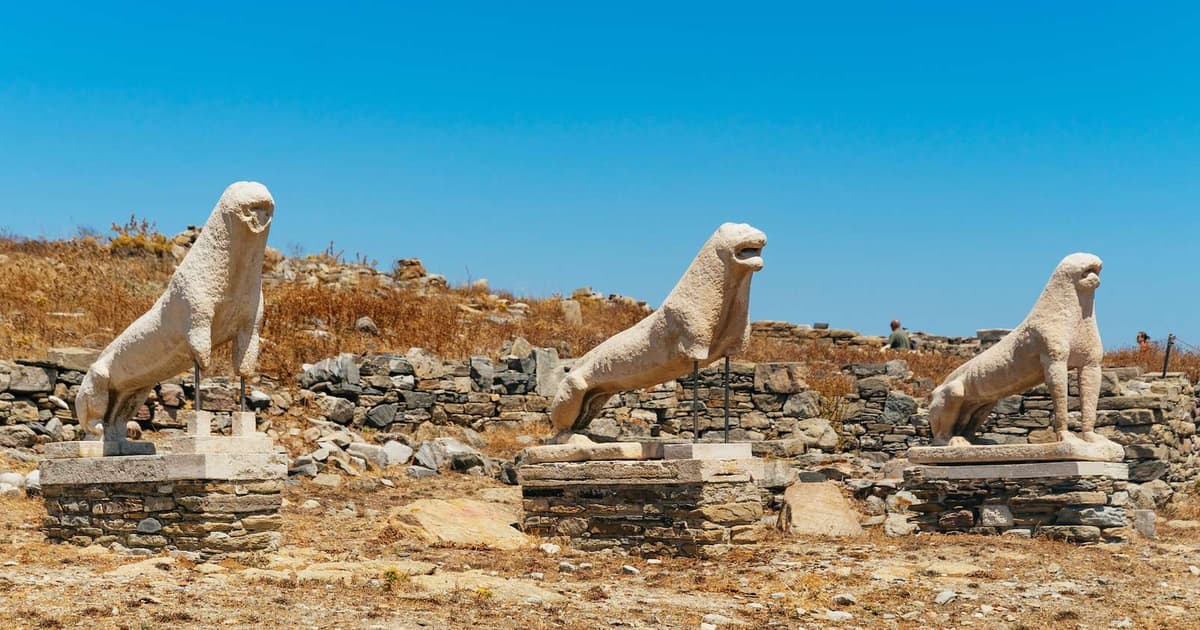
The Terrace of the Lions on a Delos tour from Mykonos holds marble lions that the Naxians dedicated to Apollo. The lions crouch and snarl. They acted as guardians of the sanctuary. The row runs beside the Sacred Way. Together the lions form a monumental avenue, comparable to the avenues of sphinxes in Egypt.
The lions face east toward the Sacred Lake. The lake sits in a small, round bowl. Caretakers keep the basin dry on purpose, to stop malaria-bearing mosquitoes from spreading. In ancient times the lake held the sacred swans and geese of Apollo. On a Delos tour from Mykonos you see the dry basin, not water.
One palm tree stands in the middle of the dry basin. It honours the tree that Leto is said to have clutched during the birth. The Homeric Hymn to Apollo tells the story. In it, Leto throws her arms around a palm tree and kneels on the soft meadow. Beneath her, the earth laughs for joy.
The Agora of the Competaliasts lies directly beside the Sacred Harbour. It is a Hellenistic market square. Merchants, sea captains and bankers put up monuments here. The stone paving shows postholes for market awnings. Two bases, one square and one round, carried monuments to Hermes. A Delos tour from Mykonos passes this old marketplace.
The Stoa of Philip was a gift to Apollo from Philip V of Macedon. A stoa is a covered walkway lined with columns. This one stands on the north side of the Agora of the Competaliasts. Beside it is a small Ionic temple dedicated to Hermes. The Sacred Way runs beside the stoa.
The Sanctuary of Dionysos, also called the Stoibadeion, lies northeast of the Sanctuary of Apollo. A statue of the god stands on a rectangular platform. Two pillars flank the platform, and each once carried a large phallus, the symbol of Dionysos. The southern pillar also carries relief scenes of a Dionysiac circle.
The southern pillar’s inscription says Carystios, a Delian, put it up to celebrate a victorious theatrical production he sponsored. A Delos tour from Mykonos passes this shrine and its two pillars, which stand northeast of the Apollo sanctuary.
Which houses and mosaics does a Delos tour from Mykonos reach?
The guided half-day Delos tour from Mykonos walks past luxurious villas with ancient mosaic floors. Named stops are the House of Cleopatra and the House of the Dolphins. The House of the Masks and the House of Dionysos are named stops too.
The houses of Delos stand in separate quarters. The House of Dionysos and the House of Cleopatra lie in the Theatre Quarter. The House of Hermes, the House of the Dolphins and the House of the Masks lie in the Inopos Quarter. Elsewhere, the luxurious homes of Greek, Italian, Egyptian and Syrian merchants survive in the foreign quarters.
Walkers on the guided half-day Delos tour from Mykonos pass the villas named above and look at the mosaic floors. Those floors have survived since ancient times. On the New Port guided tour, guests see the House of Dionysos, which is well preserved. Its mosaics show scenes from myth.
Houses and private homes gave up the bulk of the mosaics on Delos. The House of the Dolphins takes its name from the mosaic in its courtyard. A circle sits inside a square frame. Pairs of dolphins carry tiny winged riders, and the riders hold the emblems of Greek gods. The circle holds a rosette ringed by garlands and griffins.
The artist signed this floor. Only one other floor on Delos carries a signature. The Phoenician owner of the house also ordered a floor mosaic of the goddess Tanit for his entrance hall. That makes two mosaics in one house, one in the courtyard and one at the entrance.
On the guided half-day format, a Delos tour from Mykonos also reaches the House of the Masks. The name comes from theatre masks set among ivy scrolls in its mosaic. The courtyard is paved with marble chips. The corridor floors use broken pieces of amphorae. The house is a large complex beside a large outdoor cistern.
The House of Dionysos is named for a floor mosaic of the wine god riding a big cat. The god has open wings, and the cat wears a necklace of vine and grapes. Doric columns frame the court and the mosaic. The tiny pieces measure about one millimetre square. They are cut from glass, faience, terracotta and natural stone.
An Athenian named Dioskourides and his wife Kleopatra owned the House of Cleopatra. A Delos tour from Mykonos passes it on the guided half-day walk. Statues of the couple stand inside the house. The House of Hermes follows the slope of the ground. It has a peristyle, a stairway and rooms, including a bathroom.
On a Delos tour from Mykonos, the plain floors show the everyday rooms. Nearly all decorated floors carry only simple geometric patterns. Broken marble set in cement makes up the bulk of the floors. Rooms for receiving guests got richer mosaics. Kitchens and latrines were paved with pottery, brick and tile fragments, which kept water out.
Water was limited on Delos. The islanders used cisterns, an aqueduct system, wells and sanitary drains. Wells stood inside the houses. On one house well, deep cuts show where ropes ran for years. A walk through the houses on a Delos tour from Mykonos shows how much water management mattered to the Delians.
What do the theatre quarter and the Mount Kynthos viewpoint add to a Delos tour from Mykonos?
In the theatre quarter, a Delos tour from Mykonos adds an ancient theatre and the sanctuaries of foreign gods. The theatre seated thousands of spectators. Mount Kynthos adds a climb of about 20 minutes and a view over the nearby islands.
The theatre was built at the edge of the town, but the town grew around it. Houses, a large hotel and small sanctuaries closed in on all sides. That crowded district is the Theatre Quarter. On a Delos tour from Mykonos, it is where the ruins turn from temples into streets.
Builders worked on the theatre from the late fourth century BC into the third century BC. It seated thousands of spectators. The seating is divided into two sections, an upper one of 26 tiers and a lower one of 17. The whole seating area is 65 metres wide.
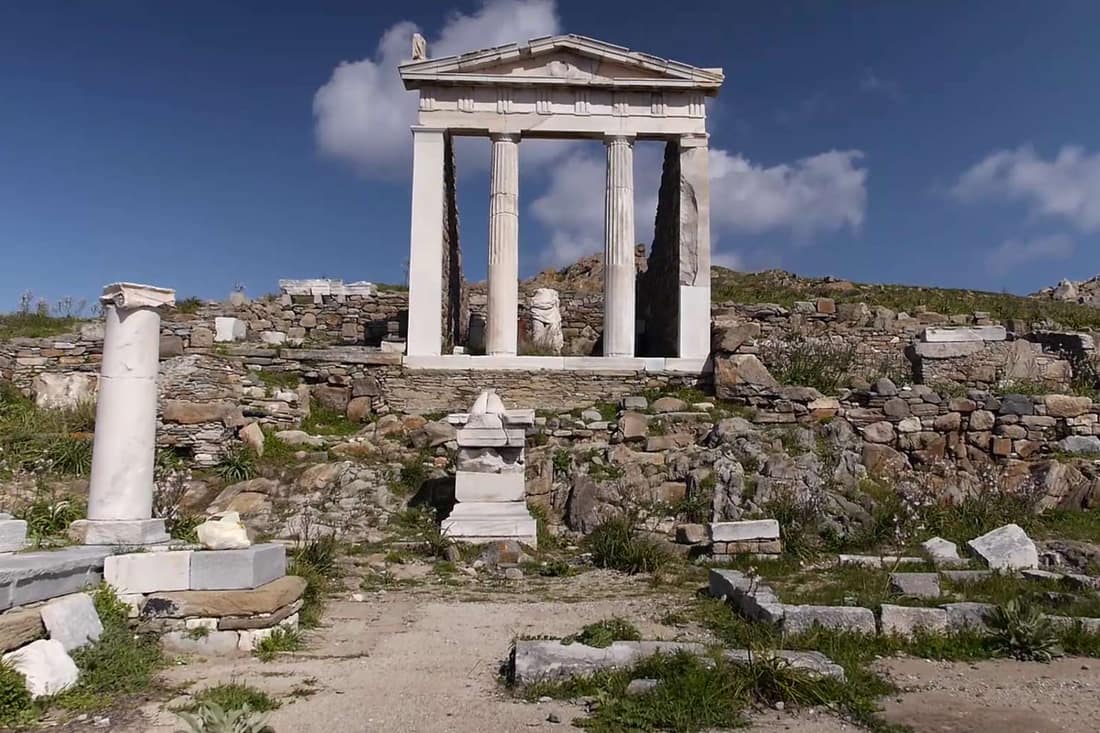
The semicircular orchestra was the main part of the theatre. A stage building closed its straight side. That building was a rectangle of 15.26 by 6.64 metres. The seats and the stage building survive in very poor condition.
The Theatre Quarter grew without a plan, and its houses vary greatly in size and layout. A twisting main road of changing width, known as the road of the Theatre, ran through it. Shops looked onto this road. Alleys opened off it, sometimes widening into crossroads. A Delos tour from Mykonos walks through this tangle on foot.
A separate quarter of Delos was set aside for foreigners and for the sanctuaries of foreign gods. The Terrace of the Foreign Gods lies on the lower part of Mount Kynthos. Gods from Egypt, such as Sarapis and Isis, and the Syrian pair Hadad and Atargatis were worshipped on Delos.
The largest of the three Egyptian sanctuaries, called Sarapeion C, measured 120 by 50 metres. A long walkway led up to the main temple, and sphinxes lined an avenue in Egyptian style. Its Temple of Isis follows Greek architecture. In the early second century BC, the administration of the Sanctuary of Apollo took it over.
Syrian worshippers had a sanctuary of their own, with a theatre and a terrace used for processions. Another sanctuary, the Kynthion, honoured Zeus Kynthios and Athena Kynthia. Mount Kynthos itself is crowned with a sanctuary of Zeus. On a Delos tour from Mykonos, the summit is therefore a place of worship as well as a viewpoint.
Mount Kynthos is the highest point of Delos and rises just over 100 metres. Its top is bare rock. Two flights of steps once led up to the summit: one on the north side, one on the west. A visitor climbing the old staircase needs about 20 minutes.
From the summit, the view covers the innermost islands of the Cyclades: Mykonos, Naxos, Paros, Syros and Rhenia. Mykonos is the island you left behind for the crossing. The winners of the Delian games climbed this mountain to be crowned. Visitors on a Delos tour from Mykonos can follow them.
Walking among the temples and houses on Delos takes about two to three hours. The staircase up Mount Kynthos is a separate climb of about 20 minutes. Anyone who wants the summit on a Delos tour from Mykonos needs time for both the walk and the climb.
What does the archaeological museum add to a Delos tour from Mykonos?
The museum holds the original marble lions, statues, reliefs, mosaics and pottery found on the island, while copies stand outdoors. A Delos tour from Mykonos that includes it lets you see the real objects behind the ruins.
The museum stands inside the archaeological site. One boat ride from Mykonos reaches both the ruins and the exhibits. The Archaeological Society of Athens built it on the island at the start of the twentieth century. Its job was to house the discoveries made there. It is a small museum.
On a Delos tour from Mykonos, the open-air ruins show where people lived and prayed. The museum shows what they left behind. The display holds sculpture and reliefs found on Delos, pottery, and small objects from private homes.
The original lions of Delos are inside the museum, and exact replicas stand outdoors. The lions were carved from porous marble of Naxos. Gales, rain and sea salt had eaten the stone away, layer after layer. The originals were moved under a roof to spare them another winter in the open.
A Delos tour from Mykonos shows copies outdoors and originals indoors. The museum is where the real stone can be seen. The plan for the replicas used plaster casts and silicone moulds made in Athens. The plan called for artificial stone, with cement and ground Naxos marble in the mix.
Two statues follow the same rule as the lions. The marble statues of Dioskourides and his wife Kleopatra are originals in the museum, and replicas of them stand outdoors. A marble group shows Boreas, the Greek god of the cold north wind, carrying off the Athenian princess Oreithyia. It came from the Temple of the Athenians.
The museum adds early Greek sculpture to a Delos tour from Mykonos. A kouros torso and a kore statue came from the Sanctuary of Apollo. A kouros is a standing statue of a young man. A kore is the female counterpart.
Smaller finds add detail. An ivory plaque from the Artemision shows a Mycenaean soldier, and a bronze mask shows the bearded god Dionysos. A wall painting from the Skardana quarter shows Heracles, two boxers and a musician. The figurines, jewellery and mosaics in the museum date to the second and first centuries before Christ.
One floor mosaic from the Skardana quarter is on display in the museum. Its central panel shows Athena with a spear and an owl, and Hermes with a staff called a caduceus. The border has bull heads, theatre masks and flowers. Other mosaic pieces show a comic mask, doves and an animal.
Timing matters on a Delos tour from Mykonos. The site opens at eight in the morning, and the closing hour moves earlier as autumn goes on. Admission stops twenty minutes before closing time, so the museum visit has to start before then. The entrance ticket covers both the site and the museum.
Each Delos tour from Mykonos uses the museum in its own way. On the afternoon guided tour, the guide leads the walk for one hour and thirty minutes. Visitors then have free time at the museum. A morning guided tour gives two hours and fifteen minutes on the island and includes a visit to the museum.
Which Delos tour from Mykonos format fits you: guided, evening, small group or private?
Choose the guided tour if you want the ruins explained, and the boat transfer if you prefer to walk alone. A Delos tour from Mykonos also comes as an evening tour, a small-group tour or a private visit.
The morning guided tour is the standard format. The boat leaves at about 10 am, and the whole outing lasts about 4 hours. The guided walk takes 90 minutes on one schedule and 2 hours on another. Both schedules include the boat tickets, a guide and the entrance to the archaeological site.
Morning guided tours use a wireless guide system for the group. The shared morning tour caps its group at 50 people. Hotel pickup, meals, drinks and tips are not included. On a second schedule, the morning Delos tour from Mykonos sets no limit on the group size.
Check the language before you pick a Delos tour from Mykonos. One morning schedule runs English every day at 10 am, French on Thursday and Sunday, and Italian on Wednesday. German runs only as a private tour on that schedule. A second morning tour offers English, French, Italian or Spanish.
Two schedules add a guided departure at 5 pm. The evening Delos tour from Mykonos lasts 3.5 hours in total. The guide leads for 1.5 hours, then comes 1 hour of free time. Boat tickets, site entrance, museum access and a wireless system are included, but food and drink are not. The tour needs at least 8 people to run.
The New Port tour starts at the cruise ship landing and lasts 5 hours in total. The guided walk takes 1.5 hours, followed by 1 hour of free time. English runs daily at 10 am and 5 pm, French on Thursday and Italian on Wednesday. The entrance fee, food and tips are not included.
Group size separates each Delos tour from Mykonos format. One half-day tour is capped at 12 people. The shared morning tour takes up to 50. The private morning tour from Mykonos Town allows up to 6 people. Choose the cap that matches your party.
On a private tour only your own party joins the guide. The private morning tour lasts about 4 hours. The private guide leads about 2 hours among the ruins, and the entrance ticket is included. The boat is shared. Hotel pickup and drop-off are included, while meals, drinks and tips are not.
A private speedboat tour takes up to 7 guests and lasts 3 hours 30 minutes. Food and drink are not included. A separate walking tour in English lasts 3 hours and comes with an archaeologist as guide. It includes boat tickets and the entrance fee.
The boat transfer with an audio guide is the self-guided Delos tour from Mykonos format. The ticket covers round-trip boat travel and a phone audio guide in English, French, Spanish and Italian. It gives about 3 hours on the island. No live guide comes along. Bring cash for the entrance fee and any purchases.
You can also walk the site on your own. Visitors who buy a ticket at the entrance receive a small guide and a map. Three routes are proposed, depending on your time and ability. The blue route takes about 90 minutes, the blue-green route 3 hours and the blue-green-brown route about 5 hours.
When you buy a ticket, ask what time the boat returns from Delos. The return time changes with the season. The guided formats give 1.5 to 2 hours of walking with a guide. The transfer gives about 3 hours alone. Compare that with the route times above.
How does a Delos tour from Mykonos combine with Rhenia and a swim stop?
Cruise formats pair a Delos tour from Mykonos with a swim stop at Rhenia, the uninhabited island west of Delos. The stops are swimming and snorkelling, a meal on board and the ruins. The order of the stops and the time at each one differ from one cruise to the next.
Rhenia is the island that cruise versions of a Delos tour from Mykonos add to the day. Its other spellings are Rineia and Rheneia. It belongs to the Cyclades and lies just west of Delos. From Mykonos it lies further to the southwest. The island covers 14 square kilometres.
Nobody lives on Rhenia today. The island lies inside a Special Protection Zone of the EU. It has no roads and no tavernas. On the semi-private sailing cruise, guests swim and snorkel from the ladder of the yacht. No pier or tender serves the shore.
In ancient times, Rhenia served as the burial place of the Delians. The southern half of the island formed the necropolis of Delos. Burials there continued until Roman times. The swim stop on a Delos tour from Mykonos lies at the old burial island of Delos.
The six-hour barbecue version of a Delos tour from Mykonos anchors the yacht for two hours in a cove. Guests swim, snorkel and eat a grilled barbecue lunch there. On Delos they then have about ninety minutes ashore. The Delos entry ticket comes with that cruise, and the visit is self-guided. The sail back to Mykonos takes about ninety minutes.
The semi-private sailing cruise runs for six hours. The yacht sails for about one hour to Rhenia first. The swimming and snorkelling stop there lasts about two hours, and lunch and drinks follow on board. A licensed English-speaking guide then leads a tour of Delos for about one and a half hours.
The five-hour catamaran cruise visits Delos before Rhenia. On this Delos tour from Mykonos, guests discover the island from the boat. The catamaran then sails to Rhenia for a swimming and snorkelling stop. A meal is served on board. The cruise ends with a sail past Little Venice before the return to the start point in Mykonos.
The sunset catamaran follows a timetable that shifts through the season with the time of sunset. This half-day Delos tour from Mykonos includes a guided tour that introduces the history of Delos. Rhenia is the swim stop. The last stop is Little Venice as the sun goes down, and dinner is served on board.
A cruise on a traditional wooden motor sailer lasts six and a half to seven hours. Guests get two hours of free time on Delos. On Rhenia they get free time to swim or lounge on the beach. A Greek barbecue with local wine is served. Entry to the Delos site is not part of that cruise ticket.
Swimming is not permitted on Delos, which is a protected archaeological site. A swim stop on a Delos tour from Mykonos takes place at Rhenia instead. On the barbecue cruise, guests who skip Delos can stay on the yacht and swim in a nearby bay. Another cruise lets those guests visit a different beach and keep swimming.
Cruises do not all follow one route. On one sailing yacht cruise, the weather and operational constraints set the sequence. The morning sailing of that cruise takes six hours, and the sunset sailing takes five hours. A self-guided audio option on that cruise lasts about one hour.
What season, weather and rules apply to a Delos tour from Mykonos?
Plan a Delos tour from Mykonos around the warm months. The site closes from December to March and on a short list of public holidays. Wind, strong sun and island rules decide how each day goes. Check all three before you go.
Daily crossings to Delos run in summer. The site stays open through November, then closes for December to March. A visit in those months needs a written request and is allowed only on an exceptional basis. So a Delos tour from Mykonos belongs to the open season.
The ministry timetable names no weekly closed day. Its closed dates are public holidays. These are 1 January, 25 March, Easter Sunday, Labour Day, and 25 and 26 December. Opening hours change in steps through the season, so check the timetable for your date.
Mykonos is dry in summer. July has a mean daily high of 27.8 °C, and August one of 27.6 °C. July brings 0.1 mm of rain on average and August 1.3 mm. The rainy season runs from October until March. On a Delos tour from Mykonos in midsummer, sun and wind are the weather to plan for.
Shade is limited on Delos, because the island has no dense tree cover. A hat, sunglasses and high-SPF sunscreen are essential. Light long sleeves add cover as well. The marble adds glare, so sunglasses matter as much as the hat. The wind makes the sun feel weaker than it is.
In the Aegean Sea, the meltemi is a strong, dry wind from the north. It blows from late spring until about the middle of September. It arrives in clear weather with no warning and is at its strongest in the afternoon. Any Delos tour from Mykonos in that window can meet it.
Strong etesians can last for days without a break. Yachts and inter-island ferries cannot always sail in them. A strong meltemi can cancel the Delos boats on a day when a large ferry still docks on Mykonos. A sailing cruise from Mykonos needs good weather to run.
Camping and overnight stays are forbidden on Delos, since the whole island is archaeological. Staying on the island outside the site’s opening hours is not allowed either. Pets, dogs included, are not allowed as a rule. A Delos tour from Mykonos is therefore a return trip within the site’s opening hours.
Greek aviation rules list archaeological sites as restricted zones for drones. Such flights need approval in advance or are banned outright, depending on the activity. On foot, stay on the paths and do not climb the columns. There are no restaurants on the island, so bring snacks and water.
The site has uneven ground, ancient pathways and steps, and a visit means extensive walking. Comfortable walking shoes with good grip matter more than fashion sandals. Visitors with mobility problems face significant challenges. The island does have ticket offices, public toilets and facilities for disabled visitors. Ask about access before booking a Delos tour from Mykonos.
Advance booking of tickets is recommended. Plan the visit for the first or second day of a Mykonos stay. Keep a spare day in case the wind cancels the boats. Check the departure kiosk the evening before and again at breakfast. Live availability for your Delos tour from Mykonos shows which dates and boat times still have places.
- Hat and sunglasses
- High-SPF sunscreen and light long sleeves
- Water, more than you think you need, plus snacks
- Comfortable walking shoes with good grip
- Your ticket stub, kept until you are back in Mykonos
- A spare day in your plan