
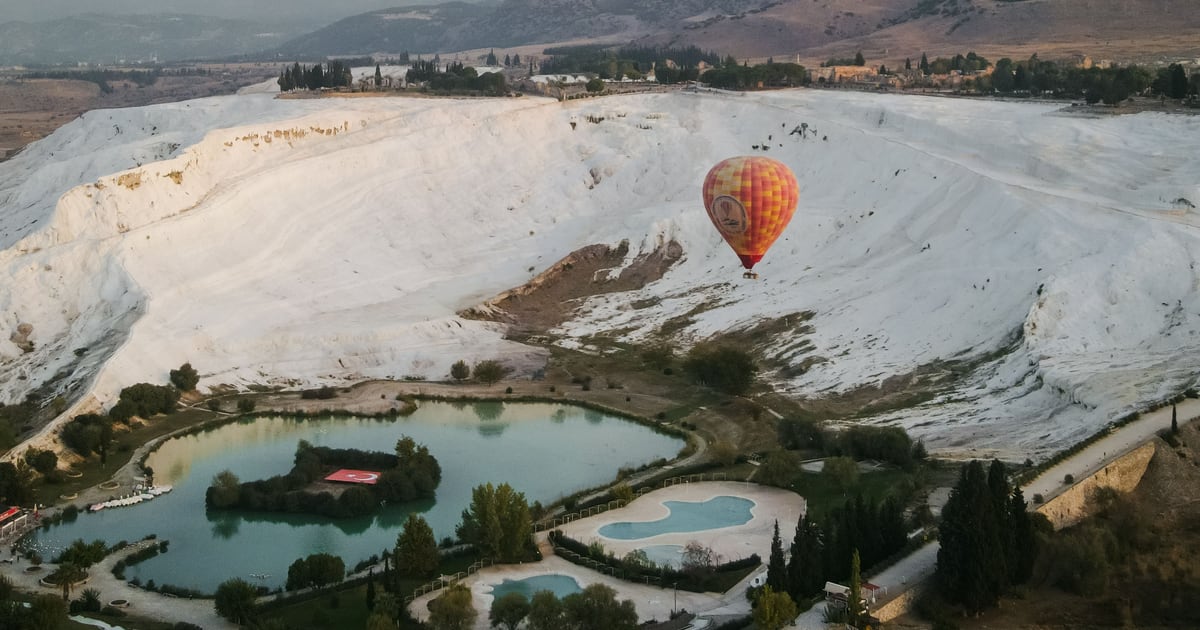
A Pamukkale hot air balloon flight lifts you over white terraces at sunrise. This post covers the day, the terraces, the balloon, the rest of the day and the booking rules. The homepage lists more Greece Tours for the Greek islands.
Every tour card below opens a live GetYourGuide booking. Pickup points and group sizes are shown on each card.
What is a Pamukkale hot air balloon flight and how is the day built?
A balloon ride over Pamukkale starts at sunrise, and the day tour from Antalya begins with an early hotel pickup. On a Pamukkale hot air balloon day tour, one format lists a one-hour flight, then lunch and the ride home.
Hotel pickup in Antalya comes in the early morning. The drop-off at the end of the day belongs to the same service. A minibus carries the group to the area where the balloon ride starts. That is the format that adds a lunch in Denizli.
After the flight, the homepage lists Turkey tours for Cappadocia, Istanbul and the Aegean coast.
The seat on a Pamukkale hot air balloon flight in this format comes with a pilot who speaks English. An English-speaking guide also travels with the group. A flight certificate is part of the ticket, and so is the buffet lunch.
Flight time differs from format to format. The day tour with lunch in Denizli lists a flight of one hour. A dawn ride from Antalya lists a ride of thirty-five minutes. Compare those minutes before booking a seat on a Pamukkale hot air balloon trip.
The dawn ride from Antalya lists groups of up to forty-five people. At least six must book for it to run. English is the only language on that ride. Travellers need a moderate level of fitness for it. Another day tour suits average physical fitness, given the early start and moderate walking.
A day tour from Antalya lists what the ticket covers. The list holds a pre-flight safety briefing, insurance and a commemorative flight certificate. An open buffet lunch of traditional Turkish cuisine is on it too. Hotel transfers and a tour guide complete the list. Entrance fees, photos and videos are not.
The day tour with lunch in Denizli leaves out breakfast and drinks. Entry to the ancient site is bought separately on that format. So is entry to its thermal pool. A third format lists round-trip transport, a guided balloon flight and lunch at a local restaurant. Personal expenses and gratuities stay outside that ticket.
Day tours from Antalya also come in a version where the flight is an option. A traveller who wants to be on a Pamukkale hot air balloon flight picks the flying version when booking. The watching version takes guests to a viewing area for the sunrise balloon display. The flights are not included there.
Cappadocia Hot Air Balloon covers Balloon too.
On a Pamukkale hot air balloon ride, the float begins as the sun starts to rise. As the balloon gains height, the view takes in terraces with hot springs. The flight comes first. Lunch follows later in the day, and the transport back to Antalya closes it.
The length of a day on a Pamukkale hot air balloon tour from Antalya depends on the format. Listed day tours run from twelve to eighteen hours. The day with lunch in Denizli ends with a goodbye at the hotel in Antalya. Before that, the group boards the transport for the return journey.
Why do the travertine terraces belong to a Pamukkale hot air balloon flight?
The white terraces are the main sight below the basket. Spring water rich in calcium built them from travertine, and Pamukkale means cotton castle in Turkish. Passengers float above them during a Pamukkale hot air balloon flight that lifts off at sunrise.
Pamukkale takes its name from limestone with a shimmering, snow-white face. Denizli Province holds the site, which sits in the Inner Aegean region within the River Menderes valley. From Denizli’s hills across the valley, the pale slope comes into view. Passengers see it from above during a Pamukkale hot air balloon experience.
The spring water is rich in calcium carbonate. At the surface it loses carbon dioxide into the air, and the calcium carbonate settles as a soft gel. Over time the gel crystallises into travertine, a sedimentary rock. A passenger looks down on that rock during a Pamukkale hot air balloon ride.
More about Pamukkale: Pamukkale Tour From Antalya.
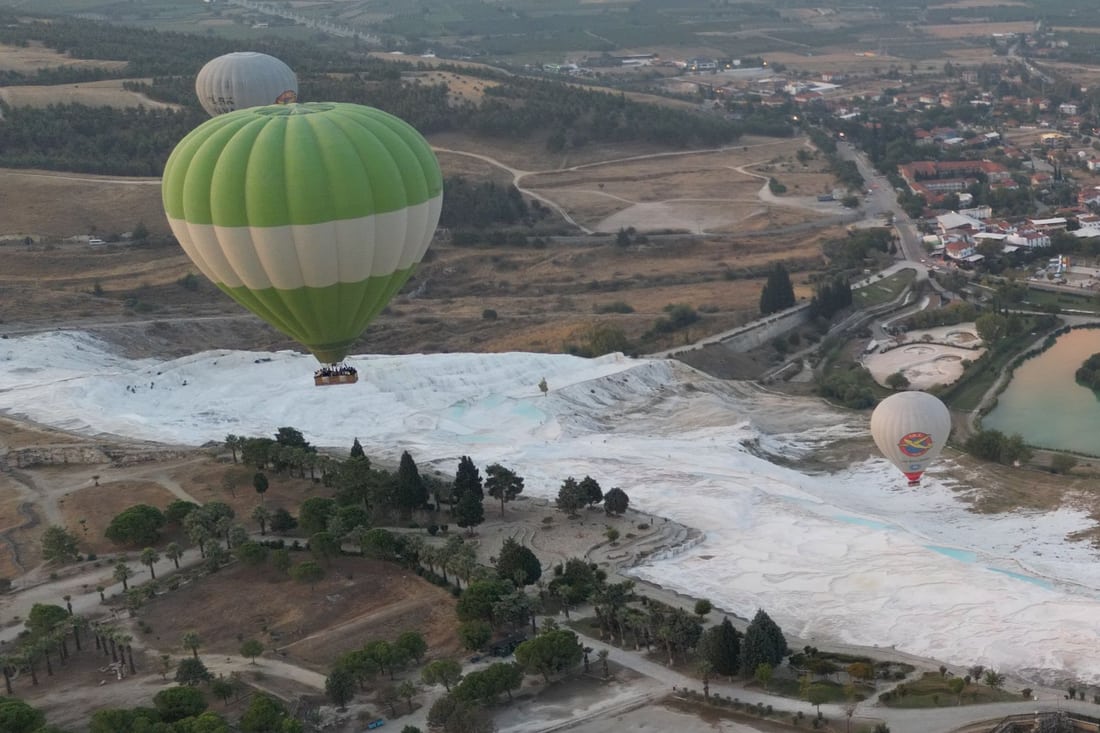
The spring water travels 320 metres to the head of the terraces. From there it cascades down the slope into the pools below. Low travertine dams hold it back and form small natural lakes. Cleopatra’s Pool holds ancient marble columns under its water. On the sunrise flight, early light emphasises the patterns of the mineral pools.
The terraces and the ancient city beside them were listed together as a UNESCO World Heritage Site in nineteen eighty-eight. On the sunrise flight over both, the first light paints the terraces and water in shades of pink and gold. The 360-degree views from the basket turn the cliffs gold during a Pamukkale hot air balloon trip.
Hierapolis sits on a shelf of land above the Lycus river, whose modern name is the Curuksu. The Lycus joins the Buyuk Menderes, the classical Meander. Ancient Laodicea and modern Denizli lie across the valley. The Greek name Hierapolis means Holy City. The sunrise flight over the terraces shows vineyards and the Menderes valley stretching toward the Aegean.
Spa use of the hot springs goes back to at least the second century BC. Hierapolis grew into a healing centre where doctors used the thermal water to treat patients. The great baths, built around natural thermal pools, hold the archaeology museum. The ruins of Hierapolis lie below the basket during a Pamukkale hot air balloon tour.
Readers interested in Pamukkale can open Pamukkale Tour From Istanbul.
The Roman theatre dates to the second century AD and was renovated under the emperor Septimius Severus. The necropolis stretches over two kilometres and holds about 1,200 tombs. The tombs range from graves and sarcophagi to round tumuli and bigger family tombs built like small temples. Passengers spot the theatre and tombs during a Pamukkale hot air balloon journey.
Travertine free of impurities is white, while impurities tint it brown or yellow. A proconsul named Julius Frontinus built the monumental gate at the entrance to the Roman city. Its three openings stand in squared blocks of travertine. At the Hierapolis hot springs, one mausoleum stands submerged in a travertine pool.
Which equipment and crew stand behind a Pamukkale hot air balloon flight?
Four parts do the work aboard a Pamukkale hot air balloon flight. They are a fabric envelope, a propane burner, a basket and a crew. The burner heats the air inside the envelope until it is less dense than the air outside.
The envelope is cut from panels of ripstop nylon or polyester. Panels sewn in vertical rows form triangular strips called gores. Webbing tapes run along the strips to a load ring at the top. Strong cables pass the weight of the basket to those tapes.
Air heated to 99 degrees Celsius needs about 3.91 cubic metres of envelope for each kilogram it lifts. A warm day cuts the load a balloon can lift, and a cool day raises it. Lift also falls about three per cent for each thousand metres of height the balloon gains.
Pamukkale comes up again in Ephesus Pamukkale Tour From Istanbul.
The heater system has one or more burners, tanks of liquid propane and fuel lines between them. Each burner puts out about two to three megawatts of heat. The pilot aboard a Pamukkale hot air balloon opens a propane valve, called the blast valve, to fire it.
Wicker is the preferred basket material because it is sturdy, flexible and light. Baskets are made for two people at the smallest and thirty at the largest. Aluminium or stainless steel tanks share the basket with the pilot and everyone aboard a Pamukkale hot air balloon ride.
A small pod holds the altimeter, a rate-of-climb indicator called a variometer and a gauge for the envelope’s temperature. Precise steering is not possible, so riders aboard a Pamukkale hot air balloon drift with the wind. The pilot changes height to catch a different wind stream.
On the sunrise flight listed for Pamukkale, the ground crew prepares and inflates the balloon. A fan first fills the envelope partly with cold air, and the burners finish the inflation. The pilot and crew give instructions and a safety briefing before riders step aboard a Pamukkale hot air balloon basket.
Another page that includes Pamukkale is Ephesus Pamukkale Tour From Izmir.
For a sport balloon, the optimum inflation crew is four people. The pilot works the burner, two people hold the mouth open and one steadies the envelope on the crown line. The chase vehicle’s recommended minimum crew is a driver and a navigator who spots the balloon.
At the launch field, a pilot releases a small helium balloon, called a pibal, to read the wind. A pibal that rolls along the ground, or climbs and then dives, tells the pilot to cancel. For the Pamukkale region, the exact launch point is chosen from the morning’s wind direction.
Passengers aboard a Pamukkale hot air balloon return to the ground once the pilot lowers the energy in the envelope. With a parachute top, partly opening the valve is the normal way to cool the balloon. On one Pamukkale sunrise tour, the balloon comes down in a field after a gentle descent.
Turkey’s Directorate General of Civil Aviation is the aviation regulator for the country. Under its authority, a university centre assesses take-off suitability and airspace requests for designated balloon flight areas. Denizli, Pamukkale is one of those areas. A training organisation approved by the authority teaches balloon pilot licence courses and trains ground crews.
A related page on Pamukkale: Pamukkale Hierapolis Tour From Bodrum.
Where does the day lead after a Pamukkale hot air balloon landing?
A day tour continues after a Pamukkale hot air balloon flight with a walk, a meal and the road back. On one day tour from Antalya, a guide leads a three-hour tour of the hot springs and the ruins.
What happens on the ground depends on the format. After a Pamukkale hot air balloon landing, the format with a private transfer brings a toast and a commemorative certificate. On another format, a small ceremony and a flight certificate are presented. A third offers a toast, then an optional walk around the town.
Breakfast is not fixed after a Pamukkale hot air balloon ride. One schedule ends with breakfast and the return to Antalya. On the format with a private transfer, breakfast is not included, and the passenger can eat or explore the site. Lunch is included there. One listing leaves out both breakfast and lunch.
On the format with a three-hour programme, a guide leads the group around the hot springs and the ruins. That walk begins after a Pamukkale hot air balloon trip. An optional swim in Cleopatra’s Pool, with its warm mineral-rich water, comes with it. Another format adds the ancient baths to the ruins before a dip in the same pool.
Denizli is the seat of a province on high ground above the Aegean coast. A visit there after a Pamukkale hot air balloon morning leads to the city of the rooster. For at least nine hundred years the bird has been the emblem of the city and province.
Pamukkale also features in Pergamon and Pamukkale Tour From Izmir.
The breed has long legs, a long strong neck and a broad deep chest. Breeders name three crowing styles: tenor, bass and davudi. A good crow starts slow, speeds up and ends slow again. In a good rooster, the quality of the crow matters more than its length.
Denizli tandir kebab is a geographically indicated product and a symbol of the city’s cooking. The lamb comes from milk-fed animals under one year old. A tandir oven fired with mastic tree wood cooks it slowly in its own fat, with no marinade. Vegetable dishes are the base of Denizli cooking.
The economy of Denizli developed mainly through the making and export of textiles. Buldan is a district of Denizli Province, forty-six kilometres from the city. The town ranks as a very important centre for Turkish textile making. Its weavers were known for a thin handwoven cheesecloth-type fabric, used mainly for bed covers and tablecloths.
The thermal tradition reaches beyond the terraces. The ground around Pamukkale has seventeen hot springs. Their water is thirty-five degrees Celsius at the coolest and one hundred at the hottest. Karahayit, five kilometres north of Pamukkale, has thermal spa hotels. A spring at Kizildere reaches two hundred degrees Celsius, and a power plant there makes electricity from the steam.
For more on Pamukkale, see Pamukkale Ephesus Tour From Bodrum.
The drive back to Antalya begins after a Pamukkale hot air balloon day. By car the journey takes about three hours. The road leads into the Taurus mountains, which stand between the Mediterranean coast and the plateau of central Anatolia. Its western arm curves around the Gulf of Antalya.
When can a Pamukkale hot air balloon fly and which rules apply?
Flights leave at sunrise on every day of the year, provided the weather is favourable. Wind or fog can cancel any morning. Book early for a Pamukkale hot air balloon ticket in July and August, and read the health rules.
Flights are scheduled throughout the year and leave at sunrise, when the air is calm and visibility is good. Pickup times vary through the year. No flight is guaranteed for a Pamukkale hot air balloon date, because operations depend on weather and on official authorisation.
Wind or fog can cancel a flight, and the pilots and local authorities make the safety decision. Close to the ground, wind is calmer at night and gains speed during the day. Cancellations for a Pamukkale hot air balloon morning are more frequent from October to March, because of fog or rain.
After a weather cancellation, the options are a move to the next day or a full refund. If too small a group signs up, the choice is a later date or a full refund. Keep one spare day for a Pamukkale hot air balloon booking, because the last day leaves no second try.
Pamukkale comes up again in Aphrodisias Pamukkale Tour From Ankara.
The cut-off for a full refund differs from one card to the next, so read that line before paying. Demand spikes in the high tourist season, so book a week ahead at least, and earlier in July and August. Live availability on the booking cards lets you test more than one date against the forecast.
Denizli has a Mediterranean climate: dry heat in summer and a wet, cooler winter. At the Denizli weather station the average lowest temperature is 2.5 degrees Celsius in January and 20.5 in July. Sunshine lasts 11.7 hours a day on average in July and 3.5 in December. January has about twelve rainy days; July has two.
Dress for a Pamukkale hot air balloon sunrise in breathable layers that are easy to adjust. A light jacket handles the morning chill. Sturdy, closed shoes matter, since the landing can be a bit bumpy. A hat or visor and sunglasses cut the sun and the glare. Long pants protect the legs.
Medical rules for a Pamukkale hot air balloon passenger start with pregnancy, which is advised against. The same advice covers heart problems and other serious medical conditions. People healing from surgery and people with hip problems are told to skip it. One flight is not wheelchair accessible, and a second also turns wheelchair users away.
More about Pamukkale: Sardis and Pamukkale Tour From Izmir.
Minimum ages and weight rules differ between flights. One excludes children under six, another sets the line at four, and a third at two. One flight caps the load at three hundred and eighty kilograms in total, and individual limits can apply. Check both lines on the card.
Bring a passport or a valid photo ID, and show the voucher on a mobile phone at the starting point. Own food and drink cannot come on the flight, and special dietary needs go to the operator in advance. A charged phone covers photos and emergencies.