
An Athens city pass is a prepaid ticket that bundles sites, museums, a bus ride and transport. This post covers the pass, the Acropolis, the museums, the ancient sites, the bus and metro, and the rules. The homepage lists more Greece Tours for Athens and the islands.
Every tour card below opens a live GetYourGuide booking. Pass types and dates are shown on each card.
What is an Athens city pass and how does it work?
Sites, museums and a 48-hour bus ticket come bundled on an Athens city pass lasting up to five days. On the format with the bus, the prepaid digital pass arrives by email and starts at the first scan.
A city pass bundles entries that are otherwise booked one by one. The format with the bus joins skip-the-line Acropolis entry, museum entries and a hop-on hop-off ticket in one package. The visitor holds one pass instead of a ticket for each site, plus an Acropolis ticket that arrives with it.
If you plan to cross into Turkey as well, the homepage also lists Turkey tours.
Lengths on an Athens city pass stop at five days on the bus format. The visitor picks the day count at booking. The size of the list explains the limit: the included attractions cannot feasibly be seen in a single day. Inside that span, the 48-hour bus ticket lets a rider hop on and off freely.
Delivery on an Athens city pass works by email. After booking, a message from the activity provider carries the pass and the Acropolis entry ticket. The voucher of the booking site cannot be redeemed for entry at the attractions. A valid ID or passport and a charged smartphone help the visitor to display the digital pass.
Activation on an Athens city pass differs by format. The format with over 30 sites activates the pass with the first scan. A flexible format, where the visitor picks two to seven attractions, stays valid for thirty days once activated. Its digital pass reaches the visitor as a link in an email.
Site entries form the core of the bundle. The format with over 30 sites names the Acropolis along with the Ancient Agora, the Roman Agora and the Kerameikos. Another format counts more than 15 attractions. The visitor chooses which locations to see, and the Acropolis entry is skip-the-line on the bus format.
Museum entries sit beside the open-air sites, since the format with the bus lists museums in its bundle. The format with more than 15 attractions lists museums too. The bus is the other fixed piece. Its hop-on hop-off ticket runs for 48 hours on passes of two, three, four or five days.
Transport on an Athens city pass comes as an extra choice on one format. That extra ticket grants access to buses, trams and the metro. A separate transport-led format lists unlimited rides on public transport inside its bundle, next to attractions and bus tours. Cruises appear in that bundle too.
For more on Athens, see Athens Hop On Hop Off Bus.
Extras sit on top of the base pass. An optional one-day cruise to Hydra, Poros and Aegina is an addition, not part of the standard pass. Lunch and a transfer come with it when booked. The pass itself carries no tour guide. Instead, the Acropolis entry on the bus format comes with an audio guide.
The fit is clearest for first-time visitors who want the main sights without the stress of individual bookings. Families and small groups are named as a second fit. Plans on an Athens city pass stay flexible, which suits anyone who likes audio guides and a self-paced visit. The flexible format suits travellers who know what they want to see.
Why does the Acropolis belong to an Athens city pass?
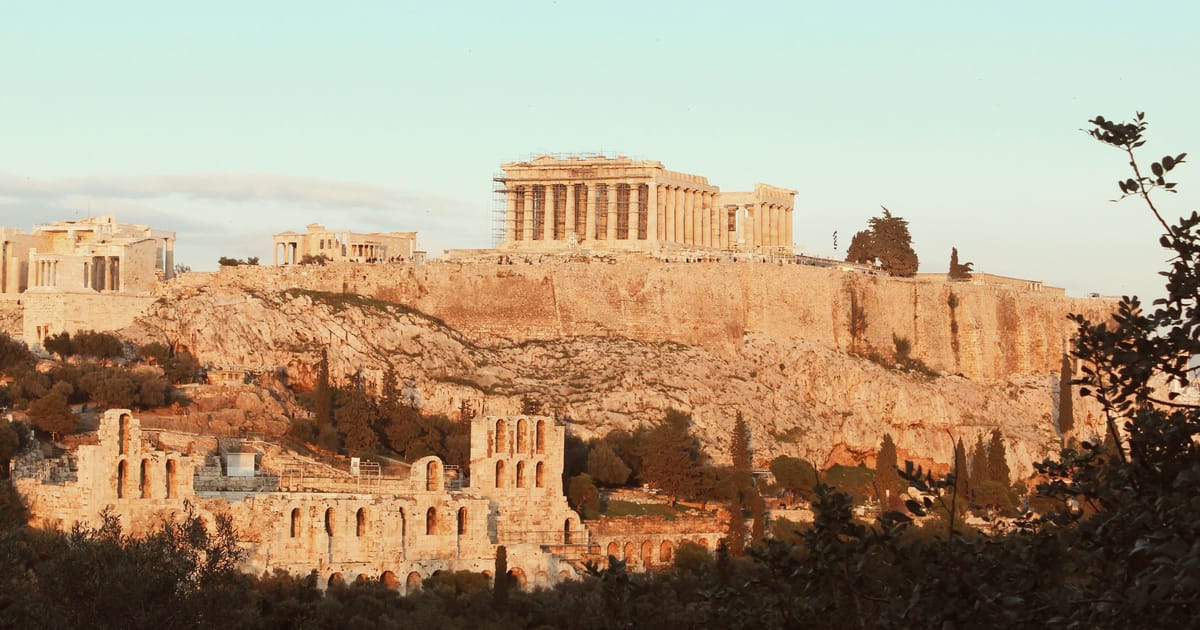
Parthenon, Propylaia, Erechtheion and Temple of Athena Nike share one rock, all raised in the fifth century BC. The format with museums, bus and transport names the Acropolis first in its title. Look for these four during an Athens city pass visit.
The Acropolis stands on a flat-topped rock that rises 150 metres above sea level. Its summit covers about three hectares. The hill is a klippe built of two rock units: limestone on top and softer Athens schist below. Springs and caves form where the two layers meet.
People lived on the hill as early as the fourth millennium BC. In the late Bronze Age a massive wall, about 760 metres long, ringed the summit. After the Persian invasion of 480 BC, Pericles coordinated the rebuilding of the temples on the rock.
The Parthenon was built for the goddess Athena and also served as the city treasury. Work began in 447 BC under Ictinus and Callicrates, with Phidias in charge of the sculpture. The temple was completed in 438 BC, and the carved decoration went on until 432 BC.
5 Day Greece Tour Package From Athens covers Athens too.
During an Athens city pass walk, the Parthenon stands as a Doric temple of white Pentelic marble. It has eight columns across each end, not the usual six, and seventeen down each side. Its floor bulges upward by 10.3 centimetres over 70 metres, and each column swells slightly.
At the western end of the rock stands the Propylaia, a monumental gate. Mnesikles designed it, and building ran from 437 to 432 BC. A Doric front opens onto a passage between two rows of Ionic columns. Walkers who climb during an Athens city pass route meet that front first.
The Erechtheion was built from about 421 to 406 BC. Scholars link its uneven plan to the irregular site or to the different cults it housed. Its west floor lies 3 metres lower than the east. The sanctuary of Pandrosos held Athena’s sacred olive tree.
The Erechtheion’s south porch rests on six sculpted women, the Caryatids, who stand on a low wall. Their elaborate hairstyles support the necks. Replicas stand there during an Athens city pass tour. Five originals are kept indoors, and one went to London in the early nineteenth century.
The Temple of Athena Nike sits on a bastion at the rock’s south-west corner. Kallikrates was the architect, and work ended around 420 BC. Four Ionic columns stand at the front and four at the back. Its south frieze showed the victory over the Persians at Plataea.
Athens also features in Argolis Tour From Athens.
Below the rock, on its south slope, lies the Theatre of Dionysus. It began as a wooden structure, and Lycurgus later turned it into stone. Plays by Sophocles, Euripides and Aristophanes were staged there. During an Athens city pass stop, part of the front two rows of stone thrones survives.
Later ages changed the rock. The Parthenon became a church and later a mosque. In the late seventeenth century an explosion in a powder store inside the temple damaged its middle part. In nineteen eighty-seven UNESCO added the Acropolis of Athens to its World Heritage List.
Which museums come with an Athens city pass?
Acropolis Museum is named on the pass with the bus and transport, beside other museums. Its top floor holds the Parthenon marbles. A visit after an Athens city pass ticket for the rock adds the sculptures from the temple.
The museum stands on pillars above an excavation. Parts of its floor are glass, so a visitor looks down at the dig below. Diggers found two layers of small private houses and workshops along an old road. The collections fill three levels, and a fourth middle level holds the rooms that support them.
The Parthenon Gallery fills the top level. Forty-eight columns trace the outline of the ancient temple. The frieze runs round the walls as one band behind the metopes. The metopes stand on the columns, two to each column. Pediment marbles sit at eye level, set in front of the end columns.
The top level sits at an angle to the floors below, matching the temple’s direction. From its north side the temple shows above on the rock. The carvings face outwards, as they did on the temple. A visitor who comes after an Athens city pass walk up the rock sees the two settings side by side.
Readers interested in Athens can open 6 Day Athens Santorini Tour Package.
On the format with the bus and transport, a holder adds the Herakleidon Museum after an Athens city pass visit. It sits in the Thissio district, close to the Acropolis. It focuses on antiquity and the science, art and mathematics of the ancient Greeks. A jewellery museum is also named there and covers the art of jewellery making.
The National Archaeological Museum appears by name on a pass where the visitor chooses from a list of attractions. Its neoclassical building went up in the nineteenth century. The prehistoric collection holds objects from the Neolithic era. A holder who chooses it after an Athens city pass stop at the rock meets that collection.
The National Archaeological Museum keeps the Mask of Agamemnon, a gold funeral mask from Mycenae. Heinrich Schliemann found it in a shaft tomb and named it after the king of Homer’s Iliad. The mask dates to around the sixteenth century BC, so the name does not fit. It was hammered from one thick gold sheet against a wooden backing.
The Antikythera mechanism is the oldest known example of an analogue computer. It was recovered from a shipwreck off the island of Antikythera. Its gears let a user predict astronomical positions and eclipses decades in advance. The find is split into 82 fragments, and the National Archaeological Museum keeps all of them.
The Museum of the Ancient Agora fills the Stoa of Attalos, built by King Attalos II of Pergamon. The American School of Classical Studies rebuilt it in the twentieth century. The exhibits relate to Athenian democracy, such as the stone kleroterion that chose jurors by lot. A holder meets it after an Athens city pass entry to the Stoa.
Athens comes up again in Athens to Aegina Ferry.
How do the ancient sites of the lower city fit into an Athens city pass?
Ruins such as the Ancient Agora and the Lyceum appear on the multi-day format with the long attraction list. Kerameikos takes its name from the city’s potters. Stone ruins like these recur throughout an Athens city pass route.
The pass with the long attraction list names open-air stops. They are the Ancient Agora, the Roman Agora, Hadrian’s Library, the Temple of Olympian Zeus, Kerameikos and the Lyceum. Other formats name other stops. Greek and Roman ruins stand side by side throughout an Athens city pass listing of that kind.
The Ancient Agora stands northwest of the Acropolis. The Areopagus hill bounds it on the south and Market Hill on the west. In classical Athens it served trade and public assembly. Its Monument of the Eponymous Heroes worked as a notice board for laws, public events and military conscription.
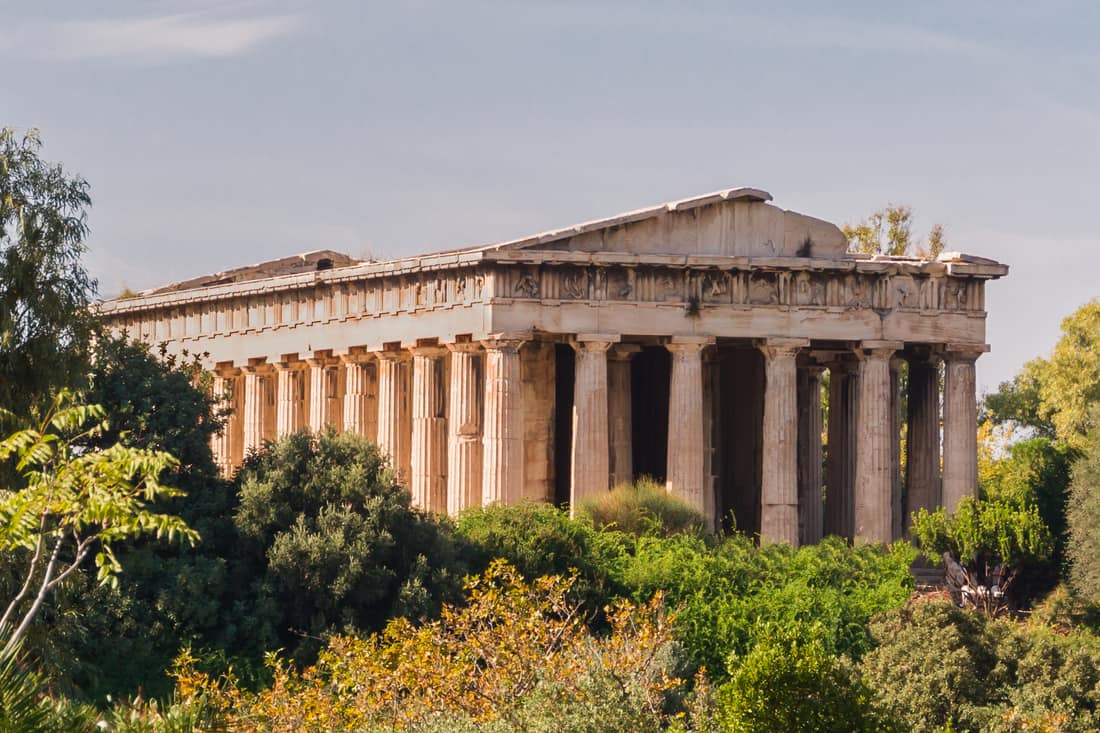
The Temple of Hephaistos stands on Market Hill, at the northwest side of the Agora. Doric columns surround the temple: six on each short side and thirteen along each long side. Pentelic marble appears throughout an Athens city pass route. The temple, the Tower of the Winds and the library capitals use it.
The Roman Agora lies east of the Ancient Agora and north of the Acropolis. Funds donated by Augustus paid for it, in line with a promise by Julius Caesar. Its west entrance was the Doric Gate of Athena Archegetis. An inscription there records a decree from Hadrian’s reign on the taxes of oil merchants.
The Tower of the Winds stands in the Roman Agora. The astronomer Andronicus of Cyrrhus designed it, and it was complete by about fifty BC at the latest. The octagonal marble tower is 12 metres tall. A frieze shows the eight wind deities. It held a water clock, and sundials marked its outer faces.
More about Athens: Mycenae Epidaurus Day Trip From Athens.
Hadrian’s name recurs throughout an Athens city pass itinerary. He founded the library in AD one hundred and thirty-two. The building followed a Roman forum plan, with one entrance, a high wall and an inner courtyard. Papyrus rolls lay on the east side, and the corners served as lecture halls.
The sons of Peisistratus began a colossal temple of Olympian Zeus in the late sixth century BC. Antiochus IV Epiphanes revived the work, and Sulla carried unfinished columns off to Rome. Hadrian dedicated the finished Corinthian temple in AD one hundred and thirty-two. Later builders quarried the ruins, and a nearby basilica took their stone.
Kerameikos lies northwest of the Acropolis, on both sides of the Dipylon Gate. The Panathenaic procession gathered in the Pompeion, a building between the two gates. Reuse of older stone appears throughout an Athens city pass circuit. At the suggestion of Themistocles, funerary sculptures were built into the city wall.
The Lyceum lay outside the city wall, to its east, and took its name from Apollo Lyceus. Aristotle founded his Peripatetic school here in the fourth century BC. A dig in nineteen ninety-six, made to clear space for a museum, found a gymnasium and a wrestling area.
How do the bus and metro work within an Athens city pass?
Line 1 is the oldest line of the Athens metro and runs between Piraeus and Kifissia. The city line of the hop-on hop-off bus starts at Syntagma Square. Study both routes before an Athens city pass day begins, then pick a stop to board.
On the bus-only ticket, the red city line begins at stop A1 on Syntagma Square. One full ride takes 90 minutes. The route passes the Acropolis, the Parthenon, the Temple of Olympian Zeus and Syntagma Square. A Piraeus line and a Riviera line join it, reaching the Mikrolimano marina and the Glyfada beaches.
A related page on Athens: Olympia Tour From Athens.
The pass with the bus includes a hop-on hop-off ticket with audio commentary. On the bus-only ticket, the bus is an open-top double-decker, and English is one of the commentary languages. Show your phone ticket as you enter, then hop on and off at any stop. Study the stop map before an Athens city pass ride starts.
Line 1 opened as a steam railway between Piraeus and Thissio in eighteen sixty-nine. The Piraeus to Omonia section was electrified in nineteen hundred and four. The line is 25.7 kilometres long and has 24 stations. At Monastiraki, riders change to Line 3. Note that change before an Athens city pass journey begins.
Lines 2 and 3 were inaugurated in January of the year two thousand. Syntagma was the terminal station for both lines when they opened. Line 2 is entirely underground, while Line 3 is largely underground. The system has five interchanges: Attiki, Monastiraki, Omonia, Piraeus and Syntagma.
With over 50,000 finds, stations such as Syntagma and Monastiraki operate as underground museums. Syntagma shows the burial of a young woman, the mosaic floor of an ancient house and water supply pipes. At Monastiraki, the enclosed bed of the ancient Eridanos river continues to flow.
Akropoli station shows replicas of the Parthenon frieze. Its display cases hold ancient children’s toys, pointed-bottomed amphorae and a representation of a loom. Dafni shows the remains of ancient farmsteads, and Panepistimio holds funerary finds. Spot these stops before an Athens city pass holder boards a train.
Another page that includes Athens is Hydra Day Trip From Athens.
The tram opened in two thousand and four, weeks before the Summer Olympics. Line 6 starts at Syntagma Square, where the stop lies south of the square beside Vasilissis Amalias Avenue. Line 7 starts at Voula and follows the coast. Syntagma is the transfer point between Line 2, Line 3 and the tram.
The city’s transport authority runs the metro, tram, trolleybuses and buses. Tickets are valid on every mode of transport in Athens except trains and buses to the airport. On the pass with transport, the ticket covers buses, trams and the metro, but not airport transfers. Plan the airport trip separately before an Athens city pass tour starts.
Line 3 was extended to the airport in summer two thousand and four. Line 3 and the suburban railway both run trains to the airport station. The station stands next to the terminal and joins it by an elevated walkway. Buses leave from the arrivals level between exits 4 and 5.
When can an Athens city pass be used and which rules apply?
Summer heat decides the day for an Athens city pass holder because the exposed Acropolis summit has almost no shade. Book the first slot and wear closed shoes with grip. Carry a small bag, and check lift and cancellation terms for the format.
The Athens climate is hot-summer Mediterranean, and the capital has been called the hottest city on the European mainland. At the Elliniko station, July brings 362.7 hours of sunshine and August 341.0. In the city centre, July rain totals only 10.7 mm. The record high for July stands at 42.8 degrees Celsius.
Take the earliest slot for an Athens city pass visit to the rock. The marble returns the heat to anyone standing on it. The first slot is the coolest of the day. Summer middays are hot and busy, with queues at the entrance.
Athens comes up again in Delphi Day Trip From Athens.
Pack for the sun as well. Public heat advice in Athens asks for light cotton clothing, a hat, sunglasses and sunscreen. Wide-brimmed hats suit the open rock in summer. The same advice asks for plenty of water and extra care for children and the elderly.
Heat can change plans for an Athens city pass day. The Ministry of Culture has closed the Acropolis site for part of an afternoon when high temperatures were forecast. Such closures can come at short notice. Check the Ministry page on the evening before the visit.
The marble is genuinely slippery, especially after rain, so closed-toe shoes with grip are the right choice. Avoid sandals and flip-flops. High heels have been banned at certain ancient Greek sites, because a heel can hit a crack and widen it. Flat soles avoid that problem.
Pack light for an Athens city pass entry to the rock. Large bags must stay in the cloakroom near the entrance, so a small backpack is the advice. Carry about one litre of water per person. Food and drink other than water are on the prohibited list.
The North Slope of the Acropolis is wheelchair accessible, and the help of an attendant is advisable. A lift on the north side serves people with reduced mobility, and a lone parent with two infants or more. Call the guards an hour before arrival, because strong wind stops the lift.
Another page that includes Athens is 8 Day Athens Mykonos Santorini Package.
Check museum access for an Athens city pass group with wheelchairs or strollers. The Acropolis Museum has ramps for both at every entrance. Lifts and accessible toilets serve every floor, and wheelchairs can be borrowed at the Information Desk. A short Braille text on the museum waits at the desk.
The first slot suits families in every month except winter. Timed entry works as the queue system on the Acropolis. A visitor without a slot can face a long wait at the ticket office. On two formats the Acropolis slot sits on the first day of the pass.
Book early for an Athens city pass purchase in high season or near a public holiday. On the city-card format each attraction can be entered only once. Cancellation terms differ: one format allows none, while another refunds a cancellation made before a cut-off time. The availability cards on this page show open dates.