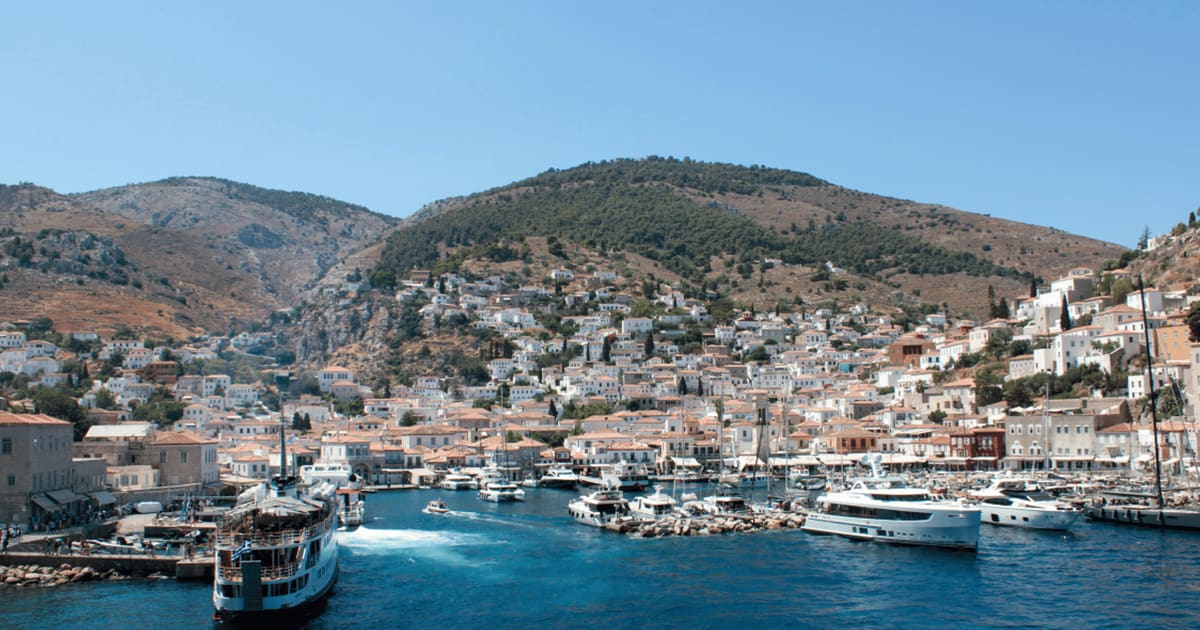
A Hydra day trip from Athens is a boat trip to a car-free island in the Saronic Gulf. You walk the stone harbour town and swim from the rocks. Below you find the port, the sailing, the sights, the formats and the rules. The homepage lists more Greece Tours like this one.
Each tour card below opens a live GetYourGuide booking. Dates, start times and boat types are shown there.
What is a Hydra day trip from Athens?
A Hydra day trip from Athens is a boat journey to the island of Hydra and back within one day. You leave in the morning, spend free time in the harbour town and sail back to Athens in the evening.
Hydra is one of the Saronic Islands, named after the Saronic Gulf. The Athens area lies on that gulf’s north coast, and ferries link the islands with the city’s port. The route is popular for day trips all year. A Hydra day trip from Athens follows it out and back.
If you plan to cross into Turkey as well, the homepage also lists Turkey tours.
The island has one main town, known simply as Hydra port. Its crescent-shaped harbour is lined with restaurants, shops and markets. The town is built around the port like an amphitheatre. Small villages and hamlets lie elsewhere on the island. The harbour is the first stop on all Hydra excursions.
The day has a clear shape. It starts early in the morning, with a hotel pickup on the tours that include one. After the sailing comes free time on the island to wander, shop and eat. A Hydra day trip from Athens ends with the return sailing and an evening arrival back in the city.
On the private day trip you get about five hours ashore, and no escort stays with you. On the cruise the time on Hydra is shorter, because the same day also covers Poros and Aegina. The ferry schedule decides the exact times, so your hours on the island move with the boats.
The plainest Hydra day trip from Athens is a ferry ticket and your own plan. Daily ferries cross between Athens and the island, and you choose where to walk, eat and swim. The speed-ferry tour adds a guided walk through the town, and the rest of the day is free time.
The private day trip adds hotel pickup, port transfers and ferry tickets, then a drop-off in the evening. The full-day trip with swimming adds a swim stop and a guided town walk to the ferry ride. Both leave the rest of the day free for sightseeing, shopping and a meal.
On the one-day cruise, the ship calls at Poros and Aegina as well as Hydra. Free time ashore comes on each island, and a buffet lunch is served on board. On this Hydra day trip from Athens, the day is split among three islands. A show of Greek music and dance runs on the return sailing.
Travellers who want a break from the city find it in a Hydra day trip from Athens. Hydra is a place to rest, walk, eat well and swim. Independent travellers pick the ferry. Those who want a fixed plan, a lunch on board or a guided walk pick a tour.
Anyone who wants a short outing finds this a full day. The sailing and the time ashore fill the hours from morning to evening. The cruise gives Hydra less time than the ferry formats do. Travellers who want an unhurried visit pick a ferry format instead. Day trips are the common way to see Hydra.
A stay differs from a Hydra day trip from Athens in its timing. On a day trip the boat times set your hours on the island. A stay of a couple of nights ends that limit. It suits travellers who want to hike to the monasteries or ride a donkey along the beach.
Which port starts a Hydra day trip from Athens and how long is the sailing?
Piraeus, the main port of Athens, starts a Hydra day trip from Athens. Every ferry from Athens to the island leaves from there. The sailing takes about 1.5 hours on average, and the fastest catamaran needs just over one hour.
Piraeus is the largest port in Greece and the main gateway to the islands. Its gates serve different island groups. Ferries to Hydra normally leave from Gate E8. The gates lie far apart, so read the gate on your ticket, paper or e-ticket, and check the display boards.
Line 1 of the Athens metro ends at Piraeus station. The port has luggage storage, cash machines, cafes, restaurants and travel agencies that sell tickets. For a Hydra day trip from Athens, reach the gate at least 45 minutes before departure. The port is busy in summer.
Crossing times depend on the boat and on its route. A boat that calls at another island before Hydra needs longer than a direct one. A Hydra day trip from Athens by line ferry and one by tour boat take different times. The figures are these:
- Fastest catamaran on the line ferry: just over one hour.
- Line ferry on average: about 1.5 hours, and longer when the boat stops at another island.
- Private ferry day trip with hotel transfers: less than two hours to reach Hydra.
- Tour boats such as a yacht, a ship or a rib boat: 1.5 hours on average, with speedboats faster.
Poros is the call that adds time. A catamaran that stops on the way puts in at Poros before Hydra. The leg from Poros to Hydra takes 25 to 40 minutes. Hydra Port also receives boats from Spetses, Porto Heli and Ermioni, but no direct line ferry arrives from Aegina.
Only high-speed craft run the line to Hydra: catamarans and hydrofoils. They are smaller and faster than conventional ferries and have no open deck. Numbered aeroplane-style seats fill air-conditioned lounges, and a snack bar sells coffee and snacks. The boats have no cabins and no garage.
Every boat has a designated luggage area. Bulky suitcases go there, and only small personal items go up to the seat. In Hydra, all ferries arrive at the port in Hydra Town, the main town of the island. They tie up along its waterfront.
Every Hydra day trip from Athens by line ferry needs a boat back. Ferries to Piraeus leave from Hydra Port and tie up at Gate E8 again. The last sailing leaves in the evening, and the timetable changes with the season. Arrive at the quay at least one hour before sailing.
A Hydra day trip from Athens with hotel pickup starts with a half-hour road transfer to the port. On the private ferry trip, guests meet a driver at their hotel in the morning. The driver takes them to Piraeus port. The booking asks for each guest’s nationality, since it is needed to issue the ferry tickets.
Other formats set a meeting point inside the port. On the full-day trip with swimming, a trip attendant meets guests at the ferry company’s ticket offices. A local host helps with boarding. On the guided tour that also calls at Poros, the attendant waits inside Piraeus metro station. The boarding point is about five minutes away.
The one-day cruise with Poros and Aegina sails on its own ship, not on the line ferry. It is a different kind of Hydra day trip from Athens. Guests choose a coach from the hotel to the port, or they meet the ship at a marina. From the ship’s deck, passengers admire the stone houses of the islands.
Drivers have one more option to reach Hydra. A passenger ferry runs between Metochi on the Peloponnese coast and Hydra Harbour. Athenians who drive can leave the car in the secure car park at Metochi and cross in 20 minutes.
How is the day planned on a Hydra day trip from Athens?
The day starts with a morning pickup or boarding and ends in the evening. A Hydra day trip from Athens lasts eight to twelve hours across the formats below. Formats that stay on Hydra give the longest stretch ashore, while the lunch cruise splits the day between three islands.
A Hydra day trip from Athens begins with a hotel pickup or a set boarding time. On the private day with taxi transfers, boarding is at 09:00, and you are free on the island from 10:30. The boat home leaves Hydra at 16:25. These times are approximate and move with the boat schedule.
The ferry day with hotel transfers follows a similar rhythm. You are picked up at your hotel in the morning and taken to the boat. On the island you have about five hours to explore alone, because nobody leads you. The exact times depend on which ferry tickets are available.
A Hydra day trip from Athens with a private guide has a different shape. On the private speed-boat tour, the whole trip lasts eight hours, and three of them are spent on Hydra. The guide presents the island and its history. Lunch is a one-hour break at your own cost, and the guide helps you pick the place.
The private day trip by road swaps the long boat ride for a coastal drive along the Saronic Gulf. You spend three hours on Hydra. A driver takes you there and back, but does not walk the island with you. Lunch and a guide are not in the ticket.
The full-day swimming format is a twelve-hour Hydra day trip from Athens. A coach leaves Athens.A guided walk through Hydra Town opens the island time, then four hours are free. In the afternoon a boat carries the group to a quiet cove with a seaside taverna. A boat and a drive bring you home as the sun dips.
Lunch needs a plan on the days that stay on Hydra. The swimming trip, the road trip, the ferry day and the speed-boat tour all leave lunch out of the ticket. You pay for your own meal. A Hydra day trip from Athens by cruise works differently, because the ship serves lunch on board.
The one-day cruise to three islands lasts eleven and a half to twelve hours. A buffet lunch on board is part of the ticket, and live music with traditional dances entertains the passengers. Shore excursions cost extra. The time ashore on each island is free and stays the same whichever stop comes first.
One cruise adds a free audio walk of Hydra. Download it first, because the download needs a strong internet connection. On the Hydra-first itinerary, the ship calls at Poros, a green island with shops and places to eat. Aegina comes last. An optional bus tour to the Temple of Aphaia and the monastery of Agios Nektarios costs extra.
The evening closes the day. On the private day with taxi transfers, the boat reaches Athens at 18:00. A taxi then takes you to your hotel. On the ferry day with hotel transfers, you are back at your hotel at about eight. The three-island cruise returns in the evening.
On a Hydra day trip from Athens, every clock time is a plan, not a promise. The guide of the swimming trip can adjust the itinerary for unforeseen circumstances. The cruise timetable changes with weather, traffic and other circumstances. On the private day with taxi transfers, the boat schedule moves the times.
Why is the island car-free on a Hydra day trip from Athens?
Hydra bans cars, motorcycles and bicycles, so every Hydra day trip from Athens is a walking day. Donkeys, mules and handcarts move the goods, and water taxis serve the coast. The ban protects the original character of the island.
The rule is old. A ban on cars and bicycles came in during the nineteen fifties. Its aim was to keep the island as it has always been. That law is why a Hydra day trip from Athens begins on a quay with no traffic. The same rule covers the whole island.
The ban lists cars, motorcycles, scooters, bicycles and e-bikes. Car hire and ride-share apps therefore do not work on the island. Emergency vehicles of the local authority are exempt from the rule, and rubbish trucks run too. On land, everyone else goes on foot or on an animal.
Animals do the heavy work. Locals use donkeys and mules to move big objects and to carry the weekly food shopping. Small handcarts also move goods through the town. A Hydra day trip from Athens puts you in the middle of this working traffic.
Donkeys and mules wait at the port when the ferries arrive. They carry luggage to homes and hotels on the hillside, and heavy bags are the reason to hire one. Hotels can arrange a luggage transfer from the harbour by animal. A day bag stays with you, because you walk the lanes yourself.
The lanes are stone, with cobbles, slopes and steps. Steep stone streets climb away from the harbour, and local homes and hotels stand along them. Donkeys are well suited to these narrow stepped streets. The harbour level is the easiest ground to walk. The town is hilly, so a Hydra day trip from Athens involves climbing.
The inhabited area is compact. People walk everywhere, and every place in town lies within a short walk. Walking is the way to explore the town, and the climbing is the only cost. The ways to travel on the island are simple:
- On foot, through the town and along the coastal paths
- By horse, mule or donkey, for people and goods
- By small handcart, for goods in the lanes
- By water taxi, along the coast
Water taxis give a Hydra day trip from Athens access to the coast beyond the town. They are the main motorised transport for the beaches and coastal villages. They leave from the port, and they cluster on its east side. Agree the fare before you board. Boats reach the farthest beaches, which lie beyond the end of the path.
The harbour works without wheels. A narrow entrance opens into a rounded basin, and boats moor along the quay wall or stern-on to the pier. The water taxis run around the clock, and they can also cause a swell in the harbour basin. Inside the harbour area, no vehicle is needed.
Without cars, the sound of the town changes. Hooves and carts on cobbles replace the noise of cars and exhaust fumes. Boats zoom around the bays instead of motorbikes around the lanes. Anyone on a Hydra day trip from Athens can hear glasses clink in the harbour bars.
Calm is a direct result of the ban. Mules shift from hoof to hoof in the sun, and cats doze nearby. The absence of vehicles also leaves room for walking trails.
Which harbour sights and mansions does a Hydra day trip from Athens reach?
A Hydra day trip from Athens lands at a horseshoe harbour. A cathedral with two marble bell towers stands on the quay. Stone mansions hold a museum and a maritime academy, and old public buildings show contemporary art.
The harbour that a Hydra day trip from Athens reaches is shaped like a horseshoe. Mountains rise steeply on its west and east sides, and the houses face the sea. The town centre lies at the point opposite the breakwater. Banks, public offices, shops, restaurants and cafes stand there side by side.
The main church stands in the middle of the quay. It served as a monastery before it became the cathedral of the Dormition of the Virgin. Two marble bell towers rise from it, and one carries the town clock. The smaller tower dates from eighteen oh six, the larger from eighteen seventy-four.
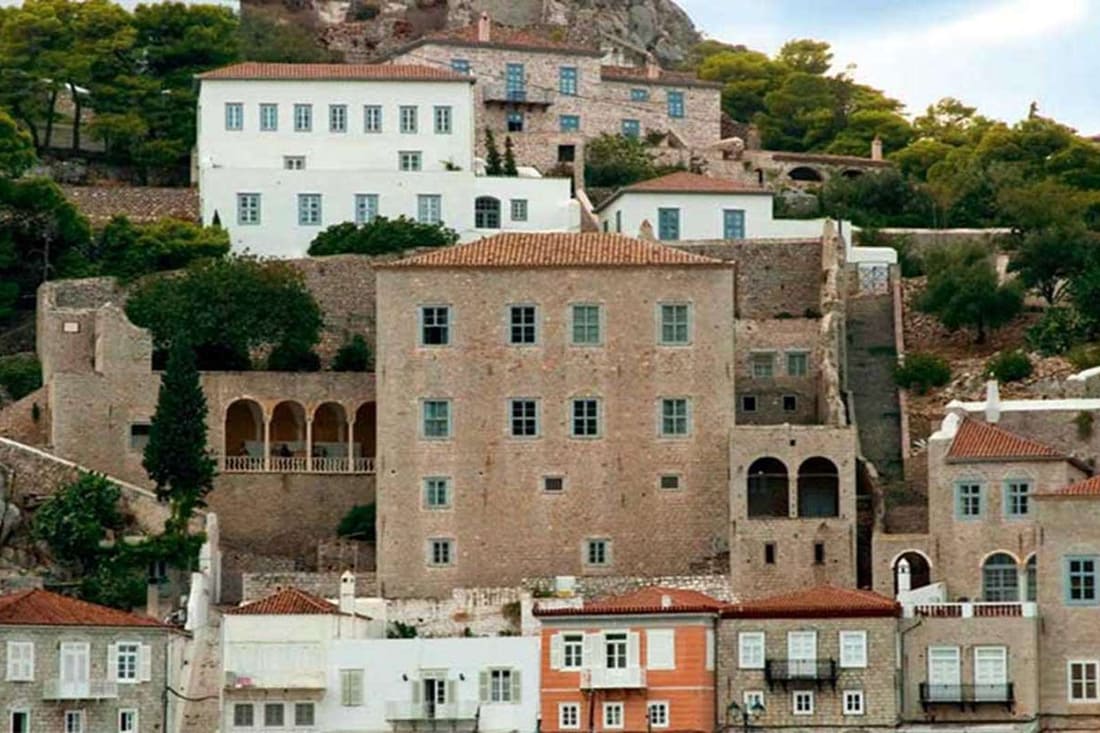
The courtyard holds the tomb of Lazaros Koundouriotis, a Balkan Wars memorial and a statue of King George the First. The old monastery buildings house the town hall. A small ecclesiastical museum occupies the space where a prison once stood. It shows vestments, relics, offerings and icons from the eighteenth century.
The mansions on a Hydra day trip from Athens rise three and four storeys and look austere. Shipowners built them in the late eighteenth and early nineteenth centuries. The design bears Genoese touches. The owners had travelled and wanted European styles on the island. Islanders then copied the four-sided roofs in place of whitewashed terraces.
The Tsamados mansion on the east side of the harbour houses the merchant marine academy. The Lazaros Koundouriotis mansion dominates the waterfront on the west side. It is shaped like the Greek letter pi and painted in natural ochre. The last descendant of the family donated it, and it is a branch of the National Historical Museum.
On a Hydra day trip from Athens, a full-length oil portrait of Lazaros Koundouriotis greets visitors at his mansion. The Hydriot artist Andreas Kriezis painted it. It hangs in a vestibule with a marble-slab floor. The marble opening of a cistern sits in one corner. A shrine beside the entrance and a smoking room are on show.
The Historical Archive Museum is the marble building beside the Port Authority on the port’s east side. A shipowner paid for the first building, which passed to the state in nineteen fifty-two. A Hydra day trip from Athens shows the present building, opened in July nineteen ninety-six. Its gallery shows portraits and nautical charts.
Foreign artists and writers settled on Hydra in the nineteen fifties and sixties. The Australian writers Charmian Clift and George Johnston moved there in nineteen fifty-six. The Canadian singer Leonard Cohen arrived in nineteen sixty. He wrote “Bird on the Wire” and “So Long, Marianne” on the island. Their island is the one a Hydra day trip from Athens visits.
Earlier, in nineteen thirty-nine, the writer Henry Miller stayed on Hydra with the painter Nikos Hadjikyriakos-Ghikas. He praised the island in his travel book The Colossus of Maroussi. The painter Panagiotis Tetsis was born on Hydra. His grandparents’ house shows his studio and paintings beside a candle workshop and a wine cellar.
Old public buildings hold contemporary art. The former slaughterhouse is a project space, and a sculpture by Jeff Koons stands on its roof. The old secondary school hosts a summer exhibition each year, organised by the artist Dimitris Antonitsis. An art gallery and concert space stands at the start of the harbour front.
How did Hydra’s sea captains shape a Hydra day trip from Athens?
Sea trade made Hydra rich in the eighteenth century. Its captains then gave their ships to the fight for Greek independence. The town you reach on a Hydra day trip from Athens still stands under strict protection.
Hydra has poor ground for farming, so its people turned to the sea. A Hydra day trip from Athens reaches a town that grew around its harbour. The houses spread up the slope like seats in a theatre. The harbour became the centre of the island’s trade, government and social life.
At first, Hydra built boats of 15 to 20 tons or 40 to 50 tons. Then, in seventeen fifty-seven, the islanders launched a vessel of 250 tons. Bigger ships made Hydra an important trading port. By seventeen seventy-one, up to 50 vessels from across Greece anchored there. Ten years later, the island had fitted out 100 vessels.
The Treaty of Küçük Kaynarca changed Hydra’s trade. Russia won the right to protect the Ottoman Empire’s Orthodox Christians. Hydriot ships began to sail under the Russian flag. The treaty also opened free passage between the Aegean and the Black Sea. So Hydriot ships carried goods between southern Russia and the Italian ports of Ancona and Livorno.
From seventeen eighty-five, Hydriot shippers traded goods themselves, not only carried them. Britain and France were rivals then, and the Hydriots ran the British blockade to bring food to France. Hydriots came to dominate Mediterranean trade, and Hydra became the leading sea power among the Greek islands. A Hydra day trip from Athens visits that sea power.
Lazaros Kountouriotis shows how these family firms grew. At 14, he represented his father’s business on Hydra while his father was in Genoa. After his father’s death, he ran the family interests and grew them substantially. His younger brother Georgios was a shipowner too. A Hydra day trip from Athens reaches the home port of families like these.
Hydriots were far from united at first. Island leaders feared losing the privileged place they held under Ottoman rule. Still, on 16 April the island declared for the revolution. Its squadron put to sea under Admiral Iakovos Tombazis, a shipowner. The ships of the three naval islands, Hydra, Spetses and Psara, formed a force ready to fight.
From eighteen twenty-two, Admiral Andreas Miaoulis led the Hydriot fleet and gave Hydra command of the revolution’s sea war. A fire ship is a wooden vessel set alight and sent against enemy ships. Hydriot fire ships inflicted heavy losses on the Ottoman fleet. A Hydra day trip from Athens visits the home island of that fleet.
Small fire ships moved more easily than big warships among the Aegean islands. Fireship captains such as Sachtouris, Kriezis and Pipinos fought at the front of the naval struggle. Georgios Kountouriotis, a shipowner, led the revolution’s executive committee. His brother Lazaros gave much of his fortune to the cause. A bronze statue of Miaoulis overlooks the port.
After independence, the fleet lost the privileges that the Russian flag had given it. The old shipping families failed to see the value of steamships, which needed smaller crews and less wind. Companies in Piraeus, Patras and Syros pulled ahead. Families left, and their large mansions fell into ruin. Sponge fishing became the mainstay of the economy.
The whole settlement of Hydra has been under strict protection since nineteen sixty-two. Any change to a building needs approval from the archaeological service. Greece’s Supreme Court has ruled that nobody can add a floor unless it stood before and can be proved. A Hydra day trip from Athens reaches a settlement that the state still protects.
Where can you swim on a Hydra day trip from Athens?
On a Hydra day trip from Athens you swim from rock platforms at Spilia and Hydronetta, near the harbour. Pebble coves at Kamini and Vlychos lie farther along the coast, reached on foot or by water taxi.
The sea off Hydra offers rocks and pebbles, not long sandy shores. Smooth rocks and pebble bays line the coast, and the water is clear. Only Mandraki is a large sandy beach. Plan a Hydra day trip from Athens around ladders, steps and stones, not a soft sandy slope.
Spilia is the closest swimming spot to the harbour. Take the coastal road west towards Kamini, then walk down the steps through the cafe to the rocks. The flat stones leave room to lay a towel. You dive or jump from the ledges, or you climb down a ladder.
Depth is the main point to know about Spilia. The platforms drop away at once into deep water, which suits adults and confident swimmers. For young children the gentler beaches are a better match. On a Hydra day trip from Athens, Kamini, Vlychos and Mandraki have shallow water near the shore.
Hydronetta lies right beside Spilia, on the same rocky shore below the cannons. Steps lead down from its terrace to a bathing platform. The sun sets over this platform, while the rocks below the Spilia cafe catch the morning light. Locals dive from the cliff beside the road to Kamini. Skip that jump unless you know what you are doing.
The paths down to these platforms are public rights of way. You are not obliged to use the cafes above them, although drinks and meals are on sale there. Toilets stand at the neighbouring cafe and restaurant, for customers who have bought a drink or a meal.
Kamini comes next along the coastal road. A path from the harbour leads there, and so does a water taxi. On a Hydra day trip from Athens, swimmers find shallow, clear water at its small pebble beach. Its nickname is Baby Beach. A beach bar beside it offers sun loungers.
Vlychos lies farther west. A Hydra day trip from Athens reaches it on foot along the coastal road or by excursion boat. The beach mixes sand and grey pebbles and slopes gently. Entry needs a careful tread on slippery rocks. Tavernas line the seafront. Plakes follows just beyond, with pebbles and sand.
Mandraki lies east of the town, with beach bars and restaurants. You reach it on foot, by water taxi or by boat. Farther coves need a boat on a Hydra day trip from Athens. Agios Nikolaos is a pebble beach in a sheltered bay, reached mainly by water taxi. Bisti, beside a forest, takes a boat too.
Pack water shoes for the stones. They are a recommended item for Hydra’s beaches, which are mainly pebbly. Crystal-clear water is the common point of the island’s beaches, from the town platforms to the farthest coves.
The full-day swimming format of a Hydra day trip from Athens builds the swim into the day. It opens with a one-hour guided walk through the town. The rest of the six hours ashore is free time. The swim is at Spilia, or at Vlychos for travellers who add the optional boat transfer. Sunbeds at Vlychos cost extra.
Which walks, viewpoints and monasteries fit a Hydra day trip from Athens?
Two monasteries, Profitis Ilias and Agia Efpraxia, stand on the hill above the port. Marked paths lead up to them. For a Hydra day trip from Athens, the coastal walk to Kamini and Vlychos is the easy choice. The monastery climb is the steep one.
Hydra has more than 80 kilometres of walking trails, and the sea is in view from every route. Wooden signs point the way to the sights. Trail 1 begins by the clock tower on the port, where the main trail map is. That gives a Hydra day trip from Athens an easy starting point.
The coastal walk leaves the harbour to the west on a stone-paved lane towards Kamini. Kamini is a fishing village where sailors have long repaired and stored their boats. The route then follows the shore to Vlychos. Near Vlychos you climb steps, cross a small bridge and come down to the bay.
Past Vlychos, a shady path runs to Plakes and on to Palamidas, where a pebble beach meets clear water. You can return by the same route. Water taxis are also available for the return from Palamidas. So a Hydra day trip from Athens can mix a walk out with a ride back.
Shade is limited on this route, above all between Kamini and Vlychos. Summer midday heat is fierce there, and the walk is easy but exposed. The surface changes between stone, gravel, dirt and paved sections, with cobbles in the hamlets. Walking in the cooler parts of the day is the sensible plan.
The climb to Profitis Ilias is the steep option. The path is well marked and runs uphill through pine forest, and mules use it as well. The climb takes at least an hour. Check your boat’s departure time before you start up on a Hydra day trip from Athens.
Monks live at Profitis Ilias. From the monastery the view takes in the town, the Saronic Gulf and the island of Dokos. Mount Eros, the highest summit, lies half an hour beyond the monastery. The summit falls away steeply to the south and gives a 360-degree view.
Agia Efpraxia is the shorter climb. It takes about 40 minutes on foot from the town, and you can ride a donkey instead. The convent stands about 500 metres above sea level. Its view covers Hydra and the Saronic Gulf. That makes it the lighter choice for a Hydra day trip from Athens.
The path forks at a junction, with one branch to Profitis Ilias and the other to Agia Efpraxia. Nuns live at Agia Efpraxia and run a small embroidery workshop in the complex, where you can buy handicrafts. The nuns are known for their charity work and their spirituality.
Kiafa is one of the oldest quarters of Hydra and lies high above the port. A walk up to it passes the Kala Pigadia, which means good wells. After Kiafa, walkers head to the seven windmills on the hill of Agios Athanasios for the view. This viewpoint walk is another option on a Hydra day trip from Athens.
Wildflowers on the island include cyclamen and poppies. On the way up Mount Eros, walkers pass through an opening in a dry-stone wall and bear slightly left. The demanding walk is the one to Zourva monastery. A water taxi can take you to the steps below it, which makes the climb easier.
Which Hydra day trip from Athens format fits you: private, speed ferry or cruise?
Pick a Hydra day trip from Athens by the hours you want on the island. The ferry on your own and the private trips keep Hydra as the only stop. The cruise adds Poros and Aegina, with a buffet lunch on board and less time ashore.
The ferry on your own is the freest format. You buy a ticket, make your own plan and walk the island alone. A day built on the first boat out and the last boat back leaves about 10 hours on Hydra. Nothing else is arranged, so you pick every meal, swim and stop yourself.
A Hydra day trip from Athens also comes as a ticket package. One version bundles round-trip ferry tickets with private transfers from your hotel or holiday rental. Bottled water, snacks and onboard WiFi are included. You get about 4 hours of free time on Hydra, and no guide joins you during it.
Families, solo travellers and couples who want an easy, independent day fit the ticket package. The speed-ferry tour adds a guide to that simple day. A private guide leads a walking tour, and a high-speed boat does the sailing. Visitors who want the town explained, and are happy with one island, fit this Hydra day trip from Athens.
The private day trip is built around your own party. No other travellers join the group, and the trip uses an exclusive vessel. Hotel pickup and a multilingual driver and guide are part of it. Guests who want a day without strangers on the boat pick this format.
The full-day swim format is a Hydra day trip from Athens. It runs 12 hours and starts with a coach from the city. You get about 4 hours of free time, plus a guided walking tour of Hydra Town. Free time fits a swim, a drink or shopping. Lunch, sunbeds, umbrellas and sea taxi tickets are left out.
The cruise changes the shape of the day. Hydra shares the hours with Poros and Aegina. A buffet lunch with Greek and Mediterranean dishes is served on board. Drinks and shore excursions are left out. Hotel transfers depend on the ticket option you choose.
A cruise suits a Hydra day trip from Athens for visitors who cannot choose between the three islands. It gives a first taste of each, but the time on each is short. Multilingual escorts sail on board, and a free audio tour of Hydra is included. A long walk or a slow swim fits the other formats better.
A two-day package turns the same trip into a stay. One version includes an overnight on Hydra, round-trip hydrofoil tickets and hotel transfers in Athens. Day one covers the arrival and a first look around. Day two covers morning shopping and exploring before checkout and the return boat.
Each format fits a different kind of day. For the longest time ashore on a Hydra day trip from Athens, take the ferry on your own. For the town explained on the spot, book the speed-ferry tour or the private trip. For swimming time, take the swim format. For three islands and lunch on board, take the cruise.
Check three details on the booking page before you pay:
- The inclusions: lunch, drinks and sea taxi tickets differ between formats.
- The guiding language: the format names do not state it.
- The group size: the format descriptions leave it out.
When do boats run and what do the rules say on a Hydra day trip from Athens?
Fast boats run between Piraeus and Hydra all year, with fewer sailings in winter. Allow for the summer heat and the wind on a Hydra day trip from Athens. Wear flat shoes and cover legs and shoulders at monasteries.
The boats between Piraeus and Hydra run all year, from early morning until evening. The peak season has multiple departures every day, while winter has fewer. The companies announce the summer timetable in March. Check the dates for your Hydra day trip from Athens against that year’s schedule.
In the peak season the route can get fully booked, so booking ahead is strongly recommended. A booking page lists the next free dates. The private day trip with transfers lists instant confirmation and a mobile ticket. The full-day trip with swimming lists a mobile ticket too.
Cancellation wording differs by format on a Hydra day trip from Athens, so read it before you pay. The full-day trip with swimming lists free cancellation up to a cut-off before departure. It offers another date or a full refund if not enough travellers book. The private day trip with transfers lists all sales as final.
June to August is hot on Hydra. A summer Hydra day trip from Athens meets highs of 25 to 38 degrees Celsius, low humidity and rare rain. Spring is short and changeable, with highs from 15 to 25 degrees and a risk of sudden showers. Autumn stays warm enough to eat outdoors in the evening.
Winter is chilly and damp, but the rain never lasts for endless days. Sunny, dry days are as common as wet ones. A northerly wind can feel cold, and swimming is not recommended from January to April. A day cruise still calls at Hydra through the winter, and its visitors keep shops open until they leave.
The meltemi is a dry wind from the north that blows hard across the Aegean. It comes in spells until about mid-September and is strongest in the afternoon. A spell sometimes lasts for days. The wind brings fine, clear weather and cools the summer heat. A Hydra day trip from Athens can be sunny and windy together.
The boats from Piraeus are small, and bad weather easily delays them. When no sea transport is safe, a day-tripper can end up staying longer than planned. The coastguard or port police office then issues a statement that sea travel was impossible. That statement can back up an insurance claim.
Two rules matter on a Hydra day trip from Athens. At the monastery and the convent, modest clothing is required, so legs and shoulders must be covered. For working animals, Greek rules cap a load at 100 kilograms or one fifth of the body weight. They also bar ill or injured animals from work.
Swim with care. A red flag on a beach means entering the water is prohibited. On a beach without lifeguards, stay close to the shore and watch the waves and the wind. The toll-free emergency number in Greece is 112.
Shoes matter on the stone lanes, and flat shoes handle the stairs. Barefoot walking is not advised, because of broken glass and drowsy wasps. Hot cobbles also burn bare soles in summer. The bank lobbies on the harbour front hold cash machines that are open at all hours. The full-day swimming trip asks for these items:
- Swimsuit and towel
- Comfortable shoes
- Sunscreen, hat and sunglasses
- Water and an ID card