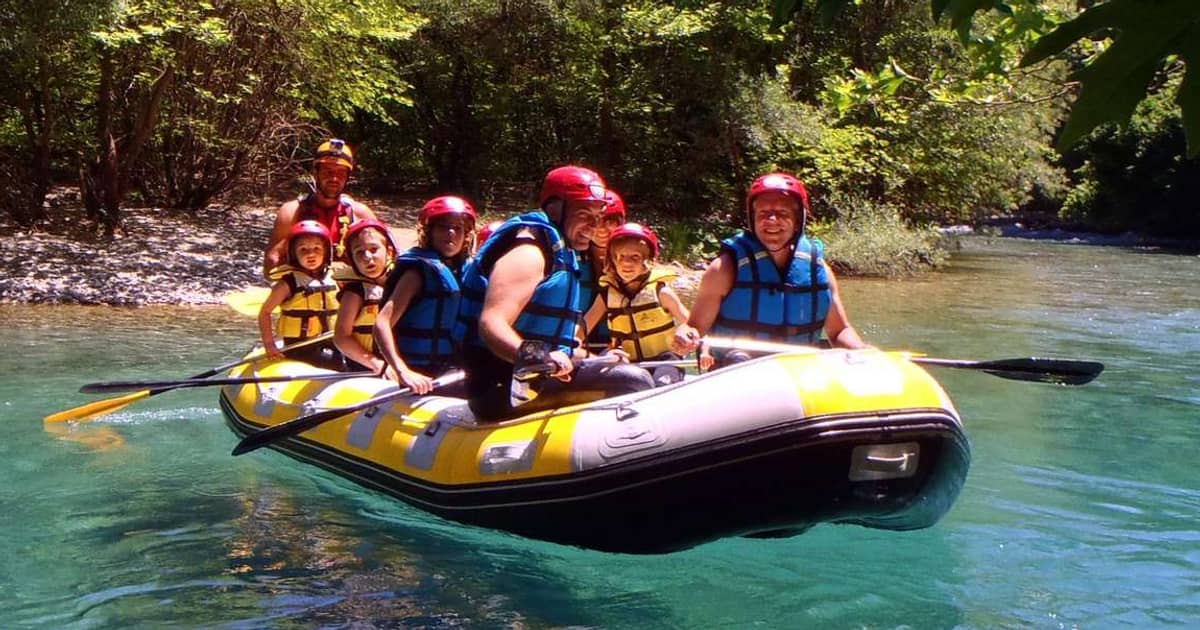
Voidomatis river rafting is a raft trip on a river in the Zagori area of Epirus, in north-west Greece. You paddle with a group and a guide. Below you find the river, the route, how a trip runs, the tours and the season. The homepage lists more Greece Tours like this one.
Each tour card below opens a live GetYourGuide booking. Dates, pickup points and group sizes are shown there.
What is Voidomatis river rafting?
Voidomatis river rafting is a raft ride down a clear, cold river in the Zagori area of Epirus, Greece. The river runs through the Vikos-Aoos National Park, which is also a UNESCO Global Geopark. Easy trips there welcome beginners and families.
Rafting means using an inflatable raft to travel down a river. The Voidomatis is known for rafting and kayaking, and the wider Vikos-Aoos area draws rafting and canoe-kayaking fans. Voidomatis river rafting takes place in the Ioannina regional unit of north-western Greece.
If you plan to cross into Turkey as well, the homepage also lists Turkey tours.
The river rises from springs near the village of Vikos, in central Zagori. There, crystal-clear turquoise water gushes out from the base of the mountains. The Vikos Gorge ends near the same village, and the Voidomatis forms in the last stretch of that gorge.
Streams from the slopes of Mount Tymfi and from the gorge itself join the river on its way down. In total the Voidomatis is 15 kilometres long, and it ends in the Aoos. Anyone booking Voidomatis river rafting meets water that stays quite cold all year round.
The Aoos, which the Voidomatis joins, is much longer at about 272 kilometres. It starts in the Pindus mountains of Epirus, near the village of Vovousa, and runs for 80 kilometres inside Greece. In Albania the same river is called the Vjosa, and the Voidomatis is one of its main tributaries.
The Voidomatis is described as one of the cleanest rivers in Europe. Voidomatis river rafting takes place on this water, inside the Vikos-Aoos National Park in the Pindus mountains. Four villages lie inside the park, and its wider area belongs to the UNESCO Global Geoparks.
The Vikos Gorge forms the core zone of the park, on the southern slopes of Mount Tymfi. The Guinness Book of Records lists it as the world’s deepest canyon in proportion to its width. The main part begins between the villages of Vitsa and Koukouli and ends near Vikos. The Voidomatis carved it over millions of years.
Voidomatis river rafting happens in Zagori, a mountain region of Epirus with 46 villages known as the Zagori villages. Houses there are built of local stone and have roofs of stone tiles. The villages are built around a central square. More than 160 arched stone bridges were built across the wider area.
UNESCO lists Zagori as a Cultural Landscape, set in the Pindus range of Epirus. The UNESCO record names the traditional limestone masonry, the stone-arched bridges and the cobbled paths that link the villages. The Voidomatis setting is a green landscape of traditional stone bridges and turquoise, crystal-clear water.
On the trip that starts at Klidonia, Voidomatis river rafting is rated easy and open to all skill levels. That trip runs through a UNESCO-protected natural landscape. One Zagori trip welcomes first-time rafters and families with young children at any fitness level. Another trip calls the descent fairly easy and needs no earlier rafting experience.
The Aoos also flows through the canyons of the Vikos-Aoos National Park. In that area it passes through channels formed by the bulges of the nearby mountains. The UNESCO Global Geopark occupies the north-western part of the Ioannina regional unit in Epirus. Water from the Voidomatis springs therefore travels on through the Aoos and the Vjosa to the Adriatic Sea.
A different Zagori trip offers Voidomatis river rafting as a first contact with the sport. Its route needs no special technical skill. That route runs through a lush natural setting decorated with natural springs, small waterfalls and stone bridges. The rafting base on the Klidonia trip sits in the heart of Zagori.
Where does Voidomatis river rafting take place?
Voidomatis river rafting takes place in Epirus, in north-west Greece, on the run between two stone bridges. Rafts start at the Aristi bridge in the heart of Zagori. They finish at the Klidonia bridge near the town of Konitsa.
Voidomatis river rafting begins at the Aristi bridge. The bridge crosses the river on the road between the village of Aristi and the village of Papingo. Aristi itself sits at a crossroads. One road from it leads to Megalo Papingo and Mikro Papingo. The other joins the main road from Ioannina to Konitsa.
At the other end, Voidomatis river rafting finishes at the Klidonia bridge. Klidonia, which is also spelled Kleidonia, belongs to the municipal unit of Konitsa. The bridge is built of stone and has a single arch. The descent ends at this bridge.
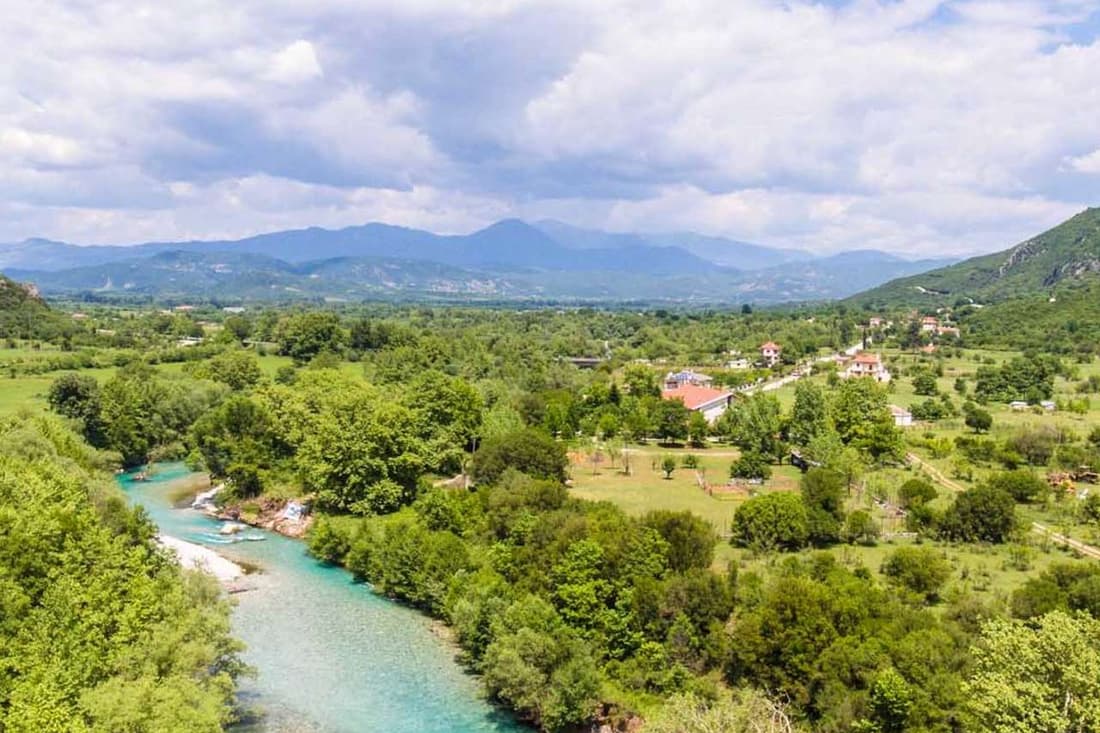
Past the bridge, the river runs into the valley of Konitsa. The town of Konitsa is built on a slope of the Pindos mountains and looks down on that valley. Konitsa lies north of Ioannina, near the Albanian border. The whole river is 15 kilometres long, so rafting covers only part of it.
Voidomatis river rafting starts about 51.7 kilometres from Ioannina by road. The drive to the Aristi bridge takes about one hour, and driving is the recommended way to get there. Visitors can use Ioannina, Konitsa or the stone villages of Zagori as a base.
Smaller villages sit closer to the bridge. Aristi village is 3.4 kilometres from it, about seven minutes by car. Megalo Papingo is 7.5 kilometres away, and the village of Vikos is 8.4 kilometres away. Vikos lies on the south side of the Vikos gorge, and Papingo lies on the north side.
The road from Aristi to the Papingo villages is narrow and has sharp bends. Drivers need to take care on it. The Voidomatis flows beneath this road at the Aristi bridge, which is the point where the rafts enter the water.
The water on Voidomatis river rafting is easy. The rapids reach class II and no higher, and the run suits beginners. Gentle rapids fill the rest of the route. The final stretch includes careful navigation of a small artificial waterfall.
The run passes age-old plane trees, caves and arched bridges. Oriental plane trees stand among the unspoilt nature around the river. Trees bow towards the water, and riparian forest covers the steep slopes. The lush setting includes natural springs and small waterfalls.
Halfway along Voidomatis river rafting, the rafts reach an abandoned monastery, the monastery of Agii Anargyri. Towering cliffs frame it, and caves used by hermits open in the rock around it.
The Vikos gorge gives the river its source. The walls of the gorge are limestone, with grey dolomite in the deepest layers. The main part of the gorge ends near the village of Vikos. From Vikos, a trail of about 40 minutes, almost 2.5 kilometres, leads down to the river.
Other streams from the slopes of Tymfi and from the gorge join the Voidomatis along its path. Here is the course in order, from the source area to the end of the run:
- Vikos village and the end of the main gorge, where the river forms.
- The Aristi bridge, where rafts enter the water.
- The Klidonia bridge, where the rafting run ends.
- The valley of Konitsa, below the town.
How does a Voidomatis river rafting trip run?
A Voidomatis river rafting trip from the rafting base runs in a set order. Guests gear up in the changing rooms, ride to the start and hear the safety briefing. Then they paddle down to the base with a guide who steers.
A Voidomatis river rafting day begins at the rafting base. On the trip from Ioannina, guests arrive 15 minutes before departure and meet an experienced instructor. On the trip from Klidonia, guests meet at the rafting base in Klidonia and leave at the scheduled time.
At the base, staff hand out the gear, and guests put it on in the changing rooms. The Aristi to Klidonia run kit is a neoprene suit, shoes, a waterproof jacket, a helmet and a life jacket. The Ioannina excursion hands out a helmet, a life jacket and a paddle.
Voidomatis river rafting briefings differ from trip to trip. On the Ioannina excursion, the instructor covers safety and the itinerary at the base. A minibus then takes the group to the start. On the Aristi to Klidonia run, a company vehicle takes guests to the start. The guides give the safety briefing there.
Technique comes before the first stroke. On the Ioannina excursion, the instructor teaches rafting and paddling techniques. The group then practises under that guidance. On the trip from Klidonia, the briefing covers navigation instructions and safety procedures. On the Aristi to Klidonia run, each boat takes up to eight people.
On any raft, the guide steers from the back and calls the strokes. Standard raft commands are short words. Forward means all paddlers stroke together. Stop means lifting the paddle out of the water. Get down means sitting on the floor of the raft, with the paddle and arms kept inside.
On the Ioannina excursion, Voidomatis river rafting time is about two hours, inside a three-hour activity. The instructor shares facts about the history of Epirus and the Voidomatis along the way. On the two-hour tour, the guides lead the group through gentle rapids and calm stretches.
Swimming during Voidomatis river rafting is optional. On the Aristi to Klidonia run, the bravest guests can dive into the river. On the guided three-hour tour, guests get time to swim in the river pools. Near the end, experienced instructors guide the careful run down a small artificial waterfall.
Safety gear is provided on the trip from Klidonia. The life jackets and helmets are certified, and guests cannot bring their own. Certified guides steer the rafts through the rapids there, and a safety briefing comes before the descent. On the Aristi to Klidonia run, the guides are certified river guides too.
Photos on a Voidomatis river rafting trip depend on the format. On the trip from Klidonia, the guides take photos during the descent. Guests receive the digital copies free of charge. The Ioannina excursion also gives guests photos of the rafting tour. The Aristi to Klidonia run includes photos and videos.
The Aristi to Klidonia run ends in front of the base. On the Ioannina excursion, the group returns to the base for a baklava snack with water. On the trip with viewpoints and lunch, a full meal follows the river. It is served at a tavern by a trout farm in Kalpaki, with water and snacks.
Which Voidomatis river rafting tours can you book?
Voidomatis river rafting tours start from a base in Klidonia or in Ioannina, or run as a private day tour. The Ioannina trip uses a minibus to the river. The day tour adds viewpoints and a riverside lunch. Each base trip lasts about three hours in total.
The Klidonia format starts at a rafting base in the village. Guests are driven together by car to the start of the run. The transfer includes the ride back to the base. Voidomatis river rafting on this format takes 3 hours in total. The base has showers and changing rooms, and photos from the trip arrive by email afterwards.
The Ioannina format starts in the city, not at the river. Guests meet at a rafting base in Ioannina. A minibus then drives them to the departure point at the Aristi Bridge. The trip has morning and afternoon departures and runs in English and Greek. Photos and videos are included. Hotel transfers are not.
Group size in Voidomatis river rafting changes with the format. The Ioannina departure takes up to 24 participants, with 8 people in each raft. At least 2 participants are needed for it to run. On the Klidonia trip, a raft holds between 4 and 8 people plus a guide, depending on the water level.
The day tour with viewpoints is a private outing of about 6 hours. It wraps Voidomatis river rafting into a longer route. A 9-seat van collects each private group from its accommodation. Pickup and drop-off are included from anywhere in the Epirus region. The route takes in Vikos Gorge viewpoints, the Stone Forest and the Bridge of Papigo.
Lunch on that day tour follows the raft run, at a riverside farm. The menu features fresh trout, local meats and seasonal produce. Professional photos and video clips from the day are sent to guests afterwards at no charge. On this format, Voidomatis river rafting comes with a meal by the river. Personal expenses are not included.
A private jeep tour shows the river from the land. It lasts 7 hours and includes hotel pickup and drop-off, with a local guide who speaks English and Greek. Vikos Gorge is the first stop. Next come the Voidomatis River, the natural pools at Ovires Rogovo and a scenic drive through West Zagori. The tour is not wheelchair accessible.
Horse riding is also on offer beside the river. The short route lasts 50 minutes. It runs through a sycamore forest next to the Voidomatis, up to the Klidonia bridge. Riders get souvenir photos, and the horses get water before the return. No earlier riding experience is needed, because instructors teach the basic principles first.
The long horse route lasts 1 hour 10 minutes. Riders cross the Voidomatis River on their horses to the opposite bank and return again. River conditions decide whether the crossing goes ahead. The minimum age for riders on both routes is 3 years, and both routes have an easy rating.
A guided walk follows the river on foot. It starts at the Aristi Bridge, at the western exit of the Vikos Gorge. It ends after the single-arched bridge at Klidonia. The walk takes 3 hours 30 minutes and is rated easy. A local transfer returns walkers to the start. It suits anyone who wants the Voidomatis without Voidomatis river rafting.
Which months suit Voidomatis river rafting, and what do you bring?
Voidomatis river rafting runs all year round, and the water runs highest in spring. Bring swimwear, a towel, a change of clothes and a second pair of sports shoes that can get wet. Age, swimming and health rules depend on the trip.
Trips on the river are not tied to one short season. The hiking and rafting combination lists its active period as throughout the year. Another trip states that rafting takes place all year round. So Voidomatis river rafting is a choice of water level and weather, not of a single open window.
Spring brings higher flows, so the ride feels punchier. The water level stays high until late spring. Spring and autumn give the top rafting conditions on this river. Spring weather also changes from day to day, and storms are hard to predict.
Voidomatis river rafting is popular in summer, and the river stays cold even then. On the easy trip from Ioannina, summer rafting can feel more subdued because the water is low. Parts of the river run dry in summer, and the first autumn rains change that. Autumn brings bright colours on the gorge rim and smaller crowds.
The water level also sets age rules. One trip lists a minimum age of 10 in winter and 3 in summer, because the water levels differ. On that trip, children can take part alone from age 12.
Voidomatis river rafting has no single age limit for every trip. One trip lists a minimum age of 5. The hiking and rafting combination takes ages from 7. One trip with a minibus transfer needs participants aged at least 8.
Swimming rules are plain. On the trips that state a swimming rule, participants must be able to swim. Health rules differ by trip. One trip is not suitable for pregnant women and the elderly. Another does not recommend rafting for anyone with back problems or a past back operation.
For Voidomatis river rafting, pack swimwear, a towel and a change of clothes. Add a second pair of sports shoes that can get wet. One trip also lists a glasses strap and sun cream. The trip with a minibus transfer adds a snack to the list.
The hiking and rafting combination has its own list. It asks for hiking shoes, ideally boots, a waterproof jacket for rainy days and your own water bottle. A small dry bag holds essentials on the water, and jewellery and loose electronics stay on shore.
The river stays cold in every month, so warm dry clothes matter after the ride. Warmer base layers help in autumn. The day trip starts in Ioannina, where the mean daily high is 17.5 degrees Celsius in April. It is 20.6 in October and 31.0 in July and August.
Voidomatis river rafting depends on the weather. On the minibus trip, a cancellation for bad weather brings a new date or your money back. A second format refunds the money in full if the provider cancels for weather. Every tour card lets you look up open dates in its own calendar.
- Swimwear, a towel and a change of clothes
- A second pair of sports shoes that can get wet
- Sun cream, a glasses strap and a snack
- Booking confirmation in digital or printed form