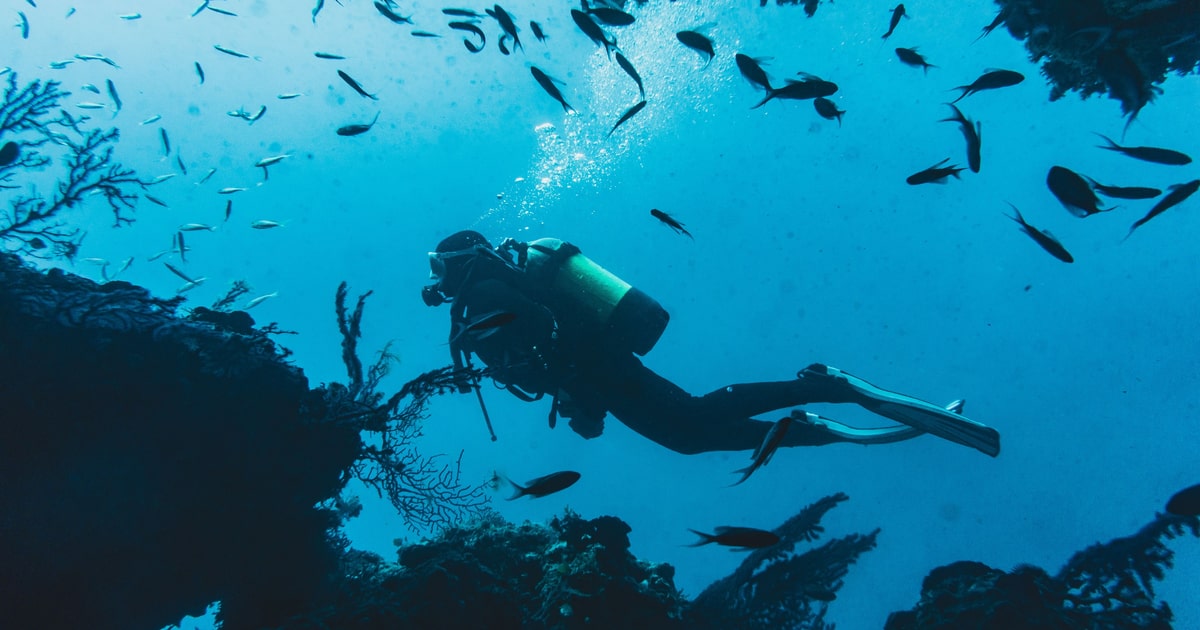
Rhodes scuba diving gives a beginner a first breath under the sea with an instructor. This post covers the session, the sea, the steps of a first dive, the dive spots and the booking rules. The homepage lists more Greece Tours for the islands.
Every tour card below opens a live GetYourGuide booking. Pickup points and group sizes are shown on each card.
What is a Rhodes scuba diving experience and how does the day run?
An introductory dive lets a person without a diving certificate try scuba under an instructor’s guidance. The two-hour session on a Rhodes scuba diving outing starts at a dive centre in Kolymbia. Free hotel pickup and drop-off come from selected areas.
An introductory dive also goes by the names trial dive and resort dive. People without any diver training can try scuba this way, under the guidance of a recreational diving instructor. It is an experience programme only, and no certification is issued at the end of it.
Turkey lies close to Rhodes, and the homepage lists Turkey tours for the coast and the cities.
The first stop on a Rhodes scuba diving day is a dive centre in Kolymbia. Kolymbia is a resort in the municipal unit of Afandou. That unit lies on the east coast of Rhodes, just south of Faliraki. Faliraki is about fourteen kilometres south of Rhodes town.
No one gets wet until the briefing is over. On a Rhodes scuba diving session it is short and easy. It covers how to use the equipment and the key safety rules before entering the water. After that the small group goes into the sea and dives.
The small-group format around Faliraki and Kolymbia adds a practice stage. Guests practise with the equipment in calm, confined water before going out. After a short introduction, they follow the instructor to explore the underwater world. In an introductory dive, the participant enters the water under close supervision of the instructor.
Length changes with the format chosen on a Rhodes scuba diving trip. The Kolymbia listing runs for two hours in all. A beginners’ format near Faliraki is also about two hours, while a half-day Kolymbia format runs four hours. The Lindos-area format takes three hours with one dive and six hours with two.
Group size is the next thing to compare on a Rhodes scuba diving lesson. The Kolymbia listing promises small groups, so every participant gets personal attention. The Faliraki and Kolymbia format caps a group at four people and adds one-to-one assistance. On the Lindos-area format, one certified leader takes a group of five or six divers.
Full diving equipment is included on a Rhodes scuba diving booking. So are certified instructors, the safety briefing, small-group diving, and free underwater photos and videos. Meals, drinks and any personal spending stay outside the listing. On the Lindos-area format, the photos arrive by e-mail after the dive.
Scuba also features in Kos Scuba Diving.
Pickup areas and languages are the last details to check. The Lindos-area format collects guests from Kalathos, Vlicha, Lindos, Pefkos, Lardos and Kiotari. Greek and English are both named among its languages. Guests give their location when booking, or they meet the group at the dive centre in Lindos.
On the Kolymbia listing the day runs in a set order. A guest arrives at the dive centre and takes the briefing and equipment instruction. Next come the safety rules, entry into the water and the dive. The hotel drop-off closes the day. The listing is built for beginners, so no diving certification is needed.
Why does the sea around the island suit a Rhodes scuba diving lesson?
The sea at Rhodes averages 17.0 degrees Celsius in February and 27.2 in August, and the Mediterranean tide is weak. A diver therefore meets only a small tidal rise and fall during a Rhodes scuba diving class near the island.
Rhodes is the eastern gate into the Aegean Sea, and the Aegean itself is a long bay of the Mediterranean. The island belongs to the Dodecanese, in the south-east of the Aegean, with Kos and Patmos. Its southern cape has the Aegean on one side and the Mediterranean on the other.
The climate table for Rhodes gives the sea temperature for each month. The lowest average falls in February and the highest in August. The figure for the whole year is 21.4 degrees Celsius. The sea therefore changes with the calendar during a Rhodes scuba diving session in each season.
More about Rhodes: Lindos Day Trip From Rhodes.
Tides in the Mediterranean are small. Atmospheric conditions can hide the rise and fall of sea level. Headwinds or higher-than-normal air pressure weaken the tide further. The Gulf of Gabes, off the coast of Tunisia, is an exception, where the range is nearly two metres.
The Mediterranean holds very low concentrations of chlorophyll and nutrients. A European marine assessment of the Aegean and Levantine region calls its coastal waters oligotrophic, meaning poor in nutrients. The report adds a threshold of at least five metres of transparency, a benchmark, not a reading from any bay.
Posidonia oceanica is a seagrass found only in the Mediterranean. It grows at depths of 1 to 35 metres, and its lower limit follows the clarity of the water. The meadows grow in the same Mediterranean water that surrounds a diver during a Rhodes scuba diving outing.
Underground stems and roots hold the plant in place, and upright stems and leaves cut down the silt that gathers. The plant takes in carbon dioxide and produces oxygen. The meadows also give juvenile animals a place to feed, find protection and grow. Other animals and plants use them for food too.
Another page that includes Rhodes is Rhodes Glass Bottom Boat.
The Hydrobiological Station of Rhodes, whose research covered the sponges and fisheries of the Aegean, hosts an aquarium. The displays include sea anemones, octopuses, sea urchins, corals, bivalves, crabs and lobsters. Each was found around Rhodes and the surrounding Dodecanese islands. During a Rhodes scuba diving trip, a diver can look for these groups in the sea.
Aegean fish catches include seabream, sea bass, grey mullets, grouper, mackerel and sardines. An estimate puts the Mediterranean at more than 17,000 marine species, and the Aegean is one of its marginal seas. Species called Lessepsian migrants entered the eastern Mediterranean through the Suez Canal, and they count as introduced species.
Mediterranean monk seals live in the Aegean Sea in Greece. The seals are shy and sensitive to disturbance, and irresponsible scuba diving trips scare them away from caves. Greece has set aside a large Aegean area for the seals and created marine protected areas on its coasts. Care around caves applies to every diver during a Rhodes scuba diving visit.
Which steps make up a Rhodes scuba diving first dive?
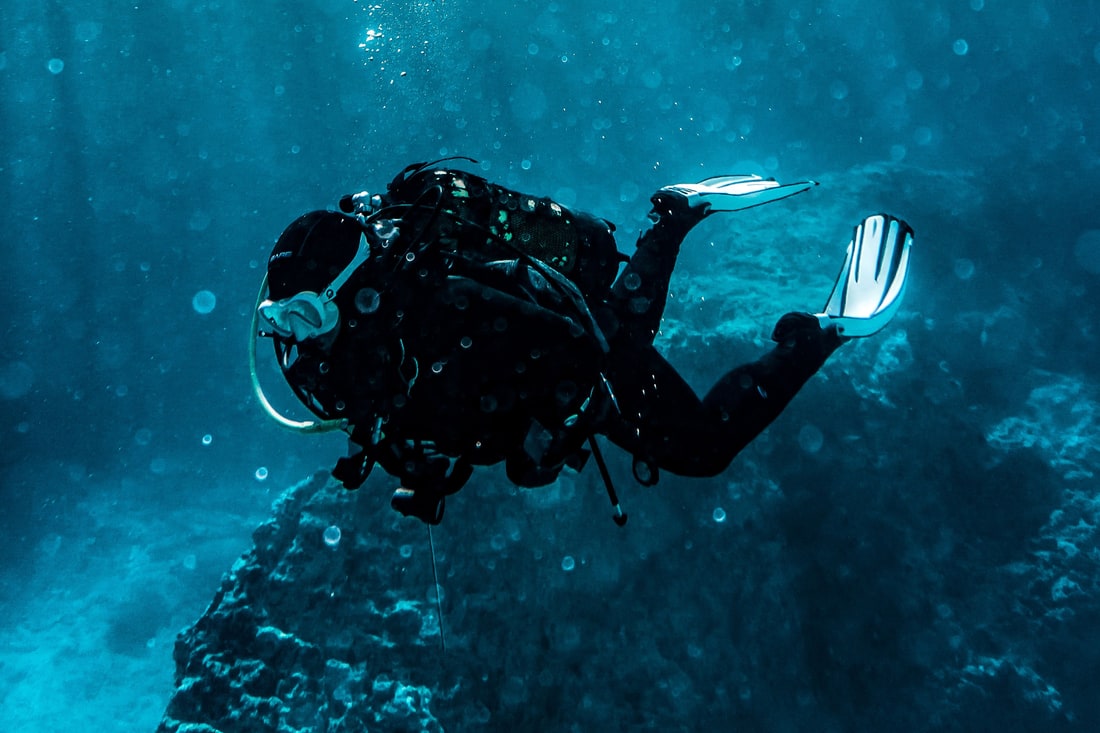
An introductory dive runs in a set order: briefing, kit fitting, breathing practice, shallow drills, then the dive. On the Lindos format the dive lasts about 30 minutes. Water time in a Rhodes scuba diving session stays brief.
The briefing opens the session. On the dive with photos and pickup, a short briefing covers the equipment and key safety rules. The Kalithea Beach format adds a theory part in a Rhodes scuba diving lesson. Then the diver is fitted for a wetsuit, tank, mask, regulator, buoyancy compensator, fins and snorkel.
For more on Rhodes, see Rhodes Submarine Cruise.
Calm breathing through the regulator is practised at the surface first. The mouthpiece valve opens when the diver breathes in and closes when the breath stops. Under ordinary conditions, underwater breathing differs very little from surface breathing in a Rhodes scuba diving class. The gas arrives at the same pressure as the lungs hold at rest.
The mask comes next. A bare eye cannot see clearly in water, and the air space in front of the eyes fixes that. To clear a flooded mask, the diver breathes out through the nose. The water leaves along the bottom edge. The drill is learned at shallow depth.
The ears need care on descent. The diver adds gas to the middle ear by pinching the nostrils and swallowing, or by blowing gently. Blowing too hard can cause damage, so pressure is held no longer than five seconds. If an ear hurts, the diver rises a little and tries again in a Rhodes scuba diving trial.
Hand signals replace speech, because divers cannot talk underwater without a full-face mask and electronic gear. A fist with the thumb up means ascend, and a thumb down means descend. A flat hand moved slowly from side to side means level off. A finger pointed at the ear means the ear will not clear.
Rhodes comes up again in Rhodes Catamaran Cruise.
Buoyancy practice in a Rhodes scuba diving outing teaches the diver to hover. Neutral buoyancy holds one depth with little effort and lowers the gas used. The jacket holds an inflatable bladder, and gas is added or vented to adjust it. Gas in the bladder shrinks or swells with depth, so the jacket needs constant attention.
On the Lindos format, a theory lesson of about 30 minutes comes first. Then comes a dive to 6 metres for about 30 minutes. The Kolymbia beach dive reaches 4.5 to 5 metres and lasts about 23 minutes. The Kalithea springs shallow session runs 20 minutes in water 2 to 5 metres deep.
The instructor stays within reach. An introductory dive runs under close supervision, and Kolymbia beach beginners get it throughout. Holding the breath while rising from as little as 4 feet of seawater can tear lung air sacs. Shallow water carries the highest lung-injury risk. The rule in a Rhodes scuba diving experience is to keep breathing.
Photos are taken during the first dive on the Kolymbia beach format. Water absorbs red light first, so frames drift to blue-green. A flash or video light restores the lost colour, and a close subject loses less colour. Through a flat mask, objects look 25 percent closer than they are.
A related page on Rhodes: Rhodes Hop On Hop Off.
Which bays and reefs does a Rhodes scuba diving trip visit?
First dives on Rhodes run in sheltered bays, led by Kalithea Bay and Anthony Quinn Bay. Both have floors of rock and sand. Entry is from a beach or a boat. At a Rhodes scuba diving site, each bay adds its own caves.
Kalithea lies on the north-east of the island, just south of Rhodes city, and its springs are 9 kilometres away. A restored monument stands right next to the sea. The sheltered bay in front suits first dives and practice sessions. Caves are listed at Kalithea and at Lindos.
The floor of Kalithea Bay is rock and sand, and the site is rated easy. Divers at a Rhodes scuba diving outing meet caves, craters and swim-throughs here. The open caves are called caverns, and a diver can surface inside them. Named spots include the Mushroom, the Blue Hole and Crystal Fish Alley.
The way into the water at a Rhodes scuba diving session depends on the format. One try dive starts at Kalithea Beach, and the diver walks into the sea with the instructor. A second format sails on diving boats to Kalithea Bay, with one dive session and an optional second dive.
The introductory dive with photos and hotel pickup begins at a dive centre in Kolymbia. A different try-dive programme runs from Kalithea, Kolymbia and Pefkos. Pefkos stands on the east coast, 4 kilometres south-west of Lindos. On that programme, hotels in the south are served by a beach dive, not by a boat.
Readers interested in Rhodes can open Symi Day Trip From Rhodes.
Anthony Quinn Bay is listed under Faliraki, a resort on the north-east coast about 14 kilometres south of Rhodes Town. It is a shore dive, reached by a fairly easy descent. The floor is sand with uneven rock formations, and natural rock tunnels and small caves add shape. Calm water suits beginners at a Rhodes scuba diving class.
Ladiko Bay is a sheltered bay with a sandy floor, a start for newcomers. The Ladiko Wall slopes steeply, and its shallower areas suit beginners. The Seal Cave, another Faliraki site, has a steep wall and cave structures. It asks for experience in deep dives.
Lindos stands on the east coast, about 40 kilometres south of Rhodes Town. St Paul’s Bay is calm and well protected, with a gently sloping floor. Its seabed varies, so beginners and experienced divers both dive there. It is named for introductory dives at a Rhodes scuba diving lesson. Caves, caverns and walls lie at sites nearby.
Prasonisi lies at the southern end of Rhodes, 92 kilometres from Rhodes Town. In summer a strip of sand joins the small island to the main island. The seabed around the cape mixes sand and rock. Shipwrecks are listed at Plimiri and Kamiros. A wreck dive off the south coast is for experienced divers with good navigation and control.
8 Day Marmaris Symi Rhodes Blue Voyage covers Rhodes too.
A beginner spot is a sheltered bay with a gently sloping floor. A deep reef is a steep wall, a cave or a wreck, and it asks for deep-dive experience. Each bay looks different at a Rhodes scuba diving stop. Kalithea has caves, Anthony Quinn Bay has tunnels and St Paul’s Bay has a gentle slope.
When can a Rhodes scuba diving session run and which rules apply?
The beginner dives at Lindos and Kalithea list bookable days from the end of March to the end of October. Rules for a Rhodes scuba diving trip cover health forms, age, alcohol and flying. The Kolymbia dive cancels free until 24 hours before the start.
Climate tables class the island as a hot-summer Mediterranean zone. At the airport weather station, July brings 0.7 millimetres of rain, August 1.3 and December 137.8. Lindos has a yearly mean near 22 degrees, and the island’s record high, 43.6 degrees, was set there. Sunscreen matters for a Rhodes scuba diving lesson.
Strong seasonal winds cross the Aegean and make Rhodes a sailing destination. The Etesian winds come and go between late spring and mid-September, strongest in the afternoon. On the Lindos beginner dive, bad weather brings a free change of date or a refund. Read that line before fixing a date for a Rhodes scuba diving outing.
Dive medicine screens divers with a three-part system. The diver fills in a questionnaire, and a physician completes an evaluation form when approval to dive is necessary. A yes answer does not bar a diver by itself. It sends the diver to a doctor. Honest answers matter, because false ones can delay medical care.
A related page on this site is Pserimos Day Trip From Kos.
At Lindos, a doctor’s note joins the paperwork for a Rhodes scuba diving booking. The beginner dive there asks for a medical certificate from a family doctor, dated within the last 3 months. Anyone under 18 brings written consent from a parent. Guests also fill in forms before the start.
The small-group dive around Faliraki and Kolymbia takes ages 8 and up in a pool. Sea dives there start at 10, and the Lindos and Kalithea dives also set 10. Swimming ability is required at Lindos and Kalithea, and neither needs a diving certificate. The Lindos dive asks for good physical condition.
A diving-safety organisation states that alcohol and diving are not compatible. Alcohol weakens judgement, reaction time and coordination. Skills of experienced divers fell at 0.04 percent blood alcohol. Severe dehydration, which alcohol can cause, is a potential risk factor for decompression sickness. Plan a drink-free evening and morning for a Rhodes scuba diving day.
A single no-decompression dive calls for a wait of at least 12 hours before a flight. Repeated diving on more than one day calls for at least 18 hours. These figures are minimums, and the trials behind them used dry, resting divers. Count back from the flight home when you pick a date for a Rhodes scuba diving visit.
Rhodes also features in Fethiye Ferry to Rhodes Greek Island From Istanbul.
Pack for the format. On the Kolymbia introductory dive, guests bring a swimsuit, a towel and sunscreen. Towels, swimwear, food and drinks are not included. The Lindos and Kalithea dives send the underwater photos by email. On the Kolymbia dive, booking as soon as possible guarantees availability.
Each booking card here shows live availability for your chosen day. On the Kolymbia dive, cancellation is free until 24 hours before the start. A later cancellation is charged in full. A late arrival at the pickup point counts as a missed start. The Lindos and Kalithea dives state the same 24-hour line.