A Naxos bus tour is a day trip around the island in a coach or minibus from Naxos Town. You stop in mountain villages and at an ancient temple, with time for lunch and a swim. This post covers the start, the stops, the food, the formats and the booking rules. The homepage lists more Greece Tours like this one.
Each tour card below opens a live GetYourGuide booking. Dates, pickup points and vehicle types are shown there.
What is a Naxos bus tour and how does the day work?
A Naxos bus tour is a day trip around the island by coach or minibus, with an escort or driver. You ride between stops, explore on foot, take free time, and go back to your pickup point.
Think of the full-day coach tour as a loop. The bus collects guests at central points and drives from stop to stop. At the end of the day it returns them to the same places. Guided visits alternate with free time. A big part of the road runs through winding mountain country, and the driver handles every bend.
If you plan to cross into Turkey as well, the homepage also lists Turkey tours.
A Naxos bus tour suits visitors who want an overview of the island in one day without driving themselves. The full-day coach tour is aimed at people who like history, architecture and village life. The escort tells the stories at the stops, so you learn the background while you look at the place itself.
The vehicle depends on the format. The full-day coach tour runs in a large air-conditioned bus with spacious seating and a local English-speaking escort. The small-group format rides in an air-conditioned minibus, with an English-speaking escort and driver. The private minibus rental has an air-conditioned minibus and a licensed English-speaking driver, but no guide on board.
Group size changes with the format. A Naxos bus tour in the small-group format takes up to 16 people. The full-day coach is a large bus, so it seats a bigger crowd than a minibus. A private tour is built around one party only, which keeps the day to your own people.
Private tours size the vehicle to the party. One to three people get a sedan, four to eight get a minivan, and nine to twelve get a minibus. The timing is flexible, and the route includes photo stops. On the private village tour, the driver also acts as an informal guide for the day.
The full-day Naxos bus tour fits a solo traveller, a couple, a family or a group of friends. Joining a group breaks up the solitude of travelling alone. Cruise passengers are covered too, because a full-day historical bus tour of the island is listed under shore excursions.
Free time is built into the rhythm of the day. At a free-time stop you explore at your own pace. The coach tour and the small-group minibus tour both set this time aside. Private tours go further, with flexible timing and photo stops.
A Naxos bus tour differs from a taxi in who plans the day. A taxi takes you where you ask. You flag one down in town or book one by phone. On the tour, the route and the stops are already set, and an escort explains them as you go.
A rental car makes you the driver. On a Naxos bus tour, the driver deals with the winding mountain roads, and you look out of the window. A boat tour is another style of day. Local companies run boat excursions to nearby islands, secluded beaches and coastal sights. You spend that day on the water, not on the road.
The private minibus rental works in a third way. A licensed driver takes you where your own interests lead, and the day follows your plan. The driver declines dirt roads in poor condition and risky places. Every format above comes with an English-speaking escort or driver.
Where does a Naxos bus tour start in Naxos Town?
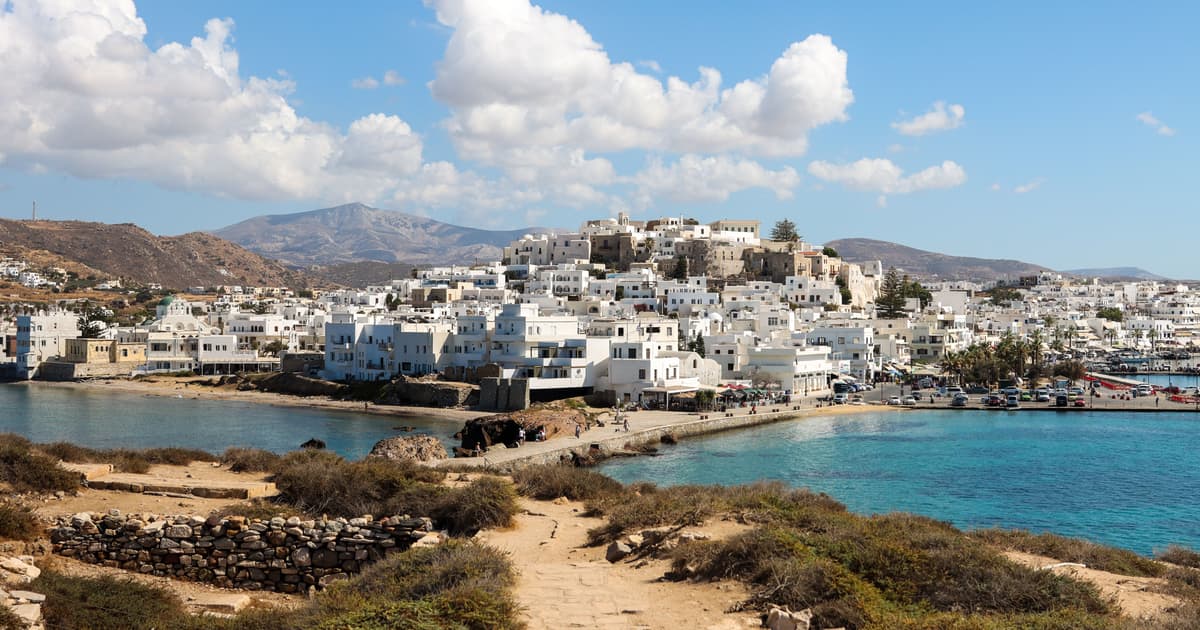
A Naxos bus tour starts in Naxos Town, also called Chora, on the western side of the island. On the highlights bus tour, guests join at the beach resorts or in town. The final meeting place is an office right outside the port.
Naxos Town is the capital and largest town of the island. Its port lies on the north-western side of the town, with a breakwater and piers. The highlights Naxos bus tour names an office right outside this port as its meeting place. For guests who make their own way, the harbour is where the day begins.
The Portara is the landmark of the waterfront. It is a large marble gate from an unfinished temple of Apollo. The gate stands on the islet of Palatia, at the northern end of the harbour. A causeway joins the islet to the town. Visitors watch the sunset through the opening of the gate.
Work on the temple began around 530 BC, under the tyrant Lygdamis. It stopped when he lost power, so the temple was never completed. The doorway is made of Naxian marble. With traces of the foundations, it is all that remains. The gate is easy to reach on foot from Chora.
Above the quay rises the old town. The Kastro stands on the hill right over the port, and small alleys climb from the waterfront to its gates. The stops listed for the highlights Naxos bus tour do not include the old town. The Kastro and its alleys stay a separate walk on foot.
The old town is the historic centre of Naxos Town. It holds the Kastro and the district of Bourgos. Bourgos was traditionally home to the town’s merchants and artisans. The Kastro, whose name means castle, is the oldest quarter, and people still live there. It is not a ticketed archaeological site but a living neighbourhood.
The walls of the Kastro are made of the houses built along its edge. The fortress stands on a hill where the ancient acropolis of the town once stood. The biggest gate faces the north-west, and the Glezos Tower stands beside it. From the waterfront, an uphill alley leads to a gate in about five to ten minutes.
The beaches near Chora, on the western side of the island, set the pickup list. The highlights bus tour collects guests from central places in Naxos Town, Stelida, Agia Anna, Agios Prokopios and Plaka Beach. The run also calls at Maragkas Beach and the Agios Georgios area. Agios Georgios Beach marks the town’s western edge.
On this Naxos bus tour the pickup run follows a set order. Plaka Beach comes first, before nine o’clock in the morning. Agia Anna and Agios Prokopios follow, then Stelida and the stretch between the airport and the town. Naxos Town comes next. The office outside the port closes the run.
The meeting point of this Naxos bus tour is the office outside the port. Specify your accommodation, so the closest pickup point can be arranged. Guests wait at the pickup point before the stated time, and the times are approximate. If you cannot find the spot, send your accommodation details. The operator then names a convenient one.
A Naxos bus tour of the highlights kind ends where it began. After the last stop, the bus drives back and returns guests to their pickup point. The booking covers the round trip, so no separate transfer back to the hotel is needed.
Which villages does a Naxos bus tour visit in the Tragea valley?
The full-day coach Naxos bus tour stops at Damalas and Halki in the Tragea valley. The private village tour adds Filoti, the largest village on the island. The valley holds olive groves and about 30 Byzantine churches.
The Tragea valley lies in the middle of Naxos, 16 kilometres from Naxos Town. The mountains Koronos and Fanari surround it to the north, and Mount Zas to the south-east. The main road to Tragea joins Damalas with Chora. A Naxos bus tour that heads for the valley from the port meets a striking change in scenery.
Old olive, plane and oak trees grow in the valley, along with vines and fruit groves. High summits stand around them. A circular walking trail loops round the largest part of the olive grove and the Byzantine park of Tragea. The valley carries the nickname Mystras of the Aegean, after a Byzantine town in the Peloponnese.

A Naxos bus tour that stops in Damalas or Halki is inside the valley that holds about 30 Byzantine churches. They carry rare frescoes, inscriptions and sculptures. Panagia Drosiani, close to Moni village, ranks among the oldest churches on Naxos. Agios Georgios Diasoritis stands near Halki, and its oldest frescoes date to the 11th century.
Damalas spreads out like an amphitheatre at the foot of Lagos hill. The clayey soil of the valley supports a pottery tradition, and a workshop stands at the village entrance. On the full-day coach Naxos bus tour, Damalas adds a pottery workshop and an olive oil lesson.
The village can be seen from other parts of the island, and it has wide views of its own. The parish church of Agia Irini holds a marble iconostasis and a marble font. The villagers restored their old olive mill and hold an annual event on the traditional way of pressing olives. A car park serves the village.
Halki was once the capital of Naxos. Neoclassical mansions with large balconies, decorated roofs and paved courtyards show its past wealth. The village thrived as the trading centre of the whole upland district. Its name comes from a family of bronze smiths, whom the Venetian rulers settled here.
Venetian towers stand in and around Halki. The Barozzi Tower dates to the 17th century. The Gratsia Tower served as a lookout in times of pirate raids. You can admire it close up, but you cannot enter it. A Naxos bus tour by coach gives Halki a stop of its own.
On a village stop in Halki, you walk the cobbled street, where artisan shops stand side by side. An art gallery and a café sit at the square. The church of Panagia Protothroni also stands in Halki and ranks among the oldest churches of the valley.
Filoti is the largest village on Naxos and lies 18 kilometres from Naxos Town. Its houses climb the slopes of two hills, at the foot of Mount Zas. High summits ring the village, with one opening to the west towards Tragea. On the private village format of a Naxos bus tour, Filoti follows Halki.
The main square of Filoti, Gefyra, has cafés, restaurants and shops, and an old plane tree stands in its centre. A folklore museum shows how a traditional house looked. Mount Zas rises south-east of the village and is the highest peak in the Cyclades. Myth says that Zeus spent his childhood there.
What do you see in Apeiranthos on a Naxos bus tour?
On a Naxos bus tour, Apeiranthos is the mountain village where the bus stops for free time. You walk marble-paved lanes under stone arches, see a seventeenth-century tower and choose between museums and a café. The full-day highlights tour gives the village 90 minutes.
Apeiranthos is built on the slopes of Mount Fanari. The houses rise in tiers, like the seats of an amphitheatre. The village looks out over the Naxian mountain ranges. A Naxos bus tour that stops here shows you old two-storey houses, Venetian towers, marble alleys and village squares.
The marble lanes are the first thing you notice. The alleys are paved with marble, and stone arches stand over them. Coats of arms sit above the doors of old houses, and ornate balconies appear along the way. The village has kept its architectural form almost intact since the time of Venetian rule.
The Zevgolis Tower stands at the entrance to the village. It dates to the seventeenth century and is built on a rock. The tower is private property and closed to visitors. A Naxos bus tour therefore lets you look at it from outside. The village grew around two seventeenth-century towers that once belonged to Frankish landowners.
The earliest historical evidence of Apeiranthos goes back to the early fifteenth century. The villagers’ dialect, customs and manners differ from those of other Naxos villages. Their speech resembles that of mountain villages in Crete. The residents are thought to descend largely from people who came from Crete and Asia Minor.
Two natives of the village became national figures, a Prime Minister of Greece and a politician and writer. The poetic disposition of the villagers belongs to the village atmosphere. Towers, marble alleys, squares and this temperament combine into a mood that is rare among the Cycladic islands.
A Naxos bus tour reaches a village with museums of archaeology, geology, natural history and folklore. The archaeological museum holds more than 1,200 objects, among them marble figurines, jewellery, tools and other material from the region. The majority date to the Proto-Cycladic period. The oldest pieces reach back to the Neolithic age.
The geological museum shows approximately 2,000 exhibits, among them rare and unique items. The natural history museum displays the fauna and flora of the area and has a small aquarium. The folklore museum shows traditional fabrics, embroidery and tools. A small children’s art museum looks at the relationship between children and toys, from antiquity to modern times.
On the full-day highlights Naxos bus tour, Apeiranthos gets 90 minutes of free time to explore and eat lunch. You use the time at your own pace. On the private half-day tour, the lunch stop is programmed in the village.
Free time on a Naxos bus tour leaves room for coffee at a traditional café. The shops sell weavings and handicrafts. The village women make woven goods on a traditional local loom. They work in a section of the cultural centre during winter. They copy designs and colours from their mothers and grandmothers.
The weavers show their work in a showroom that opens in summer, opposite a church. The cooperative also sells books by local writers. The church of Panagia Aperathitissa, built in the eighteenth century, has an imposing presence on the main street. It houses valuable icons.
Why does a Naxos bus tour stop at the Temple of Demeter?
A Naxos bus tour stops at the Temple of Demeter because the sanctuary is built entirely of marble. It dates to the late sixth century BC and was partly rebuilt from its own pieces. On the highlights coach tour, the stop lasts 40 minutes.
A Naxos bus tour reaches the temple in the Gyroulas area. It sits on a small hill in the plain, south of the village of Sangri. The site lies about 1.5 kilometres south of Ano Sangri. The sanctuary stands on a mound above the start of a fertile valley.
The area around the sanctuary suited farming, and workshops for olive oil, wine and pottery grew up close to it. People in the district began worshipping nature deities outdoors in the eighth century BC. The marble temple was built at the same spot in the late sixth century BC. Archaeologists found its ruins in the late nineteen-forties.
On the highlights coach tour, the Naxos bus tour gives the temple 40 minutes. From the gate, visitors walk uphill through a garden to the temple. Admission is not included on that tour, so visitors pay at the gate in cash. The escort explains the monument before the gate and is not licensed to lead visitors inside.
Finds from the dig point to Demeter and Kore, also called Persephone, as the goddesses worshipped here. Apollo was honoured at the sanctuary too. Their worship was tied to fertility and plant growth. The Greek ministry of culture links the temple to the building programme of the tyrant Lygdamis.
On a Naxos bus tour, the first detail to notice is the material. The temple is made entirely of marble, from the walls to the roof tiles. The stone was quarried on Naxos. The plan is almost square, 13.29 metres long and 12.73 metres wide, and the front faces south.
The porch roof is the oldest known marble roof of ancient architecture. Seven beams, each nearly four metres long, support it. The ceiling needed no connectors or dowels. A saddle-shaped roof covered the building. The roof tiles were marble as well, and they let light into the inner room.
Look inside on a Naxos bus tour and a row of five columns divides the main room. The front columns are smooth, with no flutes, and they narrow toward the top. Plaster and paint once covered the porch walls, and colour shading gave the look of relief without any carving.
The builders used optical corrections like those of the Parthenon, but about a century earlier. The outer layer of the walls leans outward by about 3 percent. The walls stand on a low base, with no stepped platform below them. The temple has no frieze and no gable.
The temple on view is a partial rebuilding. About 1,600 surviving pieces were used, and their measurements showed the original position of each piece. The work was finished in the nineteen-nineties. A Naxos bus tour therefore stops at a temple put together from its own ancient stone.
In the sixth century AD the temple was largely demolished. A three-aisled Christian basilica was built from the same stone. A wing of the temple shows a representation of that basilica. A small museum in the grounds opened in the year two thousand and one. It holds vases, tools, inscriptions and parts of the roof.
What does a Naxos bus tour show at the kouros of Apollonas?
A Naxos bus tour shows an unfinished marble giant at Apollonas, on the north-eastern tip of the island. The statue is more than 10 metres long and lies on its back in an ancient quarry. Work on it stopped for reasons that nobody can prove.
Apollonas is a small seaside village on a sandy bay at the north-eastern end of Naxos. The road from Naxos Town forks left towards the north of the island and runs via the village of Koronos. On the full-day coach tour, a Naxos bus tour reaches this bay after the mountain villages.
Apollonas itself is a fishing village. The north-eastern coast around it is almost uninhabited. Its shoreline is steep, with small bays, vineyards and herds of sheep and goats. Koronos, on the way, is an old village of emery miners. The slope between Koronos and Apollonas is long but not particularly steep.
A short walk from the village leads to an ancient marble quarry. The workings form a near semicircle cut into the mountainside. Traces of quarrying surround the statue and rise above it. This surface quarry is one of the oldest in Greece. Workers cut the stone straight from the ground and the cliff face.
The full-day Naxos bus tour stops here for the colossal statue. It is made of Naxian marble and measures more than 10 metres. The figure lies flat on its back, half finished, near the top of the hill. A footpath leads to it from the village.
People call the statue a kouros, yet it is a clothed figure. It has a short beard and hair down to the shoulders. The carver shaped it in an upright, frontal position. Archaeologists differ on whether it shows Apollo or Dionysus. The beard is the reason given for reading it as Dionysus.
Experts place the statue in the Archaic period, but nobody can give an exact date. The Naxos bus tour visits a work that was never finished, and that makes dating hard. The figure shows features of the late Archaic era. Its unfinished state is the main obstacle to a firm answer.
No one knows for certain why work stopped. A large crack runs vertically through the left part of the figure, from the head to the chest. It is unclear when the crack appeared. One view holds that the stone broke and a repair was impossible.
Other explanations exist. One says the statue was too heavy to transport. The sculptors got no further than plans to move it. Another points to the Persian occupation of Naxos. A third says the order was cancelled or never paid for. A Naxos bus tour cannot settle the question, but the giant still lies where the sculptors left it.
A Greek inscription near the statue points to a place sacred to Apollo. The Ministry of Culture presents the Apollonas figure together with the kouroi of Melanes as the colossal statues of Naxos. The inscription itself dates to the late fifth or early fourth century before Christ.
On the full-day coach tour, the bus leaves Apollonas and returns along the west coast. The loop covers the northern and western parts of the island. This Naxos bus tour therefore shows two different shores in one day, the steep north-east and the west.
Where does a Naxos bus tour stop for lunch, a swim and local tastes?
A Naxos bus tour stops for lunch in a village or by the sea. It stops for a swim at Apollonas on the north-east coast. Lunch is free time and is not included. Village tours with tastings add kitron, olive oil and cheese.
The lunch break on a Naxos bus tour is free time, not a set meal. The highlights tours do not include lunch, so you choose a table and order for yourself. One highlights tour sets lunch at a mountain village. The tour with the swim stop sets it at Apollonas.
At Apollonas, free time covers both swimming and lunch. On the swim-stop Naxos bus tour, the bus reaches the village at about two in the afternoon. Tavernas and small shops stand by the beach, so you can eat close to the water. Eat breakfast before the pickup, because lunch comes late.
Lunch at the mountain village works differently. On the highlights tour that sets lunch there, the free time is meant for local recipes. The tour names rosto and kalogiros. Lunch is not included, so each guest orders at the table. Each stop has a set length, so the meal has to fit inside it.
The swim stop of a Naxos bus tour is at Apollonas, a village on the north-east coast. Changing booths and showers stand at the beach. On the highlights tour with lunch in the mountain village, the stop lasts 45 minutes. The time is for a quick dip and a coffee or dessert by the sea.
Kitron is a citron liqueur made on Naxos from the citron tree. The green kind is sweeter and weaker, at 30 percent alcohol. The yellow kind is the strongest, at 36 percent, and has the least sugar. The first distillery opened in the village of Halki in the nineteenth century.
Cheese is the savoury taste of the island. Graviera is the renowned Naxos Gruyère and carries the PDO label, which stands for protected designation of origin. It is made mainly from cow’s milk and tastes sweet, with a full flavour. Arseniko, made from sheep’s and goat’s milk, carries the PDO label as well.
Potatoes and honey complete the list. Naxos potatoes are known across Greece for their quality and taste. The soil and climate of the island get the credit. The rich flora and changes in altitude suit honey. Bees feed mainly on thyme and heather, and in summer on sage, oregano and spring flowers.
Wine and olive oil round off the products. Local wine is sold in the shops and tavernas of the island. The island is also known for the quality of its olives and olive oil. The village tours that taste the oil stop at a press in Kaloxylos.
A minibus Naxos bus tour for villages puts tastings on the route. Guests taste kitron at the oldest distillery on the island, in Halki. They also taste extra virgin olive oil at an olive mill in Kaloxylos. On that tour, lunch is free time at a mountain village and is not included.
A food-focused Naxos bus tour changes the lunch itself. On a private village tour with tastings, lunch is a two-hour sit-down meal in a traditional tavern. It is included. The tastings cover citron and olive oil. On a group village food tour, a short cheese tasting takes place at a family taverna. The kitron distillery stop is optional there.
Which Naxos bus tour formats can you book and how long are they?
A Naxos bus tour comes as an eight-hour coach day or a six-hour small-group minibus trip. Private tours run from three and a half to six hours. Private minibus hire with a driver lasts four or eight hours.
The full-day coach format takes 8 hours. This Naxos bus tour includes the bus transfer and a local, experienced tour escort. Its stops are the Temple of Demeter near Sangri, Halki, Apeiranthos and the kouros at Apollonas. Hotel pickup comes from a list of selected hotels and other places around the island.
The small-group minibus format lasts about 6 hours. The air-conditioned vehicle holds up to 16 people, and an English-speaking professional leads the day. The stops are the Temple of Demeter with its museum, Kaloxylos, Apeiranthos and Halki. Apollonas is not among them. Hotel pickup and drop-off is sold as a separate ticket option.
The private mini island tour takes 3 hours and 30 minutes. This Naxos bus tour is private, so only your own group rides, and transport is included. The stops are the Temple of Demeter, Halki, Filoti and an olive press at Kaloxylos. Apeiranthos is not among them. Drivers and guides on this tour are locals.
This private Naxos bus tour lasts about 4 hours and centres on three villages: Halki, Filoti and Apeiranthos. The vehicle is reserved for your group only, and the local guide works in English and Greek. The driver meets you at the place you choose. The tour ends at the same spot.
Private minibus hire gives you a driver and a vehicle, not a guided day. The booking covers an air-conditioned minibus, a licensed English-speaking driver and fuel. Baby seats are on request. An English-speaking escort can be added. This kind of Naxos bus tour is booked in blocks of 4 hours or 8 hours.
On the hire, the route is flexible and built around your interests. The 8-hour version offers lookout points, wineries and farms, beaches and small tavernas as options. The sightseeing route of the 4-hour hire is a fast plan with short stops. The driver does not take the minibus on dirt roads in poor condition.
The private food version of a Naxos bus tour lasts about 6 hours. It takes only your group and a guide. An air-conditioned vehicle carries you between the villages. The stops are Halki, Kaloxylos, Filoti and Apeiranthos, and tastings and snacks come with them. Cash tickets for sites such as the Temple of Demeter are not included.
Hours set the pace. The private mini island tour at 3 hours and 30 minutes and the private 4-hour tour are the shorter formats. The small-group minibus and the private food tour take about 6 hours. The coach day and the 8-hour minibus hire take 8 hours.
Group size and pickup differ by format. The small-group minibus holds up to 16 people, while the private tours carry only your own party. The 8-hour minibus hire takes up to 19 people. On the hire, pickup and drop-off cover Naxos Port and accommodation in a listed set of areas. Pickup from other places is an add-on.
Inclusions differ by format too. The full-day coach booking leaves out entrance fees. The small-group minibus includes all of them, and that covers the Temple of Demeter. The private 4-hour tour covers private transport and the local guide. A tour escort comes with the coach booking, while the minibus hire adds an escort only as an extra.
How does the public bus compare with a Naxos bus tour?
The public bus links Naxos Town with the mountain villages and the west-coast beaches. You plan every stop and every wait yourself. A Naxos bus tour plans the route and the driving for you, so one booking carries the whole day.
The public bus station stands right beside the main port of Naxos Town. The coaches depart across the street from the ticket office, on the left just before the port entrance. Printed timetables are available at the station, and daily and weekend versions are kept at the office. The station has no seats and no luggage lockers.
Line 2 runs the mountain road from Naxos Town to Apeiranthos by way of Halki and Filoti. Only certain buses on it carry on to Apollonas. On the highlights version of a Naxos bus tour, Halki, Apeiranthos and Apollonas come in one planned route. The public bus leaves the matching of departures to you.
Line 1 follows the west coast to the beaches at Agios Prokopios, Agia Anna and Plaka. In summer it runs about every 30 minutes. Line 3 serves Alyko and Pyrgaki. Line 1 serves the coast and Line 2 climbs inland. A beach day and a village day are therefore two separate trips by public bus.
Tickets must be bought before you board, because drivers do not sell them. The ticket office at the station sells them, kiosks do too, and shops in certain mountain villages also sell them. In peak season the same operator runs a Naxos bus tour around the island. The office gives out the latest schedule.
Timetables change with the time of year. In high season the buses to tourist spots leave frequently. Quiet villages get only one or two departures a week. In winter, departures are limited and mainly serve the villages. This waiting is the main difference from a Naxos bus tour, which follows a plan set before you board.
A guided Naxos bus tour adds an English-speaking escort. On the highlights tour the escort gives commentary at the temple, the workshop and the kouros. On the small-group minibus tour, the guide gives background on each site. A public bus only moves you from stop to stop.
A rental car lets you combine villages without building the day around a bus timetable. The inland roads are paved, with bends, gradients and narrower sections. Give buses room and never stop in the road for a viewpoint. Park at the edge of the old village centre and walk in. On a Naxos bus tour, the driver handles these roads.
Car, scooter and bicycle hire shops stand in Naxos Town and the tourist resorts. A scooter suits short distances, such as the beaches on the west coast. Traffic is busiest around Naxos Town and on the road to those beaches, while the countryside is quiet. A car is the better choice for the whole island, because Naxos is large.
The mountain roads to Filoti and Apeiranthos have narrow blind corners and switchbacks, so riders slow down before each bend. Quad riders stay on paved roads, because off-road riding is not allowed on Naxos.
The bus is less flexible when you want to linger in three places, and a car solves that. A Naxos bus tour solves it differently. The route, the driver and the stops are settled before the day starts.
What do you need to check before you book a Naxos bus tour?
Book a Naxos bus tour for the warm months from April to October. Read the cancellation line on your card, and pack walking shoes and swim kit. Expect steps at the stops and winding roads between them, which suit fit walkers who do not get travel sick.
Plan a Naxos bus tour around the busy weeks. July and August are the two busiest months on the island, and August is the busiest of all. For sun, sea and relaxed sightseeing, the pleasant months run from late spring to October. Pick the week first, then check the date on the card.
The edges of the season behave differently. April is the first warm month of the year and suits sightseeing and hiking. The sea is still too cold for a swim then. In October the weather can be pleasant, yet it sometimes turns rainy. The Apeiranthos lunch tour lists a light jacket on its packing line.
Winter falls outside the April to October window, so a Naxos bus tour is a summer plan. From December to mid-March the weather is mild, rainy and windy. In January the island is calm, and closed hotels and restaurants add to the quiet. Inland villages are wetter and cooler in winter, owing to their height.
Summer is hot. Weather stations of the National Observatory of Athens record a hot semi-arid climate at places on Naxos. August is the hottest month, and the sea air keeps the nights cooler. To hold a seat, book as soon as you know your date. Each tour card here shows live space for your dates.
Cancellation terms are set tour by tour. On the private minibus with a driver, a full refund needs cancelling 48 hours ahead. Other tours set other windows, so read your card. A Naxos bus tour with free time for lunch and a swim runs rain or shine. Its stops change in rough weather.
A Naxos bus tour means walking at every stop. The highlights tour with free time for lunch and a swim is not suitable for people with mobility impairments. On it you climb steps and walk uphill at the ancient sites. The Damalas and Apiranthos tour is not suitable for wheelchairs. The island bus tour lists uneven terrain and stairs.
Winding mountain roads link the villages. The highlights tour with a swim stop advises travel sickness pills. The same Damalas and Apiranthos tour is marked as not suitable for guests who suffer from travel sickness. Wear comfortable shoes, a sun hat and sunscreen, and carry a swimsuit, a towel and a camera.
Children need an adult on a Naxos bus tour. The full-day highlights coach tour bars unaccompanied minors, smoking and pets, with assistance dogs the one exception. Age bands for children differ from tour to tour. Read the child and infant categories on your card before you pick.
Ferry days need care. If your private pickup is at Naxos Port, give your boat arrival details when you book. On the private minibus, a tour missed because your boat arrives late, or not at all, is not refunded. In high season, ferries lose time at the ports of call, so leave a gap before a Naxos bus tour.
- Your boat arrival details, if you land at the port.
- Your ticket on a phone or on paper.
- Swimsuit, towel, camera, sun hat and walking shoes.
- Cash for extras and travel sickness pills.