
A Lasithi plateau tour takes you from the coast of Crete up into the mountains. You see villages, windmills and the Cave of Zeus. This page covers the road, the villages, the cave, the tour types, the food stops and the season. The homepage lists more Greece Tours like this one.
Each tour card below opens a live GetYourGuide booking. Dates, pickup areas and group sizes are shown there.
What is a Lasithi plateau tour and who is it for?
A Lasithi plateau tour is a day trip from the coast up to a high farming plain in eastern Crete. It links the plateau villages, the Cave of Zeus and a food or craft stop. Formats run from a 4×4 safari to a bicycle ride.
The Lasithi plateau lies in the Lasithi regional unit in eastern Crete. It is the largest plateau in Crete. It sits on the north side of the main Dikti massif, a mountain range in eastern Crete. Day tours climb to it from the coast and return the same day.
If you plan to cross into Turkey as well, the homepage also lists Turkey tours.
The plain runs 11 km from east to west and 6 km from north to south. Its outline is roughly oval. Villages stand around its edge, and the flat middle is left for farming. A tour passes through those villages between its stops.
One day plan shows the whole idea of a Lasithi plateau tour. The stops are the sunken village at the Aposelemis dam, an olive oil factory and a shepherd’s house. The windmills of the plateau and the Cave of Zeus are also on the list. A traditional meal with wine and water is part of the day.
Another Lasithi plateau day plan adds the palace of Knossos. Its stops include a monastery, the plateau and a potter’s factory. A tasting point has a view over the Pediada plain. Lunch is in a plateau village, and the palace comes last with a guided tour. This format suits visitors who want mountains and a palace in one day.
The 4×4 and SUV versions of the Lasithi plateau tour use a four-wheel-drive vehicle. One SUV plan drives uphill on dirt roads through the Empasa gorge before it reaches the plateau. The jeep safari version of this format travels in a four-wheel-drive vehicle too. This format suits travellers who want to leave the paved road.
Small groups form a separate branch of the tour. One small group plan keeps the party to 12 people or fewer. A safari plan limits its group to eight travellers. A private tour with a pottery class takes a maximum of six participants. These formats suit visitors who prefer a smaller party.
The Lasithi plateau also has a pedal format. One plan offers an optional ride of 3 hours on non-electric bicycles with a local guide. The route follows flat country lanes, and the tips warn of continuous pedalling on gentle terrain. It suits cyclists who want to cross the plain at the speed of a bicycle.
One plan stretches the Lasithi plateau over two days. It includes one night in a basic double or twin room and an evening meal in Tzermiado. A pottery demonstration and conversations with farmers fill the programme. The early-evening return comes on the second day. This format suits visitors who want more than one day on the plateau.
Age and fitness help to pick the format. One small group plan is recommended for all ages. One plan in an air-conditioned vehicle is suitable for all fitness levels. The bicycle ride is easy overall, though its fitness rating is moderate. Match the format to the day you want:
- Mountain track: choose the 4×4 or SUV tour.
- Palace and plateau in one day: choose the Knossos combination.
- Smaller party: choose the small group or private tour.
- Slow pace: choose the bicycle ride.
- More than one day: choose the overnight plan.
Where is the Lasithi plateau and how do you get there from the coast?
The Lasithi plateau lies inland among the Dikti mountains of eastern Crete. A mountain road climbs to it from the coast. Drive it yourself or join a day tour with hotel pickup from resorts such as Malia, Hersonissos and Heraklion.
The Dikti range rises in eastern Crete. Its main massif forms a horseshoe around the valley of Selakano. The highest point of the range is Spathi, at 2,148 metres. Limnakaro, a smaller plateau, lies south of the Lasithi plateau. Shepherds use it, and no one lives there permanently. Katharo and Omalos Viannou are two more plateaus in the range.
From Malia, the Lasithi plateau works as a day trip by car. Tours also start in Heraklion, Hersonissos, Agios Nikolaos and Elounda. Agios Nikolaos serves as the regional capital of Lasithi. The pickup list differs from tour to tour, so check your town before you book.
The Lasithi plateau can be reached by car, bus, motorcycle or bicycle. Two paved roads climb the slopes, along with unpaved roads that only locals know. The well-known paved road climbs up to 900 metres and enters the plateau from the north-north-west. The other paved road passes through the villages of Mesa and Exo Potamoi.
On top, a paved ring road circles the Lasithi plateau and serves its villages. Farm roads across the plain can serve as shortcuts. The road to the Zeus cave has hairpin bends, and buses come and go on it. A self-drive audio tour from Stalida covers 95 kilometres.
A 103 kilometre road trip from Hersonissos via the plateau to Vrahasi starts on the road towards Kasteli. It runs through the valley of Potamia, passes the Aposelemis dam and reaches Avdou. After Avdou and the village of Gonies, the road winds up the western slopes of Mount Dikti. A stop in Krasi is possible on the way.
The road then passes Kera, a small village with a view over the valley of Avdou. The Ambelos saddle is the entrance point to the Lasithi plateau. A 4WD tour drives through Potamies, past the Aposelemis dam and through Empasa into the Dikti mountains. The dam reservoir also receives the plateau floodwater through a 3.5 kilometre tunnel.
The 4WD tour includes hotel pickup and drop-off at your accommodation and transport between the sights. The tour asks you to be in the hotel lobby 15 minutes before the scheduled pickup time. On the Heraklion bus tour, pickup begins earlier than the stated starting time.
One ten-hour trip that adds Knossos collects guests in Malia, Stalida, Hersonissos, Anissaras, Analipsi and Gouves. It also collects in Kokkini Hani, Amnissos, Karteros, Heraklion and Ammoudara. Free pickup covers the stretch between Agia Pelagia and Malia. The exact pickup spot arrives by email within 24 hours of booking.
A seven-hour Lasithi plateau trip with Knossos uses shared minivans from Heraklion, Gouves, Analipsi, Hersonissos, Anissaras, Stalida and Malia. Private versions also collect in Agios Nikolaos and Elounda. Pickup from the Rethymno or Chania regions is available on request at extra cost. The trip is not suitable for cruise passengers who dock in Chania.
A safari-vehicle trip starts at ten in the morning. It collects guests from Elounda, Malia, Gouves, Ierapetra and the areas around them. A small-group trip that starts in Agios Nikolaos holds a maximum of six guests and lasts seven hours. Another trip lists pickup at 08:50 in the morning.
Which villages and windmills does a Lasithi plateau tour pass?
A Lasithi plateau tour crosses a farmed plain ringed by villages. Tzermiado is the largest and Agios Georgios the second largest. The plain also holds a folklore museum, village tavernas and white-sailed windmills that once pumped well water onto the crops.
Tzermiado is the seat of the Lasithi plateau municipality and its largest village. Traditional stone houses give it a rural look, and the village has views of the mountains. Tavernas in the village serve Cretan dishes. In summer the village also holds its Potato Day festivities.
Stop lengths differ from one itinerary to the next. A nine-hour route gives Tzermiado one hour and 15 minutes and lists lunch at a family-run taverna. The same route allows twenty minutes in Psychro. A different route gives Tzermiado one hour and offers coffee or lunch in a local taverna as an option.
Agios Georgios is the second largest village on the Lasithi plateau. Its folklore museum is arranged room by room. The living room has a fireplace, a loom, an oven and a press. A cellar holds jars of different sizes. The stable gathers the farm tools, including a Hesiod plough.
A side room of the museum shows the tools of the trades of the time. The courtyard displays old water-pumping devices from the plateau. The same village also has a museum for Eleftherios Venizelos, a religious collection and a manor house. Hikers start the climb of Mount Dikti from Agios Georgios, and the E4 trail passes through it.
The municipal unit also lists Agios Konstantinos, Avrakontes, Kaminaki, Kato Metochi, Lagou, Marmaketo, Mesa Lasithi, Plati and Psychro. These villages stand at the foot of the surrounding mountains. They are built in a circle, close to each other. That layout leaves the floor of the Lasithi plateau free for fields.
Avrakontes stands on the northern slopes of Mount Dikti, and the E4 European path runs through the village. Mesa Lasithi has a wood-carved icon screen in its main church. Walkers on the E4 path reach both Avrakontes and Agios Georgios.
The windmills of the Lasithi plateau have white sails, and they are more exactly wind-pumps built to a local design. They stood above the wells on the plain and lifted water to the crops in summer. Diesel and electric pumps have since replaced the larger part of them.
The first wooden mills had a tripod tower and faced one fixed direction. Later models have a light metal frame and very light sails. The metal gave the mill more height and better performance. Today mills still stand in taverna courtyards, and restored mills wait at the entrance to the plateau.
A seven-hour itinerary stops at Seli, where renovated windmills stand and a local meal is served. Food and drinks are not included on that itinerary.
Farming and animal farming bring in the bulk of the income for permanent residents on the Lasithi plateau. A smaller number work in tourism. Crops cover almost the whole plain: potatoes, vegetables, fruit and almonds. Apples and pears grow there too.
The Venetians turned the plain into a major farming area, and it still supplies Crete with potatoes and vegetables. Long ditches called linies carry water across the ground, and a walk anywhere on the plain meets one. The ring of villages leaves the middle open for these fields.
What can you see at the Cave of Zeus on the Lasithi plateau?
The Cave of Zeus, above Psychro village, is a stop on a Lasithi plateau tour. It lies 1,025 metres up on the northern slopes of the Dikti mountains. Inside, a trail leads down past stalactites to a small lake. Tradition links the cave to the birth of Zeus.
The Dikteon Cave lies above the village of Psychro on the Lasithi plateau. It is also called Psychro Cave or the Cave of Zeus. It sits 1,025 metres up on the northern slopes of the Dikti mountain range. Together the chambers cover 2,200 square metres of ground.
Visitors reach the entrance on foot. From the car park, two paths climb to the cave. The left path is the easier choice. The right path is the oldest, and thousands of tourists have worn its stones slippery. Plan on 10 to 20 minutes for the uphill walk. From Psychro village, it takes about 15 minutes.
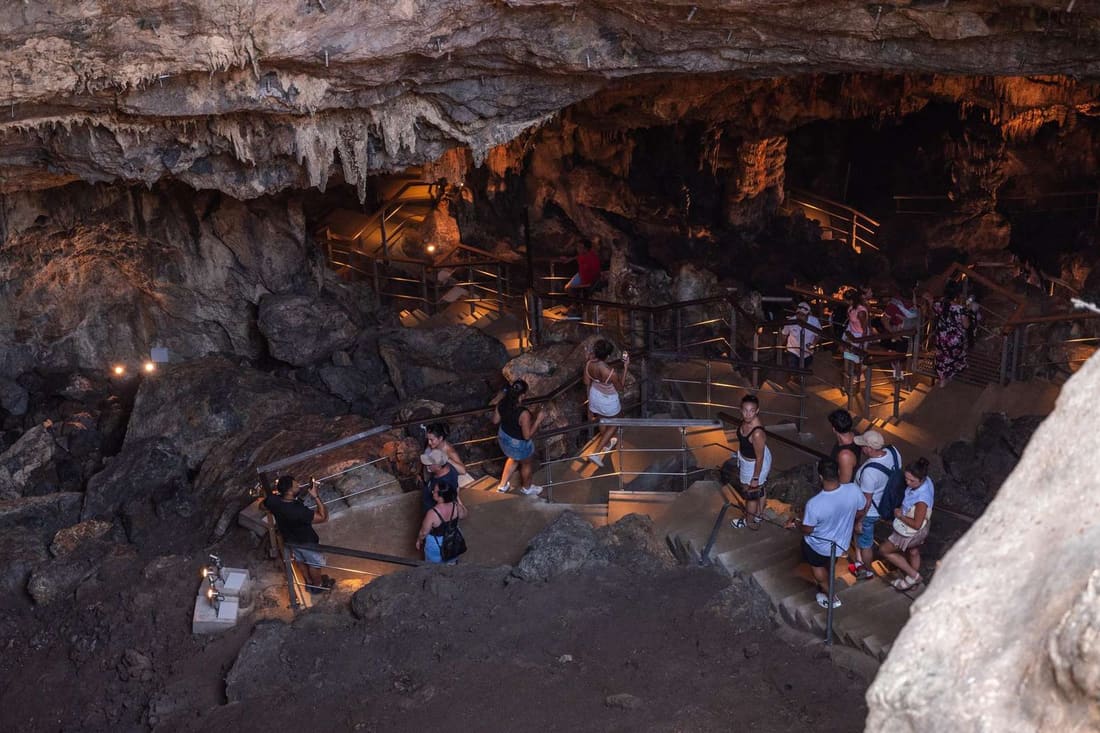
Past the entrance, the trail goes down a slope of loose stones to the cave floor. One Lasithi plateau tour with an olive-oil stop lists walking and stairs, up and down, at the cave. The air inside is cool and damp, and the interior has tight spaces. Wear sturdy shoes for the climb and the descent.
The cave has an Upper Cave and a Lower Cave, and the Lower Cave holds five chambers. A small lake lies inside. The chambers are decorated with stalactites and stalagmites. The route for visitors is about 250 metres long. A visit along it takes about 45 minutes.
Lamps light the formations. Sunlight reaches the first chamber through the wide cave mouth. In the Lower Cave, the floor drops steeply toward a pool, and traces of a rock-cut stair remain. Stalactites rise out of the pool. A large stalactite there is called the Cloak of Zeus, and the touch of visitors has worn it down.
Worship took place in this Lasithi plateau cave from Early Minoan times into the Archaic period. Visitors left votive offerings: figurines of animals and gods, shells, tools, jewellery, weapons and seal stones. Finds from the cave now sit in museums in Heraklion and Oxford. Digging began in the late nineteenth century under Joseph Hatzidakis.
Later digs found fragments of about thirty libation tables and countless small conical cups for food offerings. Layers of ash held the bones of bulls, sheep, goats, deer and a boar. Worshippers also pushed small bronze toy double axes, knife blades and needles into cracks in the lowest stalactites.
Tradition links this Lasithi plateau cave to the birth of Zeus. Rhea fled here to give birth to him and so save him from his father Kronos, who devoured his children. She gave Kronos a wrapped rock to swallow instead. The goat Amalthea nursed the baby.
A ticket kiosk stands near the entrance. On a Lasithi plateau tour, the cave ticket is a separate item. The SUV tour, the olive-oil tour and the pottery tour all list it as not included. Read that line on the tour page before you book.
Entry is optional on the olive-oil and pottery tours. On the SUV tour, the stop goes ahead only if the whole group agrees. On the olive-oil tour, guests who skip the cave wait outside during free time. That tour also names mobility problems and claustrophobia as reasons the cave does not always suit a guest.
How do the 4×4 and minibus tours of the Lasithi plateau differ?
The 4×4 safari across the Lasithi plateau runs 8 hours and follows dirt tracks into the mountains. The small-group van tour takes up to 7 guests for 7 hours. The Knossos combination from Heraklion adds the palace to the day.
The Lasithi plateau safari from Malia lasts 7 hours 30 minutes. Hotel pickup and drop-off are included, and the tour is a shared group experience. The vehicle suits mountain roads and dirt routes. Fuel and a driver are covered. One stop is a dirt route where the group takes photos.
The SUV tour of the Dikti mountains lasts 8 hours and uses a 4WD vehicle. Hotel pickup comes with it. The tour caps visitor numbers to keep crowds down. The route reaches the Limnakaro plateau at 1,250 metres. On this Lasithi plateau tour, the Psychro cave visit happens only if the whole group agrees.
The Minoan route safari lasts 8 hours and includes hotel pickup, drop-off and a driver-guide. The route follows the Minoan path through mountain passes on dirt tracks. A van can replace the safari vehicle on this tour. You must ask for the van at the time of booking. Lunch is part of the day.
The small-group van tour of the Lasithi plateau lasts 7 hours. It is limited to 7 participants. Pickup points are Heraklion Port, Heraklion and Heraklion Airport. The driver acts as the guide and speaks English, and the tour runs in English and Greek. Lunch is optional and not included in this tour.
The guided tour from Malia lasts 8 hours 30 minutes. Guests wait in the hotel lobby 10 minutes before the pickup time, and the day ends at the hotel. Lunch is free, and fuel and drivers are covered. The safari from Malia lists 7 hours 30 minutes, so the two Malia tours differ in length.
The Knossos combination from Heraklion starts in a morning window from 9 to 10. Hotel pickup is included, and an air-conditioned vehicle comes with a professional driver and a tour guide. Knossos is the final stop of this Lasithi plateau day and takes 1 hour. The return time depends on traffic.
A shorter Knossos version lasts 7 hours and runs in English. The Lasithi stops come first, and a guided visit of the Palace of Knossos comes last. Hotel pickup, drop-off and an air-conditioned vehicle are included. The Knossos ticket is an extra fee paid on site. Lunch in a village is not included in this version.
The private Lasithi plateau and Knossos tour takes 8 to 10 hours. It uses a VIP-class air-conditioned vehicle with a driver. The driver is also a local English-speaking guide. The Palace of Knossos stop takes 1 hour 30 minutes. An optional visit to the archaeological museum adds 1 hour.
A two-day package from Heraklion lists an optional bike tour on the plain. The bike tour takes 3 hours and uses a non-electric bicycle. An English-speaking guide leads it. The package includes one overnight stay, and the rooms are in Tzermiado. The package is for adults only.
Choose by what each tour includes. Pick a safari for dirt tracks and the van for a group of up to 7. Pick a Knossos version for the palace and the private tour for your own party. Check the pickup list, the length and the language before you book a Lasithi plateau tour.
Which food and crafts come with a Lasithi plateau tour?
A Lasithi plateau tour can include an olive oil tasting, a pottery workshop and a tavern lunch. Other routes add the Kera Monastery, an olive mill farm or a wine and raki tasting.
One Lasithi plateau tour of seven hours gives olive oil its own thirty-minute stop at a family factory. Guests taste olive oils of different quality and variety there. In the village of Avdou, a second route visits a small olive oil factory. The owners host a tasting of their own products.
One private route opens with a thirty-minute stop at a family olive oil factory. Guests see modern techniques used alongside traditional methods. They taste rich, golden oil freshly pressed from the harvest. The Kera Monastery route ends with a thirty-minute olive oil stop. Its tasting covers extra virgin oil and other local products.
The combination day with Knossos adds an olive mill farm to the Lasithi plateau tour. Guests join a guided visit through the production of local olive oil, honey and handmade olive-based products. The stop lasts one hour and forty minutes. The farm overlooks the mountains and the Aegean Sea. Lunch there is optional and paid by the guest.
On the route that includes the Kera Monastery, the pottery workshop stop lasts thirty minutes. Guests watch the craftsmen shape and decorate their pots. The same itinerary lists twenty minutes in Psychro village. There, artisans shape clay with time-honoured techniques.
Other routes let guests try the craft. On the private route, the Psychro workshop stop lasts one hour. Instructors guide anyone who wants to make a piece. On another route, the owners of a family-run workshop teach pottery-making, and guests shop for souvenirs. Read the stop list of each Lasithi plateau tour, because watching and making are worded differently.
The Kera Monastery stop on a Lasithi plateau tour lasts forty-five minutes. The monastery is a nunnery that is still active. Its church holds murals from the fourteenth century and an icon that tradition calls miraculous. The Cretan Revolt gave the monastery a major role and brought significant damage. Entry is paid separately from the booking.
Lunch is optional on the Kera Monastery route, and guests book it in advance. The family-run tavern cooks with fresh, locally grown ingredients. The set menu lists pork or chicken with potatoes cooked in the oven. A glass of wine or a non-alcoholic drink comes with the meal.
A private Lasithi plateau tour lists lunch in a family tavern with traditional Cretan food. The menu names stuffed zucchini flowers, Greek salad, lamb, saganaki, moussaka and stuffed vegetables. The dishes are cooked in a wood oven with fresh ingredients of the area. Guests with food allergies or intolerances contact the organiser first.
Drinks have their own stops. The private route has a ninety-minute tasting stop with Cretan wine, Greek coffee and raki in a traditional kafeneio. The same route lists wine, coffee, raki, refreshments and bottled water as included.
A 4×4 safari with a tavern lunch serves local raki with homemade delicacies and unlimited wine at the meal. The lunch offers a selection of traditional local starters and main courses. The same lunch line states that a vegetarian option is available.
Lunch rules differ between routes. The seven-hour route lists lunch and bottled water as included. The Kera Monastery route and the private route list lunch as optional. Check the included and excluded lines of each Lasithi plateau tour before you book.
Which months, clothes and rules suit a Lasithi plateau tour?
Pack layers, grip shoes, sun protection and water for a Lasithi plateau tour. Snow can stay on the plain until mid-spring, and the ground around the cave is uneven. Free cancellation on the coach and private tours ends 24 hours before the start.
Snow marks the cold end of the Lasithi plateau calendar. On the mountains of Crete, snow is a common sight from November to April. The plateau itself is covered by snow every year, and its winters can be harsh. Snow can last on the plain and the mountains around it until mid-spring.
One full-day Lasithi plateau tour from Heraklion, which lasts eight hours, is offered from April through October. Booking tools offer a check on dates and availability. They ask you to pick a departure date and time before you can book.
Dress in layers, because temperatures in the mountains vary. The weather can change between the morning and the evening. A 4×4 tour from Heraklion that lasts seven hours lists a jacket on its packing list, depending on the weather.
Sensible, flat-soled walking shoes are recommended on the private Lasithi plateau tour that meets at the pier. Guests on that tour must be able to walk over paved, cobblestone and packed dirt surfaces. Uneven terrain and cave sections need grip and support. Sturdy shoes matter more on wet or slippery ground.
Sunscreen, a hat and sunglasses are on the packing lists for the outdoor parts of the day. Water is on them too. Carry plenty of it in the warmer months. Summer brings heat instead of snow. One coach tour runs an air-conditioned coach, for the summer heat.
- A light jacket or layers for changing weather
- Shoes with grip and support for uneven ground
- Sunscreen, a hat and sunglasses for the open plain
- Water for the walks and the warmer months
Fitness counts on these days. The coach tour does not suit wheelchair users or travellers with limited mobility. It expects walking, stairs and a moderate pace. A 4×4 safari lists its transport as wheelchair accessible, so access differs between tours. Two tours advise against the trip for travellers with spinal injuries.
Age limits on a Lasithi plateau tour differ from tour to tour. The off-road tour with lunch recommends ages 8 and up, citing the physical demands. A 4×4 tour from Heraklion takes children from age 3. Another tour lets children with reasonable mobility join and advises supervision in the cave areas. Special infant seats are available on the private tour.
The booking rules of a Lasithi plateau tour are short. Free cancellation on the coach and private tours ends 24 hours before the start. On the private tour, a later cancellation gets no refund. One full-day tour needs a booking 24 hours ahead. A 4×4 tour offers a refund or a new date if bad weather stops it.
A monastery stop adds a clothing rule. On the private tour that includes one, modest clothes are required. Women need a skirt or dress below the knees and covered shoulders.
Language depends on the tour. One coach tour lists English, German and French. An olive-mill tour lists English, French, German, Dutch, Russian, Spanish, Romanian and Greek. A 4×4 tour from Heraklion lists Greek and English, and the private tour is offered in English.