
A Kleftiko Milos cruise sails you to white rock arches and sea caves by sailboat or catamaran. They stand on the southwest coast of Milos. You swim in clear bays along the way. This page covers the stops, the boats, the day plan and the season. The homepage lists more Greece Tours like this one.
Each tour card below opens a live GetYourGuide booking. Dates, departure times and group sizes are shown there.
What is Kleftiko Milos?
Kleftiko Milos is a stretch of white volcanic rock on the southwest coast of the Greek island of Milos. Sea stacks, arches and sea caves stand in clear water. The practical way to reach them is by boat, and pirate stories gave the place its name.
Kleftiko Milos lies on the southwest edge of the island, next to Cape Psalida. The coastline is full of white smooth rocks, tall arches, underwater caves and small sandy bays. The shallow water has green and turquoise colours.
If you plan to cross into Turkey as well, the homepage also lists Turkey tours.
The rocks around Kleftiko Milos are of volcanic origin. Strong wind and waves have shaped them into three small bays. The area also holds a network of sea caves, arches and tunnels, with one characteristic large rock in the sea. One cave there has two entries.
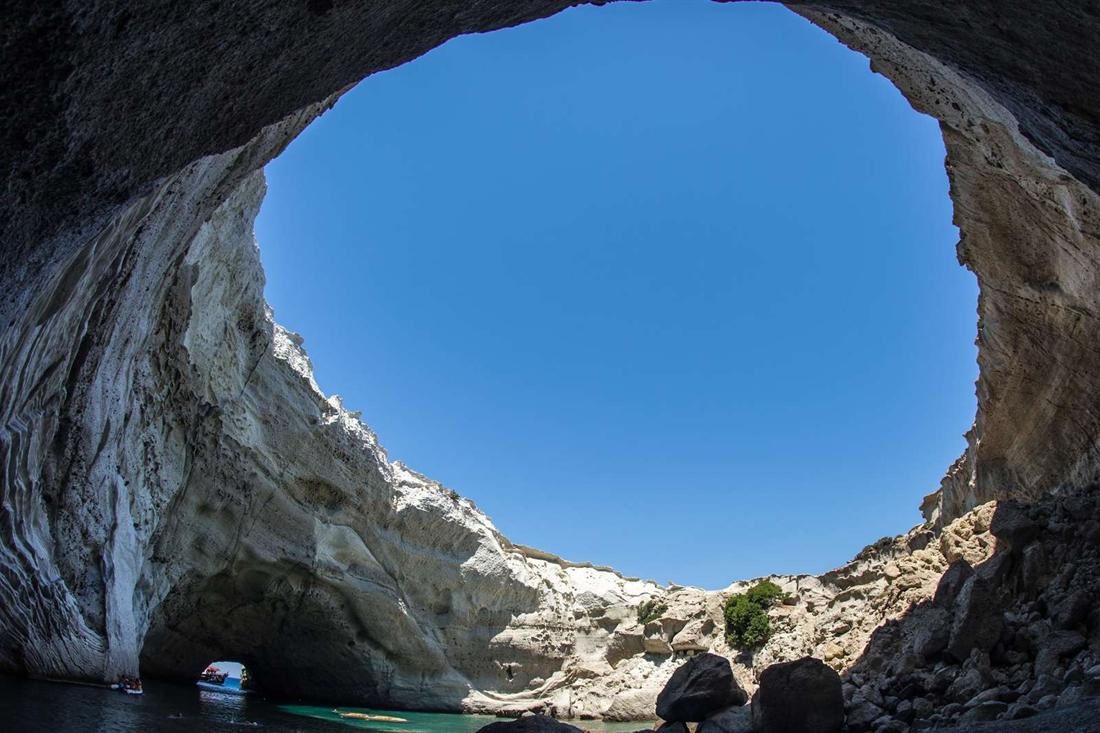
Kleftiko Milos is also called Thalassina Meteora, which translates as the Sea of Meteora. The nickname comes from its morphology, which means the form of the landscape. The site appears on posters and brochures for Milos.
The name of Kleftiko Milos comes from kleftis, the Greek word for a thief. Kleftiko is explained as a bandit’s lair. The place took its name after the pirates who sheltered in its caves and hidden coves. Klephts were armed men who took refuge in the mountains. They lived by stealing and fought against the Ottomans.
In the pirate story, the bays were a lair where men hid and attacked hostile boats. Another telling says they stole supplies from passing ships and hid the goods in the caves. Pirates stopped using these coves in the early nineteenth century.
A boat is the practical way to reach Kleftiko Milos. The place is secluded, and the rocks cut off any other safe passageway. A hiking path down to the shore exists, but it is a hard walk.
Kleftiko Milos belongs to a volcanic island in the Aegean Sea. Milos lies at the southwestern end of the Cyclades. It measures about 23 kilometres from east to west and 13 kilometres from north to south. Its area is about 151 square kilometres.
Volcanic activity on Milos began 2 to 3 million years ago, in the Pliocene. The island is considered a dormant volcano. Its natural harbour is the hollow of the principal crater. Glaronisia islet, north of Milos, has columns of dacite lava.
Tuff, trachyte and obsidian are among the rocks of Milos. Tuff is a rock made of volcanic ash ejected from a vent during an eruption. After the ash settles, it hardens into solid rock. Obsidian is a glass-like volcanic rock.
Obsidian from Milos was a commodity as early as 15,000 years ago. Ancient artists used Melian earth as a pigment. In the past, baryte, sulphur, millstones and gypsum were mined here. Bentonite, perlite, pozzolana and small quantities of kaolin are collected today.
How does a Kleftiko Milos cruise run from Adamas?
A Kleftiko Milos cruise starts at the port of Adamas and visits Kalogries and the cave of Sykia. It reaches Kleftiko for a swim and snorkel stop. The crew serves lunch on board, then the boat sails back to Adamas. A half-day cruise lasts 6 hours, and full-day cruises last between 7 and 10 hours.
Adamas is the main port of Milos, and the Kleftiko Milos day trips start from its waterfront. Guests meet the crew at a boat berth or an office on the port. The meeting point is printed on the ticket of each cruise.
Start times are early. The sailing day trip lasts 7 to 8 hours. Guests meet the crew at 8:30, and the yacht leaves Adamas at 9:00 in the morning. The half-day catamaran cruise of 6 hours also leaves Adamas at 9:00 in the morning.
Arrival rules differ from boat to boat. The nine-hour cruise asks guests to reach the meeting point 15 minutes before departure. The eight-hour catamaran cruise and the eight-hour semi-private sailing cruise both ask for 30 minutes. Each Kleftiko Milos ticket lists its own meeting time.
The nine-hour cruise has a set opening routine. The crew welcomes guests at the meeting point and introduces itself. Everyone boards. A safety and activity briefing follows, and only then does the boat leave the harbour.
Sailing cruises and half-day catamaran cruises visit Kalogries first, then the cave of Sykia, then Kleftiko. The eight-hour cruises sail past Klima and the Arkoudes rocks on the way. On this Kleftiko Milos route, the swim at the caves comes after two earlier stops.
The long cruises add more beaches. The nine-hour cruise stops at Kalogries and Kleftiko, makes brief stops at Fyriplaka, Tsigrado and Gerakas, then ends at Polyaigos. The ten-hour catamaran cruise lists Kalogries, Sykia, Kleftiko, Gerakas, the Blue Lagoon of Polyaigos, and the return to Adamas.
Lunch has a fixed place in the day. On the nine-hour cruise and the eight-hour semi-private sailing cruise, it is served on board after the Kleftiko stop. On the sailing day trip with the 9:00 start, guests eat at Kleftiko itself. Both versions of a Kleftiko Milos lunch come after the swim.
The return differs by cruise. One half-day catamaran cruise of 6 hours ends at Agia Kiriaki beach, where a car takes guests back to Adamas. Another half-day catamaran cruise ends at the Adamas port at 15:15. The nine-hour cruise returns to the meeting point.
Group size and language are listed too. The eight-hour catamaran cruise holds up to 12 passengers, and the semi-private sailing cruise holds up to 10. One half-day catamaran cruise needs a minimum of 6 passengers. The eight-hour and nine-hour cruises run in Greek and English, and the ten-hour cruise adds Spanish.
Hotel pickup is not part of the nine-hour or the ten-hour cruise, because transport to the meeting point is excluded. Guests arrange their own way to the Adamas port. Then the day on a Kleftiko Milos cruise begins with the crew at the berth.
Which stops come with a Kleftiko Milos cruise?
Every Kleftiko Milos cruise centres on the Kleftiko sea caves, where guests swim, snorkel and explore. Other routes add Sykia Cave, Gerakas, Sarakiniko, Kalogries or Polyaigos, so each cruise offers its own mix of swim stops.
The Kleftiko stop is the core of every Kleftiko Milos cruise. Guests swim and snorkel in clear water and explore the sea caves. The crew guides the exploring, and the boat trip lets guests venture into the caves. Snorkelling gear shows the life under the surface.
Sykia Cave sits on the western coast of Milos, and a Kleftiko Milos route can add it. It is a collapse doline, which formed when the roof of a cave chamber fell in. It began as a sea cave, because waves ate into the weakest parts of the rock.
The bowl is almost circular, 83 metres long and 74 metres wide. Its walls rise almost 50 metres on the southeast side and 25 metres on the northwest side. A passage 5 metres high and 20 metres wide links it to the sea.
The passage is wide enough for a boat to pass through. Smaller boats enter the bowl, while larger ones stay outside and guests swim in. A semi-private sailing tour along the west coast anchors in a nearby bay. A small motorboat then takes guests into the cave to swim or snorkel.
Walkers can reach Sykia too. The hike starts at the Agios Ioannis monastery, covers 4.3 kilometres and climbs 260 metres. It takes about two hours. In the heat that is a long walk, so cruise guests take the boat.
Gerakas is a beach on the south side of Milos. A Kleftiko Milos half-day itinerary can pair it with the caves. Cliffs of volcanic rock close it in, so no vehicle or footpath reaches it. Only boats get there. The water is turquoise and deep, even close to the beach.
Sarakiniko is the white stop on a Kleftiko Milos small-group yacht route. Its cliffs are snow white above turquoise water, and wind and water erosion shaped the rock. That tour gives guests about an hour there to swim or take in the landscape.
Polyaigos is an uninhabited island of the Cyclades, near Milos and Kimolos. It covers about 18 square kilometres, and goats are its only residents. A Kleftiko Milos full-day itinerary can add the island, and two itineraries give it a 30-minute swim stop.
Kalogries is a small bay of lava rock with calm turquoise water for floating and snorkelling. Cruises from Adamas can make it the first swim stop. Plathiena Beach appears next to Sarakiniko near the end of a full-day route, just before the Bear Rocks. Those rocks, called Arkoudes, take their name from a bear-like shape.
The stop list changes from route to route. A traditional wooden boat itinerary runs through the Glaronisia islets, Sarakiniko and Sykia Cave, then ends at Kleftiko. A half-day catamaran morning itinerary lists Kalogries, Sykia and Kleftiko. The small-group yacht tour swims at Kleftiko, Sarakiniko, Polyaigos and Gerakas. Match the stops to the Kleftiko Milos cruise you book.
Which boats sail to Kleftiko Milos?
Kleftiko Milos cruises run on sailing boats, catamarans, open yachts, traditional sailboats and self-drive boats. Group caps differ by format, from 8 passengers on a private sailboat to 38 on a traditional sailboat. Check the cap before you book.
A Kleftiko Milos sailing cruise runs on a boat propelled partly or entirely by sails. One semi-private sailing trip from Adamas uses a 13.5-metre boat that holds a maximum of 10 passengers. A second sailing trip from Adamas uses a boat with a maximum capacity of 16 passengers. Both trips include a skipper.
The 13.5-metre boat has deck seating and showers. It also has large shaded areas with hammocks, and WiFi on board. A full-day sailing cruise from Adamas caps its group at 20 travelers and has restroom facilities. A sailing yacht on another trip holds up to 18 people.
A catamaran is a boat built on two matching hulls set side by side. The wide stance keeps it steady against heeling and capsizing. It offers greater speed than a single-hull boat, and it draws less water, as little as 0.91 metres. A Kleftiko Milos catamaran cruise runs as a morning, half-day, full-day or sunset trip.
The sunset catamaran has sunbeds and shaded lounges, plus an on-board WC and an outdoor shower. A small-group catamaran trip takes up to 12 passengers and has ample space and shade. A luxury catamaran yacht on another trip takes a small group of up to 20 passengers. The full-day catamaran cruise has an on-board restroom.
The small-group yacht trip to Kleftiko Milos sails on a luxury open yacht. It is sold as a semi-private cruise with an experienced captain and crew. The sailing trip with the 10-passenger cap carries the semi-private label too.
A traditional wooden sailing boat serves one Kleftiko Milos cruise from Adamantas. Another trip uses a traditional sailboat 14 metres long, with a maximum capacity of 38 passengers. That trip explores the coastline of Milos. This is the biggest cap among the boats described here.
A private full-day sailboat trip to Kleftiko allows up to 8 people. A private excursion is an experience with just your group. A half-day speedboat tour also runs to Kleftiko along the west coast of Milos. The yacht trip comes with morning and sunset options.
A self-drive Kleftiko Milos tour needs no boat licence. The boats are small but sturdy, and they are designed for easy handling by beginners. Renters take the helm after a safety briefing. The route reaches Kleftiko and other bays and beaches.
To choose between Kleftiko Milos boats, start with the group cap. The caps above run 8, 10, 12, 16, 18, 20 and 38 passengers. Pick a sailing boat for deck seating, shade and hammocks. Pick a catamaran for sunbeds and shaded lounges. Pick a self-drive boat to steer the day yourself.
What do guests eat, drink and do at sea on a Kleftiko Milos cruise?
Catamaran and sailing cruises to Kleftiko Milos list lunch, drinks and snorkelling gear among their inclusions. Guests swim in clear turquoise water, snorkel in the sea caves, and bring a towel for the day on board.
Food on a Kleftiko Milos cruise changes from boat to boat. The West Milos catamaran cruise serves a freshly prepared lunch, with vegan and vegetarian options. Guests drink ice-cold beer or traditional ouzo alongside the meal.
The small-group sailing yacht cruise runs an open bar and a lunch table. The crew prepares fresh home-made meze. Lunch comes with a Greek salad made from local products. The Adamas sailing day trip serves a traditional Greek lunch with water, soft drinks, beer and wine.
The open bar on the small-group yacht pours wine, beer and Greek traditional alcoholic drinks. Soda and bottled water stand beside them. The half-day catamaran trip to Kleftiko Milos lists breakfast, lunch, seasonal fruit, water, cola, beer and wine.
On the Kleftiko Milos sunset catamaran cruise, lunch, fruit and drinks are listed as included. The description names platters of fruit with both non-alcoholic and alcoholic drinks. Drinks and swimming stops are both part of the booking.
Snorkelling equipment appears on the inclusions list of the West Milos catamaran, the small-group sailing yacht and the sunset catamaran. The half-day catamaran trip adds swimming noodles. The sailing yacht crew provides masks and flippers. The Adamas sailing day trip provides gear for snorkelling in the caves. Guests who skip the mask relax on deck or swim without gear.
The small-group catamaran cruise to Kleftiko Milos lists swimming noodles and an underwater camera next to the snorkelling gear. Breakfast and a light lunch are served on board. Drinks, refreshments and bottled water come with them. Seasonal fruits and traditional sweets round off the menu.
The West Milos catamaran cruise lists stand up paddling equipment. Its Kleftiko stop is a swimming, snorkelling and paddle-boarding stop. The Adamas sailing day trip to Kleftiko Milos adds a RIB safari in the caves. The crew takes underwater photos of the snorkellers.
The sea at Kleftiko Milos is crystal-clear and turquoise. It suits swimming, diving and snorkelling. The sunset catamaran cruise invites guests to dive into the same turquoise water. Towels are not provided on the small-group sailing yacht and catamaran cruises. The West Milos catamaran lists a towel to bring.
A sailing yacht can rock or tilt under sail, so guests need to feel fit enough for a cruise. The half-day catamaran crew looks after safety, especially for guests new to snorkelling. The self-drive boat tour needs no licence and begins with a safety lesson.
On the small-group catamaran cruise, an infant rides on an adult’s lap. The sunset catamaran cruise takes children from one year old. The West Milos catamaran cruise welcomes all ages. On the full-day sailing cruise, children must travel with an adult.
When is the right time for a Kleftiko Milos cruise?
The right time for a Kleftiko Milos cruise runs from June to mid-September. Little rain falls then, and the sea warms from 22 °C in June to 25 °C in August. The Meltemi wind blows in the same months, so keep a spare day.
Milos has a Mediterranean climate, with mild, rainy winters and warm to hot dry summers. January brings 74.7 mm of rain and December brings 90.3 mm. July brings 0.3 mm. A Kleftiko Milos cruise in summer meets dry skies, and winter is the wet season.
The mean daily high is 27.1 °C in June, 28.1 °C in July and 27.6 °C in August. September holds 25.2 °C and October 21.3 °C. The sun shines about 12 hours a day in July and 11.5 hours in August.
The sea holds 22 °C in June. It reaches 24 °C in July, 25 °C in August and 24 °C in September. October still records 22 °C. Swimmers at a Kleftiko Milos stop meet the warmest water in August. September stays ideal for swimming, because the sea has absorbed the sun’s warmth.
The Meltemi is the wind to plan around. It blows from late spring to mid-September. It comes from the north and holds for long periods in July and August. Average wind speed is 28 kph in July and 29 kph in August.
The wind follows a daily rhythm. It builds in the afternoon and dies down in the evening. It comes up in clear weather without warning. The Meltemi can force itinerary changes or cancellations on a Kleftiko Milos cruise.
Leave room for a backup day. Do not leave the boat tour for the final day on Milos. One sunset catamaran cruise offers free rescheduling or a refund if bad weather cancels it. For July, the advice is to book ferries and rooms two to three months ahead.
Milos is a popular tourist destination during the summer. July is the first of the two busiest months, and August is the peak for visitors. Late spring and early autumn bring fewer crowds. The Meltemi winds fade away in autumn, which makes for good late-season voyages.
The latest sunset of the year falls in late June, near 8:45 pm. On the first of October it falls near 7:05 pm. The clocks go back at the end of October, and sunset falls near 5:30 pm. Sunset times on Milos set the clock for a sunset Kleftiko Milos cruise.
Pack a swimsuit, sunglasses, sunscreen, a towel and a hat for a Kleftiko Milos cruise. Add a bottle of water and dry clothes. Check whether your tour supplies towels before packing one.
- A dry shirt or light sweater for the return trip.
- A sweatshirt in June, when cool evenings occur.
- Motion-sickness tablets, if you use them; follow the directions for your own medication.
Age rules differ by boat. One small-group motorboat cruise to Kleftiko Milos is not recommended for children under eight years old. Infants on that cruise sit on laps. One sunset catamaran cruise takes guests from one year of age. A half-day wooden boat tour and the motorboat cruise are both listed as not wheelchair accessible.