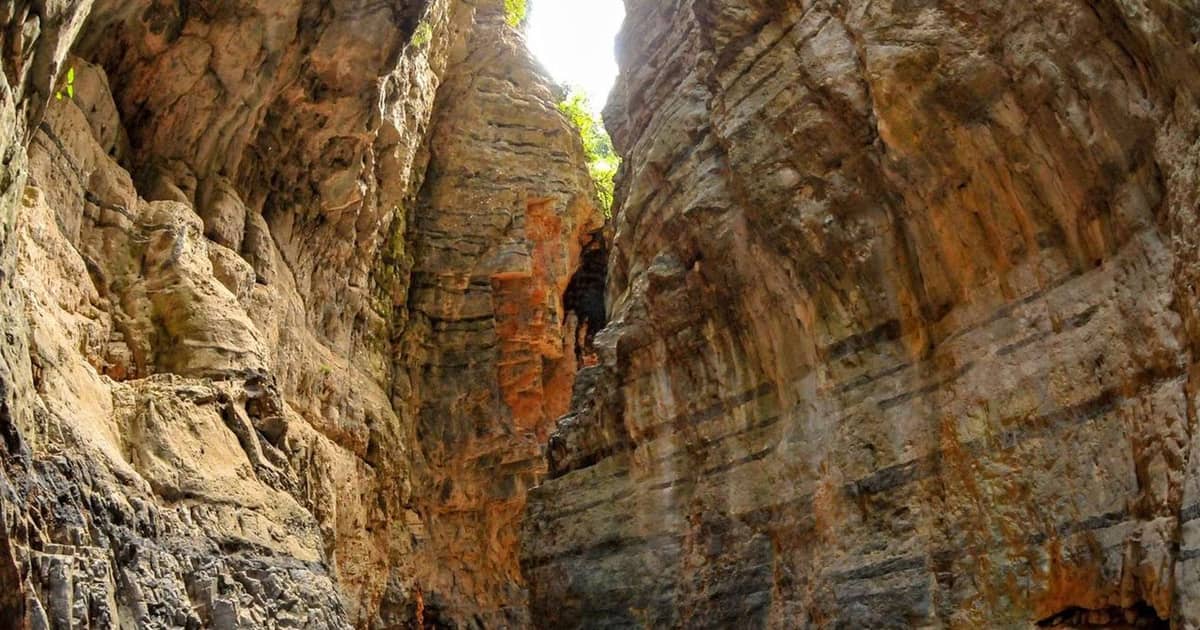
Imbros Gorge is a walking gorge in the White Mountains of south-west Crete. The path runs down from the plateau towards the Libyan Sea coast. Below you find the gorge, the hike, the tours and the season. The homepage lists more Greece Tours like this one.
Each tour card below opens a live GetYourGuide booking. Dates, pickup points and group sizes are shown there.
What is Imbros Gorge?
Imbros Gorge is a rock-walled gorge in the White Mountains of Sfakia, in south-west Crete. A path runs through it from the village of Imbros to the village of Komitades. The walls rise to a height of 300 metres.
Sfakia is a mountainous area in the south-west of Crete, inside the Chania regional unit. Imbros Gorge lies in this area, close to the town of Hora Sfakion, which stands by the sea. The path through the gorge leads down towards that coast.
If you plan to cross into Turkey as well, the homepage also lists Turkey tours.
Both villages carry more than one spelling. Imbros is also called Nimbros, and Komitades is also written Kommitades.
Imbros Gorge is a well-known gorge in the White Mountains, called Lefka Ori in Greek. The name refers to the white or off-white colour of the peaks. The range covers a large part of the centre of west Crete. Over 30 summits rise above 2,000 metres, and the highest, Pachnes, stands at 2,453 metres.
The gorge has limestone walls with vertical faces. The White Mountains themselves are made mainly of limestone, in shades from light grey to bluish or black. At first the walls are low. Further down they grow higher and close in on the path.
The tight section is called Stenada. At this point the walls of Imbros Gorge stand no more than two metres apart. On both sides the rock rises straight up. A gap that small between walls that tall makes this one of the deepest and narrowest gorges on Crete.
Trees grow straight out of the stone in Imbros Gorge. Cypresses, oaks and maples push up through cracks in the walls. Orchids and other flowers grow along both sides of the stream bed. The Cretan cyclamen, a rare plant found only on Crete, is among the plants listed here.
Birdwatchers look for the blue rock thrush, griffon vulture, crag martin and red-billed chough here. The crested lark, black-eared wheatear and corn bunting are other birds named for the site. The habitat is canyon and cliff. Wild goats climb on the rocks of the gorge as well.
Walkers choose Imbros Gorge for the mix of mountain scenery and the sea. The lower end of the gorge offers views of the water. The gorge is part of the E4 European path, which traverses the mountains of Crete. Samaria Gorge lies to the west and runs parallel. This one is the gentler alternative.
The gorge suits families with children. It also suits walkers with little hiking experience. It needs none of the special equipment that harder gorges ask for.
Rock features add detail to the walls. A natural arch of stone, named Xepitira, stands in the gorge. Caves open up in the rock faces. Small troughs carved into the rock fill with water in winter.
How does the Imbros Gorge hike go from start to finish?
The Imbros Gorge hike starts at the village of Imbros and runs downhill to Komitades. Allow about three hours for the walk. It ends at the road through Komitades, where a taxi or a public bus takes you onward.
Imbros sits at the southern end of the Askifou plateau. Walkers who drive park on the south side of the village. A wooden signpost leads to the gorge entrance, and a ticket counter stands close by.
A ticket is mandatory for entry to Imbros Gorge. The local municipality runs an online ticket office, and its form asks you to choose a date. Ticket money pays for basic works in the gorge, such as the yearly upkeep of the main path.
On the Imbros Gorge hike, the first stretch is wide, and the rock walls stand low. The upper part is called Porofarago, and its scenery is bare. The path follows a dry stream bed, so the ground is rounded stones. The slope is gentle, and the route needs no scrambling.
Traces of an old cobbled path remain along the walk. It linked Chania and Hora Sfakion before the road was built, and its stones still show in places. A spot named Airplane marks where a German plane crashed in the Second World War.
Further down, the Imbros Gorge narrows, and the walls close in on each other. The tightest stretch is called Stenada. There the passage feels like a natural tunnel. Shade is partial, because trees and canyon walls cover parts of the path while other stretches lie in full sun.
After Stenada, the gorge opens out again at Mesofarango. A resting place, a Venetian cistern and a guard house stand there. Beyond them, a landslide and a narrowing mark Gremnaria. Then comes a natural stone arch called Xepitira. More narrow passages lead on, and near the exit the gorge turns tamer, ending at a stream by Komitades.
Allow about three hours for the Imbros Gorge hike at a relaxed pace. Fitness and experience change that time. Ratings for the difficulty run from easy to strenuous. The walk suits families with children. Children can manage it if they are comfortable on uneven ground for three hours.
The Imbros Gorge path has no water refill points. Rock basins fill with water only in winter. Tavernas stand at the exit and in the village of Komitades. There you can sit down for lunch, a snack or a drink.
Komitades is where the Imbros Gorge hike ends, at the road that crosses the village. A taxi runs from the end of the gorge and from the village. It can take you back to a car left at Imbros. Bring cash for the ride.
A public bus runs along the main road near the village, so check its routes first. From Komitades you can also continue by taxi to Hora Sfakion on the coast.
What do tours add to an Imbros Gorge hike?
Tours add the transport and a south-coast stop to an Imbros Gorge hike. A bus or car collects you at your hotel, drives you to the gorge and brings you back. The stop after the walk varies by tour: a swim, a lunch, a castle or a winery.
The guided Imbros Gorge hike from Chania starts with a pickup. An air-conditioned bus collects you from select spots in Chania, and an English-speaking guide is included. One version of this day lasts 9 to 10 hours. The bus returns you to Chania at the end of the day.
Another guided hike from Chania keeps a timetable. Pickup is at 8:15 in the morning, and the drive to the gorge takes one hour. The bus leaves Sfakia at 4:30 in the afternoon. You reach your hotel between 6:00 and 6:30. Transfer times are approximate, because the time of day and traffic change them.

Pickup points for an Imbros Gorge hike differ by tour. One excursion from the Chania area covers Kolymbari, Platanias, Agia Marina, Kalamaki and Chania. Pickups sit at key points along the central road. That day lasts over six hours. You are asked to call at least 72 hours ahead to confirm the pickup time.
The Imbros Gorge day trip from Rethymno lasts 11 hours. Pickup is at about 7:30 in the morning, from central meeting points near hotels. They include Panormo, Platanias, Rethymno town, Kavros and Georgioupoli. The bus brings you back to Rethymno at about 5:30 in the evening.
The day trip from Georgioupoli takes 8 hours, with a hotel pickup and a drop-off. The bus drives south through the Askifou Mountains. A short refreshment stop at a tavern comes before the village of Imbros. The bus waits at the end of the walk, and a beach stop for swimming and lunch follows. Food and drinks are not included.
The Imbros Gorge day trip from Heraklion lasts 10 to 11 hours, depending on where you stay. Pickup zones include Heraklion, Ammoudara, Malia, Hersonissos and Agia Pelagia. Pickup starts at about 7:30 in the morning. The return bus leaves at about 5:30 in the evening. A swim in the Libyan Sea and a traditional lunch follow the walk.
The south coast is the part tours add after an Imbros Gorge hike. On the guided hike from Chania, the bus takes you to Frangokastello or Chora Sfakion after the walk. Sfakia time starts at 1:30 in the afternoon, with a swim or a meal at local taverns. Chora Sfakion lies 74 kilometres south of Chania.
Frangokastello is the castle stop. It lies about 12 kilometres east of Chora Sfakion, and the Venetians built it as a garrison. On the tour by car with a driver, you visit the fortress after the walk. You then choose a swim and lunch at a taverna, or a wine tasting at a winery.
On the private Imbros Gorge tour for one to six people, a private air-conditioned car does the driving. Pickup is at Souda port, Chania town or the airport. The guide drops you at the gorge, waits at the exit and does not hike with you. The tour ends at your pickup point.
Which months suit Imbros Gorge, and what do you wear?
Imbros Gorge can be walked in every month, apart from days of heavy rain or heavy snow. Spring and autumn bring mild temperatures, while summer brings heat and more walkers. Wear sturdy closed shoes, carry water, and add a hat and sunscreen.
The track through Imbros Gorge can be walked all year round, except in heavy rain or heavy snow. In autumn, winter and spring, rain means water in the gorge, so walkers take care. Do not set out after rain. Check the forecast on the morning of your walk.
Spring and autumn are the mild seasons for Imbros Gorge, with temperatures that are neither too high nor too low. September brings air temperatures around 28 degrees Celsius and a minimal risk of rain.
Summer is a fair choice for Imbros Gorge, yet the temperature can be high and the sun strong. More people share the path in the summer months. Pace yourself on the way down in the heat of July or August. Start before 9 am to keep the midday sun off the gorge floor.
Start the packing list with shoes. Closed shoes with a firm grip are strongly recommended, and hiking boots are not needed. Shoes with ankle support are advised as well. The guided hike from Chania calls sturdy, comfortable shoes a must on the rocky terrain.
Bring your own water on an Imbros Gorge walk. Add a light snack such as fruit, plus sunscreen, sunglasses and a hat. That is the list for the hike and swim day from Chania. The tour with a professional hiking guide lists water, sunscreen and a hat as well.
A swim stop changes the bag. On the hike and swim day from Chania, you can swim in Sfakia. Pack a swimsuit and a beach towel. On the guided hike from Chania, a swimsuit and towel allow a dip in the Libyan Sea.
Health notes for Imbros Gorge depend on the tour you book. The hike and swim day from Chania is suitable for all fitness levels. It is not recommended for pregnant travellers or for anyone with poor cardiovascular health. The tour with a professional hiking guide is not recommended for wheelchair users, because the ground is uneven.
The guided hike from Chania has no age limit. Children must stay with an adult for the whole excursion. That tour sets no specific health requirements, and it recommends a reasonable level of fitness. The rules differ from one tour to the next.
Reserve your Imbros Gorge tour ahead of the day and look at live availability for your date. A hike that needs a minimum number of travellers is cancelled when not enough travellers sign up. The hike and swim day from Chania then gives a new date, a different experience or the money back.
On the hike and swim day from Chania, a cancellation at least 24 hours ahead earns the whole payment back. Inside that last day the money is not returned, and changes are not accepted. The guided hike from Chania has free cancellation until a day before.
- Closed shoes with a firm grip
- Water and a light snack
- Hat, sunglasses and sunscreen
- Swimsuit and beach towel for a coast stop