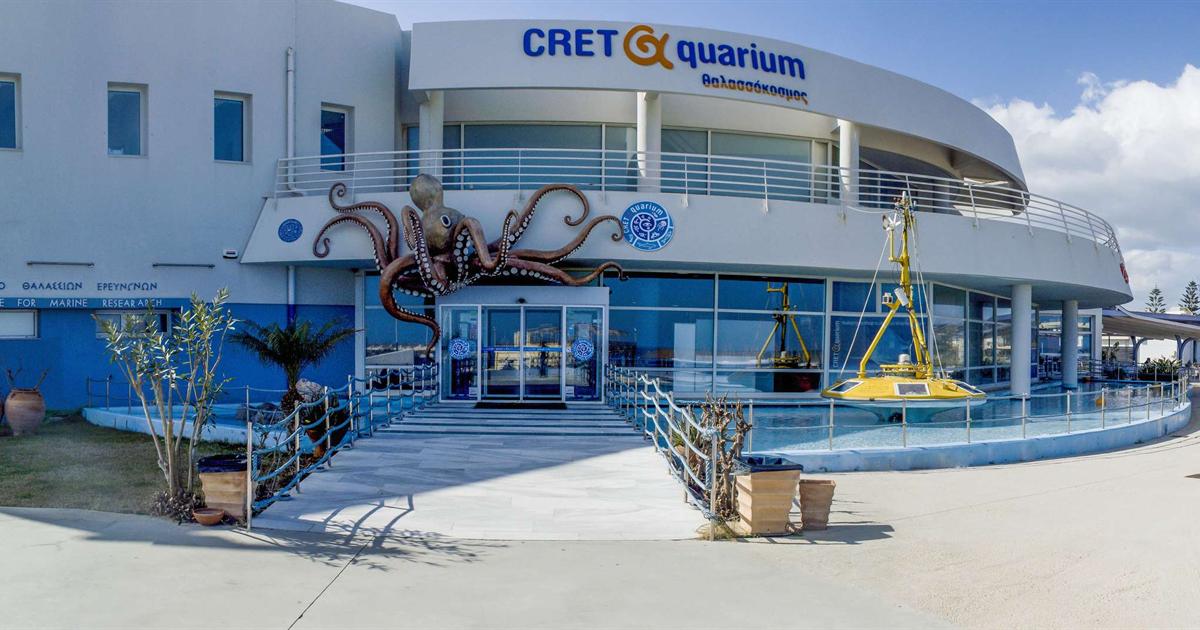
The CRETAquarium is a public aquarium at Gournes on the north coast of Crete, near Heraklion. You walk past tanks of Mediterranean and tropical sea life. This page covers what it is, what you see, how to reach it, the tickets, the tours and the season. The homepage lists more Greece Tours like this one.
Each tour card below opens a live GetYourGuide booking. Dates, pickups and ticket types are shown there.
What is the CRETAquarium and where does it sit?
The CRETAquarium is the public aquarium of the Hellenic Centre for Marine Research. It stands on the former American Base at Gournes, 14 km from Heraklion city. It holds 62 tanks and 130 Mediterranean species. It is the first large modern aquarium in Greece.
The research centre founded the CRETAquarium and still runs it. The project was a major task for the local research community and for Cretan society. The former Institute of Marine Biology of Crete and the centre share the credit for the effort.
If you plan to cross into Turkey as well, the homepage also lists Turkey tours.
The name Thalassocosmos is Greek for sea world. It names a whole site, not only the aquarium. The aquarium and the research institutes of the centre together form the Thalassocosmos complex. The official site also spells the name Thalassokosmos, with a k.
The CRETAquarium sits in the north-western part of the former American Base at Gournes. It lies east of Heraklion, in the north of Crete. Heraklion city and Nikos Kazantzakis International Airport are both 14 km away.
The ground was once a United States Air Force station, named Iraklion Air Station. The aquarium opened on that former base site. Two funders shared the cost of the project: the European Free Trade Association and the Greek National Public Investments Programme.
The CRETAquarium has 62 tanks that hold 1,800,000 litres of seawater in total. It shows 1,500 marine animals from 130 species found in the Mediterranean basin. The exhibition area covers 1,600 square metres. The support and backstage areas add another 2,600 square metres.
The water at the CRETAquarium is natural seawater from a borehole 200 metres deep. Its salinity and temperature stay steady. Water that leaves the building runs to a drain and then to the open sea, 400 metres from the shore.
The aquarium presents the species and habitats of the Mediterranean. One aim is to teach the public about the diversity of Mediterranean fish and habitats. Another is to raise questions on protecting the Mediterranean ecosystem. It also writes educational programmes for primary and secondary schools that follow the school curricula.
The CRETAquarium is also a research site. One aim is continued research on the behaviour and welfare of sea species kept in controlled conditions. The work is done with the Aqualabs, the experimental tank facilities of the centre. The staff also care for injured animals and set them free after treatment.
Inside the CRETAquarium, the visit is a walk through six sections in order, from the first to the last. The building has 300 square metres of transparent surfaces. The surrounding area covers 10,000 square metres. The pumping plant and the power room sit in the basements.
What can you see inside the CRETAquarium?
Inside the CRETAquarium you pass through six sections in a set order, from dark waters to tropical species. The two largest tanks hold 600 and 400 cubic metres of seawater.
The tour of the CRETAquarium starts with a section called Playing with Light. Sunlight is not present everywhere in the sea, and dark areas are home to countless organisms. Low light fills the area. The tanks hold the stingray, the dusky grouper and the red scorpionfish. Red corals, gorgonians and skates are listed there too.
Open Sea is the second section of the CRETAquarium and has the two biggest tanks. One has a capacity of 600 cubic metres and the other 400, which is 600,000 and 400,000 litres. The scenery is inspired by the seabed of Matala and Vai. The website describes the open sea as a world of pelagic fish and large predators.

Greater amberjacks, groupers, sea breams and European seabass swim in the big tanks. The loggerhead sea turtle and the sandbar shark live there too. Smaller tanks nearby show the common octopus and the flat lobster. Staff prepare the food daily, including mussels, prawns and squids. Visitors can watch the feeding daily at particular times.
The third section is dedicated to plankton and the animals that eat plankton. Under a microscope, a little seawater turns out to hold more than water and salt. The CRETAquarium tour then continues to the coastal areas. There you see rocky bottoms, soft muddy, sandy or gravel bottoms, and areas with sea plants.
Parrotfish, rainbow wrasses, anemones and crustaceans live in the coastal tanks. The European spiny lobster and the sea anemone are featured species. Beyond the Glass follows and differs slightly from the other sections. Its tanks are shallow and open, so you see animals from a small distance. The moon jellyfish and the rainbow wrasse are featured there.
Travelling to the Tropics is the last section of the CRETAquarium. It is dedicated to tropical species, known as Lessepsian migrants. The website links them to the building of the Suez Canal, which connects the Mediterranean with the Red Sea. The clown anemonefish and the marbled spinefoot are featured species.
Large hunter sharks, jellyfish and tiny seahorses are part of the visit. Panels in front of the tanks present facts about the animals. Touch-screen points give more detail on the life of the organisms. Remote-controlled cameras inside the large tanks give close-up views. Educational posters on marine life hang in the main areas.
A virtual reality room at the CRETAquarium is open to visitors over 12 years old. A gift shop sells ecology-related souvenirs and gifts. A snack cafe is on site, and a restaurant has a view of the sea. The official figure for a visit is about one hour to one and a half hours.
How do you reach the CRETAquarium and what does a ticket cover?
You reach the CRETAquarium by car, bus or taxi along the national road east of Heraklion. The on-site car park is free. A general ticket covers admission only, while the audio guide and the virtual reality experience cost extra.
Drivers follow the national road, which connects the CRETAquarium with the main destinations of the area. Brown road signs along the Cretan road network point the way. On arrival there is a free, spacious car park on the aquarium grounds.
From Hersonissos the road to Gournes is 11.3 km, a drive of about 9 minutes. From Malia it is 19.6 km, about 18 minutes. From Agios Nikolaos it is 49.6 km, about 42 minutes.
By car, Heraklion is about 14 minutes from the CRETAquarium. Rethymno lies 91.6 km from Gournes, a drive of about 1 hour 20 minutes. Chania is 148.3 km away, a drive of about 2 hours 16 minutes.
Buses link the CRETAquarium with Heraklion on a dense network of routes. Services run every 20 minutes in summer and every 30 minutes in winter. The same network serves the wider Malia and Hersonissos area. The official site also lists three private taxi firms that work to and from the aquarium.
Combination day trips add the transport. One Heraklion market and aquarium day trip includes hotel pickup and drop-off and an air-conditioned bus transfer. The private trip from Rethymno collects you from your accommodation or the closest point a vehicle can reach. That trip does not include the aquarium tickets.
The CRETAquarium is open 365 days a year, seven days a week, even during festive periods and holidays. Between 1 April and 31 October the doors are open from 9:30 to 19:00. In the winter months, from 1 November to 31 March, the closing time is 16:00. The hours page lists no separate last-entry time.
The CRETAquarium sells a general ticket and a reduced ticket. Reduced tickets go to children aged 5 to 17, seniors over 65 and students. Members of the Hellenic Security Forces also pay the reduced rate. Children aged 0 to 4 enter free, as do people with a disability, aquarium members and tourist guides.
The virtual reality experience has its own ticket and is for visitors over 12 years old. The audio guide is a handheld device with recorded explanations in nine languages. Visitors pay for it on site.
The admission ticket for the CRETAquarium covers entry only and is accepted as a mobile or paper ticket. Food, drinks, the audio guide and hotel pickup are not included. Children must be accompanied by an adult. All areas and surfaces are wheelchair accessible. Prams and strollers are fine for small children.
Which tours include the CRETAquarium, and which season fits a visit?
Four formats include the CRETAquarium. Buy a ticket alone, join a market bus day, add Dinosauria Park, or hire a private trip from Rethymno. Heraklion is hot and dry in July, and its wettest month is December.
The CRETAquarium admission ticket alone lists entry as its only item. Hotel pickup, food and drinks are not included, so you arrange your own travel. Its listed duration runs from one hour to six hours, so you set the pace.
Market bus days pair the aquarium with a stop in Heraklion. Hotel pickup in Malia, Hersonissos or Gouves comes with them, plus an air-conditioned bus. These days run from six to eight hours. One itinerary gives 90 minutes to the aquarium, 90 to the market and two hours to the city.
The skip-the-line version sells the aquarium ticket on the bus, so the group skips the queue. Food and drinks are not included. The tour suits all fitness levels, and infants ride on an adult’s lap.
A family day with the CRETAquarium and Dinosauria Park runs about six hours. A driver collects you from the hotel in a private air-conditioned van. The plan gives the aquarium one hour, the park thirty minutes and Heraklion two hours. Entry fees to both attractions are paid on top.
The private trip from Rethymno lasts eight hours. Pickup covers Rethymno town, Platanias and Georgioupoli. Private transport and a driver come with it, but no guide. The route visits Dinosauria Park first and the CRETAquarium second. Tickets, food and drinks are extra.
July and August are hot and dry in Heraklion. The mean daytime high in July is 30.3 degrees Celsius, and the month gets 0.8 millimetres of rain. Air conditioning inside the CRETAquarium takes the edge off the summer heat.
December is the wettest month in Heraklion, with 82.2 millimetres of rain. The mean daytime high is 16.7 degrees Celsius. The CRETAquarium route has wide indoor corridors as well as outdoor paths. Winter visits meet quiet corridors, and the indoor part of the route stays dry.
Summer brings the heaviest crowds. Arrive soon after opening, or late in the afternoon, to miss the tour groups. Pupils on school programmes visit from Monday to Friday, in slots such as 9:30 to 11:30. Weekday mornings are shared with them.
Small children have their own tour. Little Explorers is a one-hour tour built for a group of small children. The virtual reality room admits visitors over 12 years old. Pack a refillable water bottle for the walk from the car park. Add supportive shoes for the corridors and a light jacket for the coastal breeze.