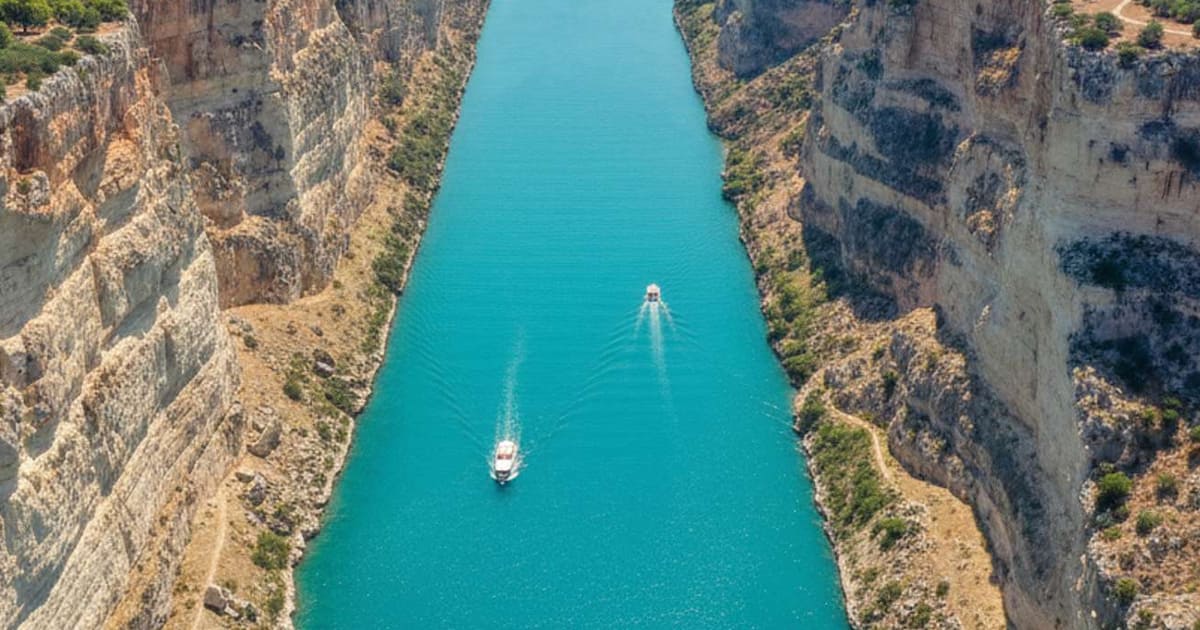
A Corinth canal cruise takes you through a narrow man-made channel cut between two gulfs. Steep rock walls rise on both sides of the boat. This post covers the trip, the route, the history of the cut and the rules. The homepage lists more Greece Tours like this one.
Each tour card below opens a live GetYourGuide booking. Dates, departure times and group sizes are shown there.
What is a Corinth canal cruise and who is it for?
A Corinth canal cruise is a boat trip through the cut that joins the Corinth and Saronic gulfs. It runs as a short cruise alone or as part of a longer day tour from Athens. Boat time runs from about forty-five minutes to four hours, depending on the format.
One canal-only cruise runs on a glass-bottom boat. A Corinth canal cruise of this type uses a boat 17 metres long with 50 seats. The base cruise lasts one hour and 30 minutes. The crew speaks English, and recorded commentary plays in English, French and Italian.
If you plan to cross into Turkey as well, the homepage also lists Turkey tours.
A longer option stretches the same cruise to four hours. It adds a stop at a beach, where guests can swim, and snorkel gear is optional. The four-hour option also includes a buffet meal.
The bridge and the boat give two different views of the canal. The cruise-line coach excursions stop on the bridge for photographs, high above the water. A boat puts you on the water, where the rock walls rise above you. A Corinth canal cruise on the glass-bottom boat adds a glass section that shows the canal’s depths.
Formats that start in Athens differ in length. The half-day boat excursion lasts from two to four hours in total, and the boat cruises along the canal. A Corinth canal cruise of that kind is a half-day outing rather than a short sail.
The private tour pairs the boat cruise with private transport from Athens. Its boat cruise lasts about one hour. The whole outing runs from four hours up to eight hours, so a stop at Ancient Corinth fits in. In this form, a Corinth canal cruise is one part of a day shaped to your preferences.
Cruise lines sell a Corinth canal cruise as a shore excursion. From the port of Piraeus, the outings last five to five and a half hours. They join a coach ride, a photo stop at the bridge and a boat trip. One adds Ancient Corinth, and another spends about 45 minutes in the canal by boat.
A shore excursion from the port of Nafplio joins the canal ride with a walking tour of the town. It lasts about four and a quarter hours in total. The narration covers the history and the infrastructure of the canal. Refreshments are served on board.
The private tour from Athens suits history enthusiasts, families, couples, solo travellers and adventure seekers. It is open to travellers of all ages. The excursions from Piraeus give photographers a photo stop at the bridge.
The boat on the glass-bottom cruise and on the private tour holds up to 50 passengers. The private tour has no minimum group size, so you can book alone, with friends or family, or privately. On the road part, a sedan takes up to 4 travellers and a van takes up to 7.
Day-tour titles use the canal name in more than one way. The private tour of Mycenae, Nafplio and Epidaurus crosses the canal on its route and describes no boat trip. A Corinth canal cruise needs a boat among the inclusions, so check for one before you book.
Where does a Corinth canal cruise begin and what do the cliffs show?
A Corinth canal cruise boards at Isthmia port, the Saronic Gulf end of the cut. The boat sails between near-vertical limestone walls, under road and rail bridges, toward the Gulf of Corinth. On the shorter version it ends where it started.
Isthmia is the eastern harbour of the canal. Its port has a small submersible bridge that links it to the mainland. A boat for a Corinth canal cruise can board there. The western end of the canal is the harbour of Poseidonia.
The canal links the Saronic Gulf in the southeast with the Gulf of Corinth in the northwest. From Isthmia, the boat sails through the narrow waterway between the two. On one trip that boards at Isthmia, traffic decides whether the boat makes the run through twice.
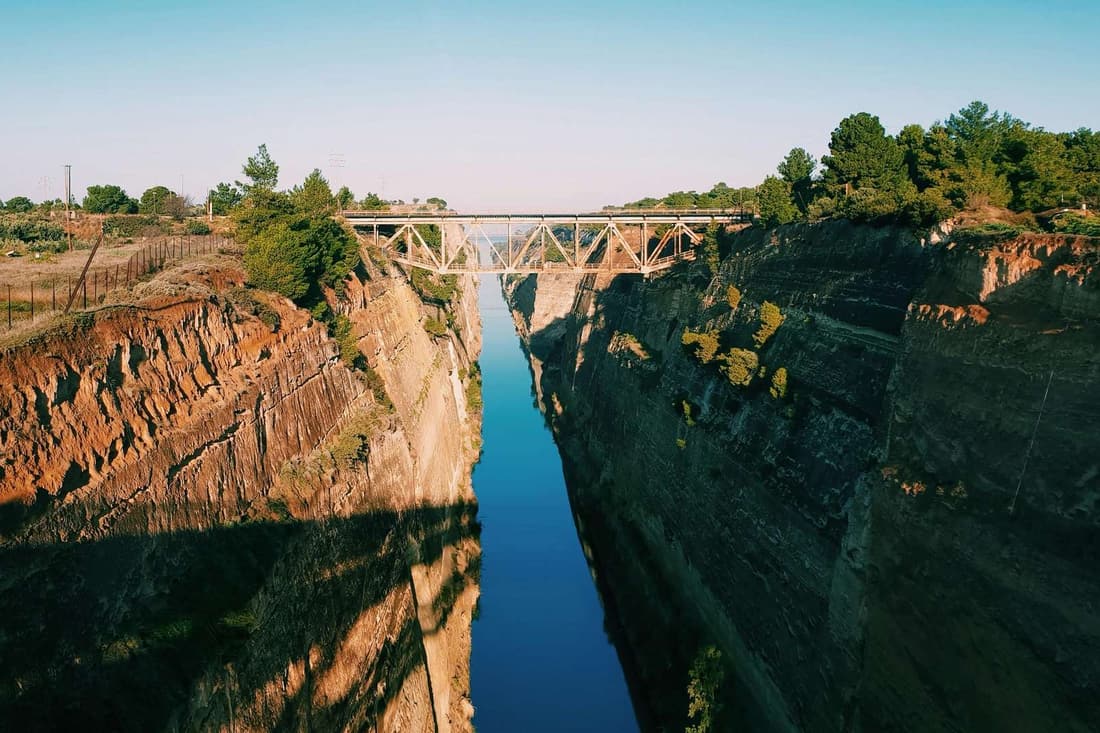
Each end of the cut has a sunken bridge, one at Isthmia and one at Corinth. When a boat on a Corinth canal cruise approaches, the deck sinks below the surface. A gap opens in the water for the boat. No structure stands above the shipping channel.
Higher up, rail, road and motorway bridges span the cut. The old Athens to Corinth road crosses on a two-lane bridge. Passengers sail under the rail and road bridges, and visitors line the overpasses to look down. On one ship passage, bungee jumpers bounced right above the deck.
The walls rise almost straight up. A Corinth canal cruise runs close under sand-coloured limestone, with bushes growing on the cliffs. From the deck of a small ship, the canal looks like a small river.
Look at the top of the faces. The upper section, down to a line of greenery, was cut back to a gentler slope than the rock below. The lower rock stays close to upright.
The rock is not one even block. The canal is cut through heavily faulted sedimentary rock. The formations in the flanks are not uniform from end to end. Fissures run east to west across the line of the canal. A Corinth canal cruise shows these formations up close.
Fig trees, caper bushes and acanthus grow on the cliffs. Visitors can spot foxes and nesting birds there.
The water moves as well. The tides in the two gulfs peak at different times, which sets up strong tidal currents in the channel. On a glass-bottom boat, you can also look down at the sea through the floor.
The canal-only trip ends by returning to the place where it started. The longer Corinth canal cruise heads for the Saronic Gulf after the canal. It passes the port of Kenchreai and the Baths of Helen. A stop at Siderona Beach allows a swim, and the boat then sails back through the canal.
How was the canal cut and why does a Corinth canal cruise matter?
A Corinth canal cruise matters: the idea dates to the seventh century BC, the cut to the nineteenth. Diggers needed eleven years to cut a channel through the Isthmus of Corinth, and ships still use it.
The isthmus is 6.3 kilometres wide and joins the Peloponnese to the rest of mainland Greece. Sailing round the Peloponnese was risky because of gales, especially off Cape Matapan and Cape Malea. A shortcut across the isthmus spared ships that voyage.
Periander, the tyrant of Corinth, was the first to propose a canal across the isthmus. A simpler, less costly plan was built instead: an overland stone road for hauling ships. On a Corinth canal cruise you look at the channel that Periander only imagined.
That road was the Diolkos, a trackway paved with hard limestone. Ships and their cargo were hauled across it. Greek historians record warships hauled across the isthmus to speed up campaigns. The road stayed in regular service until at least the middle of the first century AD. Parts of it survive next to the modern canal.
Roman rulers took up the idea. Julius Caesar considered a canal but was assassinated before the project began. Caligula ordered a study. Nero broke the first ground himself, in AD 67. His 6,000 Judean prisoners of war dug trenches from both sides. The work stopped soon afterwards.
Other workers of Nero drilled test shafts into the rock, and the later builders reused them. Nero’s workers also left a relief of Hercules as a memorial. A Corinth canal cruise passes through a cut on the same course as Nero’s.
The modern work began with a ceremony on the twenty-third of April in eighteen eighty-two. King George I of Greece attended. A company received a concession to build the canal and run it for 99 years. The principal engineers were István Türr and Béla Gerster.
The work ran into geological and financial problems that bankrupted the original builders. The money ran out after eight years. Construction resumed in eighteen ninety, when a Greek company took over. The canal was finished in eighteen ninety-three. Effectively, it made the Peloponnese an island. A Corinth canal cruise shows you the cut that did it.
The diggers cut through heavily faulted sedimentary rock in an active earthquake zone. Its limestone walls were unstable from the start. A fall in nineteen twenty-three brought down 41,000 cubic metres of soil. Collapses and repairs closed the canal for four years in total before nineteen-forty. A Corinth canal cruise shows the rock the diggers cut.
The lock-free channel runs in a straight line across the isthmus. It is too narrow and shallow for large, deep-draught ocean ships. The water measures 24.6 metres across at the surface and 21.3 metres at the bottom. Traffic moves in one-way convoys, and larger vessels have to be towed by tugs.
Tourist ships, cruise ships, small vessels and yachts make up the traffic today. Ships of at least 50 nationalities use the channel each year. A Corinth canal cruise therefore takes place on a working waterway, not in a museum.
What weather, months and rules apply to a Corinth canal cruise?
A Corinth canal cruise meets hot, dry summers and cool, rainy winters. Winds peak in the afternoon from late spring to mid-September. Glass-bottom boat bookings fix morning meeting times, and each tour has its own rules for children, boarding and cancellation.
Corinth has hot, dry summers and cool, rainy winters. July is the hottest month, with an average of 28.7 degrees Celsius. January is the coldest, at 9.1 degrees. June and July are the driest months, while November, December and January are the wettest. A Corinth canal cruise in July meets heat, and one in January meets cooler, wetter weather.
The Etesian winds blow over the Aegean Sea from about late spring to the middle of September. They are at their strongest in the afternoon. The high walls of the canal funnel wind along its length. A Corinth canal cruise sails along that same line.
Glass-bottom boat bookings set the meeting time in the morning, between ten and half past ten. A train-station pickup in Korinthos comes at the early end of that range, on request. A large free car park sits right next to the boat. Pets are not allowed on that booking.
Booking ahead is the safe route. One glass-bottom booking stays open until two hours before departure, but only while seats remain. A private day trip from Piraeus states that canal boat excursions must be booked in advance. Live availability appears on the tour cards in this post. Check your date there before you plan a Corinth canal cruise.
A landslide has shut the canal to ships before, and it reopened after safety measures. While the cut is closed, no ship can pass, so no boat can run through it. Traffic waiting to cross can also lengthen the wait before a boat crossing.
One shore excursion with a boat crossing is not guaranteed on Tuesdays, because of canal maintenance. Boarding the canal boats on that excursion involves steps, so travellers with limited mobility need to plan for that. A Corinth canal cruise has different boarding rules on each tour, so read the card first.
The private boat trip from Athens is not wheelchair accessible, but it takes strollers. It is suitable for travellers of all ages. On the six-hour half-day tour, an adult has to stay with every child at all times. Check the age rule on the card of any Corinth canal cruise you book.
The six-hour half-day tour from Athens joins Ancient Corinth, Acrocorinth and viewpoints over the canal, with hotel or airport pickup. Uneven ground, steps and inclines are part of that visit. Seating and shade can be limited at the open-air sites. Acrocorinth gives wide views over the Saronic Gulf and the Peloponnese.
A longer private day trip from Piraeus adds Nafplio. The canal stop lasts ninety minutes and the Nafplio stop three hours. The whole day takes eight hours and fifteen minutes.
Pack for a Corinth canal cruise and the land stops around it:
- Comfortable walking shoes and weather-appropriate clothing.
- Water and sun protection.
- A light layer for changing conditions.
- A valid photo ID and your booking confirmation.
- Your electronic voucher on your phone.
Leave large luggage behind. The half-day tour bars bulky items, and site rules restrict drones.