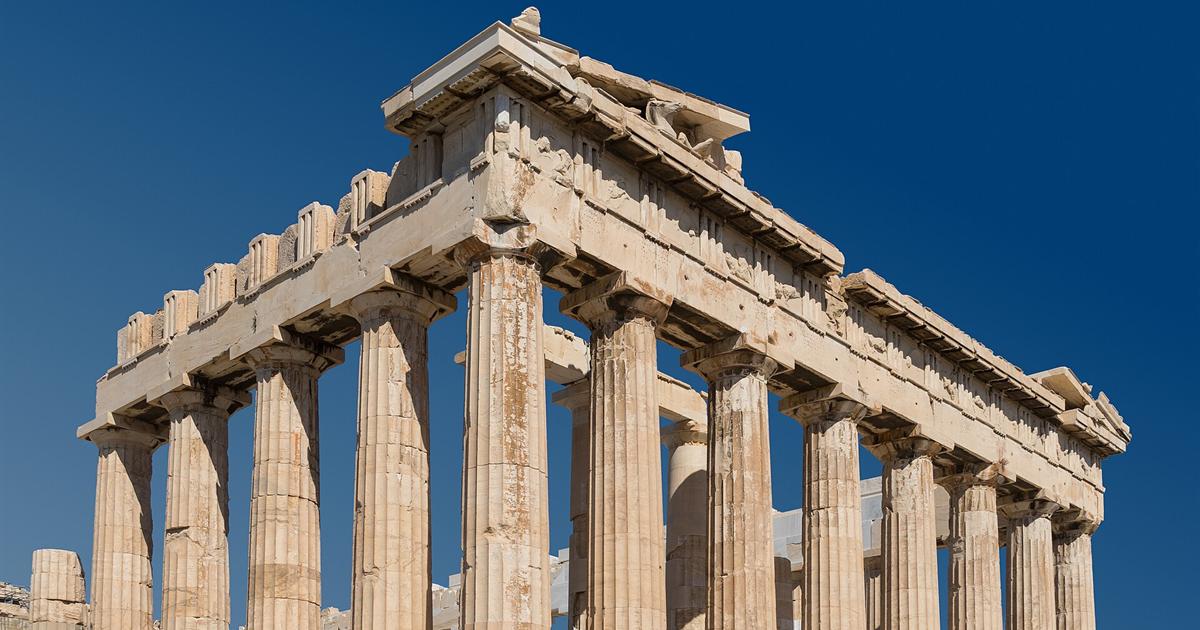
Acropolis tickets give you entry to the rock above Athens and its ancient monuments. This page covers what a ticket includes, how to buy it, what you see and when to go. The homepage lists more Greece Tours like this one.
Each tour card below opens a live GetYourGuide booking. Dates and options are shown there.
What do Acropolis tickets cover?
Acropolis tickets admit you to the Acropolis archaeological site. That means the Parthenon, the Erechtheion, the Temple of Athena Nike, the Propylaea and the south slopes. Each ticket gives one timed entry. The Acropolis Museum at the foot of the hill needs its own separate ticket.
The standard product is named “Acropolis and Slopes”. It covers the rock itself and the south slope below it. Acropolis tickets are timed, so you choose a one-hour entry window when you book. The ticket is valid only for that window.
If you plan to cross into Turkey as well, the homepage also lists Turkey tours.
The entry is single-use. If you leave the Acropolis site or the south slope, the same ticket does not let you back in. You walk the site in one loop, then you are done with that ticket.
Older sources describe a combined pass for seven sites. It listed the Acropolis, the Ancient Agora, the Roman Agora, Kerameikos, Hadrian’s Library, Aristotle’s Lyceum and the Olympian Zeus temple. One travel site now reports that this official pass is discontinued. Acropolis tickets and tickets for the other sites are sold on their own.
Acropolis tickets come in three kinds, in plain words: full, reduced and free. The full ticket is the standard adult ticket. The reduced ticket costs half of the full one. The free ticket belongs to set groups and set days.
Young people up to age 25 from EU countries enter free at any time. Children up to age 18 from non-EU countries also enter free. Both groups show proof of age or origin. Without that proof, Acropolis tickets for these visitors are not free.
Other free groups are students and teachers from EU and EEA countries on educational visits. Licensed scientists, ICOM and ICOMOS members, journalists and people with disabilities enter free too. A person with a disability of 67 percent or more brings one escort. The escort enters free as well.
Citizens over 65 from EU or EEA countries pay the reduced ticket in the off-season. That season runs from October until the last month of spring. Parents on primary school visits from EU or EEA countries get the reduced ticket too. So do non-EU teachers who escort schools. Reduced Acropolis tickets need official ID or proof of status.
Entry to the Acropolis is free on 6 March, the day for Melina Mercouri. It is free on 18 April, International Monuments Day, too. It is also free on International Museums Day, on the last weekend of September and on 28 October. Free entry also applies on set Sundays from November to March.
Free days do not remove the ticket. You still collect a free ticket at the entrance, and the official site recommends booking it in advance. On those days, Acropolis tickets cost nothing, but the timed entry still applies.
The Acropolis Museum is a separate institution with its own ticket. It has its own free days too: 6 March, 25 March, International Museums Day and 28 October. It sits at the foot of the ancient rock. Acropolis tickets for the hill do not admit you to the museum, so you buy a second ticket for it.
How do you buy Acropolis tickets online?
You buy Acropolis tickets online on one official portal, hhticket.gr, which is called Hellenic Heritage e-ticket. A notice from the Hellenic Organization of Cultural Resources Development calls it the only official online portal for these tickets.
The same notice is dated 29 July. It warns visitors about online adverts that promise entry to the Acropolis without a wait. The organisation that wrote it is the Hellenic Organization of Cultural Resources Development.
Type the address hhticket.gr yourself before you pay for Acropolis tickets. Other websites sell entry to the Acropolis too. One travel site says certain resellers simply resell valid tickets at inflated prices.
Your slot is fixed when you book. Acropolis tickets carry a chosen time. One travel site says the ticket is valid from 15 minutes before to 15 minutes after that time. That gives you a window of 30 minutes.
The same site compares the Acropolis with the Ancient Agora. The Agora uses a wider buffer of one hour. The Acropolis is managed more tightly, so you do not arrive hours early or hours late.
At the gate, you show your Acropolis tickets as a QR code. The travel site says to keep the code ready on a bright screen or on paper. A ready code keeps the line moving.
The site also tells you to download or print the voucher before you leave your accommodation. Its reason is that mobile coverage can be patchy at the entrance. A printed copy works without a signal.
A ticket-information site names two entrances. It says the main entrance to the Acropolis is on the Western Slopes. It calls the entrance on the South Slopes, at the southeastern corner of the hill, technically the side entrance.
The same site says a staffed ticket counter stands at the South Slopes. It also says the Western Slopes has a ticket office. So both entrances have a place to buy a ticket on the day.
Skip-the-line Acropolis tickets do not exist, according to the official notice. It says no ticket that skips the waiting queue has been offered or ever will be. The reason it gives is the geomorphology of the hill and the nature of the monument.
The notice calls every advert for a skip-the-line service fake and deceptive. It adds that a visitor who passed the entrance queue still has to wait at the Propylaea. The passage narrows there, so the wait cannot be skipped.
A third-party seller hands you something different from the official portal. Certain sellers offer valid tickets at inflated prices. Others take payment and send no working voucher. Forums report fake QR codes, invalid reservation numbers and difficulty getting refunds.
Street sellers near squares and metro stations also offer last-minute skip-the-line tickets, at a markup. Such Acropolis tickets do not exist. The official notice says that service is not available. One travel site calls the official portal the only online source that sells entry at face value.
Which monuments do Acropolis tickets let you see?
Acropolis tickets bring you to the Propylaea, the Temple of Athena Nike, the Erechtheion and the Parthenon on the summit. The Theatre of Dionysus and the Odeon of Herodes Atticus stand on the slopes below. You view the Parthenon from outside, because ordinary visitors cannot go in.
Your walk with Acropolis tickets starts at the Propylaea, the monumental gate that gave entry to the hill. The architect Mnesicles started building it in 437 BC. It has Doric columns of Pentelic marble. In the third century, the Beulé Gate was added in front of it to restrict entrance.
The Temple of Athena Nike is on your right once you pass the gate. It stands on a steep bastion at the southwest corner of the hill. Kallikrates designed it, and it was finished around 420 BC. The white Pentelic marble temple measures 8 m by 5.5 m, which makes it the smallest temple on the Acropolis.

The Parthenon is the largest building you reach with Acropolis tickets. The architects Ictinos and Callicrates began work in 447 BC. Builders finished the temple in 438 BC. Sculptors kept working on its decoration until 432 BC. It is built of Pentelic marble and measures 69.5 by 30.9 m.
Count the columns on the Parthenon. The short end has eight columns, where a standard Doric temple has six. Each long side has seventeen. Only a small number of the original sculptures remain on the building. The surviving sculptures are kept in the Acropolis Museum in Athens and in the British Museum in London.
You cannot enter the Parthenon. Acropolis tickets give you a view from outside the colonnade only, along designated paths. Low metal railings and ropes keep you at a set distance from the base of the temple. Guards stop visitors who step onto the base platform or touch the marble.
The Erechtheion stands next to the Parthenon. It was built in 421 to 406 BC, in Pentelic marble with a frieze of blue Eleusinian limestone. Its porch has six sculpted female figures as supports. They are the Caryatids. The ones you see on the porch are replicas, and five of the originals are in the Acropolis Museum.
The Theatre of Dionysus lies on the south slope of the hill. It began as a wooden structure. The stone theatre reached its fullest extent in the fourth century BC under Lycurgus. The two front rows survive in part today. They are Pentelic stone chairs, and each one bears the name of the priest or official who sat there.
The Odeon of Herodes Atticus is on the southwest slope. The orator Herodes Atticus built it in AD 161. It has a capacity of 5,000. In the nineteen-fifties, workers restored the audience stands and the orchestra with Pentelic marble. Today it is the main venue of the Athens Festival.
The ground under your feet changed too. A new path network, about 500 m long, joins the slope lift to the ancient Panathenaic Street. That street runs in front of the Propylaea. Acropolis tickets lead you onto these paths. The Culture Ministry says the paving is architectural concrete with 12% cement.
Marble paths on the hill are smooth and slippery, especially in wet weather, and they are uneven. A lift on the north side of the hill lets visitors skip the classic route up. The monuments you see with Acropolis tickets are the same however you climb.
What do Acropolis tickets with an optional audio or live guide include?
Acropolis tickets in this listing are pre-booked entry passes sent to you by email. You add an optional audio guide, or pick a live guide named in the title. The listing gives the visit as two hours, done on foot.
The listing is titled “Athens: Acropolis Ticket with Optional Audio or Live Guide”. Read it as an entry pass first. The audio or live guide is an extra that you choose. Acropolis tickets from this listing do not force either one on you.
The listing promises hassle-free entry with a pre-booked ticket. Its summary says the ticket is sent directly to your phone. Another line says it arrives by email. With these Acropolis tickets you hold the pass before you reach the site.
The summary names two audio guide options. One is an audio tour of the Old Town of Athens in the Plaka area. The other is the full audio option, which the listing calls an upgrade. Pick your audio option when you book.
The listing says professionals create and narrate the audio. It also says you pick up insights from that audio as you walk. You explore at your own pace. Nobody sets the speed of the visit for you.
Wikipedia defines an audio tour as a recorded spoken commentary, normally through a handheld device. It says the audio gives background, context and information on the things you view. The listing does not say which device plays the audio. Check that detail on the booking page for your Acropolis tickets.
Wikipedia also says audio tours can be pre-recorded or streamed for a heritage site. Audio means a recording, not a person. You press play, listen, and look at the monument in front of you.
The title names a live guide as the other option. A live guide is a person, not a recording. Wikipedia describes a tourist guide as a person who guides visitors in the language of their choice. If you add a live guide to your Acropolis tickets, you get a speaker who interprets the site for you.
Wikipedia adds that tourist guides provide assistance and information on cultural, historical and contemporary heritage. That is the difference from audio. A live guide is a person who helps you on the spot.
The listing gives the duration as two hours and the access mode as by foot. The highlights send you into the Theater of Dionysus and in front of the UNESCO-listed Parthenon Temple. The listing calls the Acropolis a landmark of western civilization.
The booking page lists nine languages: English, French, German, Italian, Spanish, Japanese, Polish, Dutch and Portuguese. English is the default. Choose your language on the booking page before you pay for Acropolis tickets.
The listing data gives no cancellation terms, booking cut-off or meeting point. Read those on the booking page before you confirm Acropolis tickets, since this part does not state them.
When is the right time to use Acropolis tickets and what do you bring?
Book the 8 am slot for your Acropolis tickets in summer, because the summit has almost no shade. Bring water and closed shoes with grip. The site is open every day except six public holidays.
The gates open at 8 am. The site closes at 8 pm from April to August. In winter it closes at 5 pm. Plan your day around the closing hour, because every one of your Acropolis tickets carries an entry time.
Six days are closed. They are 1 January, 25 March, the first day of the fifth month and Orthodox Easter Sunday. The last two are 25 and 26 December. Good Friday is a shorter day. The ministry lists opening hours of noon to 5 pm for it. Check the date of Easter before you pick your travel days.
Visits are capped at 20,000 people a day. Entry runs in hourly zones. Up to 3,000 people can enter between 8 and 9 am. No more than 2,000 can enter in the hour after that. Popular slots can sell out, so book the 8 am slot well ahead. Buy your Acropolis tickets early for the morning.
Before the cap, half of the foot traffic arrived between 8 am and noon. One crowd estimate rates 11 am to 2 pm as the peak. It calls the last two hours before closing the quietest of the day. Choose that window if you want space on the rock with your Acropolis tickets.
Athens is hot in summer. Downtown Athens has a mean daily maximum of 34.3 degrees Celsius in July. The summit has almost no shade, and the marble throws the heat straight back at you. Walk up at the start of the day and leave the afternoon for a museum or a cafe.
The ministry has closed the site for the hottest afternoon hours during heatwaves. In one July heatwave the gates stayed shut until 5 pm. Closures are announced when a heatwave arrives, not months ahead. Check the news on the morning of your visit before you walk up with your Acropolis tickets.
The worn marble turns slippery when wet. The ministry rules recommend proper walking shoes. Wear closed shoes with grip, and skip sandals and flip-flops. Check your shoes before you scan your Acropolis tickets at the gate.
Pack sun protection for the open summit.
Tripods, monopods and selfie sticks are forbidden. Drones are forbidden entirely.
A wheelchair lift on the north slope takes visitors up to the Acropolis platform. Call the Chief Guard’s Office an hour before you arrive to use it. The lift does not run in strong wind or severe weather. Ticket checks for visitors with disabilities happen only at the main entrance, so show your Acropolis tickets there.