
Melissani cave Kefalonia is a lake inside a cave, where daylight enters through a fallen roof. You cross the water by small boat. This post covers how the lake formed, the roads to it, the boat ride and the rules. The homepage lists more Greece Tours like this one.
Each tour card below opens a live GetYourGuide booking. Dates, pickup points and group sizes are shown there.
What is Melissani cave Kefalonia and how did the lake form?
Melissani cave Kefalonia is a limestone cave with a lake inside it. Part of the roof fell in, so daylight reaches the water. The lake is brackish, a mix of sea water and fresh water that flows underground from sinkholes at Argostoli.
Melissani cave Kefalonia began as a cave inside the island’s limestone rock. Water ate into that rock bit by bit and carved out hollows. This slow process is called karstification. It left a large chamber underground, with a rock roof overhead.
If you plan to cross into Turkey as well, the homepage also lists Turkey tours.
Then part of that roof collapsed. The fall opened a gap to the sky and uncovered the water below. Daylight pours through the gap and lights the lake. Geologists call a sinkhole of this kind a cenote. It forms when limestone bedrock collapses and exposes the groundwater beneath. The rock walls around the water overhang it everywhere.
The cave has two chambers. One chamber lies under the open roof and catches the daylight. The other chamber is dark, and stalagmites, algae and moss cover it. Seen as a whole, the cave has the shape of the letter B.
The lake in Melissani cave Kefalonia is brackish. That means it is a mix of sea water and fresh water. The cave lies about 500 metres from the sea, yet the lake surface sits about one metre above sea level. Water drains out through narrow cracks and runs on toward the sea.
The sea water in the lake starts its journey on the other side of the island. At Argostoli, sea water runs into natural sinkholes called katavothres. From there it flows underground across the island. In the cracks of the rock it meets rainwater. The mix turns brackish and comes out near Sami.
A dye test confirmed this link. Researchers poured a strong dye into the sinkholes at Argostoli. Fourteen days later the colour reached the east side of the island near Sami. Melissani cave Kefalonia was the first place where it appeared. The result tied the lake to the sinkholes on the far side of the island.
The name of Melissani cave Kefalonia comes from a Greek legend. The nymph Melissanthi fell in love with the god Pan, but he did not return her love. She threw herself into the lake and drowned. The lake took its name from her. The cave is also called the Cave of the Nymphs.
A second version of the tale says Melissanthi lost a sheep, stumbled and fell into the lake. Pan was the god of shepherds, and people worshipped him in this cave in ancient times. The archaeologist Spyridon Marinatos excavated the small island in the middle of the lake.
The finds on the island show that the cave was a cult site. They include a clay figurine of Pan and a clay disc of dancing nymphs. A clay plaque shows a procession of nymphs. A small tablet shows a woman in relief. Oil lamps and plates also turned up. The Archaeological Museum of Argostoli holds the finds.
Melissani cave Kefalonia belongs to the Kefalonia-Ithaca UNESCO Global Geopark, which calls it one of its iconic geosites. The archaeological finds also make diving in the lake complicated. Divers need permission from a government department in Athens.
Where is Melissani cave Kefalonia and which roads lead to it?
Melissani cave Kefalonia lies on the east side of the island, northwest of the harbour town of Sami. It stands near the village of Karavomylos. A paved road leads there from Sami, and the drive from Argostoli takes about 40 minutes.
Find the harbour town of Sami on the east coast of Kefalonia, in the Ionian Islands. The cave lies northwest of the town, near Karavomylos. Maps and websites also spell the village Karavomilos. Agia Efimia is about 5 km from the cave, and a main road links Agia Efimia with Sami.
Drivers reach Melissani cave Kefalonia from Sami on a paved road, and the drive is short. Coming from Argostoli, take the road towards Sami and follow the signs that point to the cave. The Ionian Sea and the Strait of Ithaca lie to the east of the cave.
The cave lies northeast of Argostoli, the island’s capital, and northwest of the town of Poros. By car, the trip from Argostoli to Melissani cave Kefalonia takes about 40 minutes. Argostoli holds the island’s main bus station and its cruise pier. Both are covered below.
Fiscardo is the northernmost port of Kefalonia, with ferries to Frikes on Ithaca and to Lefkada. The road from Fiscardo to Melissani cave Kefalonia covers 36 km. Skala lies in the south of the island, 39 km south of Argostoli. From Skala to the cave the distance is about 40 km.
Public buses reach Melissani cave Kefalonia from Argostoli, where the island’s main bus station stands. The Karavomilos and Melissani route runs two buses a day from Monday to Saturday and one on Sunday. Timetables change with the time of year, so check them on arrival.
Car parks stand near the entrance to Melissani cave Kefalonia. The large lot at the entrance fills up quickly around noon. Drivers who find it full leave the car on the side streets of Karavomilos and walk the last stretch. The walk from the village square to the lake takes about seven minutes.
Cruise passengers join shore tours that meet at the cruise pier in Argostoli. One shore tour lasts five hours and picks passengers up at the port. A private shore tour of four hours takes up to three people from the cruise pier, in an air-conditioned vehicle.
Day tours to Melissani cave Kefalonia collect guests at set places. One tour of three and a half hours picks up in Lourdas, Leivatho, Lassi and Argostoli, or at the resort. Another half-day tour offers hotel pickup or a meeting point of your choice.
That half-day tour does not collect from Agia Efimia, Sami, Fiscardo or Assos. Lixouri guests join it at Argostoli Port. An eight-hour tour with a three-hour beach stop at Antisamos picks up in Lassi, Argostoli, Agia Efimia, Karavomilos and Sami. It takes up to 45 travellers in an air-conditioned vehicle.
A six-hour tour with hotel pickup and return adds Agia Efimia, Fiscardo village and a Myrtos photo stop. It also visits Drogarati cave. Another four-hour tour is sold per group of up to three people. It picks up in Leivathos, Vlachata, Argostoli, Sami, Lourdata and Minia, and it travels by car.
What happens on the boat inside Melissani cave Kefalonia?
A visit to Melissani cave Kefalonia is a walk down a man-made tunnel, then a short rowboat ride. The boatman circles the sunlit hall, pulls the boat along a rope to the darker chamber, then loops back.
The visit to Melissani cave Kefalonia starts on foot. Visitors walk down a man-made tunnel with steps, and it ends at a very small pier on the underground lake. Boats are on the lake all the time, waiting for visitors. When a group reaches the pier, one boat lands and lets them board.
The boats are small rowboats with a boatman, and visitors share them with other people. The boatman talks about the geology and history of the cave while the boat moves. Boatmen are also happy to take your photo. Bring a little cash for the boatman’s tip.
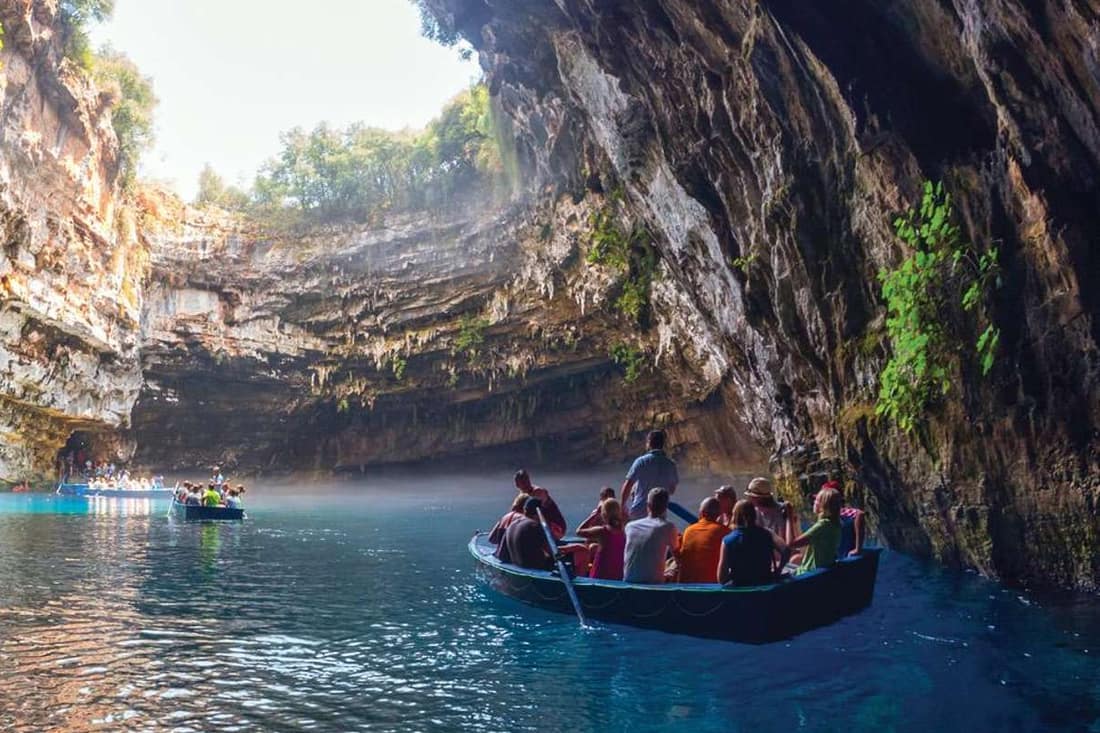
The ride is short, and it passes through both main chambers of the cave. It begins with a round trip of the first hall, the one with the hole in the roof. This is the sunlit room, where the colours of the water are brightest. Melissani cave Kefalonia also has a dark chamber, reached later in the ride.
In the sunlit hall the water glows blue and turquoise. Silver limestone walls frame the deep blue colour. The water is so clear that the boat seems to hover on a lake of blue light. The lake bed shows through. The unreal colours draw visitors to Melissani cave Kefalonia every year.
The light follows the sun. When the sun is directly overhead, its rays pass through the open roof and strike the water. The whole cave fills with turquoise light. Earlier or later in the day the light is less direct. Slanting rays in the morning and evening give the same hall another look.
A narrow passageway links the first chamber to the second. It is too narrow to row. A rope hangs along the wall, and the boatman pulls the boat through slowly. Things start to get darker here, as the boat leaves the open hall of Melissani cave Kefalonia behind.
The second chamber is enclosed and darker. Big stalactites hang from its roof, and algae and moss turn them green. Stalactites and stalagmites stick out everywhere you look. Odd shapes in the rock walls are said to look like dolphins. After this chamber the boat loops around and heads back.
A small island sits in the middle of the lake, and the boat passes it. Trees cling to its steep banks. Nobody leaves the boat, so the island stays a view and not a stop. On the loop back, riders see sunlight beaming down through the opening in the roof. The Melissani cave Kefalonia ride ends at the pier.
Photography is allowed in the cave. Do not use flash if you want the natural colours. Bring a phone or a camera. The light comes from above, through the opening in the roof.
The ride is a seated trip across calm water. The whole tour is done by boat. A non-swimmer takes the same ride as a swimmer, and the small rowboats move quietly through the calm rooms. Melissani cave Kefalonia asks for no swimming skill at all.
Which months, hours and rules apply to a visit to Melissani cave Kefalonia?
Melissani cave Kefalonia keeps its full season from late spring to October, and winter opening is limited. The light is strongest around midday, when the sun stands over the roof opening. Swimming in the lake is strictly forbidden.
Plan a visit to Melissani cave Kefalonia between late spring and the end of October for the full season. Outside those months the opening is limited, and in winter the cave is not open every day. Hours also change through the year, so confirm the exact times before the trip.
The Municipality of Sami announces the opening schedule of the cave. In the shoulder months the notice lists set dates and closed days, so the cave is not open daily. Read the notice for your travel month before you set off.
Light decides the right moment for Melissani cave Kefalonia. Around midday the sun stands over the opening in the roof, and its rays fall straight down onto the water. Late morning and early afternoon are the hours around that peak. A visit in that window catches the strongest light.
Midday also draws the biggest crowd, and lines at the ticket desk are a risk in July and August. Mornings and afternoons bring shorter lines but no direct sunlight. Arriving at Melissani cave Kefalonia right after opening shortens the wait and costs the midday light.
Tickets for Melissani cave Kefalonia are bought at the entrance. Independent visitors need no booking ahead, and the site is easy to visit without a tour. Live dates for day tours that include the cave sit in the cards on this page.
Two rules apply to every visitor of Melissani cave Kefalonia. Swimming in the lake is strictly forbidden, which keeps the fragile natural system safe. The water stays cold, near 10 degrees Celsius all year. Drones are not allowed over the lake.
The way in is a flight of stairs and a narrow tunnel, and then you get into a small boat. That can be difficult for visitors with walking problems, and wheelchair access is limited. The Argostoli shore excursion that covers both caves is rated strenuous and is not wheelchair accessible.
The shore excursion that starts with a photo stop at Myrtos is a poor fit for people with mobility impairments. The cause is the steps at Drogarati cave. On that excursion, the boat ride and the steps can be a challenge for young children. Parents judge their child’s ability.
The paths cross rocks, grass and dirt, and the steps in the caves can be slippery. Five items cover the visit:
- Shoes with a non-slip grip
- A light jacket for the cooler air inside
- A hat and sunscreen for the sunny areas
- Water for the walk in the heat
- A phone or camera, fully charged
Drogarati cave lies on the opposite side of Sami from Melissani, and a combined ticket covers both caves. Drogarati holds a steady air temperature of about 18 degrees Celsius and has laid-out corridors and staircases. The port town of Sami has a nautical museum.
Swimming is banned inside the cave, so a beach stop covers it. Antisamos beach lies near Sami and is a swim stop on the tours that add it. Myrtos beach is made of round white pebbles. The sea floor drops sharply near the shore, so the wave energy is very high.