Santorini day trips take you around a volcanic island in the Cyclades by bus, minibus or private car. You see the caldera villages, taste wine and watch the sunset in Oia. This page covers the formats, the timing, the sights, the wine, the sunset and the season. The homepage lists more Greece Tours like this one.
Each tour card below opens a live GetYourGuide booking. Dates, pickups and group sizes are shown there.
What are Santorini day trips?
Santorini day trips are guided tours that visit the island’s villages, beaches and sights in one day. Formats include highlights, small-group, private, wine and sunset tours, plus trips to Akrotiri. A coach, minibus or private vehicle carries you between stops.
Santorini day trips work because the island is compact. It measures 18 kilometres from Cape Exomitis to Cape Mavropetra, and its width varies from 2 to 6 kilometres. A drive from one end to the other takes about an hour. Those short distances let a single tour link villages, beaches and ruins in one day.
If you plan to cross into Turkey as well, the homepage also lists Turkey tours.
The island highlights tour covers the major sights. A coach or minibus carries the group between villages, and a local guide travels with it. First-time visitors choose it among Santorini day trips because one day shows the island instead of a single village. It can add wine tasting and an Oia sunset at the end of the day.
A small-group tour shows the highlights of the island from an air-conditioned minivan instead of a coach. A local guide travels with the group. A person travelling alone takes a seat in the minivan beside the other guests. Couples who prefer a smaller vehicle choose this format too.
A private tour gives one party its own driver-guide and its own air-conditioned vehicle. The route is tailored to your interests, and you choose the departure time. Couples and families who want their own pace suit this format. These Santorini day trips run on your timetable, not a group’s.
A wine-tasting tour is built around visits to wineries, so wine fans choose it. A sunset tour ends the day in Oia, so photographers get the evening light in the village. Both formats run on their own, and both also appear as the closing stops of a highlights tour.
Santorini day trips to Akrotiri put the archaeological site first. One full-day tour opens with a guided visit of the prehistoric town and ends with the sunset in Oia. A private driver-guide cannot lead the visit inside the site itself. Travellers with an interest in history pick this format.
Cruise-ship passengers on a short stop have tours designed specifically for them. These tours are time-efficient, and they bring the group back to the port for the ship. A boat cruise around the caldera is one more format, and other posts on this site cover it.
A tour differs from a rental car in who does the driving. Renting a car needs a driving licence, and an international driving permit is recommended. On a tour, the driver handles the roads and a local guide explains the stops. Santorini day trips therefore leave your attention free for the views.
A quad, also called an ATV, is a popular way to cover the island. Renting one needs your driver’s licence, and a helmet is recommended. You ride and navigate yourself, and no guide travels with you. A tour replaces that work with a vehicle, a driver and a local guide.
The public bus links the villages to Fira, and tickets are bought on board with cash. Routes branch out from Fira, so a cross-island trip means changing buses there and paying a second fare. Santorini day trips avoid those changes, because one vehicle follows the whole route.
- Highlights tour: first-time visitors who want the major sights in one day.
- Small-group tour: solo travellers and couples who want a local guide without a full coach.
- Private tour: families and couples who want their own timetable.
- Wine tour: wine fans who want the wineries at the centre of the day.
- Sunset tour: photographers who want Oia in the evening light.
- Akrotiri trip: visitors who care about history and archaeology.
- Cruise-passenger tour: travellers on a short stop in port.
How long do Santorini day trips last and how do they start?
Santorini day trips last four hours on a small-group tour and nine to ten hours by full-day bus. Pickup is at your hotel or a set meeting point. Free cancellation on group tours ends 24 hours before the start.
One of the shorter Santorini day trips is the small-group island tour of Oia, Pyrgos and Imerovigli. It lasts four hours and starts in Fira. The escort meets you at the exit of the cable car upper station. Hotel pickup is an add-on that you arrange with the provider after booking. The escort speaks English and Spanish.
You spend 30 minutes in Fira, 30 in Pyrgos and 70 in Oia. Then come 15 minutes each in Imerovigli and Firostefani, and 5 back in Fira. The drive to Pyrgos takes about 15 minutes and the drive to Oia about 40. The order of stops can change on the day.
- Small-group sightseeing tour with a local guide: five hours.
- Private half-day tour: five or six hours, depending on the listing.
- Morning wine tour: four to five hours.
- Full-day island bus tour: nine hours.
- Full-day top-spots bus tour: nine to ten hours.
- Coach tour of the traditional villages: about ten hours.
Santorini day trips for cruise travellers begin at the cable car upper station in Fira. The small-group island tour for cruise travellers lasts about four hours and holds a maximum of 20 travellers. It leaves in the morning or the afternoon, and morning guests join the escort at 10 am. Cable car tickets are not included.
Athinios is the main port of Santorini and lies about 8 km from Fira. It is the only port that large passenger ferries use. Cruise travellers on the small-group tour take a tender to Fira Old Port, not to Athinios. A cable car ride of a couple of minutes then lifts them to the meeting point.
Private Santorini day trips of half a day last five hours on one listing and six on another. You choose a morning or afternoon departure. The local driver-guide collects you from your hotel or the top of the cruise port cable car. Free cancellation ends 48 hours before the start on the five-hour listing.
The same five-hour listing also collects arrivals at the Athinios terminal and at the airport. The six-hour listing names 15 departure points, from Fira and Oia to Pyrgos and Emporio. It adds WiFi on board and bottled water, and free cancellation ends 24 hours before the start.
Small-group Santorini day trips with a local guide use an air-conditioned minivan. Pickup and drop-off are at designated points, with bottled water. Entry fees, food, drinks and tips are not included. Another small-group listing, of 4 hours 30 minutes to 5 hours, holds 19 people. Free cancellation ends 24 hours before the start, and a no-show pays in full.
On full-day Santorini day trips by bus, an English-speaking escort rides with the group. Pickup and drop-off are included, from set meeting areas rather than a private pickup. Admission to Akrotiri is not included. A coach tour of the traditional villages caps the group at 50 travellers and offers hotel pickup from selected locations.
The nine-hour island bus tour stops at Prophet Elias for 25 minutes and Pyrgos for 30. Akrotiri takes 1 hour 20 minutes, Red Beach 1 hour and Fira 1 hour. Oia comes last, with 2 hours. The top-spots coach tour picks up from 59 locations and emails your pickup time and place.
Santorini day trips built around wine start at 10 am and end around 2:30 pm in the morning version. Free hotel pickup begins at 9.30 am. Where a street is too steep for a vehicle, the van meets you at the closest accessible area. Water and an air-conditioned vehicle are included. Cancellation is free up to 24 hours ahead.
Which villages and sights do Santorini day trips visit?
Santorini day trips stop at Fira, Firostefani and Imerovigli on the caldera rim. They add Pyrgos, Megalochori and Akrotiri, with black-sand beaches at Kamari or Perissa. Together the stops cover a cliff-top capital, a hill village, a Bronze Age town and a red-cliff beach.
The caldera is a large water-filled basin left by an eruption about 3,600 years ago. The island grew through repeated shield volcano building, each cycle followed by caldera collapse. The caldera is ringed by a small, circular archipelago, and Santorini is its largest island. The inner cliffs drop more than 300 metres at their highest.
Fira, the island capital, is the natural reference point for distances on Santorini day trips. The town sits on the caldera rim above its port. You reach it from the port by cable car, on foot or by donkey. Fira has two main museums, the Archaeological Museum of Thera and the Museum of Prehistoric Thera.

Firostefani and Imerovigli follow Fira along the rim. Imerovigli lies north of Fira, at the highest point of the caldera ridge. It has 469 permanent inhabitants. Remains of a Venetian castle stand on nearby Skaros Rock. Rim stops on Santorini day trips sit close together. Fira is a 15-minute walk from Firostefani and half an hour from Imerovigli.
Pyrgos gives Santorini day trips a hill village about 7 km from Fira. Its houses climb the hill in tiers, and the views reach over the island in almost every direction. Ruins of a Venetian castle stand on top of the hill. The castle was once the administrative centre of the island. Pyrgos has 1,078 residents.
Megalochori is a quiet traditional village in the heart of Santorini, on a hill that faces east. Its cream and white Cycladic houses have colourful wooden doors. The village also has old white Cycladic churches. The roads narrow as you approach the village.
Akrotiri is the Bronze Age town that the eruption buried. The eruption destroyed the settlement in the 17th century BC, and the burial preserved its buildings, frescoes and artefacts. Santorini day trips to Akrotiri walk through the remains of that town, which lay under volcanic ash.
The excavated part holds more than 30 multi-storey public and private buildings. Rich frescoes decorate the walls, and the town has advanced drainage systems. A modern roof now covers the site, and walkways lead you through the remains of the streets and houses. Panels along the walkways explain what you see.
Red Beach is a southern stop on Santorini day trips. It lies near Akrotiri, about 12 km from Fira. Deep red volcanic cliffs surround it, and the iron-rich rock in the cliff face gives the beach its name. The walk to the sand takes about 10 minutes along a path. Rockfall from the surrounding slopes has long affected access.
The lighthouse in Akrotiri was built in the 19th century and is one of the oldest in Greece. Emporio village lies 12 km from Fira, near the Profitis Ilias mountains. It has the old Goulas Castle and churches such as Saint Nicholas Marmaritis.
Santorini day trips with a beach stop use the black-sand beaches of Kamari or Perissa. Kamari lies about 10 km southeast of Fira, and its main beach stretches for about 5 km. Perissa has thin black sand and forms one beach with Perivolos. Mesa Vouno rises behind both beaches and separates them. Ancient Thera stands on its top.
How does wine tasting fit into Santorini day trips?
Wine tasting fits into Santorini day trips as one to three winery stops with local wines, cheese and snacks. Volcanic ash soil, the Assyrtiko grape with its high acidity, and low basket-shaped vines give the island’s wine its character.
The island has no real topsoil, only pumice, ash and volcanic rock laid down by the eruption. The mix also holds pieces of solidified lava and sand, and the mix is called aspa. Vine roots reach deep into the ash to find water in the dry months. The porous subsoils also hold air humidity for the vines at night.
The tastings on Santorini day trips cover indigenous wines, and Assyrtiko is the island’s flagship white grape. It makes up 70% of all vineyard plantings and keeps its acidity even when very ripe. The wine has citrus and mineral notes. Athiri and Aidani are the other white varieties. Mandilaria and Mavrotragano give the red wines.
Growers prune each vine into round, concentric circles that form a basket shape called kouloura. They coil the canes into a nest that shelters the grapes inside. The basket protects the grapes from wind and sun. A study that compared kouloura with a common trellis system found better protection during heatwaves and strong winds.
The vines are very old and resist phylloxera. They needed no replacement during the phylloxera epidemic of the late 19th century. The clay-free soil kept the pest out. The yield per hectare is only 10 to 20% of the yields common in France or California. About 1,200 hectares lie under vine, and harvest takes place in mid-August.
The wines on Santorini day trips come in a range of styles, and Vinsanto is the sweet one. Growers harvest the grapes late and dry them in the sun for 12 to 14 days. After fermentation, the wine spends at least 24 months in oak barrels. The EU gives the island exclusive rights to the name Vinsanto.
At least 51% of a Vinsanto blend is Assyrtiko. The grape’s high acidity balances the sugar, so the dessert wine is not cloying. The wine reaches at least 9% alcohol by volume without added sugar. Its name comes from “Santo”, the mark on packages that showed their island of origin.
Wine-focused Santorini day trips visit up to three wineries. One tour tastes 12 wines with local cheese and snacks across three wineries. The snacks are not a full lunch or dinner. A second three-winery tour adds a mini tasting tutorial, with snacks and cheeses at the first and last winery.
Santorini day trips with a brewery stop add a beer tasting to three winery visits. Guests sample at least 12 labels of PDO and indigenous wines in a range of styles. The included items are snacks and bottled water.
Other Santorini day trips mix sightseeing with one winery stop. A five-hour small-group tour visits the villages and viewpoints, then tastes rare wines at a winery. Another five-hour tour combines Akrotiri with a family-owned winery and a mini wine-tasting tutorial of Greek wines. The winery visited can change with the choice of the wine expert.
Tastings and driving do not mix. Greece sets the limit for standard drivers at 0.5 grams of alcohol per litre of blood. Novice and professional drivers face a lower limit of 0.2 grams. One small-group tour includes a professional driver, so nobody needs to drive after a tasting on Santorini day trips.
What does the Oia sunset add to Santorini day trips?
The Oia sunset gives Santorini day trips their evening finish at the north-west edge of the island. Visitors watch the sun sink into the Aegean from the castle ruins or the lanes nearby. The sunset is a special event every evening in Oia.
Oia lies in the north-west of Santorini, along the caldera rim. From there you watch the sun dive straight into the sea. Sunset viewing is one of the main attractions of the town. Santorini day trips that stop here in the evening join the summer crowd. The village fills with people in that season.
The gig data shows how Santorini day trips sell the sunset. A search for Oia sunset tours returns 20 gigs, and each title names it. Two are walks inside the village, one cultural and one for photos. One private gig pairs the sunset with Ammoudi Bay. The other titles describe island tours by bus or minibus, and wine tours.
The ruined castle stands at the top of Oia, right on the edge of the caldera. It dates from the Venetian period, and a document of the 15th century already mentions it. After an earthquake in the 20th century, only a small part of the castle remained. The ruins are a favourite spot for sunset watching.
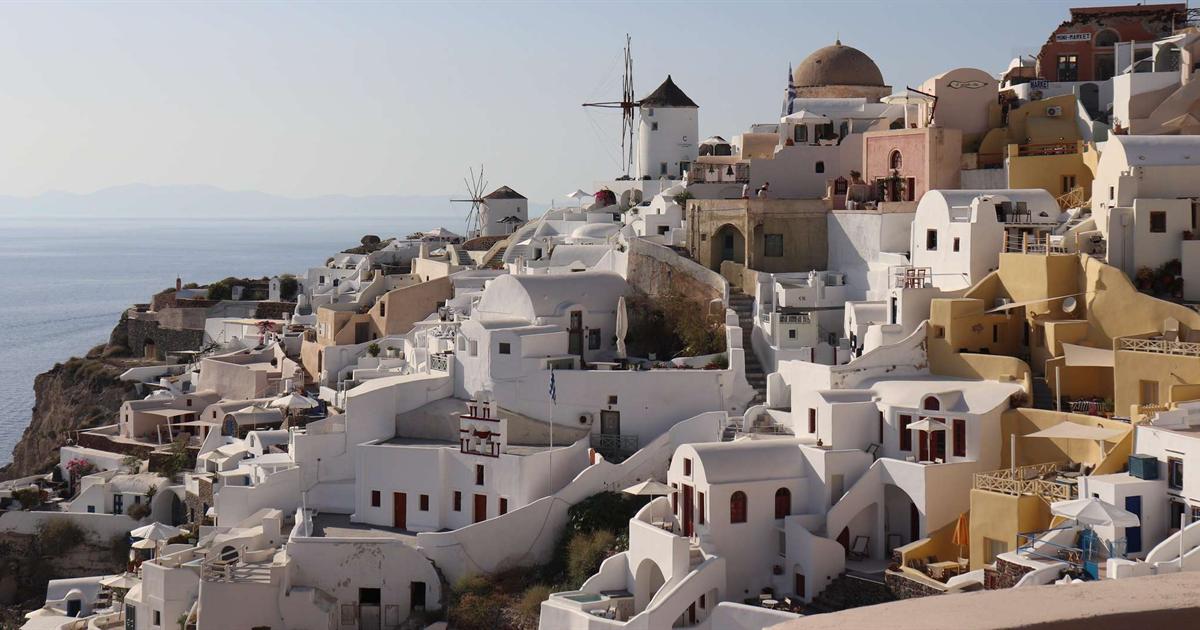
An old windmill ranks among the recognisable buildings in Oia, and it appears on postcards. The town is noted for its white and blue domed houses. Cave-style homes sit in niches carved into the caldera on the seaward side. Two-storey captains’ houses stand on the highest part of the village.
The captains’ houses are a reminder of the village’s former wealth. In the late 19th century Oia had about 2,500 residents and about 130 sailing ships. The village was called Apano Meria until the name changed to Oia in the second half of that century. Narrow passageways run around a central square.
The main street is a pedestrian route with views over the caldera, and it is lit in the evening. The paths are very narrow, so they get congested in the tourist season. Ammoudi harbour lies below the town on the western side. Steep stairs lead down to it, and it has tavernas and a pebble beach.
Sunset time moves through the year, and Santorini day trips move with it. In early December the sun sets at about 5:02 pm. In late June it sets at about 8:40 pm. At the start of October the time is about 7:02 pm. When clocks go back in late October, sunset jumps from about 6:31 pm to 5:29 pm.
Arrive well before the sun goes down. At the castle, you need at least one hour before sunset to find a place to stand or sit. On Santorini day trips between June and September, plan on at least two hours before the official sunset time. Golden hour starts roughly 60 minutes before sunset.
Santorini day trips plan the start around the sunset. One sunset transfer departs from Fira between 3:30 and 4:30 pm, depending on the sunset time. The same transfer offers drop-off at your accommodation after the sunset. Ask at booking whether the tour returns you to Fira or ends in Oia.
The castle gets very crowded, and the crowd applauds as the sun goes down. The three blue-domed churches are a 10-minute walk from the castle. They are less crowded in the golden hour. A remote yellow chapel, Agios Ioannis, near Oia has a more private atmosphere. Reservations are strongly recommended at bars and restaurants with sunset views.
Which season and packing list suit Santorini day trips?
Santorini day trips suit the shoulder seasons: mid-April to June and September to mid-October. Days are warm and crowds are thinner than in July and August. Pack a hat, sun cream, comfortable walking shoes and one light layer for the evening.
July and August are the hottest months on Santorini. The island’s weather station logs an average daytime high of 30°C and a record of 39.4°C. July receives 0.03 millimetres of rain on average. Santorini day trips in high summer run under clear skies, so the sun is the main weather risk.
The average UV index is 10 in June and July and 9 in August. That is the very high band. For this band, limit time in the sun between 10:00 and 16:00. Wear a wide-brimmed hat and sunglasses, and renew SPF 50 sunscreen every 1.5 hours. Sand and water increase exposure.
Shade is limited, so light, long clothing works as a cover-up. Walking on Santorini day trips means uphill paths and uneven ground in the villages. Wear comfortable walking shoes and carry bottled water. If the route includes a beach stop, add swimwear and a towel. Sea temperatures suit a swim from July to September.
The meltemi is a north wind that blows from late spring to mid-September. Gusts reach Beaufort force 7 or 8, mostly in the afternoon. The wind cools the summer heat, and evenings turn windy and cool. Travellers who feel the cold can pack a sweatshirt even in midsummer.
April and October show the shoulder-season range. In April the average high is 19.6°C and the low is 13.6°C. In October the high is 22.8°C and the low is 17.5°C. April brings 12.1 millimetres of rain, October brings 15.1 and November brings 33.7. Pack a light jacket for those evenings.
Winter is mild but wet. The average daytime high is 14.3°C in January, and December and January each receive more than 50 millimetres of rain. Tours and organised activities follow the tourist season, and restaurants and clubs close for part of winter. Confirm that a tour runs on your date before you plan Santorini day trips in winter.
August is the busiest month, and July is also very busy. June and September give summer weather without the same crowds. Tourism is the island’s main industry, especially in the summer months. An estimated 2 million tourists visit each year. Reserve Santorini day trips before you arrive in July or August.
On days when cruise ships call, Fira and Oia are busiest between 10:00 and 16:00. The crowd stays on the caldera rim. Inland stops are quieter at midday. UV guidance also marks those hours for limiting sun. Choose Santorini day trips that visit the rim villages early or late in the day and spend midday inland.
Strollers work in parts of Fira and Oia, but stairs run through both towns. A baby carrier keeps both hands free on the steps. Walkers with limited mobility meet the same stairs. Ask the tour provider about stairs and walking distances before you book.
Match the format of your Santorini day trips to the month. In July and August, keep long walks for early or late hours, because UV guidance limits midday sun. From December to February, choose a bus or minibus route, as each month brings over 40 millimetres of rain. In spring and autumn, pick by interest.