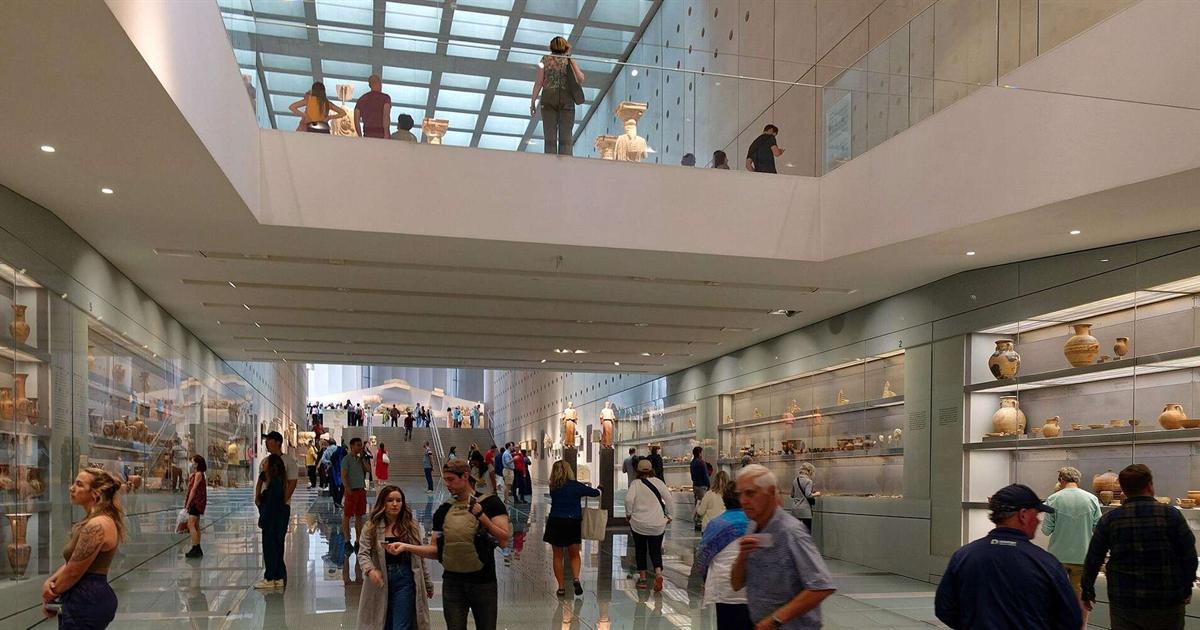
An Acropolis Museum guided tour leads you through the galleries at the foot of the Athens rock. This page covers the galleries, the sculptures, the tour length, the start point, the hours and the tour types. The homepage lists more Greece Tours like this one.
Each tour card below opens a live GetYourGuide booking. Dates, group sizes and start times are shown there.
What is an Acropolis Museum guided tour?
An Acropolis Museum guided tour is a walk through the museum’s galleries with a licensed guide. The guide explains the sculptures, statues and everyday objects found on the Acropolis and its slopes. It is a separate visit from the rock itself.
The Acropolis Museum is an archaeological museum in Athens, Greece. It holds the findings of the Acropolis site. Its displays include original sculptures, statues and everyday objects. It was built to house every artefact found on the rock and on the surrounding slopes. The building stands by the southeastern slope of the Acropolis hill.
If you plan to cross into Turkey as well, the homepage also lists Turkey tours.
On an Acropolis Museum guided tour, the guide leads the group from one gallery to the next. The guide explains the stories, the symbolism and the historical meaning of what the group sees. Greek history, mythology and daily life all come up along the route.
A museum-only tour stays inside the building from start to finish. The guide walks the group through the galleries and helps visitors read the meaning of the sculptures and objects. This acropolis museum guided tour format suits visitors who want the culture behind the objects, explained inside a modern building.
A combined Acropolis Museum guided tour adds the rock to the visit. The group walks the Acropolis site first and then continues to the museum. There the guide ties the original artefacts and sculptures back to the monuments the group has just seen.
A small-group tour keeps the visit shared. One licensed guide leads everyone through the masterpieces of ancient Greece, and the group stays together from room to room. A solo traveller joins the other guests and follows the same route.
A private tour is dedicated to your group alone. The guide brings the classical period to life and tells the stories and myths behind the pieces. Couples, friends and families can each book it as their own group, so the questions stay their own.
An Acropolis Museum guided tour for kids turns the visit into a game. Children follow clues, solve challenges and complete playful missions on the way through the galleries. Families learn, compete and explore together, then earn rewards at the end. The museum’s own family audio guide uses the same idea, an exploration game for parents and kids.
An audio-guide visit has no person at your side. The museum offers a free digital guide for it. Visitors scan a QR code in the museum and pick a language and a tour format. Then they explore at their own pace. A live guide is what separates an Acropolis Museum guided tour from this.
First-time visitors have someone to explain what each gallery holds. History fans get the full story, since the guide covers history and mythology. Families choose the game format. Couples pick a private tour, and solo travellers join a small group.
The museum’s own visitor page names the Tour Guide Association as a way to contact guides. The museum also offers gallery talks, led by its own archaeologists. The talks tour the permanent and temporary exhibitions and show little-known sides of the ancient world. These are other ways to hear the objects explained by a person.
Which galleries does an Acropolis Museum guided tour cover?
An Acropolis Museum guided tour covers the galleries on the ground floor, the first floor and the third floor. They climb from the Gallery of the Acropolis Slopes to the Parthenon Gallery at the top of the building.
The museum has three main levels and two intermediate levels. Its exhibition space measures 14,000 square metres. Beige marble covers the floors of the exhibition galleries, and dark marble covers the walkways between them.
The glass floors come first. On an Acropolis Museum guided tour you walk over panels and look straight down at the excavated ancient neighbourhood below. The ruins are part of the display and can also be seen from the balconies. The museum counts 43 columns in the excavation area.
The Gallery of the Acropolis Slopes is the first exhibition space, on the ground floor. Its floor slopes upward, like the path up the Rock. It has two sections, The settlement and The sanctuaries. The finds come from sanctuaries, theatrical and musical venues and private houses on the slopes.
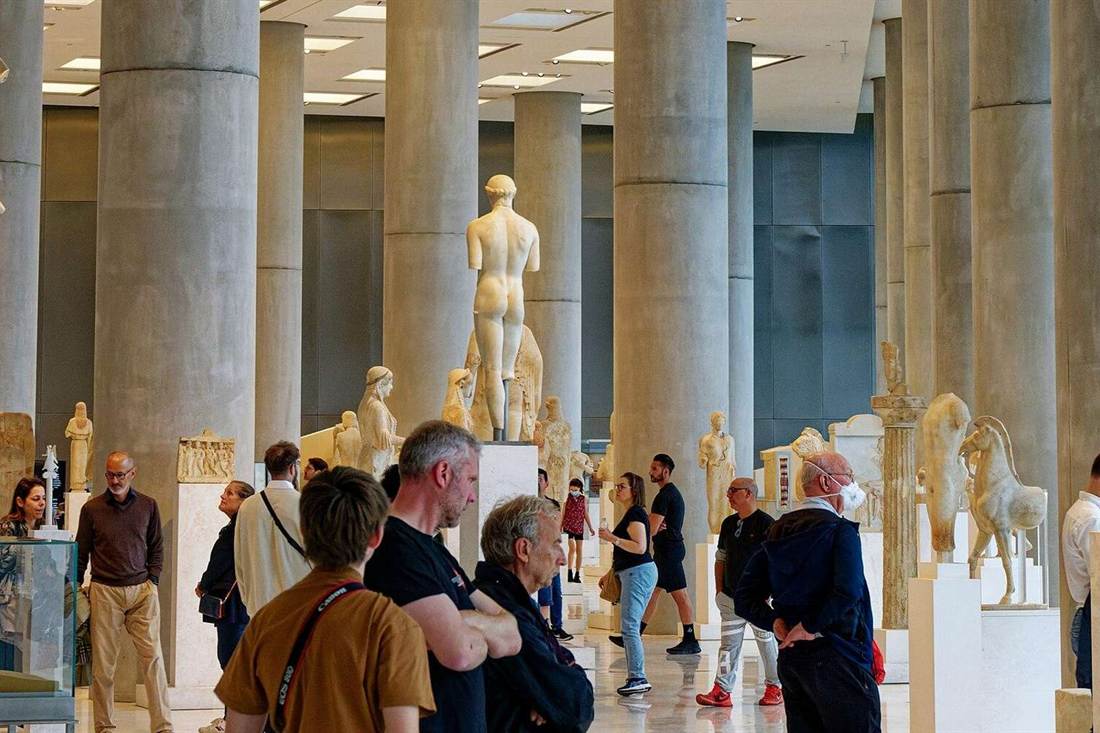
The first floor follows a circular route. The Archaic Acropolis Gallery fills the eastern and southern sections and covers 700 to 480 BC. An Acropolis Museum guided tour reaches it by this route. Large windows and roof skylights recall the open-air atmosphere of the sanctuary.
The korai are statues of young women. The Peplos Kore, Antenor’s Kore and the Kore with the almond-shaped eyes stand in this gallery. So do early temple pediments. One shows a lioness and a calf, and another shows the Gigantomachy. The museum counts 28 columns in the gallery.
The west side of the first floor holds the Propylaia, Athena Nike and Erechtheion display. It shows sculptures and architectural members from all three monuments. One highlight is a slab of the Athena Nike parapet known as the Sandalbinder. The Caryatids from the Erechtheion are shown here too. An Acropolis Museum guided tour stops here for them.
The north wing of the first floor covers works from the fifth century BC to the end of antiquity. The first floor as a whole spans the time from the second millennium BC to the end of antiquity.
The third floor is devoted entirely to the sculptures of the Parthenon. The Parthenon Gallery measures 39 by 84 metres. It is a glass-walled chamber wrapped around a rectangular core. The core matches the orientation and size of the inner chamber of the temple, called the cella. This hall is where an Acropolis Museum guided tour meets the Parthenon sculptures.
The walls of the core carry blocks of the Ionic frieze. They are mounted in the same positions as on the temple, but lower, so visitors can see them. The metopes stand in pairs between steel columns, and the columns match the number of the Parthenon’s columns. The pediment figures stand on low pedestals at the east and west ends.
Plaster casts stand beside the original marbles. The casts copy sculptures that the British Museum and other museums abroad hold. Visitors on an Acropolis Museum guided tour see the originals and the copies side by side in the same hall.
The glass walls give a direct line of sight between the sculptures and the Parthenon. The top floor also offers a panoramic view of the Acropolis and modern Athens. The glass walls bring daylight into the hall.
The shop and the café are on the ground floor, and the café terrace looks over the excavation. The restaurant is on the second floor. It has panoramic views of the Acropolis and other historic hills of Athens.
Which stories do the sculptures tell on an Acropolis Museum guided tour?
The galleries on an Acropolis Museum guided tour tell the story of Athens in stone. The frieze shows a festival procession, and the pediments show gods. Archaic statues were buried after the Persian attack. Five Caryatids stand in Athens, and a sixth stands in London.
Phidias had charge of the Parthenon’s sculpture. The frieze shows an idealised version of the Panathenaic procession. Carvers cut it in place on the temple, around 443 to 438 BC. The complete band was 160 metres long. It held 378 figures and 245 animals, and horsemen make up 46 percent of it.
The metopes carry the battle stories on an Acropolis Museum guided tour. The Parthenon had 92 metopes. The east metopes show the Gigantomachy, the battle between the gods and the Giants. The west metopes show the Amazonomachy, the Athenians against the Amazons. The south metopes show the Centauromachy, the fight with the Centaurs, set in Thessaly.
The pediments sat above the two ends of the temple and held the divine scenes. The east pediment showed the birth of Athena. The west pediment showed her contest with Poseidon for control of Athens. The east pediment originally held 10 to 12 sculptures. Only two corners survive, with the figures of Helios and Selene.
The Persian invasion of 480 to 479 BC destroyed the sculptures of the Acropolis. The Athenians buried the damaged items in a ceremony. Archaeologists dug them up in the nineteenth century. The finds include the Kritios Boy and the Rampin Rider. The Peplos Kore is a statue of a young woman from around 530 BC.
On an Acropolis Museum guided tour, the Caryatids tell a split story. The Erechtheion’s south porch rested its roof on the heads of six Korai statues. Five of them are now in the Acropolis Museum. The sixth is held in the British Museum in London. Replicas replace the five originals on the porch.
The Parthenon sculptures are divided too. At the start of the nineteenth century, the Earl of Elgin removed sculptures from the temple. He shipped them to England. Today 56 frieze blocks are in the British Museum. An Acropolis Museum guided tour shows the 40 frieze blocks held in Athens.
The return debate is a matter of record. In the twentieth century, the Greek government made a formal request for the return of the sculptures held in London. The British Museum has refused. Other museums hold pieces too, among them the Louvre, the National Museum of Denmark and the Kunsthistorisches Museum in Vienna.
The building behind an Acropolis Museum guided tour has its own story. The first museum stood on the Rock, southeast of the Parthenon, and housed the finds of the first excavations. It was completed in the nineteenth century. The new museum stands 300 metres from the monuments. Its design came from Bernard Tschumi and his Greek collaborator Michael Photiades.
An ancient Athenian neighbourhood came to light during the excavation for the museum. It spans from the fourth millennium BC to the twelfth century AD. The remains include houses with courtyards and wells, mansions with private baths, and workshops with water cisterns. They lie at the base of the building that hosts an Acropolis Museum guided tour.
Architects and archaeologists worked together to find places for the foundation columns. The building had to adapt to the ancient remains. The planners treated the dig as an enormous exhibition inside the museum.
How long does an Acropolis Museum guided tour last and where does it start?
A museum-only Acropolis Museum guided tour lasts about 75 minutes. Group tours that add the Acropolis rock run from 2 to 4 hours. Meeting points include Dionysiou Areopagitou 3 and Makrigianni 7, which sits outside Akropoli metro station.
The shortest Acropolis Museum guided tour fits a quick visit. It runs about 75 minutes. The fee covers the guide and skip-the-ticket-line access, while entrance fees are paid separately. You get a full refund when you cancel up to 24 hours in advance.
Private tours flex with your plan. The private tour of the Acropolis and the museum lasts between 1.5 and 3 hours, depending on your choices. The start time is flexible, and admission tickets are not included.
Adding the rock lengthens an Acropolis Museum guided tour. The small-group tour lasts about 3 hours. The premium tour lasts 3.5 hours. The early-access tour lasts 3 to 4 hours, and the early-morning tour about 4 hours. One more walk, with an optional museum visit, runs 2 to 4 hours, depending on the option.
Group size follows the format. The early-access tour takes up to 19 people. Another walk with an optional museum visit describes small groups of around 10 people. The private tour keeps the guide exclusive to your own party.
Start times and languages differ. The early-morning Acropolis Museum guided tour starts around 8 or 9 am and runs in English and Spanish. The early-access tour runs in English. The private tour offers guides in English, German, Italian and Greek.
Headsets come with three combined tours. The small-group tour includes headsets, the early-morning tour includes audio devices, and a third tour supplies headphones. Tickets differ by tour. The small-group tour includes pre-reserved Acropolis and museum tickets, and the early-access tour includes skip-the-line tickets. Three tours include entry only when you pick a with-tickets option.
Meeting points name a street number. Three tours start at Dionysiou Areopagitou 3. The museum-only tour starts at the beginning of the pedestrian walkway from Hadrian’s Arch. The early-access tour meets at an office on Mitsaion Street. The museum itself stands at Dionysiou Areopagitou 15, so read your voucher for the number.
Akropoli is the nearest station to the museum, on Metro Line 2. Syntagma is the stop before it. Two of its three entrances stand on the museum’s eastern wall, and one of those is lift-only. An Acropolis Museum guided tour can start at Makrigianni 7. The small-group tour gathers outside the station there.
The museum’s main entrance stands on the pedestrian street Dionysiou Areopagitou. Groups of 16 to 40 people must reserve, and groups enter through Mitseon Street. Tour buses drop groups off in Hatzichristou Street. Groups without a reservation can be refused entry on peak days and hours.
Pack light for an Acropolis Museum guided tour. A security check-point with an X-ray scanner stands at the entrance, and the museum recommends avoiding large bags and backpacks. Two cloakrooms on the ground floor hold backpacks and bulky items, one for independent visitors and one for groups. Everyone also passes the ticket validation machines on that floor.
Which hours, seasons and tour formats suit an Acropolis Museum guided tour?
The museum opens at 9 am on all seven days and stays open until 10 pm on Fridays. Last entry is 30 minutes before closing. Book your acropolis museum guided tour inside those hours, then match the format to your group.
The summer schedule covers 1 April to 31 October. On Monday the museum closes at 5 pm. On Tuesday, Wednesday, Thursday, Saturday and Sunday it closes at 8 pm. On Friday it closes at 10 pm. The galleries start to clear 15 minutes before closing time.
The winter schedule covers 1 November to 31 March. From Monday to Thursday the museum closes at 5 pm. On Saturday and Sunday it closes at 8 pm, and on Friday at 10 pm. Last entry Monday to Thursday is 4:30 pm, so an acropolis museum guided tour must enter before then.
The schedule has no weekly closing day. The museum closes on set dates, among them 1 January, Orthodox Easter Sunday, and 25 and 26 December. Entry is free on Melina Mercouri Day, International Day of Museums and two national holidays. Check the site before you book an acropolis museum guided tour near a holiday.
In July and August the mean daily high in the city centre is 34.3 degrees Celsius. Rain peaks in December at 76.3 millimetres, against 5.4 in August. A museum-only acropolis museum guided tour stays indoors, but a tour that adds the rock brings an outdoor walk. Pack a sun hat and water for the rock.
Peak days and hours exist, but the museum lists no quiet times. Tickets are sold at the Ticket Desk or through the museum’s e-ticketing service. The excavation beneath the museum closes at 5 pm every day in winter. In summer it closes at 8 pm from Tuesday to Sunday and at 5 pm on Monday.
Rules apply to every visitor. Do not bring food or drinks into the galleries. Do not touch the exhibits. Keep mobile phones on silent while you tour the galleries. Pets are not allowed, but guide dogs for visitors with disabilities are.
Amateur photography and filming for personal use are allowed in all areas of the museum except one. The Archaic Acropolis Gallery bans photos and video. Flash, portable lights and tripods are not allowed anywhere inside. On an acropolis museum guided tour, expect a no-photo rule in that one gallery.
Ramps for wheelchairs and strollers serve all museum entrances. Elevators and accessible WCs are on all floors. Wheelchairs can be borrowed at the Visitor Services Desk, and strollers at the ground-floor cloakroom. Entry is free for visitors with disabilities who show an ID card or passport and a Disability Certificate.
An early-access acropolis museum guided tour starts in the early morning and uses a separate museum entrance. Nobody skips the queue at the rock itself. A premium tour asks for comfortable shoes and clothes, plus water, a hat and sunscreen. The small group tour with the rock bars sandals, flip-flops and baby strollers.
Check the access line of each acropolis museum guided tour format. The private tour with an archaeology expert lists wheelchair access. The small group tour with the rock does not suit wheelchair users. Families borrow a themed backpack for ages 6 to 12 at the Visitor Services Desk. Borrowers leave an identity card, first come, first served.