An Izmir Cesme Alacati tour by flight from Ankara crosses the Aegean coast in two days. This route flies to Izmir and drives west to Alacati for the night. Day two visits Cesme before the flight home. For island trips, open Greece Tours on the homepage.
Day one covers the Asansor lift and the Kordon in Izmir, then Urla and its vineyards. Day two covers the windmills of Alacati and the shore of Cesme. Each card below opens a live GetYourGuide booking page.
How was the Asansor lift built on an Izmir Cesme Alacati tour by flight from Ankara?
Brick on a stone base forms the tower, with bricks brought from Marseille. Two lifts inside carry people up a steep cliff in Karatas. Day one reaches that tower on an Izmir Cesme Alacati tour by flight from Ankara. Builders finished it in nineteen hundred and seven.
Karatas follows a small cove of the same name in the Gulf of Izmir. Karatas served as a quarry area throughout history. Cliffs divided the seafront from the Halil Rifat Pasha district on the heights above. The lift tower stands in that gap. The Asansor is a historical building of the quarter.
Looking further? Turkey tours on the homepage reach Istanbul, Cappadocia and the Mediterranean coast.
Karatas has no official boundaries or status, and it roughly matches the official quarter of Turgut Reis. The area opened officially for housing in eighteen sixty-five and took on a resort-like air. The Konak district contains the quarter. The lift later joined its shore to the hill above.
Before the lift, a flight of 155 steps joined the shore to the hill. Turks called it the Karatas Stairs. The sea strip below carries the name Mithatpasa Avenue. The tower answers that climb on an Izmir Cesme Alacati tour by flight from Ankara. Cabins carry people and goods up the cliff instead.
An inscription above the entrance door is written in French and Hebrew. The French line opens with Ascenseur and ends with a date. It names the builder as Nissim Levy on an Izmir Cesme Alacati tour by flight from Ankara. Nesim Levi Bayraklioglu, a banker and trader, had the lift built as a public service.
The tower is brick laid on a stone base. Builders brought the bricks from Marseille. Two lifts stand inside it, and they link the shore street with the hill street above the cliff. The Turkish word asansor means a lift and comes from the French ascenseur.
A wooden platform on iron brackets forms the balcony at the top of the tower. The balcony gives a bird’s-eye view of Izmir. Brick, stone and iron meet in the tower on an Izmir Cesme Alacati tour by flight from Ankara. Cast-iron railings line its edge, and the brackets are iron too.
Income from the lift served the Karatas hospital. Until its sale in nineteen forty-two, that income met the hospital’s costs. In nineteen eighty-three the Izmir Metropolitan Municipality received the tower as a donation. The gift carried one condition: the lift had to keep the same use.
The municipality restored the tower in the late twentieth century. In the same period it changed the machinery to electricity. Electric power drives both lifts on an Izmir Cesme Alacati tour by flight from Ankara. Cabins rise and fall between the shore street and the hill street, through the cliff.
The small street that led to the tower took the name Asansor Street. The city later renamed it Dario Moreno Street in memory of a singer. He lived there in the nineteen forties and bought a house there for his mother. Both street names point to the tower on an Izmir Cesme Alacati tour by flight from Ankara.
Day one begins with the morning flight from Ankara to Izmir. The Asansor comes before the Kordon shore on this route. The tower is the first city stop on an Izmir Cesme Alacati tour by flight from Ankara. Brick, iron and cabins come first, and the shore follows.
Alacati comes up again in Izmir Cesme Alacati Tour By Flight From Istanbul.
How did the Kordon shore take its shape beside an Izmir Cesme Alacati tour by flight from Ankara?
Engineers gained land from the sea in the nineteenth century to build the Kordon quay. A later fill became the walking promenade, which opened in June two thousand. That shore sits beside an Izmir Cesme Alacati tour by flight from Ankara. Quay and promenade follow the south shore of the Gulf of Izmir.
A yali is a house built right on the waterside, and houses of that type once lined the Kordon. Earlier quays were built of wood, and a seismic wave destroyed them. Port works began. The last remains of the old port castle, Okkale, and the yali-type houses were demolished. That cleared space for a wharf and a street.
A quay plan of eighteen sixty-five covered the coast between Konak and Alsancak, then called Punta. The concession went to a company founded by British entrepreneurs in December eighteen sixty-seven. Work began in eighteen sixty-eight. French brothers took over the management in eighteen sixty-nine. Sections were finished by early eighteen seventy-six, apart from the strip before the customs house.
The works joined a landing stage, a street with a tram line and an esplanade in one strip. That strip is a little over three kilometres long. All of it stands on land gained from the sea. Reclaimed ground lies underfoot beside an Izmir Cesme Alacati tour by flight from Ankara. Change followed, since the quay altered the city’s look.
Buildings with different architectural features rose along the shore. The French customs house of the project, reportedly designed by Gustave Eiffel, is the building named Konak Pier. Pasaport pier stands on landfill beside an Izmir Cesme Alacati tour by flight from Ankara. Built in eighteen eighty-nine, it has a passenger hall of nineteen twenty-six.
On the land side stand houses, offices and eating places of different periods. The Ataturk Museum building was raised as a house between eighteen seventy-five and eighteen eighty. Its walls are stone masonry, and its doors, windows and stairs are wooden. The Provincial Culture and Tourism Directorate building is masonry work of the late nineteenth and early twentieth century.
Fill work began in nineteen ninety-seven for a six-lane road along the shore. In places the fill reached about 150 metres into the sea. The road was not built. A decision set the fill aside for walkers and recreation. That ground became a park and promenade beside an Izmir Cesme Alacati tour by flight from Ankara.
Opening day for the reshaped shore was the fifteenth of June in the year two thousand. About 66,000 square metres became green space. About 54,000 square metres went to pedestrian and bicycle paths, a road and a running track. Two large streets run parallel to the coast, named the First Kordon and the Second Kordon.
Gundogdu Square marks the centre point of the Kordon esplanade beside an Izmir Cesme Alacati tour by flight from Ankara. Crews raised it together with the esplanade. A wide hard-surfaced area and lawns make up the square. The Tree of the Republic monument stands 13.5 metres tall in all, on a marble-clad base 8.5 metres high.
The running and walking path on the Kordon is 1,426 metres long and 2.5 metres wide, with a tartan covering. This route reaches the shore after the Asansor lift, beside an Izmir Cesme Alacati tour by flight from Ankara. Roads lead on to Urla in the west.
What do the painted clay coffins of Klazomenai show for an Izmir Cesme Alacati tour by flight from Ankara?
Animals, mythical beings and patterns fill the painted frames of Klazomenai coffins, each one fired as a single piece. Their craft adds clay art for an Izmir Cesme Alacati tour by flight from Ankara, kilns and brushes alike.
Scholars assume that the firing kilns were built over the unfired coffins. The workshops probably stood near the cemeteries, so a finished coffin travelled only a short distance to its grave. Kiln and grave therefore lay close together. That link frames the clay story for an Izmir Cesme Alacati tour by flight from Ankara.
Those workshops, scholars think, worked mainly on clay decorations for buildings. Frames were frequently coated with a white slip, a liquid mix of clay, and then painted. Only a small proportion of the coffins was painted in the red-figure technique. There the background is black, while the figures keep the natural colour of the clay.
More about Ankara: Izmir Ephesus Tour By Flight From Ankara.
The Borelli Painter ranks among the earliest recognised painters of these coffins. The Albertinum Painter and the late Hopkinson Painter are named as well. Scenes chiefly concern aspects of life that matter to the local aristocracy. That subject choice gives the coffins a social setting for an Izmir Cesme Alacati tour by flight from Ankara.
The Ny Carlsberg Glyptotek in Copenhagen holds a coffin with a grazing goat between a lion and a panther. The goat scene sits on the head end. The coffin is 183 centimetres long, 66 wide at the head and 55 at the foot. It belongs to the Albertinum Group and dates to the early fifth century BC.
The Getty Villa in California holds a longer coffin than the Copenhagen one. It measures 221.5 centimetres in length, 101 in width and 60 in depth. Ornamental patterns appear on it, and records date it to the early fifth century BC. These figures show the scale of the work for an Izmir Cesme Alacati tour by flight from Ankara.
The sides of a rim in the Metropolitan Museum of Art show a centaur and a siren. The museum’s record calls the type East Greek and assumes local makers for such rims. Their size and weight support that view, the record adds. It places the rim in the Archaic period.
A rim fragment in the Princeton University Art Museum carries a cable pattern on its upper surface. Complex pattern work covers the sides of the rim. A pair of griffins appears on the same fragment. In its top frieze, winged goddesses and chariots flank the central pair of figures.
One head end in the Izmir Archaeological Museum shows a story from myth. Its scene closely resembles the Boreads saving King Phineus, a tale told in the Argonautica of Apollonius of Rhodes. Scholars call the subject almost unique in Ionian art. That rare scene adds myth for an Izmir Cesme Alacati tour by flight from Ankara.
Klazomenai is the main find site for these coffins. Smyrna is the second major site, after Klazomenai itself. Other coffins have been found on Rhodes, Samos and Lesbos and at Ephesos. The Antikensammlung in Berlin also holds examples, so the painted frames lie far from Urla.
Robert Manuel Cook catalogued the coffins in Clazomenian Sarcophagi, published at Mainz in nineteen eighty-one. It forms part of the series Kerameus. The Copenhagen coffin appears in that catalogue under the mark G.50. Cook’s entries add a scholar’s view for an Izmir Cesme Alacati tour by flight from Ankara, coffin by coffin.
How was olive oil pressed at Limantepe during an Izmir Cesme Alacati tour by flight from Ankara?
Olives went under a millstone with a cylindrical roller, then a lever-and-weights press squeezed the paste. The Klazomenai workshop shows these steps during an Izmir Cesme Alacati tour by flight from Ankara. Oil settled in three separation pits.
The workshop stands on the original mainland site of Klazomenai, where the city first lay at Limantepe. The Limantepe mound sits near an old harbour. People inhabited that harbour settlement from the late fourth millennium BC. An international team has explored Limantepe on land and underwater.
The olive oil installation dates to the sixth century BC. It belongs to the lever-and-weights type of press. The press comes at least two centuries before the next securely datable presses found in Greece. Day one reaches this early press during an Izmir Cesme Alacati tour by flight from Ankara. Ancient Klazomenai lies in modern Urla.
Ancient mills paired a large stone basin with a rotating millstone. The stone crushed the fruit and its pits into a pulp. Traditionally, a beast of burden harnessed to a wooden beam turned the upper stone. The millstone visible at Klazomenai carries a cylindrical roller.
Ankara also features in Izmir Sardes Tour By Flight From Ankara.
In a lever-and-weights press, the pulp goes into frails, which are flexible baskets woven from thick fibrous material. The same method lies behind the press seen during an Izmir Cesme Alacati tour by flight from Ankara. Frails are stacked, a stone weight presses them, and a lever beam on a pivot lifts that weight.
Ancient mills collected the pressed liquid in settling pits, where the oil separated by itself and was skimmed off. Pressing also produces a liquid byproduct known as amurca. The Klazomenai press has three separation pits. Earthen vessels for separating oil were found at the site as well.
Hand mortars and grinding stones were found at the site. These portable tools served household needs. The Klazomenai equipment was built for large-scale production. That contrast stands out during an Izmir Cesme Alacati tour by flight from Ankara. Shaped parts and small finds showed that the building was an olive oil workshop.
The traces at Klazomenai indicate the first exports of olive oil by sea. Olive oil served in food and, formerly, as lamp fuel. Modern cultivars trace primarily to the Near East, the Aegean Sea and the Strait of Gibraltar. Researchers refer to Limantepe as a possible candidate for the oldest regularly used port in the world.
Ege University, local artisans and partners restored and rebuilt the press between two thousand four and two thousand five. The rebuilding follows that millstone and the three separation pits. The result is the press reached during an Izmir Cesme Alacati tour by flight from Ankara. Interior views show the workshop as Ege University restored it.
Olive oil once paid for grain. Around the middle of the fourth century BC, Klazomenai faced a shortage of grain and little money. Aristotle records that the city asked citizens with olive oil to lend it at interest. The city then hired ships and bought grain, with the value of the oil as the pledge.
The workshop stands in olive country. About 600,000 olive trees grow across the district of Urla. Olive orchards take 36 per cent of the farmland, and vegetable gardens take 17 per cent. Those figures set the scene during an Izmir Cesme Alacati tour by flight from Ankara. Finds from the excavations are exhibited in the Izmir Archaeology Museum.
Which grapes grow in the vineyards near an Izmir Cesme Alacati tour by flight from Ankara?
Bornova Misketi and Urla Karasi, two native grapes, grow near an Izmir Cesme Alacati tour by flight from Ankara. Chardonnay and Cabernet Sauvignon, both international grapes, grow beside them. A signed wine route links a cluster of smaller wineries on the peninsula.
Coastal vineyards of the Aegean stand around Urla, a district of Izmir Province. The wine region that holds them has a maritime Mediterranean climate, with hot summers and mild winters. Its coastal vineyards sit at about 150 metres above the sea. Its soil is partly clay loam and partly calcareous, made of chalk and limestone.
Bornova Misketi is a white grape from the Bornova district of Izmir. It counts as a clone of Muscat. Plantings of it have gone into the Urla peninsula since the early twenty-first century. Those vines grow near an Izmir Cesme Alacati tour by flight from Ankara. Berries carry thin skins that invite fungal disease and hold the aroma.
Bornova Misketi smells of bergamot, orange blossom, apricot, basil and mint. Unlike a cloyingly sweet Muscat, it can keep a fresh acidity. Modern makers ferment it in stainless steel tanks at low temperatures. The cold protects the volatile aroma compounds and gives a crisp, dry white. Traditional makers use it for semi-sweet or sweet wine.
Urla Karasi is a native grape that had been little used since the early twentieth century. Producers began replanting it in the early twenty-first century. The once near-extinct vine grows again near an Izmir Cesme Alacati tour by flight from Ankara. Foca Karasi and Gaydura, two other old local grapes, were also reproduced and saved from extinction.
Another page that includes Ankara is Izmir Pamukkale Tour By Flight From Ankara.
International vines grow beside the native ones. The Aegean wine region lists Chardonnay, Sauvignon Blanc and Viognier among its whites. Its reds include Syrah, Grenache, Carignan and Sangiovese. Cabernet Sauvignon and Merlot grow on the Urla route near an Izmir Cesme Alacati tour by flight from Ankara. Local Bogazkere, a tannic red, joins them.
Vine growing is old on this stretch of the Aegean coast. Homer mentions wines from the region. Amphorae carried the wine of the area to the Western Mediterranean and the Black Sea coasts. Vineyards cover only one or two per cent of the farmland of the Urla district. Their added value for the district economy is still significant.
The vineyard routes run their season from April, when the buds break, to early October, the harvest. Vines near an Izmir Cesme Alacati tour by flight from Ankara follow that same calendar. The Urla grape harvest festival takes place in August. Grape treading is a highlight there, a traditional way to release the juice before fermentation starts.
Red wine ferments together with the grape skins. The skins give colour, flavour and tannin through a soak called maceration. Fermentation of red wine runs at about 22 to 25 degrees Celsius. Afterwards the free-run wine goes into tanks, and the skins are pressed to extract the wine that remains. Press wine is blended back as the winemaker decides.
White wine starts as pressed juice, and the skins leave before fermentation begins. White fermentation runs cooler, at about 15 to 18 degrees Celsius. Rose comes from red grapes whose juice touches the dark skins only until it turns pink. Bornova Misketi, grown in vineyards near an Izmir Cesme Alacati tour by flight from Ankara, follows the white method.
Which greens and artichokes reach the table along an Izmir Cesme Alacati tour by flight from Ankara?
Urla’s early sakiz artichokes and boiled wild greens reach plates along an Izmir Cesme Alacati tour by flight from Ankara. Cutting of the early artichoke runs from November to April, and boiled greens take olive oil with lemon.
The artichoke is a perennial, and its flower bud, cut before it opens, is what reaches the plate. Cooks eat the fleshy base of each leaf, then the heart once the inedible choke is peeled away. The flower heads sit at the tips of long stalks. Harvesters leave an inch or two of stem on each head.
The sakiz artichoke of Urla is very early compared with other artichoke varieties. It has flat leaves and a cylindrical head. Cutting runs from November to April, while the peak season of artichokes in general is spring. Artichoke dishes can appear along an Izmir Cesme Alacati tour by flight from Ankara, Urla first.
Each year the plant grows again from dormant buds on its underground stem. The first irrigation, called the wake-up water, comes in mid-August. The geographically indicated Urla artichoke gives an average of 11,000 tonnes a year from about 8,000 decares. Farmers who keep heirloom seed prefer the sakiz type.
In Izmir the artichoke is an essential ingredient of olive oil dishes. A classic Aegean plate pairs fresh artichoke with carrot and peas. Water acidified with lemon juice keeps cut artichokes from discolouring. Cooks serve such plates along an Izmir Cesme Alacati tour by flight from Ankara, Urla’s table included.
Cooks simmer artichokes for 15 to 30 minutes, or steam them for 30 to 40 minutes. Small ones need less time. Thin slices of the bud take a dressing of lemon and olive oil. Turkish cuisine also includes artichokes with lamb, a dish called kuzu etli enginar.
Urla has held an artichoke festival each spring since the year two thousand fifteen. It shows the cuisine of the district. Producers sell their own artichokes, vegetables and fruit there. Young chefs at one edition made bread, lemonade and tarts from artichoke. Slow Food lists armola, a herders’ dairy product of the Urla-Cesme-Karaburun peninsula, in its Ark of Taste.
A related page on Cesme: Cesme Chios Tour From Izmir.
Researchers gathered information at 18 open-air markets in Izmir over two years. They recorded 46 kinds of wild edible plants. The Asteraceae family led with seven kinds, and the Apiaceae family followed with six. Folk knowledge of these plants has faded across the generations, the authors note.
Spring fills the markets of Izmir with a wide variety of greens. Cooks eat the leaves raw, boiled, fried in oil or baked. Stew, salad and a hot drink are among the dishes. Boiled and fried leaves turn up along an Izmir Cesme Alacati tour by flight from Ankara, Alacati included.
Cibez and arapsaci belong to the Aegean list, as do radish greens. Cooks boil radish greens for a salad, or fry them with an egg on top. A bitter wild bulb grows around Alacati, so cooks boil it twice and add olive oil and lemon. Such bulbs reach tables along an Izmir Cesme Alacati tour by flight from Ankara.
Cooks fry nettle, poppy and goosefoot leaves as a kavurma, starting with onions in the pan. An egg can be broken on top, or garlic yogurt added. The Ozbek neighbourhood of Urla holds a Mart Dokuzu Herb Festival each year. Pans of greens are served along an Izmir Cesme Alacati tour by flight from Ankara, Urla’s among them.
What do the old houses of Urla show across an Izmir Cesme Alacati tour by flight from Ankara?
Stone houses of the nineteenth century line Zafer Street in Urla. This protected site holds registered civil buildings in the town centre. The town lies on the road west across an Izmir Cesme Alacati tour by flight from Ankara. Beyond Alacati lies Cesme.
The town centre of Urla lies in the middle of the isthmus of a small peninsula. Its name comes from the Greek word Vourla, which means marshlands. Seasonal homes line the beaches and coves of the district. Day one brings the old town into view across an Izmir Cesme Alacati tour by flight from Ankara.
Building in the town centre gathered along Zafer Street over the years, a study finds. The street also carries the name Sanat Sokagi, which means Art Street. Until the early twenty-first century it was known only as Zafer Street. Its stone buildings reach back to the nineteenth century, and the area is a site of registered civil architecture.
Until the nineteen-sixties the only road between Izmir and Cesme passed through this street. Tobacco shops stood there, because tobacco was grown in large amounts for a time. Later those shops closed, and a market began to take their place. The old road shows Urla as a trading town across an Izmir Cesme Alacati tour by flight from Ankara.
Scholars have sorted the historic houses of the town centre into five plan types. The sorting looks at the number of storeys and the use of each floor. It also notes whether the hall sits at the centre or at the side. One of the five is the two-storey house with a central hall. Other houses fall outside the types.
A study of Zafer Street examines fourteen historical houses. It lists their alterations: restoration, change of use and changes to facades and original structures. The study traces the cultural development that migration brought in the nineteenth century. The houses of this street show that history across an Izmir Cesme Alacati tour by flight from Ankara.
Greeks used one house of Urla as a home, before it passed to the Treasury. Its walls are wholly of stone, and its eaves are of the hedgehog kind. The Izmir No. 1 Board for the Protection of Cultural and Natural Heritage has registered it. Its owner gave it to serve as a school for girls.
The district centre holds Art Street and the historical Arasta and Malgaca Market. Mosques and baths from the Ottoman period stand in the district. These places mark the old centre across an Izmir Cesme Alacati tour by flight from Ankara. Pious-foundation ownership covered almost all of Urla in the sixteenth century.
Zafer Street’s stone buildings had stood derelict before the work began. The street was closed to traffic, and a restoration followed. Restoration and restitution work took place in a large number of the buildings. The greater part were restored. The street kept its historic texture across an Izmir Cesme Alacati tour by flight from Ankara.
Readers interested in Izmir can open Izmir Ephesus Tour By Flight From Istanbul.
Karantina Island, which a road joins to Urla, holds a quarantine station built by the French in the nineteenth century. The station has lodging units and storerooms. Its Pasha Mansion is a single-storey house on a rectangular plan with a terrace. A stone print of the early twentieth century shows the Urla pier and a factory building there.
How do the windmills of Alacati turn around an Izmir Cesme Alacati tour by flight from Ankara?
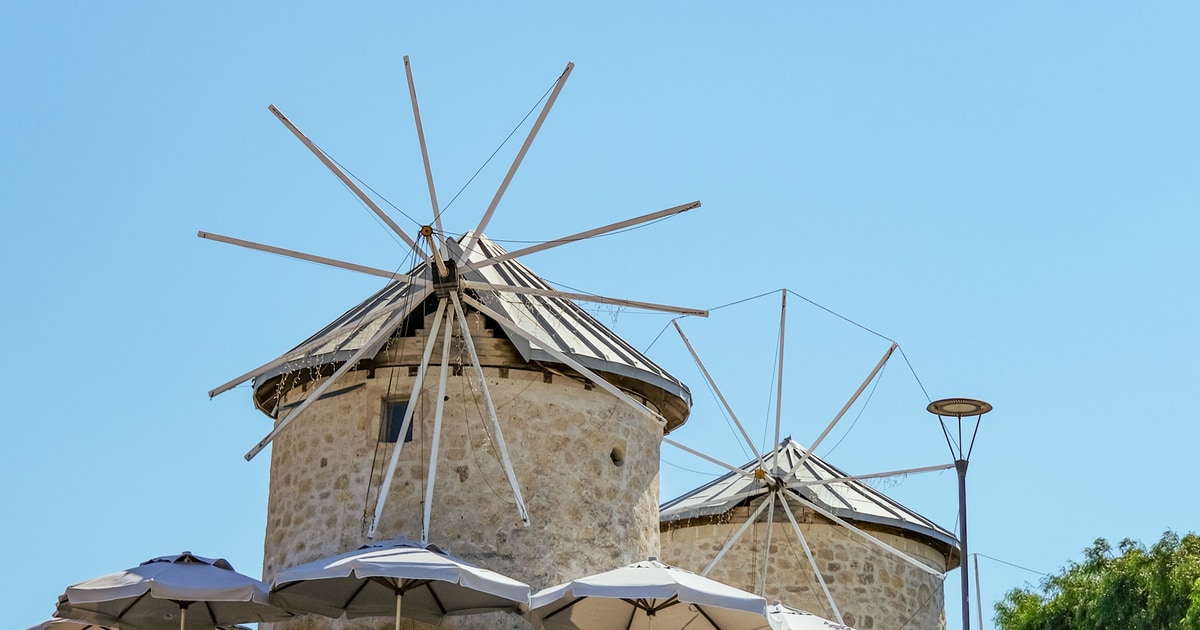
Tower mills keep their stone bodies still and turn only the cap. The sails spin a windshaft, and gears pass that turn to the millstones. Wind and stone gather around an Izmir Cesme Alacati tour by flight from Ankara. Tower mills of the eighteen-fifties stand at Alacati.
A tower mill is a brick or stone tower with a wooden cap, or roof, on top. The Alacati mills are stone windmills on a hill above the village. Day two of this route is built around an Izmir Cesme Alacati tour by flight from Ankara. Hilltop Alacati comes first.
Only the cap of a tower mill turns into the wind, so the main structure can be built much taller. Taller towers allow longer sails. Early millers turned the cap with a long tail-pole that reached the ground. Later mills used winches or gearing inside the cap.
The traditional tower mill carries a four-sail frame. Common sails are a lattice framework with sailcloth spread over it. The jib sail, a simple triangle of cloth wound round a spar, is common in Mediterranean countries. The miller adjusts the cloth to the wind and the power needed, but only with the mill stopped.
The sails ride on a horizontal windshaft, made of wood or of wood with a cast-iron pole end. A brake wheel is fitted onto it between the front and rear bearings. Shafts and wheels centre around an Izmir Cesme Alacati tour by flight from Ankara, mills of Alacati among them.
Teeth on the side of the brake wheel drive a horizontal gearwheel called the wallower. The wallower sits on the top end of a vertical upright shaft. Lower down that shaft, the great spur wheel drives one or more stone nuts. Each stone nut sits on a shaft that drives a millstone.
Millstones work in pairs. The bedstone is the stationary base, with a convex rim. The runner stone has a concave rim and rotates. Together they make a scissoring action that grinds the grain trapped between them. Talk of stones and flour revolves around an Izmir Cesme Alacati tour by flight from Ankara, bedstone first.
In a gristmill, sacks of grain are lifted by a hoist to the sack floor at the top. The sacks are emptied into bins, and the grain falls through a hopper to the stone floor below. A sloping trough called the slipper controls the flow. The grain drops into a hole in the centre of the runner stone.
The milled grain emerges through the grooves in the runner stone at the outer rim. A chute leads the flour down to sacks on the meal floor. Early stone windmills in Turkey used Aegean wind to grind wheat into flour until the nineteen-seventies. On windy days, a mill ground about 320 kilograms of wheat in an hour.
Mills on the western coast of Britain were built mainly of stone to withstand stronger winds. A gallery on a tower mill gave access to the sails for repairs. Stone towers are part of the picture around an Izmir Cesme Alacati tour by flight from Ankara, hilltop first.
Historical evidence does not support windmills before the ninth century. The horizontal type first appeared in Persia in that century. By the end of the thirteenth century, builders had introduced the masonry tower mill, where only the cap turns. A short lesson in that history fits around an Izmir Cesme Alacati tour by flight from Ankara, Cesme next.
For more on Ankara, see Ephesus Sirince Tour by Flight From Ankara.
Why does the wind of Alacati suit windsurfing under an Izmir Cesme Alacati tour by flight from Ankara?
North wind reaches the bay of Alacati as an offshore breeze, so waves stay regular even in heavy wind. Sailors find that pattern under an Izmir Cesme Alacati tour by flight from Ankara. Shallow, clear water in a V-shaped bay completes the setting.
Cesme municipality gives the summer average of the bay as grade four to six, from June to mid-September. It names the north as the prevailing direction. Those figures describe the season that sailors meet under an Izmir Cesme Alacati tour by flight from Ankara. Waves, depth and gear then shape each day on the water.
Three limits on wave size are wind speed, wind duration and fetch. Fetch is the uninterrupted stretch of open water that the wind crosses without a change of direction. An offshore wind starts on land, so it crosses open water only from the shore outward. At Alacati that arrangement gives regular waves even under heavy wind.
Day two puts the bay under an Izmir Cesme Alacati tour by flight from Ankara. Water in the V-shaped bay is clear. A shallow section nearly 500 metres long and 400 metres wide holds completely flat water. Water depth is a fourth limit on wave size. The PWA calls that section very safe.
Alacati has reliable thermal winds and mirror flat water. Together they give fast, close racing. Slalom is a high-speed race, and slalom boards are small and narrow. Those boards need high winds. Racers on the world tour nicknamed Alacati the Slalom Capital of the world.
Alacati hosts one lap of the world windsurfing tournament known as the PWA. The town has hosted historic PWA events over the years and has long been a hotbed of talent. The PWA archive holds World Cup pages from the first decade of the twenty-first century. That racing history sits under an Izmir Cesme Alacati tour by flight from Ankara.
Young riders race there too: the PWA has staged a youth and junior slalom event at Alacati. Racing runs in fin and foil classes for riders under 21, under 17, under 15 and under 13. Between 8,000 and 10,000 professional and amateur windsurfers come to the bay each year, by the PWA’s own figure.
Four winds visit the surf area through the year, and three of them carry the names Zephyr, Notos and Boreas. Boreas is the north wind, bringer of cold winter air. Zephyr is the west wind of light spring and early-summer breezes. Notos is the south wind of late-summer and autumn storms.
From October to April, half of the wind comes from the south. Southern wind gives Alacati good waves for freestyle windsurfers. The bay changes with the wind under an Izmir Cesme Alacati tour by flight from Ankara. Flat summer water and winter waves share one bay.
A windsurfing sail is tensioned at two points: the tack, by the downhaul, and the clew, by the outhaul. The rider steers by moving the rig forward to turn away from the wind. In planing conditions a harness lets the rider use body weight more efficiently. Longboards carry a retractable daggerboard.
Kitesurfing, the sister sport, pulls a rider across the water with a large power kite. Pirlanta beach became a destination for kitesurfing in the first decade of the twenty-first century. That second sport shares the coast under an Izmir Cesme Alacati tour by flight from Ankara. Wind power drives both sports.
What does the Ayios Haralambos church show through an Izmir Cesme Alacati tour by flight from Ankara?
Ayios Haralambos in Cesme is a basilica of three naves, built in eighteen thirty-two. Medallions on its central vault hold painted figures. Day two visits the church through an Izmir Cesme Alacati tour by flight from Ankara. Cesme’s next stop is Dalyan village.
The church was built in eighteen thirty-two as a Greek Orthodox place of worship and is dedicated to Saint Haralambos. His feast day falls on the tenth of February. Records spell the name Ayios, Aya or Agios Haralambos. The Greek name Haralambos means glowing with joy. The building stands in the Ismet Inonu neighbourhood of Cesme.
Izmir Sardes Tour By Flight From Istanbul covers Izmir too.
Seen through an Izmir Cesme Alacati tour by flight from Ankara, Haralambos follows the basilica plan. Its three naves lie from east to west. A basilica has a central nave between lower side aisles, and an apse at one end. The word nave comes from navis, the Latin word for ship. The church holds between 150 and 200 people.
The plan once included an arched narthex, but that entrance area has not survived. A narthex sits at the west end of the nave. A wall, arcade or screen can divide it from the nave. The central nave stands higher than the side naves, which stresses the apse. An apse is a semicircular recess that a half-dome can cover.
Haralambos shows its decoration through an Izmir Cesme Alacati tour by flight from Ankara. Medallions on the vault of the central nave hold painted figures in vivid colours. They show Christ Pantocrator, Saint John, and Mary with the child. The Greek word Pantocrator means all-powerful. In church art this image fills a dome, an apse or a nave vault.
Plaster applied later had covered the frescoes and motifs inside the medallions. Restorers uncovered them with methods of restoration. A fresco is a painting made on freshly laid lime plaster. The pigment merges with the plaster, and the painting becomes part of the wall. A chemical reaction fixes the colour, which is why a fresco lasts.
The municipality of Cesme began the restoration in twenty ten, with funds from the Izmir Provincial Special Administration. Work ended in late spring of twenty twelve. Day two meets the result through an Izmir Cesme Alacati tour by flight from Ankara. Specialist teams did all of the work under expert supervision.
Dense plant growth had formed on the outer surfaces over time, and the restorers removed it. They repaired the outer walls. All excess loads came off the roof and the terraces. The building was freed of cement-based applications. Original plaster and motifs in the interior were kept, with only cleaning, consolidation and partial retouching.
Day two adds the later history of the building through an Izmir Cesme Alacati tour by flight from Ankara. Storage space was one of its later uses, according to a scholarly study of Ionian church buildings. The same study dates its registration as a cultural asset to nineteen eighty-five. Years of neglect came before the restoration.
Through an Izmir Cesme Alacati tour by flight from Ankara, Cesme’s basilica shows a raised central nave. Church builders customarily put the sanctuary at the east end and the entrance at the west end. Haralambos keeps its three naves on that line. Early basilicas carry clerestory windows, set high above eye level, in a wall over the nave.
How do the fish farms of Dalyan work within an Izmir Cesme Alacati tour by flight from Ankara?
Net cages in a bay of the Cesme district hold young sea bass, fed on extruded pellets. Day two reaches Dalyan village within an Izmir Cesme Alacati tour by flight from Ankara. Dalyan, by contrast, means a fishing weir that traps wild fish.
A fishing weir is a barrier set in tidal water, or across a river, to steer fish or trap them. Builders traditionally used wood or stones. The Turkish word for such a trap is dalyan. One Turkish etymological dictionary traces the word to the Greek aliia, which means fishing.
In a lagoon dalyan, mats woven from reeds and sedges are fixed where fish pass, with gaps left open. Fish schools swim into the lagoon to spawn. The gates are then closed, and the fish left inside are caught. Dalyan village carries the same word as a stop within an Izmir Cesme Alacati tour by flight from Ankara.
Gulluk Lagoon, studied by a university, shows how one works. Its traps stand at two openings to the sea, about 350 metres apart. They open in March to let fish in and close in June. The traps and barriers are made of reeds. The lagoon is 0.5 to 3 metres deep.
For more on Ankara, see Ionian Cities Tour by Flight From Ankara.
Dalyan lies on the east coast of the Dalyan peninsula, where the Uc and Top headlands stand. Cesme town lies 4.1 kilometres away, and Dalyan Cove lies to the east. Day two puts the village between church and shores within an Izmir Cesme Alacati tour by flight from Ankara.
Gerence Bay, in the Cesme district, holds a sea bream and sea bass facility. A university study there used four round net cages of HDPE plastic, each 20 metres across and 10 metres deep. Each held 50,000 young sea bass of about 35 grams. That district belongs within an Izmir Cesme Alacati tour by flight from Ankara.
Hatchery rearing of sea bass starts with eggs 1.2 millimetres wide. The larvae hatch blind, with the mouth not yet open. Light comes on only from about day ten, when the swim bladder fills with air. Sea bream larvae measure under 3 millimetres at hatching, which makes them harder to rear.
In the study, feed came as extruded pellets 2 to 3 millimetres wide. The recipe listed fish meal, soya meal, fish oil, wheat flour, wheat gluten, pea protein, maize gluten, vitamins and minerals. The 2 millimetre pellet held at least 48 per cent protein. Fish were fed morning and evening until they stopped eating.
A random sample of fish was weighed and measured every 30 days. The study ran for 91 days, from September to November. Sea bass reach portion size, about 300 to 500 grams, after two years at natural sea temperature. They are sold whole and fresh.
The first sea fish farm in Izmir was set up in nineteen eighty-five. The Aegean has the densest sea farming in Turkey, because its coast and water suit it. Izmir and Mugla are the leading farming provinces. Gilt-head bream was reared in lagoons and saltwater ponds before intensive systems arrived in the nineteen eighties.
Two Turkish names label the farmed fish within an Izmir Cesme Alacati tour by flight from Ankara. Cipura or cupra is the gilt-head bream, and levrek is the sea bass. Pazida levrek is sea bass cooked in chard leaves. Bugulama cooks fish with lemon and parsley under a cover, so that steam does the cooking.
What shapes the Pirlanta and Altinkum shores after an Izmir Cesme Alacati tour by flight from Ankara?
Miocene lake beds and volcanic rock form part of the Cesme peninsula, and Posidonia seagrass adds to Mediterranean sand. Day two meets that ground after an Izmir Cesme Alacati tour by flight from Ankara, Pirlanta and Altinkum included.
Day two reaches the Pirlanta and Altinkum shores after an Izmir Cesme Alacati tour by flight from Ankara. Studies sort the Cesme peninsula’s sediments and volcanic rocks into two stacks of layers, an older and a younger. The Miocene epoch extends from approximately 23 to 5 million years ago.
The older stack is the Cesme Group, and lake deposits dominate it. It dates from the Early to Middle Miocene. Three formations make it up, named Sifne, Ovacik and Ciftlik. Those beds record old lakes on land, not the open sea. Volcanic deposits interrupted the lake sedimentation.
Pyroclastic rocks are made of rock fragments ejected by explosive volcanic eruptions. The silica-rich Alacati pyroclastics were an early product of the Armagandagi volcanism. They rest on the Sifne formation. The calc-alkaline volcanism then left andesitic volcaniclastics and lavas, named Reisdere and Zeytineli. Andesite, lime and marble are quarried in the Cesme area.
The Alacati area also holds Miocene tuffs, which are hardened pyroclastic rocks. West of Izmir, these silica-rich, glassy tuffs are partly altered to zeolites and clay minerals. Mordenite is the commonest zeolite there. Fracture zones running north-east to south-west gave the tuffs the porosity and permeability for that change.
Readers interested in Ankara can open Izmir Pergamon Tour From Ankara.
The younger stack is the Kastepe Group, which dates from the Late Miocene. It covers all the older units across a break in the layers, an angular unconformity. Alluvial fan beds, the Karagoz formation, grade upward into lake beds, the Inlice formation. Carbonate rocks of the Late Triassic form the basement under all of these layers.
Rocks erode near the shoreline from the constant motion of waves, and that wear feeds the sand. Day two meets such a shore after an Izmir Cesme Alacati tour by flight from Ankara. Sand grains are smaller than gravel and coarser than silt. The commonest material in sand is silica, found as quartz, and calcium carbonate comes second.
Day two follows the Turkish Aegean coast after an Izmir Cesme Alacati tour by flight from Ankara. Researchers studied Posidonia meadows at seventeen stations along that coast. Posidonia oceanica is a flowering plant that grows in dense meadows or along sandy channels in the Mediterranean. It lives between one and 35 metres deep, depending on water clarity.
Posidonia does well in clean water, and its presence marks a lack of pollution. Subsurface rhizomes and roots stabilise the plant, while erect rhizomes and leaves reduce silt accumulation. The meadows supply a large share of the sediment that ends up in Mediterranean beach sand. Masses of decomposing leaves on beaches reveal the plant.
Fibrous Neptune balls, made from the leaves, wash up on nearby shores. The plant flowers in September and October where the meadows lie closest to the surface. The fruit floats free, and Italians call it the olive of the sea. Seagrass also slows the water, which cuts wave energy. The plant protects the coastline from erosion.
A protected sea area lies near this route after an Izmir Cesme Alacati tour by flight from Ankara. Presidential decree number 823 declared the Karaburun-Ildir Gulf a Special Environmental Protection Area. The Official Gazette published it in March of two thousand nineteen. The zone covers the sea and islands of Ildir Gulf on the Karaburun Peninsula.