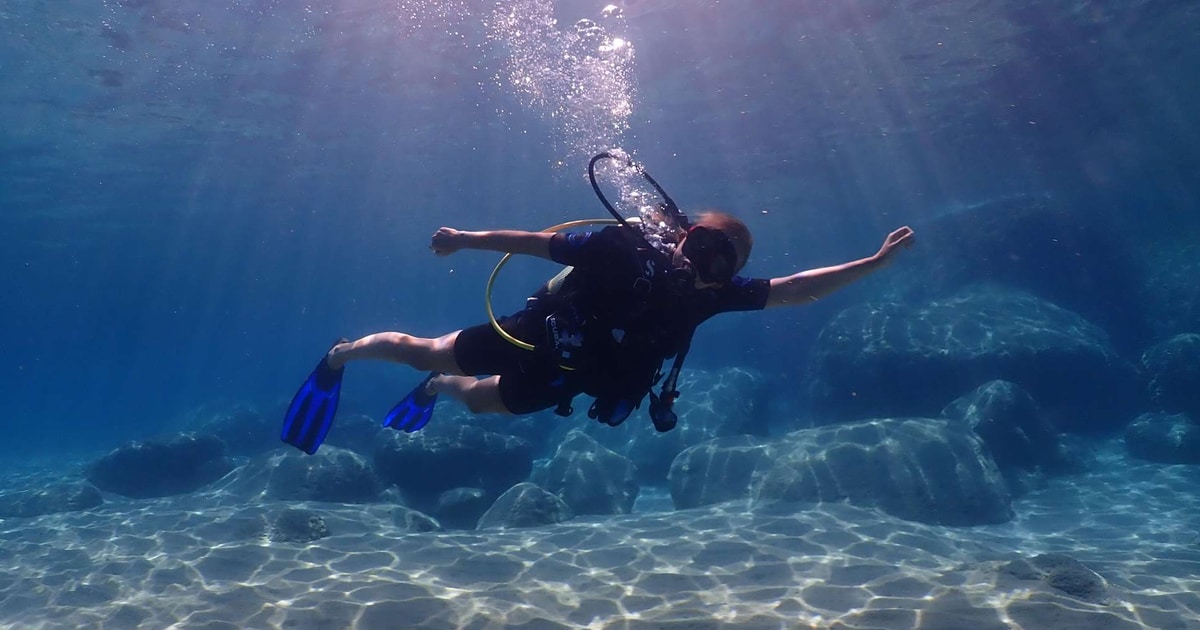
Kos scuba diving is a guided dive with an instructor, from the shore or from a diving boat. Beginners and certified divers can both book a dive. This post covers the formats, the sea, the safety steps and the booking rules. The homepage lists more Greece Tours like this one.
Each tour card below opens a live GetYourGuide booking. Dates, pickup points and group sizes are shown on each card.
What does Kos scuba diving involve and who can try it?
Kos scuba diving is a dive led by an instructor, from the shore or from a diving boat. First-timers join a beginner dive. Certified divers choose a night dive or a dive with an underwater scooter. Hotel pickup comes with the beach, scooter and night dives.
A try dive is an experience, not a course. People with no diver training can take part under an instructor’s guidance. It does not lead to a diving certification. That is the entry point for Kos scuba diving. You need no earlier dives, only an instructor who watches you closely in the water.
If you plan to cross into Turkey as well, the homepage also lists Turkey tours.
The beach dive is designed for beginners. A hotel pickup takes you to a beach that the team picks on the day, based on the weather. The instructor explains the gear, then you practise basic skills in shallow water. After that you swim on, one-to-one with your instructor beside you.
The standard dive with hotel pickup welcomes beginners and divers who already have experience. After a safety briefing, an instructor teaches the basic techniques in English. Complete scuba equipment and dive insurance are included. A commemorative certificate of completion is optional. Food, drinks, and underwater photos and videos are not included.
A diving boat is another way in. On one beginner trip, guests board a 25-metre dive boat with shaded seating and a sun deck. The briefing comes as you board. Scuba gear and snorkelling gear are both provided for use during the trip. Photos and videos are sold on site.
Kos scuba diving from a boat also works for mixed groups. One boat trip suits first-timers and experienced divers alike. A friend who does not dive can come aboard to snorkel and sunbathe. The same trip is sold as a group dive or as a private dive. Another beginner trip names families and couples as a fit.
Kos scuba diving with an underwater scooter is written for certified divers. A diver propulsion vehicle, or DPV, is a compact device that extends a diver’s range underwater. On the Kos dive, it covers more ground with little effort. The dive includes scooter rental, a safety briefing on the beach, an instructor and dive insurance.
The night dive is the other format for certified divers. After hotel pickup, a transfer takes you to calm, sheltered dive sites. Certified instructors lead. The dive includes complete diving equipment, a dive light and dive insurance. A dive light is the basic requirement for any night dive.
For Kos scuba diving, the instructor is the fixed part of every format above. Each hotel-pickup dive also includes dive insurance. Food and drinks are not part of any of them. The beach, standard, scooter and boat formats open with a briefing, and the briefing is included.
You choose the rest. Pick the beach, the boat, the scooter or the night. Pick a beginner dive or a certified one. On the boat, choose between diving and staying aboard as a non-diver. On the standard dive, you choose whether to add the optional certificate of completion.
Where does Kos scuba diving take place and what lives underwater?
Kos scuba diving happens in calm, shallow bays on try dives and at reefs, walls and wrecks deeper down. Kos sits in the south-eastern Aegean. Kalymnos and Pserimos lie to its north, and Nisyros lies to its south. Dive boats reach the neighbouring islands too.
A beginner boat dive goes to a quiet, sheltered bay on Pserimos. Rocky outcrops on either side form a natural barrier. The maximum depth is 5 metres, the water is calm and visibility is excellent. Kos scuba diving on this boat dive therefore stays in a shallow bay with clear water.
Another try dive with a diving boat sails from Kos harbour and dives around Pserimos. The first dive reaches a maximum of 5 metres, and an optional second dive reaches 12 metres. The crew picks the site on the day. A try dive with hotel pickup uses Kokina Bay, where the shallow water reaches about 5 to 6 metres.
The certified shore dive starts on land. Its dive sites are Poli Beach at Kardamena Mikri and Stefanos Beach at Kefalos Agios. Kamari Beach at Kefalos and the Kos Marina wreck complete the list. Divers begin near the diving centre or drive to the site. Kos scuba diving from the shore is for certified divers only.
A certified two-boat dive from Kefalos visits Strogili, Gyali or Nisyros. The depth there is about 30 metres, with clear visibility. Strogili and Nisyros cannot be dived on the same day. Kos scuba diving at this depth suits certified divers. Visibility in the Aegean can reach 25 metres.
The named sites differ in depth. The Potteries off Pserimos lies at about 12 metres, and amphorae on the seabed make it unique. Bubble Reef off Kefalos lies between about 15 and 30 metres. The steep Pserimos wall lies between about 25 and 40 metres. The Blue Hole off Kardamena reaches down to 40 metres.
The Blue Hole off Kardamena is known for four wrecks that divers can explore in a single dive. The Cave of the Black Rock off Pserimos lies at 8 to 20 metres. A dive centre in Kardamena also offers rock formations with caves and tunnels. Kos scuba diving therefore includes wrecks and caves as well as reefs.
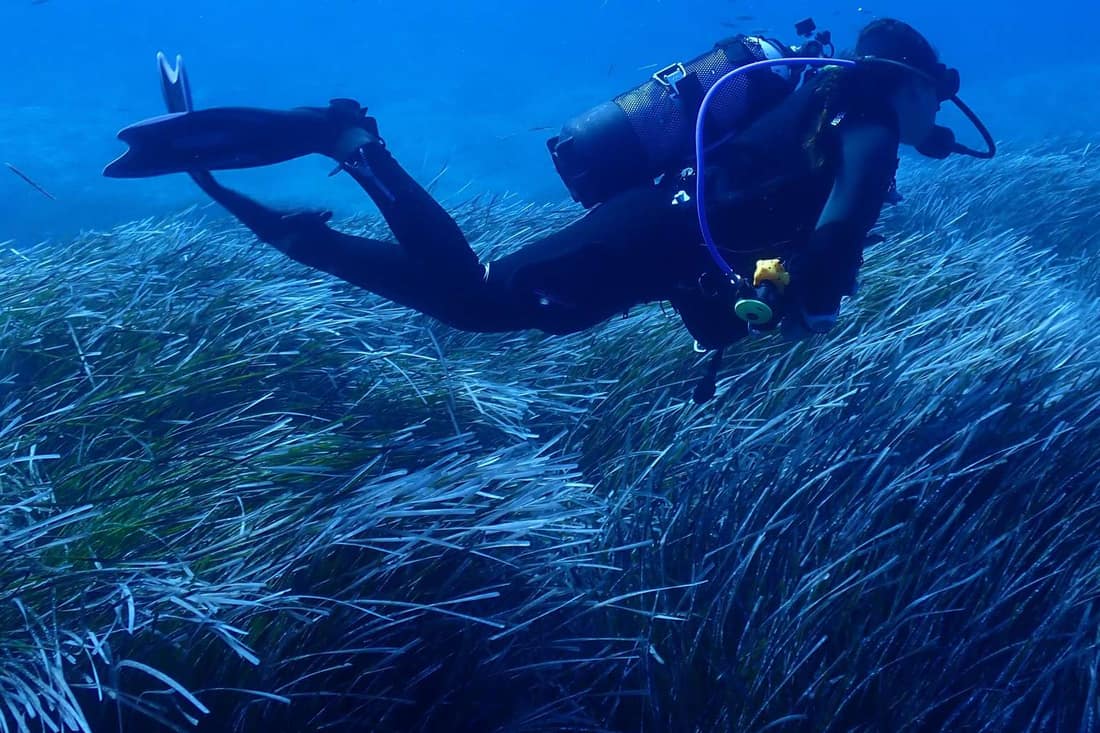
Seagrass meadows grow along about 70 percent of the Greek coastline, the Aegean included. Posidonia oceanica is by far the dominant species. It covers the vast majority of the seabed between the shoreline and 25 to 30 metres. Animals and plants find food and protection in the meadows, and juveniles use them as a nursery.
Kos scuba diving at Bubble Reef shows reef fish, scorpionfish and octopus. The Pserimos wall adds larger bream, an occasional barracuda, moray eels and scorpionfish along the rock edges. The rocky reefs of the Blue Hole show octopus and wrasse. At the Potteries, octopus hide in amphora necks and sponges grow on the ancient ceramics.
The moray and the octopus follow clear habits. The Mediterranean moray spends much of the day in cavities and clefts between rocks and is more active at night. The common octopus prefers the floor of shallow, rocky, coastal waters. Both prefer rocky seabeds, which matches the rocky reefs and wall edges at Pserimos and Kefalos.
What training, equipment and safety steps come with Kos scuba diving?
Kos scuba diving begins with a safety briefing on breathing, signals and equipment, then a close-supervised dive led by instructors. Dive teams supply the gear, ask for a health statement, and keep first-time dives shallow. Certified boat dives also ask for proof of training.
Kos scuba diving starts with a briefing before anyone enters the water. On the try dive by diving boat, the briefing covers breathing techniques, underwater communication and equipment use. It takes about 15 minutes. On that trip, two instructors look after each group of four to five guests.
The kit comes with Kos scuba diving. On the discover dive from Kefalos, it is a wetsuit, mask, fins, snorkel, regulator and dive tank. The regulator lowers the pressure of the air in the tank to the pressure around the diver. It delivers air only while the diver breathes in.
The wetsuit holds a thin layer of water against the skin, and the body warms it. The foam also guards against scrapes, ultraviolet light and stings from marine life. A dive computer measures time and depth. It works out an ascent profile that keeps the risk of decompression sickness low.
Talking does not work well through a scuba mouthpiece, so Kos scuba diving relies on hand signals. On the beach dive with hotel pickup, the instructors stress buoyancy basics and hand signals. A circle of thumb and forefinger means OK. An open hand rocked palm down means something is wrong.
On the way down, the middle ear can sit at a lower pressure than the outside. It does not always even out alone. Divers first learn to pinch the nose, close the mouth and breathe out gently through the nose. Without release, the pressure difference can burst an eardrum. A blocked or congested ear passage rules out diving.
Every guest on the beach dive with hotel pickup completes a health questionnaire before diving. Pre-existing conditions such as asthma or heart conditions can prevent diving, so guests consult a doctor. That dive is not recommended for pregnant guests or for guests with poor cardiovascular health.
Diving medicine backs the asthma and pregnancy warnings. With asthma, narrowed airways can trap gas in the lungs on the way up, and the lung can rupture. For pregnancy, the advice is to avoid diving, because it raises the risk to the unborn baby.
For first-timers, Kos scuba diving stays shallow. The guided try dive lasts 20 to 25 minutes. The discover dive from Kefalos is capped at 6 metres in the sea.
The certified boat dive from Kefalos requires a basic diving certification or equivalent, plus an annual medical clearance. A scooter dive adds a task, because the diver handles depth, buoyancy, breathing gas and direction at once. A night dive needs a dive light, and a spare light helps if the main one fails.
Plan flights around Kos scuba diving. Diving medicine sets a minimum wait of 12 hours before flying after a single dive without decompression stops. After repeated dives on more than one day, the minimum is 18 hours. The boat try dive asks for a longer gap, at least 24 hours. The wait guards against decompression sickness.
When does Kos scuba diving run and which booking rules apply?
Kos scuba diving runs from late spring into October, and the sea is warmest in August. Each format sets its own length, age limit and pickup rule, so read its card before you book. Booking well ahead is recommended, and the booking cards on this page list the open days.
The main season for Kos scuba diving stretches from late spring to October. In those months the water is warmer. The try dive from a diving boat runs daily. Weather still decides each day, because a rough sea can move or cancel a boat dive.
The sea around Kos stays at 16 degrees Celsius or warmer in every month. February and March bring the coldest water, and August brings the warmest. Long-run averages differ by a degree or two between tables. Treat each figure as a rough picture, not a promise for your day.
Each format of Kos scuba diving has its own length. The introductory dive with hotel pickup lasts about 1 hour and 30 minutes. The scooter dive and the night dive each take about 3 hours from pickup to drop-off. The shore dive for certified divers takes 2 to 3 hours.
The try dive from a diving boat fills the morning and early afternoon. The boat leaves from Kos harbour and is back in Kos at about half past two. Arrive at the harbour about half an hour before departure. Divers go out in groups of four or five.
Age limits depend on the format. Kos scuba diving on the try dive from a diving boat starts at age 12. The night dive starts at age 12 as well. The shore dive for certified divers takes children from age 10, and every child must have an adult along. Read the limit on each card first.
Pickup comes with these formats. Kos scuba diving with hotel pickup covers the introductory dive, the scooter dive and the night dive. The certified shore dive has it too. Enter your hotel name on the card to see if it lies inside the pickup area. The supplier sends the exact pickup time closer to the date.
Pack by format. A boat dive and a shore dive ask for slightly different bags. The diving gear itself comes with the dive, so no one packs a tank.
- Boat try dive: swimwear, a towel, sun cream, a hat, sunglasses and cash for extras.
- Shore dive for certified divers: water, snacks, a change of clothes and a camera, besides the swimwear and sun protection above.
- Dives for certified divers: your diving certification card.
- Every pickup: your hotel name.
Booking well ahead is recommended for Kos scuba diving. Each booking card checks live availability for the date you pick. Choose a format and pick a day on its card. Check that the day is open before you plan the rest of your trip.
Cancellation terms differ by format. The introductory dive with hotel pickup gives a full refund for a cancellation made a day ahead or earlier. On the try dive from a diving boat, a rough sea brings another date or a full refund. Read the cancellation line for your date before you pay.