A Konya tour from Istanbul swaps the long road for a short flight and a plain full of old sites. This route visits Catalhoyuk, the museum, Kilistra and Sille over two days. Below you find the flight, the digs, Saint Paul, the rock-cut valley and Rumi. For Greek islands, open Greece Tours on the homepage.
Pick a card below to see open dates on GetYourGuide.
How does the flight shape a Konya tour from Istanbul?
A nonstop flight lasts roughly one hour and fifteen minutes, while the road runs more than 600 kilometres. That gap is why the flight fits a Konya tour from Istanbul into two days.
Flights to Konya leave from both airports of Istanbul. A Konya tour from Istanbul can therefore start on either side of the Bosphorus. The Asian side has Sabiha Gokcen, in the Pendik district. The European side has Istanbul Airport, in the Arnavutkoy district.
Want more days? The Turkey tours on the homepage run from Istanbul to Cappadocia and the Aegean coast.
The city spans two continents. Europe holds roughly two thirds of the population and Asia the rest. Of the two airports, Istanbul Airport is the larger, and Sabiha Gokcen is the secondary one. The M4 metro line runs from Kadikoy to Sabiha Gokcen. Istanbul Airport sits on the M11 metro line, where trains run east to Gayrettepe.
Express public buses link Sabiha Gokcen with Taksim and Kadikoy, and public buses also serve Istanbul Airport. City taxis serve Istanbul Airport day and night. Konya Airport carries the code KYA on the ticket.
The flight itself is short. From Sabiha Gokcen the direct flight takes between one hour ten minutes and one hour twenty minutes. From Istanbul Airport it takes one hour eighteen minutes. Either way, a Konya tour from Istanbul spends little more than an hour in the air on each leg.
Distance explains the choice of a flight. The straight line between Istanbul and Konya is under 500 kilometres. The road is longer, at more than 600 kilometres, and the drive takes more than six hours each way. A coach between the two cities takes at least ten hours.
A high-speed train also links Istanbul and Konya, but the ride takes more than three hours each way. A journey of that length leaves little ground time for the sights of a Konya tour from Istanbul.
Konya Airport lies in the Selcuklu district, less than 20 kilometres from the city centre. Selcuklu is one of the three urban districts of Konya, beside Karatay and Meram. The State Airports Administration (DHMI) runs the airport, and the Turkish Air Force shares it. NATO also uses it.
The airport is home to the 3rd Air Wing of the Turkish Air Force and has two runways. A taxi ride into the city takes about half an hour, and airport shuttle buses run to the centre too. Private cars follow Ankara Avenue between the airport and the centre.
On a Konya tour from Istanbul, the drive from the airport to Catalhoyuk takes less than an hour. Catalhoyuk is the first stop of this route after the landing, ahead of the Konya Archaeological Museum.
This route spreads a Konya tour from Istanbul over two days. Day one holds the flight from Istanbul to Konya, then Catalhoyuk and the Konya Archaeological Museum. The evening is in Konya, and the night is spent there. Day two goes to Kilistra, then Sille, and ends with the flight back to Istanbul.
Flights between the two cities are frequent, and both Istanbul airports connect to Konya. The return flight on day two closes a Konya tour from Istanbul.
What does Catalhoyuk add to a Konya tour from Istanbul?
Catalhoyuk gives a Konya tour from Istanbul its oldest chapter. It is a Neolithic town founded about nine thousand years ago. Its houses stood back to back, with no streets, and people entered them through the roof.
Catalhoyuk overlooks the Konya Plain, south-east of the city, inside the Cumra district. On this route, a Konya tour from Istanbul reaches the site on day one, before the museum. Two mounds rise from the surrounding plain and form a distinctive feature of the landscape.
UNESCO calls Catalhoyuk a very rare, well-preserved Neolithic settlement. Its layers show how early people adapted to settled life and farming. That age makes Catalhoyuk the deepest layer of time on a Konya tour from Istanbul.
The site has an eastern and a western mound, separated by an extinct channel of the Carsamba River. The eastern mound covers about 12.5 hectares and stands about 20 metres high. The western mound is roughly 400 metres across and 7.5 metres high. It lies about 300 metres to the west.
The eastern mound holds the Neolithic town, with eighteen layers of settlement. People renewed a house by pulling part of it down and rebuilding on the rubble. That is how the mound slowly rose. The western mound holds later levels from the Chalcolithic, the Copper Age that followed the Neolithic.
The houses were rectangular, single-storey and built of mud brick. They stood back to back in a honeycomb-like cluster. Each main room held raised platforms, and storage rooms opened off it. No footpaths or streets ran between the houses. A Konya tour from Istanbul looks at a town laid out without a single lane.
People entered through a hole in the ceiling and climbed down a timber ladder or steep stairs. The same opening let smoke from the open hearths and ovens escape. It was the only source of ventilation. Inside, the walls and platforms were plastered to a smooth finish.
People moved from house to house across the rooftops, so the roofs worked as streets. The town held only homes, with no obvious public buildings. The dwellings are of comparable size, which UNESCO links to community and egalitarian ideals. Early estimates gave 5,000 to 7,000 people. Later work suggests 600 to 800 in an average year of the middle phase.
UNESCO lists the property for two reasons. One is its record of the first farming settlements in central Anatolia, which grew from villages into urban centres. The other is its house clusters: streetless neighbourhoods whose dwellings have roof access. The listed property covers 37 hectares, and the excavated remains are preserved in place.
Shelters stand over the two main excavation areas and protect the remains from rain and erosion. Beneath these roofs, a Konya tour from Istanbul passes the dig itself. The North Area shows one neighbourhood, and the South Area gives an overview of the whole occupation. Signs explain the features and the archaeological process.
A replica house on site shows a Konya tour from Istanbul what a Neolithic home looked like inside. Its shape, size and room plan follow excavated houses, but it copies no single one. The visitor centre, developed by Konya Metropolitan Municipality, has halls with interactive displays in Turkish and English.
What did the digs at Catalhoyuk reveal for a Konya tour from Istanbul?
The digs at Catalhoyuk revealed painted house walls, burials beneath the floors, clay figurines and traded obsidian. Visitors joining a Konya tour from Istanbul stand on ground where two separate dig teams worked in turn, decades apart.
James Mellaart reached the mound during a survey of the Konya Plain. The survey found traces of burnt walls, pottery and obsidian tools on the surface. He then led four seasons of digging. Those seasons are the first chapter behind a Konya tour from Istanbul that includes the mound.
In that time Mellaart opened nearly two hundred buildings. Even so, the trenches covered less than four percent of the eastern mound. His team uncovered murals that show leopards, dancers and deer hunters. Red images of aurochs, the extinct wild cattle, stand beside hunting scenes.
Painters coated the walls with white plaster and then added figures in red and black. Later inspection found murals hidden under layers of plaster, laid on at different times to cover dirt and soot. Not every fresh coat was painted, because the others were left blank.
Open air is hard on the plaster. A conservation report records surface erosion, layers lifting apart and weak cohesion after weather exposure. The authors proposed cutting a whole wall away as a panel for laboratory treatment.
The same report notes that the plasters had been backfilled and then dug out again. The project’s first newsletter set the aim of covering part of the site to protect the houses. It also planned to return a share of the paintings to conserved houses on the site.
Burials were the second great find. The villagers buried their dead in pits beneath platforms and floors. Remains of sixty-seven people came from a single house. Certain skulls were plastered and painted with ochre to recreate faces.
The dig also produced clay figurines. More than 2,500 baked-clay figurines have been found, mainly animals, with 187 of people. The Seated Woman stands out among them. She is a nude figure between feline-headed arm-rests, found in a grain bin. Mellaart suggested the placing was meant to protect the food supply.
Mellaart read the figure as a fertility goddess, a view that Hodder’s team later questioned. The figure itself is kept in a museum in Ankara, a city that lies outside a Konya tour from Istanbul.
Obsidian tied the village to distant places. The volcanic glass came from peaks to the north-east. Researchers think obsidian tools were traded for Mediterranean sea shells and flint from Syria. A Konya tour from Istanbul therefore reaches a village that traded with far regions.
Ian Hodder, a British archaeologist at the University of Cambridge, restarted the digs late in the twentieth century. His project was planned to run for twenty-five years. It aimed to conserve the site, set it in context and present it to the public.
Hodder spent a whole season on one building, while Mellaart had opened nearly two hundred. Hodder let each excavator record a personal reading of the site. Two ways of digging meet on a Konya tour from Istanbul, one wide and one narrow.
On day 1 of this Konya tour from Istanbul, the dig site comes before the museum.
What does the Konya Archaeological Museum hold for a Konya tour from Istanbul?
The Konya Archaeological Museum holds finds from the Neolithic age to Byzantine times. A marble sarcophagus with the twelve labours of Hercules stands in its Roman hall. A Konya tour from Istanbul visits the museum on day one.
The collection began in one corner of a secondary school and later moved between buildings. It reached its present home in nineteen sixty-two. The museum stands on Sahip Ata Street, reached by narrow lanes in the old part of the city. The state owns eight museums in Konya, and this is one of them.
The prehistoric hall holds Neolithic finds from Catalhoyuk, among them terracotta pottery and stone tools. Obsidian and flint arrowheads and spearheads come from Catalhoyuk, Erbaba and Suberde. Visitors on a Konya tour from Istanbul can set these objects beside the mound they saw earlier that day.
The same hall holds Bronze Age pottery. Terracotta and bronze rings of the Middle Bronze Age come from Konya Karahoyuk. The Iron Age hall carries painted pottery from the eighth to the sixth century BC. Phrygian and Lydian vessels from Kicikisla stand there. Hellenistic pottery dates from the late fourth to the late first century BC.
Roman Konya fills the next hall. A Konya tour from Istanbul meets pottery, glassware, ivory and jewellery from the city there. Small bronzes show Hermes, Eros and a bull. A stone slab of Cybele, the Anatolian mother goddess, is also shown, with a second-century statue of Poseidon.
The Hercules sarcophagus is a columned marble sarcophagus of the Sidamara type. It is dated to the third century. It measures about 2.5 metres in length, 1.3 in width and 1.7 in height. The museum also shows a clay sarcophagus of the Roman period and a marble one carved with festoons.
Reliefs on the sides show the twelve labours that King Eurystheus set for Hercules. They include the Nemean Lion, the Lernaean Hydra and Cerberus, the three-headed dog. In the lion scene, Hercules holds the animal by the neck, and its head reaches only to his chest. The carving is in high relief.
Istanbul also features in 5 Day Istanbul Tour Package.
The sarcophagus came from Beysehir district in Konya province. Sources name either a village or the ruins of an ancient town as the exact spot. Anyone planning this Konya tour from Istanbul can rely on the district alone and treat the finer detail as open.
The Byzantine section keeps a large floor mosaic of the sixth century. It comes from a church at Tatkoy in the Sille area. Floor mosaics from Alibeyhoyuk are also kept. Small Byzantine bronzes include door knockers, cauldron handles and crosses. The porch shows Byzantine gravestones from Sille and Konya.
The museum holds 231 Greek inscriptions and ten Latin ones. Texts join the objects in a Konya tour from Istanbul. The museum also keeps six trade amphorae made for wine, olive oil and garum, a Roman fish sauce. Outside, the yard shows sarcophagi, column capitals and inscriptions.
On this route the museum follows Catalhoyuk. The evening of the Konya tour from Istanbul then stays in the city, and the night is spent there.
Why is Iconium part of a Konya tour from Istanbul?
Konya is the Iconium of Acts, where Paul and Barnabas taught in the synagogue until the city divided over them. That Bible link adds a second layer to a Konya tour from Istanbul beside the dig and the museum.
Acts chapter 13 sets the scene. Leaders in Pisidian Antioch drove Paul and Barnabas out of the district. The two men shook the dust from their feet and went on to Iconium. Behind them the disciples were filled with joy. This route spends its night in the city where that journey went next.
Another page that includes Konya is Konya Whirling Dervishes Tour By Flight From Istanbul.
The Iconium story fills the opening verses of Acts chapter 14. Paul and Barnabas went into the Jewish synagogue. They spoke so effectively that a great number of Jews and Greeks believed. That scene is why the old city name Iconium turns up on a Konya tour from Istanbul.
Jews who rejected the message stirred up the other Gentiles and set their minds against the believers. Paul and Barnabas still stayed a long time and spoke with confidence for the Lord. The people of the city split into two sides, one backing the Jews and the other backing the apostles.
Then a plot formed among Gentiles and Jews, with their leaders, to mistreat the two men and stone them. Paul and Barnabas learned of it and left for Lystra and Derbe, two cities of Lycaonia. There they went on preaching. The Iconium episode ends with that flight.
Paul himself names the city in a later letter. In chapter 3 of the second letter to Timothy, he recalls his persecutions in Antioch, Iconium and Lystra. Iconium therefore stands in his own list of hardships. He adds that the Lord rescued him from all of them.
Acts chapter 16 returns to the same region on Paul’s second journey. There Paul met a disciple named Timothy. The believers at Lystra and Iconium spoke well of him. The overnight city of a Konya tour from Istanbul, then, already had believers in Paul’s day.
More about Konya: Konya Tour From Ankara.
The Acts of Paul and Thecla, an apocryphal text of the second century, tells a story that Acts omits. Thecla there is a young noble woman of Iconium. She listens to Paul from her window and leaves her fiance to follow him. Tradition ties her to the place where a Konya tour from Istanbul ends its first day.
Rome gave the city titles of its own. The emperor Claudius conferred the title Claudiconium, which appears on its coins and inscriptions. In the reign of Hadrian the city carried the title Colonia Aelia Hadriana Iconiensium. Those titles form the Roman layer of the city that a Konya tour from Istanbul visits.
Christianity came to Iconium very early. It is presumed that Paul appointed bishops or presbyters there during his visit. Michel Le Quien’s list of its bishops opens with Cephas, placed in the first century, then Sosipater and Terentus. Anyone on a Konya tour from Istanbul reaches the seat of a bishopric with that record.
Xenophon calls Iconium the last city of Phrygia, though other ancient writers place it in Lycaonia. In the fourth century the see became the metropolis of Lycaonia, with Amphilochius as its first metropolitan. He accompanied Gregory of Nazianzus to the Council of Constantinople. The Orthodox Church honours him on 23 November.
Is Kilistra the Lystra of Acts on a Konya tour from Istanbul?
No. Scholars place the Lystra of Acts at a mound north of Hatunsaray, while Kilistra lies near the village of Gokyurt. This route stops at Kilistra on day two, so a Konya tour from Istanbul needs the two names kept apart.
Acts chapter 14 says Paul and Barnabas fled to Lystra and Derbe, two cities of Lycaonia. The name Kilistra appears nowhere in that chapter. Anyone who plans a Konya tour from Istanbul around Paul’s first journey therefore has to ask where Lystra really stood.
For more on Istanbul, see Ankara Tour From Istanbul.
Acts describes a man at Lystra who had been lame from birth and had never walked. Paul told him to stand up, and he sprang to his feet and walked. The crowd then called Barnabas Zeus and Paul Hermes. A priest of Zeus brought bulls and wreaths to the city gates.
Two inscriptions found near Lystra in the early twentieth century name both gods. One names priests of Zeus. The other records a statue of Hermes, given with a sundial to Zeus the sun-god. Within a Konya tour from Istanbul, this scene stays a story from Acts. The mound is not a stop on this route.
Later in the chapter, Acts says a mob stoned Paul and dragged him outside the city, thinking him dead. The disciples gathered around him, and he got up and went back into the city. The next day he and Barnabas left. That makes Lystra the place of the stoning as well as the healing.
Acts chapter 16 puts Paul at Lystra, where a disciple named Timothy lived. His mother was Jewish and a believer, while his father was Greek. Readers of Acts who plan a Konya tour from Istanbul meet Lystra in chapters 14 and 16.
A related page on Istanbul: 7 Day Turkey Bus Tour From Istanbul.
Scholars place Lystra at a mound called Zoldera, also spelt Zoldura, on a hill north of the village of Hatunsaray. Hatunsaray is a neighbourhood of Meram district in Konya Province. Konya lies about 30 kilometres to the north of the mound. That placement rests on a Latin inscription found at the site.
J. R. S. Sterrett found the stone on that hill in the nineteenth century. Its Latin text names the colony of Julia Felix Gemina Lustra and a statue of the deified Augustus. Because the stone carries the city’s own Roman name, it fixed the site. The stone is kept in the Konya Archaeological Museum.
Kilistra lies elsewhere: near the village of Gokyurt, south-west of Konya. It is a separate settlement, and Lystra is not Kilistra. This route visits the rock-carved settlement on day two. A Konya tour from Istanbul reaches it as its own place, not as the city of Acts.
The names get mixed for plain reasons. They sound alike, and both places lie in Meram district. A Turkish reference entry also puts Gokyurt village inside the town of Hatunsaray, historically called Lystra. A visit by Paul to Kilistra is only a claim. Researchers tie it to the Royal Road toward Pisidian Antioch, but the claim is unconfirmed.
Put plainly, the Lystra of Acts is the mound of Zoldera, and Kilistra is a different place near Gokyurt. Acts never places Paul at Kilistra. A Konya tour from Istanbul keeps the Acts scenes for the mound and takes Kilistra as its own site.
Readers interested in Istanbul can open Cappadocia Tour From Istanbul.
What can a visitor see at Kilistra on a Konya tour from Istanbul?
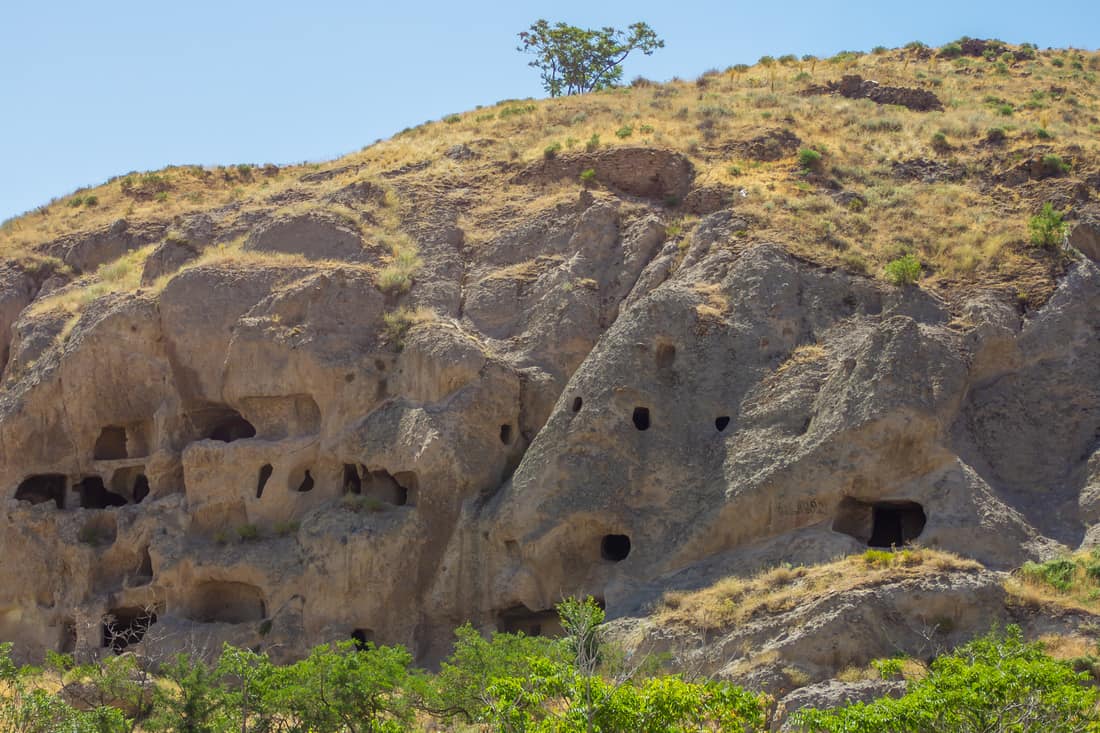
Kilistra is a rock-cut town in cliffs of soft volcanic tuff. It has carved houses, churches, cisterns and tombs around the village of Gokyurt. This route reaches it first on day two of a Konya tour from Istanbul, before Sille.
The cliffs around Kilistra are volcanic. The rock dates from three to eleven million years ago. The main church area is cut in tuff that welded together after the explosion. People chose the place because this stone carves and works easily. Wear from water and temperature change leaves cone shapes that resemble the fairy chimneys of Cappadocia.
The town is carved into the rock. Rooms open straight into the cliffs, and the entrances are well camouflaged, so they show only from close up. Ventilation systems and light holes were cut into the stone. Walkers on a Konya tour from Istanbul need to look closely to spot them.
The Byzantine centuries brought change. Builders widened the rock houses and joined the rooms with corridors, until the town became an underground city. The Christian community grew, and Kilistra served as a safe shelter. Seljuk-era coins found in a small chapel point to a community that lasted into Seljuk rule.
The religious buildings include churches, chapels and monasteries. Sandikkaya Church, whose name means Chest Rock, is small and carved to a cross plan inside and out. Its layout resembles Belli Church in the Soganli Valley of Cappadocia. Villagers can point out the two main rock churches to visitors on a Konya tour from Istanbul.
6 Day Turkey Bus Tour From Istanbul covers Istanbul too.
Water was stored in cisterns cut into the rock. A massive cistern with a triple vault lies on the southern slope of the north-west valley. Cellars, canals and a bridge are recorded as well. Rock tombs, wineries, workshops and fountains complete the town that this Konya tour from Istanbul visits.
On a Konya tour from Istanbul, the barracks and watchtowers show the defensive side of the place. Natural stone spires took the place of defensive walls. Kilistra served as an outpost that guarded the approaches from Konya and Bozkir. It also worked as a police station while it was in use.
Kilistra lies inside the village of Gokyurt, so ruins and homes stand side by side. Residents still use carved rooms as stores and barns. Stone buildings and narrow winding streets line the village. Villagers farm and raise livestock and keep a traditional Konya village lifestyle.
Gokyurt sits off the Konya-Antalya road. The turn south comes just before Erenkaya village, and the lane then runs about thirteen kilometres. Restaurants and grocery stores are hard to find in the village, so visitors bring a picnic and drinks.
Visitors need to be ready for uneven ground and steep inclines. The site is not wheelchair accessible and calls for moderate fitness. The settlement sits on a stony hillside. A Konya tour from Istanbul therefore asks for sturdy walking shoes, water and extra time for breaks.
Istanbul comes up again in Bodrum Kos Tour From Istanbul.
Spring and autumn suit a Konya tour from Istanbul better than the other seasons. Summer can be hot, and a winter chill limits outdoor time. After the valley, this route continues to Sille and then to the flight back to Istanbul.
Who was Rumi, and why does a Konya tour from Istanbul follow his steps?
Rumi was a thirteenth-century Persian-language poet and Sufi teacher who settled in Konya and died there. His followers founded the Mevlevi order, whose turning ceremony, the Sema, links this Konya tour from Istanbul to his life.
Rumi’s family came from the city of Balkh. The advancing Mongol armies forced them to flee west while he was young. They made the pilgrimage to Mecca, crossed Anatolia through Malatya, Sivas and Kayseri, and spent seven years in Karaman. That road brought the future poet to the city at the heart of a Konya tour from Istanbul.
Rumi was nineteen when the family settled in Konya. His father, Baha ud-Din Walad, a theologian and mystic, headed a religious school there. When he died, Rumi, aged twenty-five, took over the post. Years later, on 15 November, he met the dervish Shams of Tabriz, and the teacher became an ascetic.
One night, while he and Rumi were talking, Shams was called to the back door. He went out and was never seen again. Rumi’s grief found its voice in lyric poems. His long poem, the Mathnawi, has six books, and its title means Spiritual Couplets.
Rumi wrote in Persian, his mother tongue. He dictated the Mathnawi to his disciple Husam al-Din Chalabi, who wrote the lines down and read them back. Each story in the poem illustrates a point, and each moral is discussed in detail.
For more on Istanbul, see 6 Day Istanbul Cappadocia Tour Package.
Rumi died in Konya on 17 December in the thirteenth century. The diverse community of Konya mourned him. Local Christians and Jews joined the crowd that carried his body through the city. He was buried beside his father, and his tomb lies in Konya. A Konya tour from Istanbul spends a night in that city.
Once Rumi was gone, the Mevlevi order was set up by his followers together with his son Sultan Walad. Its head carries the title Celebi, a word meaning “man of God” or “noble, courteous”. In the twentieth century a secular policy closed every Mevlevi lodge. Performances later returned, though only in public.
The Sema is the Mevlevi turning ceremony. UNESCO has entered it on its list of the intangible heritage of humanity. Its music, the ayin, has four sections of vocal and instrumental pieces. The whirlers, called semazens, circle around their shaikh. A Konya tour from Istanbul meets the Sema as a public performance.
Each turner spins from right to left around the heart. The right arm points to the sky, and the left hand turns toward the earth. The ceremony opens with a solo on the reed flute. That sound stands for the divine breath behind all life.
A related page on Istanbul: Antalya Tour From Istanbul.
The semazens arrive in a black cloak, a symbol of death and the grave. Their tall hat stands for the tombstone of the ego. Taking off the cloak means being reborn to the truth. Watching it on a Konya tour from Istanbul turns each symbol into movement.
Each December, Konya marks Seb-i Arus, a name meaning Night of Reunion. Rumi saw death as the way to unite with the Beloved, a Sufi term for God. So the event is not only mourning but a celebration. It ends on 17 December, the day Rumi died. Pilgrims from around the world travel to Konya for it.
The Mevlana Cultural Centre in Konya has a large Sema Hall. During the December commemoration, the Sema is performed there every evening. A visitor who wants the Sema on a Konya tour from Istanbul heads for that hall.