A Mycenae Epidaurus day trip from Athens takes you into the Argolis. A Bronze Age citadel, an ancient theatre and a harbour town fit into one long day. This page covers the road, each site, the tour types, the tickets and the season. The homepage lists more Greece Tours like this one.
Each tour card below opens a live GetYourGuide booking. Dates and group sizes are shown there.
What is a Mycenae Epidaurus day trip from Athens?
The mycenae epidaurus day trip from Athens is a one-day tour. It joins two archaeological sites, Mycenae and Epidaurus, with the coastal city of Nafplio. All three stops lie in Argolis, a region in the eastern Peloponnese, so a single route links them.
Three places make up the route. Mycenae is an archaeological site near Mykines in the north-eastern Peloponnese. Epidaurus lies on the Argolid Peninsula by the Saronic Gulf and is known for its healing sanctuary. Nafplio is a coastal city on the Argolic Gulf.
If you plan to cross into Turkey as well, the homepage also lists Turkey tours.
All three stops belong to Argolis, which sits in the eastern part of the Peloponnese peninsula. Because of that shared home region, a mycenae epidaurus day trip from Athens covers all three places on one route. Nafplio is the seat of the regional unit, and Epidaurus is the seat of its own municipality.
Argolis faces the sea on two sides. The Saronic Gulf lies to the northeast, and the Argolic Gulf lies to the south and southeast. Mountain ranges stand to the northwest, west, and east. Argolis is one of seven traditional regions of the Peloponnese. The Peloponnese is a peninsula at the southern tip of mainland Greece.
Each stop adds a different kind of place to the day. Mycenae is an archaeological site. Epidaurus holds a healing sanctuary and an ancient theatre. Nafplio is a coastal city with restaurants and cafes. A mycenae epidaurus day trip from Athens therefore mixes ruins, a theatre, and a port town in one outing.
Nafplio is described as a popular destination for weekend and one-day excursions. Tour listings treat the town as a place to stroll and eat. One listing gives free time in the town, and another lists restaurants and cafes where you can try Greek dishes.
Tour listings share a basic outline. The day starts at a fixed meeting point in Athens, where you meet your driver. You travel into Argolis, visit the sites, and return to the original departure point in Athens. That outline frames the mycenae epidaurus day trip from Athens.
The order of stops changes between listings. One runs Mycenae, then the Epidaurus theatre, then Nafplio, then lunch. A second visits Mycenae, then Nafplio with lunch, then Epidaurus. A travel writer’s account of a coach tour puts Nafplio before Mycenae. The order decides when lunch falls and which site you see last.
Lunch in Nafplio is a separate choice on a mycenae epidaurus day trip from Athens. One listing states that lunch is not included in the ticket price. A second calls the traditional lunch in Nafplio optional. A third marks lunch as “if selected”. Read the inclusions of your listing before the day.
Age bands show who the day suits. One listing sets an adult band from age 16 and a child band from age 5 to 15. Another sets children at 4 to 12. A mycenae epidaurus day trip from Athens therefore has ticket bands for school-age children. One listing welcomes everybody and sets the tour for ages 5 and up.
Booking titles name the same three places in different orders. One title reads “Mycenae, Epidaurus and Nafplio Tour from Athens”. Another reads “Nafplion: Mycenae and Epidaurus Day Tour” and leads with the town. Nafplio is also spelled Nafplion in these titles. Both spellings point to the same city on the Argolic Gulf.
How far is a Mycenae Epidaurus day trip from Athens and what road does it take?
A Mycenae Epidaurus day trip from Athens starts with a drive of 120 km to Mycenae. Epidaurus lies 128 km from Athens by road, and Nafplio lies 136 km away. The three sites sit between 22 and 44 km from each other.
Start with Mycenae, the closest of the three. A route planner measures 120 km by road from Athens to the Lion Gate of Mycenae. It gives a drive time of 1 hour 30 minutes. Wikipedia also places Mycenae about 120 kilometres south-west of Athens.
The other two sites sit a little farther out. For a Mycenae Epidaurus day trip from Athens, the planner shows 128 km and 2 hours 7 minutes to Epidaurus. It shows 136 km and 1 hour 48 minutes to Nafplio. Each figure counts driving only.
The A8 is a toll motorway that connects Athens with Pyrgos and Patras via Corinth. Its eastern end is at Elefsina. Exit 1 is Eleusis and exit 2 is the Attiki Odos interchange. Exit 3 is Nea Peramos and exit 4 is Megara. The A8 has a toll station at the Isthmus.
The Corinth Canal sits on this road. Wikipedia says a railway line, a road and a motorway cross the canal at a height of about 45 metres. A route note for Mycenae says to follow the road toward Nafplion and Mycenae after the canal. A mycenae epidaurus day trip from athens therefore passes the canal before that turn.
The A7 motorway begins just west of the Isthmus of Corinth. It connects Corinth and Kalamata via Tripoli, and the stretch from Corinth to Tripoli is 74 km long. On the A8, exit 11 is Corinth centre and exit 12 is the Moreas interchange with the A7. Exit 13 is Ancient Corinth.
The old national road EO7 also links Corinth and Kalamata, via Nemea, Argos, Tripoli and Megalopolis. At Fichti the short road EO68 branches off the EO7. It runs 3.77 km east to Mycenae and passes through Mykines. This is the last road of a mycenae epidaurus day trip from athens before the Mycenae site.
The same route planner splits the trip at Corinth and between the sites. These are its road distances and drive times, with Mycenae measured to the Lion Gate:
- Athens to the Corinth Canal: 77.2 km, 58 minutes.
- Athens to Corinth: 80 km, 59 minutes.
- Corinth to Mycenae: 42.1 km, 36 minutes.
- Corinth to Epidaurus: 56.5 km, 1 hour 17 minutes.
- Mycenae to Nafplio: 21.5 km, 28 minutes.
- Mycenae to Epidaurus: 44.4 km, 52 minutes.
- Nafplio to Epidaurus: 26 km, 31 minutes.
Epidaurus has its own road on a mycenae epidaurus day trip from athens. The EO70 runs 51.5 km from Argos in the west to Palaia Epidavros in the east. A branch at Lygourio leads to the Ancient Theatre of Epidaurus. Nafplio is one of the main destinations on the same road.
When does a Mycenae Epidaurus day trip from Athens start and where do you meet?
A Mycenae Epidaurus day trip from Athens lasts 9 to 11 hours, or one day, in eight listings. Six of those eight mark pickup as available. The listing data holds no clock time for the start and no meeting point.
Length is the clearest figure for a Mycenae Epidaurus day trip from Athens. One of the eight listings runs 11 hours. Four run 10 hours and two run 9 hours. The last is listed as one day, with no hour count.
Four more listings cover Mycenae and Epidaurus without Athens in their widget titles. Three of them run 10 hours. A private Corinth, Epidaurus and Mycenae day trip runs 8 hours.
The starting town changes the length. A tour from Loutraki runs 8 hours. A day tour from Nafplion runs 6 hours, and a half-day shared tour from Nafplio runs 5 hours. None of them is a Mycenae Epidaurus day trip from Athens, because each one starts in another town.
Pickup is the second clear signal. Six of the eight Athens listings carry the label Pickup available. The two without it show no pickup label at all. For a Mycenae Epidaurus day trip from Athens without the label, read the meeting point on the full listing page.
The label names no area. No listing in the data names a hotel zone, a street, a square or a station. None holds a check-in time either. The widget shows a date picker and a Check availability button, and the full listing sits behind that button.
Language options for a Mycenae Epidaurus day trip from Athens differ by listing. Three of the eight Athens listings offer English only. Two offer English and Greek. One lists ten languages and one lists six. The eighth lists none. The longer lists read as follows.
- Ten languages in one Athens listing: English, French, German, Italian, Spanish, Russian, Portuguese, Polish, Chinese and Japanese.
- Six languages in another Athens listing: English, Spanish, French, German, Japanese and Italian.
- Eight languages in a listing without Athens in its title: English, Italian, Portuguese, Spanish, Dutch, French, Japanese and German.
- Eight languages in a private Argolis listing: English, Chinese, French, German, Italian, Portuguese, Russian and Spanish.
Booking cut-offs show how late you can still reserve a Mycenae Epidaurus day trip from Athens. Seven of the eight Athens listings carry a cut-off label. Two ask for 30 minutes and one asks for 1 hour. One asks for 8 hours, two ask for 10 hours and one asks for 20 hours.
Outside the Athens set the range is wider. A Nafplion day tour asks for 15 minutes, and a private Argolis tour asks for 2 days. Those are the two ends among all the tour listings in the set.
Stop lengths on a Mycenae Epidaurus day trip from Athens are not stated in minutes. One listing calls its Nafplio visit a short stop. A separate private tour of Mycenae alone runs 1.5 hours. It is the only listed duration tied to one site.
The pickup label also shows on three of the four extra route listings. It shows on all three Nafplio and Loutraki starts too. The fourth, which lacks it, is the 10-hour tour with eight languages including Dutch.
What is the history behind Mycenae on a Mycenae Epidaurus day trip from Athens?
Mycenae was one of the two greatest cities of the Mycenaean civilization, says UNESCO. That civilization dominated the eastern Mediterranean from the fifteenth to the twelfth century BC. A mycenae epidaurus day trip from athens takes you into its ruined citadel.
A mycenae epidaurus day trip from athens reaches a hill that people settled in the Neolithic period. Its population grew a great deal in the Middle Bronze Age. Mycenae became a major power between the sixteenth and fifteenth centuries BC. Historians believe it became the main centre of Aegean civilization in the fifteenth century BC.
Historians call the period from about the sixteenth to about the twelfth century BC Mycenaean, after this site. At its peak in the fourteenth century BC, the citadel and lower town held 30,000 people on 32 hectares. Egypt knew Mycenae by name as a capital city on the level of Thebes and Knossos.
Around the middle of the fourteenth century BC, builders rebuilt the fortifications of the acropolis in the Cyclopean style. The stone blocks were so massive that later ages believed the one-eyed giants known as the Cyclopes had made them. Much of that wall can still be seen. Inside it, builders raised one palace after another.
In Greek legend, Atreus had two sons, Agamemnon and Menelaus. Agamemnon inherited Mycenae, and Menelaus became king of Sparta. On a mycenae epidaurus day trip from athens, you enter what UNESCO calls the kingdom of the mythical Agamemnon. In the Iliad, Homer mentions a loose confederacy of city-states under the king of Mycenae.
In the story, Agamemnon led a ten-year war against Troy to win Helen back for his brother. He came home to Mycenae, and his wife Clytemnestra killed him. Their son Orestes returned with his sister Electra and killed Clytemnestra and her lover Aegisthus. Playwrights retold it in the Oresteia and in the Electra plays of Sophocles and Euripides.
Heinrich Schliemann was obsessed with the epic poems of Homer and believed they rested on historical truth. His first dig was at Hisarlik, believed to be ancient Troy. In the nineteenth century he moved on to Mycenae to find the grave of Agamemnon. A mycenae epidaurus day trip from athens takes you over ground that he and later teams excavated.
Schliemann uncovered a royal cemetery with six shaft graves. Among his finds was a gold death mask that he named the Mask of Agamemnon. The mask is dated more than 300 years before the Trojan War, so his claim about Agamemnon fails. Admirers call him the father of scientific archaeology, while critics blame his destructive digging.
The Bronze Age Collapse destroyed Mycenae near the end of the thirteenth century BC. A second destruction in the twelfth century BC ended Mycenae as a major power. The cause behind the ruins on a mycenae epidaurus day trip from athens is unknown. Scholars debate two main ideas: invaders and internal conflict.
One proposal is a Dorian invasion, an idea from ancient Greek tradition. Others propose climate change, drought or earthquakes. Mycenae was partly rebuilt, but it was no longer the centre of a literate bureaucracy. In the fifth century BC, troops from Argos captured Mycenae, expelled the people and razed its fortifications.
UNESCO added Mycenae and Tiryns to the World Heritage List late in the twentieth century. It cites the outstanding architecture and the link to Homer. The five criteria show why a mycenae epidaurus day trip from athens visits a World Heritage site.
- Criterion one: the architecture and design of Mycenae and Tiryns are outstanding examples of human creative genius.
- Criterion two: the Mycenaean civilization had a profound effect on classical Greek architecture and urban design.
- Criterion three: the sites bear unique testimony to the political, social and economic development of the Mycenaean world.
- Criterion four: the sites show the achievements of Mycenaean civilization in arts, architecture and technology.
- Criterion six: the sites are linked with the Iliad and the Odyssey, which influenced European literature and arts for more than three millennia.
What do you see at the Mycenae site on a Mycenae Epidaurus day trip from Athens?
On a Mycenae Epidaurus day trip from Athens, you see the Lion Gate, Grave Circle A and the palace ruins. Nearby are a deep underground cistern, the domed Treasury of Atreus and a site museum of Mycenaean daily life.
The Mycenae stop on a mycenae epidaurus day trip from athens is a walk on foot. From the car park, a path leads to the acropolis past exposed house foundations and shaft tombs. Behind the ticket office, a side path branches left to the museum. The citadel stands on a hill 274 meters above sea level.
The Lion Gate is the main entrance to the citadel. Builders raised it in the thirteenth century BC. Above the doorway, a triangular slab shows two lions or lionesses on either side of a central column. Their heads are missing, but their necks survive. The Ministry of Culture calls the gate the symbol of the Mycenaean rulers’ power.

The doorway is 3.10 meters wide and 2.95 meters high at the threshold. A lintel 4.5 meters long spans it. The largest stones in the gate weigh well over 20 tonnes. To the right of the entrance lies the Granary, named for the burnt grain found in its basement.
Your mycenae epidaurus day trip from athens passes Grave Circle A behind the entrance, south of the Granary. The ring is 27.5 meters across and holds six shaft graves. The largest grave measures about 6.5 by 4.1 meters. Nineteen people were buried here, two to five per grave. Diggers found gold death masks, weapons, and gold and silver cups.
On a mycenae epidaurus day trip from athens, you read the palace from its stone outlines. It stands on terraces at the highest point of the citadel. A ramp from the Lion Gate once led up to it. The palace you see began in the fourteenth century BC. Its main building holds a courtyard, a guesthouse and the megaron.
The megaron had a columned porch, a vestibule and a main chamber. The ruler’s throne stood in the main chamber. Palaces of this age in southern Greece shared one plan. Each megaron had a raised hearth under a roof opening held up by four columns. Painted frescoes covered the plaster walls and floor.
At the northeast corner of the citadel, a corbelled corridor leads down eighteen meters to the underground cistern. The passage has about 99 steps. Builders added it to keep water within reach during sieges. Only part of the cistern is open to visitors. Near its entrance stands the North Gate, built like the Lion Gate but smaller.
A mycenae epidaurus day trip from athens also reaches the Treasury of Atreus, a beehive tomb. It stands outside the walls. A stone-lined passage, the dromos, leads in. It is 36 meters long and 6 meters wide. The round chamber is 13.2 meters high and 14.2 meters across. Its roof has 33 stacked rings of stone.
Above the door lies a lintel of two enormous slabs. The inner slab is 8 meters long and 5 meters wide and weighs around 120 tons. Its dome was the largest in the world until the Roman period. The Tomb of Clytemnestra is a second beehive tomb, built around the thirteenth century BC. Its chamber is 13.4 meters across.
The museum sits in the northern part of the acropolis. Its displays cover Mycenaean daily life and beliefs about death. The golden exhibits are copies, and the originals are in Athens. It adds the finds behind the ruins on a mycenae epidaurus day trip from athens. A tour of the Mycenae site on its own is listed at 1.5 hours.
What is the Asklepieion at Epidaurus on a Mycenae Epidaurus day trip from Athens?
The Asklepieion is the sanctuary of Asklepios, the Greek god of healing. On a mycenae epidaurus day trip from athens, you walk through its ruins. Sick people slept in a sacred hall and waited for the god to advise them in a dream.
Epidaurus was the healing centre with the highest standing in the Classical world. Ill people travelled there hoping for a cure. The cult of Asklepios is recorded there in the sixth century BC. By then the older hilltop sanctuary of Apollo Maleatas no longer had enough room.
Water was part of the treatment. The faithful went through purification with water, and baths were central to the healing process. Healing temples of the cult also used purging and a cleansing diet, which lasted days. The sanctuary had hot and cold bath houses. Pythodorus donated the bathhouse of Asklepios called the north-east baths.
The patient spent the night in the abaton, also called the enkoimeterion. This was a big sleeping hall with columns. Only the sick were allowed inside. The practice is called incubation, or temple sleep. On a mycenae epidaurus day trip from athens, you find the abaton beside the temple of Asklepios.
In the dream, the god himself advised the patient what to do to regain health. The patient reported the dream to a priest. The priest interpreted it and prescribed a cure, for example a visit to the baths or a gymnasium. The patient then made an offering of money or a prayer to the temple.
The sanctuary held sacred snakes. The serpents were tame with people and belonged to Asklepios. His snake-entwined staff is still the symbol of medicine today. Pilgrims stayed in the katagogion, a guest house with 160 guest rooms. More than 300 temples of this kind have been found across ancient Greece.
The Tholos stands in the sanctuary you cross on a mycenae epidaurus day trip from athens. It is a round building of white marble from the fourth century BC. Its design is credited to Polykleitos, an architect from Argos. Doric columns formed the outer ring and Corinthian columns the inner ring. A labyrinth of narrow corridors lay in the foundation.
The temple of Asklepios was a Doric building with six columns by eleven. It dates to the early fourth century BC. An inscription names Theodotus as the architect, and the project took nearly five years. Thrasymedes of Paros made the gold and ivory statue of the god. On a mycenae epidaurus day trip from athens, you see only the foundations.
The stadium lies next to the sanctuary and is 181 metres long. It hosted athletic games in honor of Asklepios every four years. Spectators first stood, and limestone seats came in the late fourth century BC. On a mycenae epidaurus day trip from athens, you still see the starting pillars and part of the stone benches.
Panagiotis Kavvadias excavated Epidaurus for nearly thirty years. He built the site museum at the start of the twentieth century. It holds inscriptions, statues, roof pieces and parts of important buildings. Fragments of the temple’s upper structure are among them. If your mycenae epidaurus day trip from athens includes the museum, the exhibits help you picture the lost buildings.
Sulla sacked the sanctuary during the First Mithridatic War. A visit by Hadrian in AD 124 revived it. The Goths raided it in AD 395. By the mid fifth century it was still a Christian healing centre. UNESCO inscribed the site in nineteen eighty-eight for its exemplary architecture. A mycenae epidaurus day trip from athens visits that World Heritage Site.
Why is the Epidaurus theatre the highlight of a Mycenae Epidaurus day trip from Athens?
The Epidaurus theatre is the highlight of a mycenae epidaurus day trip from athens because it is still in use. It seats around 14,000 people on 55 rows, and the Athens and Epidaurus Festival stages ancient drama there in summer.
Your mycenae epidaurus day trip from athens reaches the theatre inside the Sanctuary of Asklepios. Contests, including theatre contests, were held there as part of the worship of Asklepios, the god of medicine. The same seats now hold audiences at modern performances.
The Argolis culture website names Polykleitos the Younger as the architect. It dates the building to the late fourth century BC. The festival’s venue page notes that Pausanias credits a Polykleitos. It adds that it is not clear whether he names the architect of these buildings.
Experts believe the theatre went up in two phases. The first belongs to the fourth century BC and the second to the middle of the second century BC. Count the rows during your mycenae epidaurus day trip from athens. The lower tier has 34 rows of benches. The upper tier, built in the second phase, has 21 more.
A semi-circular aisle, the diazoma, separates the two tiers. Steps divide the seating into wedge-shaped sections, 12 in the lower tier and 22 in the upper tier. The front rows of each tier were places reserved for important people.
The theatre you visit on a mycenae epidaurus day trip from athens seats around 14,000 people. The Argolis culture website gives a maximum of 13,000 to 14,000 spectators. The circular orchestra at the centre measures 20 metres across. The benches of the eight central tiers curve in circles around its centre point.
The festival’s venue page credits the excellent acoustics to the geometry of the design. Georgia Tech researchers added a second cause, the ridged stone seats. They found that the seats hold back sound up to 500 hertz while higher sounds ring out. One reference says people seated about 60 metres from the stage hear actors without amplification.
Researchers from Eindhoven University of Technology tested the legend of the dropped coin at Epidaurus. They found that a falling coin or tearing paper can only be heard up to about halfway up the seating. A struck match needs a seat nearer the stage. A whisper carries only to the front row.
The stage you see on a mycenae epidaurus day trip from athens hosts the Athens and Epidaurus Festival each summer. The festival was founded in the middle of the twentieth century. It opened with a National Theatre production of Euripides’ Hecuba. Its programme includes tragedies by Aeschylus, Sophocles and Euripides and surviving comedies by Aristophanes.
For its first two decades the festival reserved the theatre for the exclusive use of the National Theatre. The theatre has also hosted opera, dance and concerts. The Greek National Opera staged Bellini’s Norma and Cherubini’s Medea there in the early nineteen-sixties, both starring Maria Callas.
Climb the steps to the diazoma and on to the top rows during your mycenae epidaurus day trip from athens. A visitor reference suggests going all the way to row 55 and sitting there for five minutes. It budgets 45 to 60 minutes for the theatre alone, covering the climb, the acoustic test and quiet sitting.
- At a festival performance, nobody enters after the start except during an interval.
- Children under the age of six are not permitted at performances.
- Smoking, food and drink are not permitted inside the theatre.
What do you see in Nafplio on a Mycenae Epidaurus day trip from Athens?
On a Mycenae Epidaurus day trip from Athens, Nafplio is where you walk the Venetian old town and Syntagma Square. You also see the Palamidi fortress on its hill and the Bourtzi sea fort on its islet in the harbour.
Nafplio is the stop where a Mycenae Epidaurus day trip from Athens leaves the ruins and enters a living town. It was chosen as the first capital of the newly founded Greek state, under Governor Kapodistrias. Earlier, the Venetians had made it the capital of their Kingdom of the Morea.
Syntagma Square is the heart of Nafplio, and its name means Constitution. Neoclassical buildings frame it. At the west end stands the Venetian arsenal, built in the early eighteenth century and now the archaeological museum. People from the town sit there with a coffee in the morning.
The Trianon, an old mosque, stands at the end opposite the museum. The Vouleftiko is a big grey stone building south of the square. The Turks built it, and it later held the first Greek People’s Assembly. A Mycenae Epidaurus day trip from Athens therefore passes Venetian, Turkish and Greek history in one square.
Everything in the old town is within walking distance. Wikivoyage says you can walk from one end to the other in less than 15 minutes. So a Mycenae Epidaurus day trip from Athens can cover the old town on foot.
Below the rocky hill of Acronafplia lies Psaromachala, a name that means fishermonger’s. Wikivoyage lists it as a place to walk around. On Kapodistriou Street stands the church of Saint Spyridon, where the first governor of Greece was killed. Two beaches and a coast path lie near the old town:
- Karathona is a quiet sandy beach close to the town, just south of the castle hill.
- Arvanitia beach is 10 minutes’ walk south of the town, at the back of the castles.
- A walking path along the coast leads from Karathona back to Arvanitia and Nafplio.
Palamidi is the fortress on the hill above Nafplio, and the hill reaches 216 metres. The Venetians built it in the early eighteenth century. It has eight bastions that are joined together yet can hold out alone in a siege. The Miltiades bastion served as the prison of Theodoros Kolokotronis, a hero of the Greek Revolution.
The climb to Palamidi is called 999 steps. The official Greek tourism site says the real count is 857. A road also reaches the entrance, about 4 km away, a drive of about 10 minutes from Syntagma Square. On one listing for a Mycenae Epidaurus day trip from Athens, the walls of Palamidi are a brief photo stop.
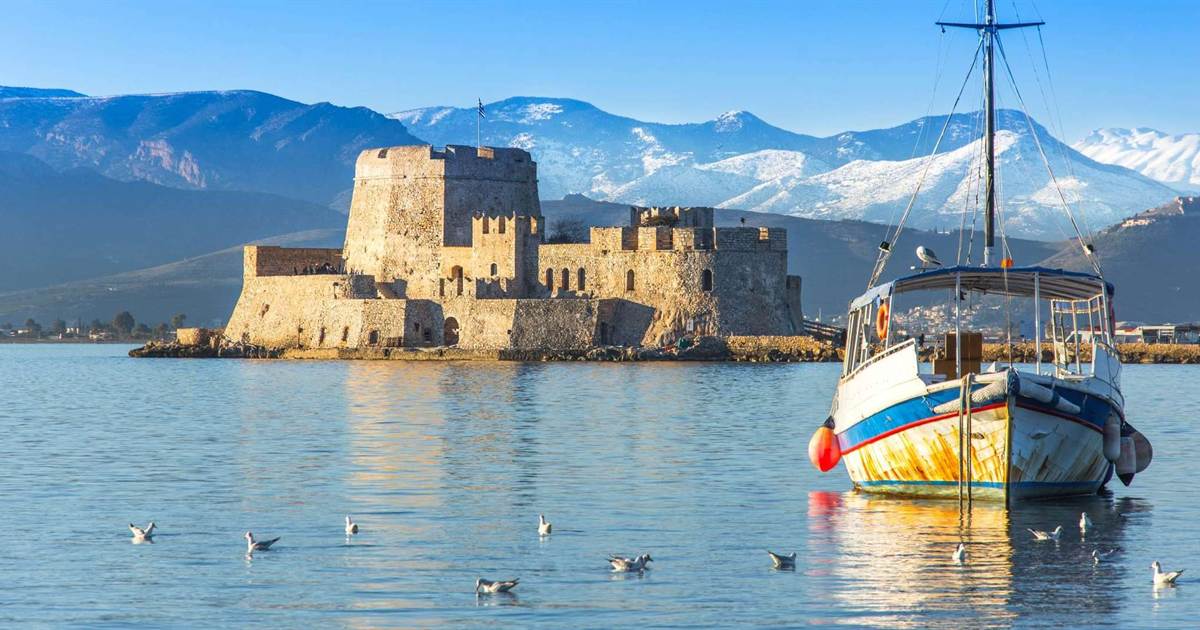
Bourtzi is the small Venetian sea fortress on the rocky islet of Agioi Theodoroi, in the middle of the harbour. Antonio Gambello was its first architect, and the engineer Brancaleone oversaw the building after him. Work began in the fifteenth century. The fortress has two gates, one on the north side and one on the south.
A chain once ran from Bourtzi to the town. It was raised close to the water during a siege to block enemy ships. The town took the name Porto Cadena, Harbour of the chain, from it. Later the fortress housed the executioners of the Palamidi prisons, and in the twentieth century a hotel and restaurant.
Small boats at the port reach Bourtzi in 5 minutes, says Wikivoyage. One listing for a Mycenae Epidaurus day trip from Athens gives free time in Nafplio. It states no fixed number of hours.
Which extra stops can a Mycenae Epidaurus day trip from Athens include?
The Corinth Canal is the extra stop that six of 18 related listings name. One eight-hour variant adds Ancient Corinth. No listing summary names Tiryns, Argos, Isthmia or Lerna on a mycenae epidaurus day trip from Athens.
The canal that a mycenae epidaurus day trip from Athens stops at separates the Peloponnese peninsula from the Greek mainland. It connects the Gulf of Corinth in the Ionian Sea with the Saronic Gulf in the Aegean Sea. One related listing says you cross it to leave mainland Greece.
The cut is 6.4 kilometres long. It is 24.6 metres wide at the surface and 21.3 metres wide at the bottom. The rock walls rise 90 metres above sea level at a near-vertical angle of 80 degrees.
The tyrant Periander proposed a canal here in the seventh century BC. Roman emperor Nero broke the first ground with a pickaxe in the first century AD. The canal opened formally in July, in the last decade of the nineteenth century. Large vessels find it hard to navigate, so tourist ships and small recreational boats use it today.
Six of the 18 related listings for a mycenae epidaurus day trip from Athens name the canal. The small-group tour lists a stop at it. A private day trip travels along the coastal road to it. A coach tour lists it as a highlight, and a fourth tour calls it an engineering wonder.
Three of the six are private tours. The others are the coach tour, the small-group tour and the tour called Journey into Greek Legends. The other 12 listings do not name the canal in their summaries.
Only one variant of the mycenae epidaurus day trip from Athens adds Ancient Corinth. Its summary lists the Corinth Canal, Ancient Corinth, Ancient Mycenae and the theatre of Epidaurus on a full-day private tour. It runs eight hours and names no Nafplio stop.
The Temple of Apollo at Ancient Corinth dates to the sixth century BC and follows the Doric order. It had 38 columns, and seven still stand. The Roman Forum is one of the largest public areas uncovered in Greece. The Archaeological Museum of Ancient Corinth holds the finds. Julius Caesar refounded the city after it lay largely deserted.
Isthmia is not on any listing for a mycenae epidaurus day trip from Athens. It lies on the Isthmus of Corinth and holds a sanctuary of Poseidon. The Isthmian Games began there in the sixth century BC. Only the games at Olympia ranked higher, and the site now has a museum.
Tiryns also stays off every summary for a mycenae epidaurus day trip from Athens. It lies on the Argolid plain between Nafplio and Argos. Galleries over 20 metres long run inside its south and east walls. Myth places Heracles there during his Twelve Labours. The people of Argos destroyed the town in the fifth century BC.
Argos is one of the oldest continuously inhabited cities in the world. Its ancient theatre was built in the third century BC with a capacity of 20,000 spectators. Larissa castle stands on the site of the ancient acropolis. Argos lies 11 kilometres from Nafplio, its historic harbour.
Lerna lies in the village of Myloi, on the west side of the Gulf of Argolis. The regional antiquities office ranks it among the leading prehistoric sites in Greece. Its House of Tiles measures 12 by 25 metres and dates to the third millennium BC. Myth says Heracles killed the Lernaean Hydra there as his second labour.
A short day cuts every extra stop. The half-day shared tour from Nafplio lasts five hours and names only Mycenae and Epidaurus. A six-hour day tour from Nafplion names the same two sites. A mycenae epidaurus day trip from Athens with the canal stop runs from eight to eleven hours.
Which formats does a Mycenae Epidaurus day trip from Athens come in?
A mycenae epidaurus day trip from athens comes as a coach group, a small group or a private car. A shorter tour starts in Nafplio. The listings run from 5 hours to 11 hours, so the format sets the length of your day.
The coach group is the long format. One listing, titled Mycenae, Epidaurus and Nafplio Tour from Athens, runs 11 hours and describes a coach service. Another large-group listing runs 10 hours and names expert guides and tour leaders. No other mycenae epidaurus day trip from athens listing with stated hours runs longer than that 11-hour coach tour.
Audio changes what you hear on the coach. The 11-hour listing offers a virtual reality device and an audio guide in 8 languages. A 10-hour listing from Athens marks the audio guide as optional, and so does the 10-hour small-group listing. Read that label first when you compare one mycenae epidaurus day trip from athens with another.
The booking form of the 10-hour Journey into Greek Legends listing shows eight languages. They are Dutch, English, French, German, Italian, Japanese, Portuguese and Spanish. A second 10-hour listing from Athens shows six: English, French, German, Italian, Japanese and Spanish. If you want a mycenae epidaurus day trip from athens in Spanish, four listings in this set offer it.
The listing titled From Athens: Small-Group Mycenae, Epidaurus & Nafplio Trip runs 10 hours. Its booking form lists English only. The Small Group Tour listing runs 9 hours, also in English only. It carries a skip the line label and a private option. Neither title gives a seat count, so the title tells you only that the group is small.
Private listings name the vehicle. One names an SUV with leather seats. Another names a premium Mercedes with a local expert chauffeur. A third names a Tesla or Mercedes fleet. The SUV and Tesla listings run 10 hours, and the Mercedes listing runs 1 day. A private mycenae epidaurus day trip from athens swaps the coach for a car.
Two private titles state a group cap. The Private Day Trip listing allows up to 7 people in a group. The Private Day Trip with Chauffeur listing allows up to 6. Both are labelled private group and small group, and both list English and Greek in the booking form. Those caps tell you the largest party that fits one booking.
Private day trips differ in length. The private listings with hours stated run 8 to 10 hours. The Corinth, Epidaurus and Mycenae Day Trip runs 8 hours and drops Nafplio from its title. The listing that starts in Loutraki also runs 8 hours. A private tour from Athens runs 9 hours, in English only.
Two listings start in Nafplio instead of Athens. The From Nafplion: Mycenae & Epidaurus Archaeology Day Tour runs 6 hours and carries a skip the line label. The From Nafplio: Half-Day Shared Tour runs 5 hours and calls itself half-day. Neither is a mycenae epidaurus day trip from athens, because the start is Nafplio.
Single-site products sit beside the day trips. One listing sells an e-ticket for Mycenae with an audio tour you download to your phone. A Mycenae private tour with a licensed guide runs 1.5 hours. A third product sells an Epidaurus entrance ticket with optional audio. Each covers one site, so none matches a full mycenae epidaurus day trip from athens.
Every day-trip listing named above carries a free cancellation label. Four private listings add a wheelchair accessible label. They are the up-to-7, up-to-6, Loutraki and Argolis day tour listings. The Argolis one runs at your own pace. Match that label to your party before you choose a format.
What do tickets and opening hours cover on a Mycenae Epidaurus day trip from Athens?
A Mycenae Epidaurus day trip from Athens needs one entry ticket for Mycenae and one for Epidaurus. Each ticket opens the ruins and the site museum. Both sites open at 8 am from April to October, and last entry is 20 minutes before closing.
Each site sells its own ticket on the Hellenic Heritage portal, which the Ministry of Culture runs. The Mycenae page and the Epidaurus page both list a full ticket and a reduced ticket. A Mycenae Epidaurus day trip from Athens therefore needs two entries, one at each site.
The Mycenae ticket gives access to the archaeological site, the Mycenae museum and the Tholos Tomb of Atreus. The museum stands inside the site area. The Epidaurus ticket gives access to the site and the museum of the Sanctuary of Asclepius. The theatre is part of that sanctuary. Both pages offer online sales.
Mycenae sets its hours by season. From 1 April to 31 October it opens at 8 am. From 1 November to 31 March it opens at 8:30 am and closes at 3:30 pm. Check these hours first when you pick a date for a Mycenae Epidaurus day trip from Athens. The summer closing times step down like this:
- 1 to 30 April: closes at 7 pm
- First day of the fifth month to 31 August: closes at 8 pm
- 1 to 15 September: closes at 7:30 pm
- 16 to 30 September: closes at 7 pm
- 1 to 15 October: closes at 6:30 pm
- 16 to 31 October: closes at 6 pm
The ministry’s museum portal gives Mycenae one summer closing time, 6 pm, which differs from the list above. Call the museum to confirm. Epidaurus opens at 8 am in every season. Its summer closing times match the Mycenae list. In winter it closes at 5 pm, and in March at 6 pm.
Last entry is 20 minutes before closing time at both sites. Both sites close on 1 January, 25 March and Orthodox Easter Sunday. They also close on the first day of the fifth month and on 25 and 26 December. A Mycenae Epidaurus day trip from Athens cannot enter either site on those dates.
The ministry’s museum portal lists the days when Mycenae stays open. They are 6 January, Clean Monday, Orthodox Easter Monday, Holy Spirit Monday, 15 August and 28 October. The portal adds that hours change on Good Friday and on the Saturday after it.
Entry to both sites is free on set dates. They are 6 March, 18 April, 28 October, the last weekend of September and the 18th of the fifth month. From 1 November to 31 March, the first Sunday of each month is free too. Hellenic Heritage adds the third Sunday, but the ministry portal names only the first.
Reduced tickets exist at both sites, but the ticket pages do not say who qualifies. The Mycenae portal page sends you to a separate ministry page on free and reduced admission to state museums. Read that page for your own age and status before a Mycenae Epidaurus day trip from Athens.
Two widget gigs sell tickets alone. One is an e-ticket for the Mycenae site and museum, with an audio tour on your phone. It needs a booking one hour ahead. The other sells Epidaurus entry and needs 15 minutes of notice. Each gig covers one site, so a Mycenae Epidaurus day trip from Athens built from tickets needs both.
A group day trip sells the whole day as one gig. Its widget card shows the length and labels such as pickup and audio, but no line about entry fees. Seven of the eighteen related gigs carry a Skip the line label. Check what the price covers on the gig page before a Mycenae Epidaurus day trip from Athens.
When is the right season for a Mycenae Epidaurus day trip from Athens?
Spring and autumn suit a mycenae epidaurus day trip from athens. Argos averages 21 degrees Celsius by day in April and 25 in October, against 34 in July. Travel sources report thinner crowds outside summer.
Nafplio has dry, hot summers, so the season shapes every mycenae epidaurus day trip from athens. Argos, the largest city in Argolis, lies 11 kilometres from Nafplio and has a hot-summer Mediterranean climate. Its weather record shows 9.1 millimetres of rain in July and 82.5 in November.
July is the hottest month. Argos averages a daytime high of 34.0 degrees Celsius in July and 33.7 in August. It counts among the hottest Greek places in summer. Nafplio, a port on the Argolic Gulf, averages 32 degrees by day in both months. Its sea reaches 26 degrees in July and August.
A mycenae epidaurus day trip from athens in July meets a UV index of 10. The weather source rates that very high. Nafplio logs 12 hours of sunshine a day that month. The same source rates heat and humidity as high in July and August, and as moderate in June and September.
One travel guide says to reach Mycenae at opening, ahead of the day-trip buses and the midday heat. Another suggests early morning or late afternoon. Both lines apply to a mycenae epidaurus day trip from athens in summer. A third guide calls summer very hot and busy with tourists. Guides add water, sunscreen and a hat.
In a June heatwave, the culture ministry closed archaeological sites from noon until five in the afternoon. The order applied once forecasts reached 41 degrees Celsius, and it covered the Peloponnese and Attica. The same notice named Mycenae and Epidaurus among the major sites that stayed open. Hours change by notice, so check the ministry website before you go.
Argos averages a daytime high of 21.3 degrees Celsius in April and 24.7 in October. Both months carry more rain than July, with 8.6 and 6.9 rainy days against 2.1. Guides link spring and autumn to cooler weather and fewer visitors at Mycenae. That suits a mycenae epidaurus day trip from athens.
Evening shows add a second season at the theatre. The festival as a whole spans six months and ends in October. Performances in the ancient theatre run on Fridays and Saturdays in July and August, and they begin around sunset. A daytime mycenae epidaurus day trip from athens and an evening show are separate visits.
Daylight shrinks by a third between June and December. Nafplio gets 15 hours in June and 14 in July and August. It gets 12 in September, 11 in October and 10 in December. Sunshine falls from 12 hours a day in July to 4 hours a day in January.
Winter on a mycenae epidaurus day trip from athens means cool, wet days. Argos averages a daytime high of 14.6 degrees Celsius in January, with lows near 3.0. It logs 10.3 rainy days in January and 12.2 in December. A guide to Nafplio calls winters mild and rainy, with quieter sightseeing and fewer crowds.
The meltemi, the dry north wind of the Aegean, blows from late spring to mid-September and peaks in the afternoon. Mountains protect the Argolic Gulf from its strong summer gusts, and Nafplio sits at the gulf’s northwestern end. A charter site calls the wind much weaker there than in the Cyclades.
What do you bring and how fit do you need to be for a Mycenae Epidaurus day trip from Athens?
Bring sturdy walking shoes, a hat, sun cream and water on a mycenae epidaurus day trip from athens. Expect uneven stone, inclines and steps at both sites. Wheelchair access is limited, so check the tour listing for an accessible label.
Start with your feet. Visitor advice for Mycenae says the paths are unpaved and uneven, so sturdy, comfortable walking shoes are critical. Advice for Epidaurus recommends walking shoes with good grip on uneven ancient stone and steps. Pack these shoes first for a mycenae epidaurus day trip from athens.
Leave high heels at the hotel. A radio report says Greek guidelines ban high heels, food and drink at archaeological sites to limit damage. Plan lunch outside the gates. Lygourio, a small village by the Epidaurus theatre, has traditional kafeneia and a stone-paved square. Mycenae village, a short drive from the site, has tavernas.
Sun cream and a hat come next on a mycenae epidaurus day trip from athens. Mycenae sits on an exposed hilltop. Its visitor advice lists a hat, sunscreen, sunglasses and plenty of water in summer. Advice for Epidaurus adds layers for spring and autumn, when temperatures fluctuate. Take a light layer you can remove at midday.
Fitness here means walking, climbing and standing. Paths at Mycenae are unpaved and include inclines and steps. The main site at Epidaurus has paved paths in places. The theatre there has tiered seating and ancient stone steps. Balance on stone matters more than speed.
Official pages name the access features at both stops of a mycenae epidaurus day trip from athens. Mycenae lists parking and a toilet in the museum under amenities for the physically challenged. The museum page also lists a ramp and a toilet for disabled visitors. Epidaurus lists access to the archaeological site and the first room of the museum.
Visitor advice for Mycenae calls access limited for wheelchairs, and full exploration of the site is difficult. Reaching the upper seating at the Epidaurus theatre is difficult too. Four private tour listings carry a wheelchair accessible label. The coach and small-group listings from Athens do not show it.
Ask about ages before you choose a mycenae epidaurus day trip from athens with children. One coach listing counts ages 5 to 15 as children. Another group listing counts ages 4 to 12, and a small-group listing counts ages 3 to 12. Six listings, four of them private, use one band from age 0.
Mycenae advice calls the uneven terrain hard for very young children and strollers. It adds that children need sturdy shoes and supervision near steep areas. Epidaurus advice asks you to watch for uneven terrain and steps with children. It also says comfortable shoes are a must for everyone, including children.
Official amenity lists help you plan toilet stops on a mycenae epidaurus day trip from athens. The Hellenic Heritage portal lists a café or restaurant, a shop, toilets and parking at Mycenae. Its Epidaurus entry lists a shop, toilets and parking, with no café, so take a snack for that stop.
How do you reach these sites on your own instead of a Mycenae Epidaurus day trip from Athens?
You reach Mycenae, Epidaurus and Nafplio on your own by regional KTEL bus or rental car. Nafplio is the hub. A mycenae epidaurus day trip from athens joins all three in one fixed plan. Going alone splits them into separate transfers.
The public route starts at Kifissos Bus Terminal A in Athens. The X93 bus from the airport runs to it. Listings give 12 to 14 daily KTEL buses to Nafplio, and the ride takes about 2 hours. A bus version of a mycenae epidaurus day trip from athens spends about 4 hours on the Athens legs alone.
In Nafplio the bus station sits at the end of the park, just before the old town. The address is Sygrou Street 8. Buses to Epidaurus and Mycenae leave from here. The old town is within walking distance, and you can cross it end to end in less than 15 minutes.
For Mycenae, KTEL buses link the site with Nafplio, Argos and Athens. The Athens to Nafplio bus also stops in the village of Fichti, 4 km from the archaeological site. A taxi covers the rest. A short taxi from Argos or Nafplio also reaches the site. That helps a public-transport mycenae epidaurus day trip from athens.
Epidaurus buses run from Athens KTEL Terminal A. Departures are limited through the day, with extra trips around theatre productions. Buses also link Epidaurus with Nafplio and the Corinth Canal. Read the KTEL Argolida timetable for your date before you plan a mycenae epidaurus day trip from athens by bus.
On performance nights at the ancient theatre, special buses run from Nafplio and from Athens. They return after the drama ends. In one past season the festival sold these seats online and closed sales 24 hours before departure. Train services to Nafplio are suspended, so the regional bus is the public option.
A rental car removes the timetable. Argolis is easily travelled by car because the villages and towns lie close together. A car also reaches places that buses link rarely. Rental agencies operate in Nafplio and in Argos. A self-drive mycenae epidaurus day trip from athens can stay in Nafplio and drive out to each site.
Read the rental terms first. The UK government notes that hire companies can set stricter terms. They can ask for a year of driving experience, a higher minimum age and an international driving permit. At Mycenae, follow the signs from Argos or Nafplio to the village of Mykines. The site and the visitor parking are located there.
One visitor report describes a very large car park at Epidaurus. In Nafplio, signs lead to a large parking area at the harbour. Tour buses come and go constantly at Mycenae. One source advises arriving at opening to be ahead of them.
Compare the options by transfers. Mycenae links to Nafplio, Argos and Athens. Epidaurus links to Nafplio, the Corinth Canal and Athens. Nafplio is the shared link. Tour bus companies already run day trips to Epidaurus. A listed tour joins Mycenae, Epidaurus and Nafplio from Athens. Compare that with a mycenae epidaurus day trip from athens built from three bus rides.
Nafplio is a good base for the archaeological sites around it, including Epidaurus theatre and Mycenae. Spend one night there. Day one: ride the Athens bus in and walk the old town. Day two: take the Nafplio buses to the sites and check each return time first.