
A Meteora day trip takes you to the rock pillars of central Greece. Monasteries stand on top of them. This page covers the route, the monasteries, the tour with caves, lunch and sunset, and the season. The homepage lists more Greece Tours like this one.
Every tour card on this page opens a live booking on GetYourGuide. You can check dates and group sizes there.
What is a Meteora day trip?
A Meteora day trip is a one-day visit to Meteora, a group of tall sandstone pillars in Thessaly, Greece. Monasteries stand on top of the rocks, and UNESCO added the site to its World Heritage List in nineteen eighty-eight.
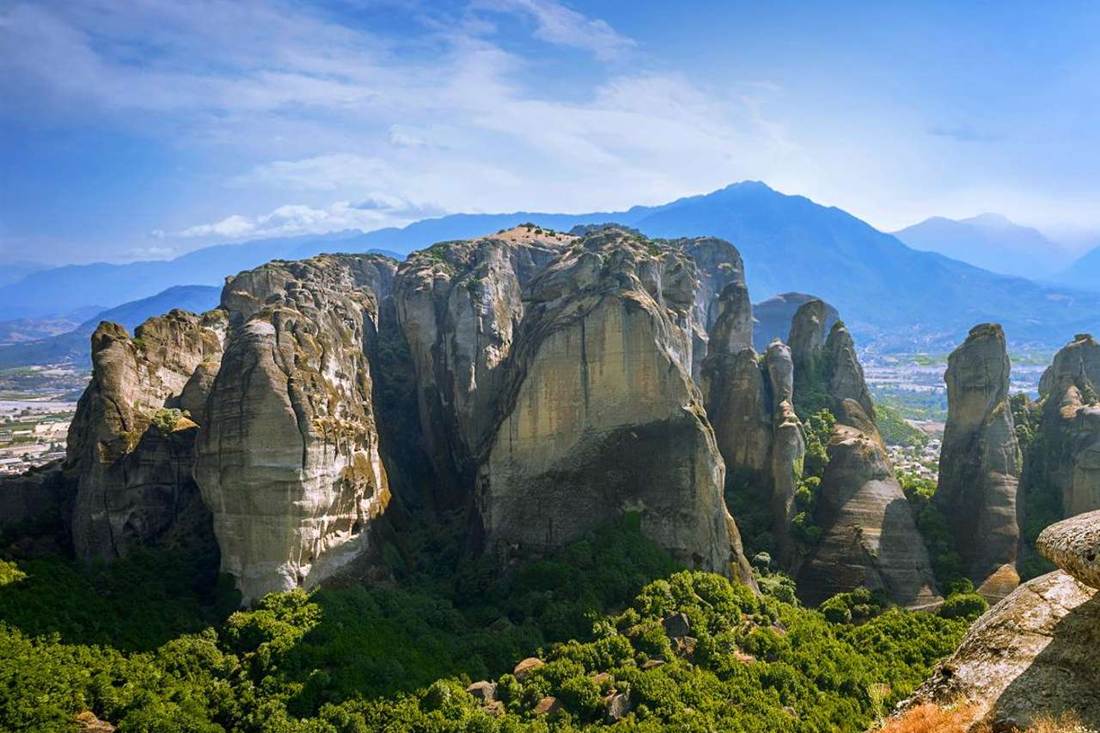
Meteora is a rock formation in the regional unit of Trikala, in Thessaly, in northwestern Greece. Columns of rock rise steeply from the flat ground. A Meteora day trip takes place in this setting. The rock is the main sight, and the monasteries sit on top of it.
If you plan to cross into Turkey as well, the homepage also lists Turkey tours.
The name Meteora means “lofty” or “elevated”, and it is related to the word meteor. UNESCO gives a second reading: “suspended in the air” is what Meteora means in Greek. Both names fit the pillars, because the sandstone peaks rise over 400 metres above ground level.
The rock is a mix of sandstone and conglomerate. UNESCO says the peaks were created 60 million years ago from deltaic river deposits. On a Meteora day trip you look at old river sediment that turned into stone.
Wikipedia adds the steps. About 60 million years ago, in the Paleogene period, earth movements raised the seabed. Streams carried sediment, and over millions of years it built up the conglomerate. Water, wind and extremes of temperature then weathered the vertical faults and shaped the pillars.
UNESCO added Meteora to the World Heritage List in nineteen eighty-eight. The listing uses five criteria: i, ii, iv, v and vii. Four of them concern the monasteries and their art, and the fifth concerns the landscape. Your Meteora day trip therefore visits a site that is protected for both reasons.
- Criterion i: the monasteries are a unique artistic achievement and turn a site into a place of retreat, meditation and prayer.
- Criterion ii: the frescoes of Theophanes the Cretan became a basic reference for post-Byzantine painting.
- Criterion iv: the site is an outstanding example of monastic construction in the fourteenth and fifteenth centuries.
- Criterion v: homes built under impossible conditions, with no practicable roads, still stand.
- Criterion vii: the area has exceptional natural and visual importance.
The monastic story starts with hermits. UNESCO says hermits and ascetics began settling in the area in the eleventh century. In the late twelfth century, a small church was built at the foot of one column. Monks already lived there. A Meteora day trip follows that story upward.
Wikipedia says the monasteries were not built until the fourteenth century. UNESCO links the building to political instability in Thessaly in that century. Monasteries were built step by step on the inaccessible peaks. Towards the end of the fifteenth century, there were 24 of them.
Monasteries were built or renovated during the sixteenth century, a period of prosperity for monasticism at Meteora. They kept flourishing until the seventeenth century. The site on a Meteora day trip today holds six monasteries. Four of them still house religious communities.
Two settlements lie below the rocks. Kalambaka is a town at the foot of the Meteora massif, and it is the seat of Meteora municipality. Kastraki is a community of Kalambaka on the west side of the massif. Meteora lies between the town of Kalambaka and the village of Kastraki.
How do you reach Meteora for a day trip from Athens or Thessaloniki?
A Meteora day trip from Athens covers 359.7 kilometres of road and takes 4 to 5 hours by car. From Thessaloniki the drive is about 230 kilometres and about 3 hours. Coach tours from both cities take care of the driving for you.
If you drive yourself on a Meteora day trip from Athens, plan for 4 to 5 hours at the wheel. One travel writer calls the traffic out of Athens terrible and unpredictable. The same writer advises you to avoid rush hours when you leave the city.
The drive is shorter from Thessaloniki. One source puts Kalambaka about 230 kilometres southwest of the city and calls driving the quickest way to travel. Your Meteora day trip on that road takes about 3 hours.
The direct Athens to Kalambaka train is suspended after Storm Daniel, according to one tour source. Trains run only as far as Paleofarsalos, a ride of about 3 hours. A bus then covers the rest to Kalambaka in about 2 hours. Check the railway timetable before you buy a ticket.
Trains from Thessaloniki all switch at Paleofarsalos. The quickest option takes 2 hours and 42 minutes, and a second source gives about 3 hours. Kalambaka station sits on the line that starts at Palaiofarsalos. A Meteora day trip by rail ends on that branch.
Buses to Kalambaka run through Trikala. From Athens, coaches leave the Liosion station for Trikala and the trip takes 4 hours and 30 minutes. From Thessaloniki, buses to Trikala take 2 hours and 30 minutes. You then change to a local bus for Kalambaka.
Kalambaka station sits right under the rocks, but the monasteries are higher up and closer to Kastraki village. The uphill walk takes well over an hour to the first monastery. A bus links the town and the rocks, though one source calls its timetable limited. Plan the last leg of your Meteora day trip around it.
If you drive, parking is available near each monastery. One source says spots are limited on busy summer weekends. Another source says parking at the monasteries is very limited in high season.
A coach Meteora day trip from Athens leaves from Deligianni Street, opposite Larissa train station. One listing asks you to meet by quarter to eight for an 8 o’clock departure. The coach stops for a seaside break at Kamena Vourla. It reaches Meteora at half past twelve, after 4.5 hours on the road.
The same coach leaves Meteora at 6 in the evening and stops by the sea again. It returns to Larissa station at about half past ten at night. The listing gives the full day as 13.5 hours. Another listing gives the ride out as about 5 hours with a 20-minute stop. A Thessaloniki coach tour lasts 10 hours.
Volos and Corfu also start a Meteora day trip. In Volos, a private driver waits next to the cruise ship, and the drive to Meteora takes two hours. That tour lasts 7 to 8 hours. From Corfu, a coach tour includes the round-trip ferry to Igoumenitsa and covers about 4.5 hours each way.
Which monasteries does a Meteora day trip visit?
The six monasteries are Great Meteoron, Varlaam, Roussanou, St. Nicholas Anapausas, Holy Trinity and St. Stephen. A Meteora day trip reaches only the ones open on your day, because each monastery closes on a different weekday.
On a Meteora day trip, Great Meteoron is the largest and oldest monastery of the group. Athanasios the Meteorite founded it on the Broad Rock in the fourteenth century. Its church is dedicated to the Transfiguration of Jesus. The site also has a rock-carved hermitage, a hospital and three old chapels.
Inside Great Meteoron you can enter the church, a museum, an ossuary and a kitchen. The church has frescoes from the sixteenth century, and the museum shows old codices and icons. The monastery is open from 09:30 to 15:00 and closes on Tuesdays. In winter it also closes on Wednesdays and Thursdays.
Varlaam is the next stop on a Meteora day trip. It stands on a cliff 373 metres above the valley. Two brothers began to rebuild its churches in the sixteenth century. A museum holds relics and church treasures. Varlaam is open from 09:00 to 16:00 and closes on Fridays. In winter it also closes on Thursdays.
Roussanou sits on a rock about 484 metres above sea level. Builders raised it in the fourteenth century, and its cathedral was decorated in the sixteenth century. It closes on Wednesdays. In summer it is open from 09:00 to 16:30, and in winter from 09:00 to 14:00. On Sundays it is open from 09:00 to 16:00.
St. Nicholas Anapausas stands on a small narrow rock, and it was founded in the late fourteenth century. Inside, a staircase links the floors. The church is on the second floor and the Holy Table on the third. A Meteora day trip finds it closed on Fridays. In summer it is open from 9:00 to 17:00.
Holy Trinity was built in the late fifteenth century on a rock cliff. A James Bond film, For Your Eyes Only, used it as a filming location. Access is a steep walk. The monastery is open from 10:00 to 16:00 and closes on Thursdays, in summer and in winter.
St. Stephen is the easiest stop on a Meteora day trip. A small footbridge leads to the entrance with no major stairs. The new church dates from the eighteenth century, and an old refectory is now a museum. It closes on Mondays. In summer it is open from 9:00 to 13:30 and from 15:30 to 17:30.
The climb sets the limit for a Meteora day trip. Holy Trinity and Great Meteoron have over 300 steps. Roussanou, Varlaam and St. Nicholas Anapausas average 140 steps. One tourism site advises against seeing all six in one day in summer heat. It recommends visiting the busiest ones early and finishing by noon.
Closing days decide which monasteries a Meteora day trip can enter. On Monday St. Stephen is closed, on Tuesday Great Meteoron, on Wednesday Roussanou and on Thursday Holy Trinity. On Friday both Varlaam and St. Nicholas Anapausas are closed. The monks set the hours and can change them without notice.
Dress modestly. Women need skirts below the knee and tops that cover the shoulders. Men need long trousers. Sleeveless tops are not allowed for anyone. Entrances give out skirts and scarves for women, but not clothing for men. The monks do not allow photos of church interiors. Courtyards and viewpoints are open for photos and video.
What does a Meteora day trip with caves, lunch and sunset include?
This Meteora day trip lasts 14 hours and leaves Athens at 9 AM by air-conditioned bus. The listing includes a live local guide, a visit inside 3 monasteries and a look at all 6. It also lists the hermit caves, a lunch with about 10 dishes, and the Meteora sunset.
The listing calls this Meteora day trip “Meteora Monasteries Day Trip at 9 AM, Sunset, Caves & Lunch”. It shows free cancellation, and you must book at least 10 hours in advance. A private option is also offered. The tour starts in Athens and is filed under the day trip category.
Here is how the Meteora day trip is timed. The bus leaves Athens at 9 AM, and the listing says this departure hour is offered only by that supplier. The whole day is listed as 14 hours. Inside it sits a Meteora tour of 4 hours or more with a live local guide.
On this Meteora day trip you ride an air-conditioned bus with WiFi and USB on board. The highlights also list a free audio guide. At Meteora itself, the listing promises that you go inside 3 monasteries and see all 6 of them.
The caves are named in the title of this Meteora day trip. The listing says you discover and see the Hermit Caves. Wikipedia explains what they are. In the ninth century an ascetic group of hermit monks moved up to the ancient pinnacles. They lived in hollows and fissures in the rock towers.
Wikipedia says the first hermits led a life of solitude and met only on Sundays and special days. It also says an ascetic community had flocked to Meteora by the end of the twelfth century. Wikipedia also says monks occupied the caverns of Meteora as early as the eleventh century.
Wikipedia names two rocks, Pyxari and Ambaria, with cave hermitages perched on cliffs, once lived in by ascetics. Pyxari lies at the southwestern edge of the rock complex. The monastery of St. Nicholas of Badova was founded in a rock cave on Badovas Rock. The way up is a series of ladders through three caves.
Lunch is part of the Meteora day trip. The listing says you choose from about 10 dishes, vegan ones included, and you get a complimentary bottle of water. The short description of the tour speaks of Greek lunch and dinner.
The listing calls the sunset its top highlight. Its short text says you admire the majestic sunset with a full panoramic view. The title of this Meteora day trip names the 9 AM start, the sunset, the caves and the lunch.
A local tour site says the rock pillars shift through amber, rose and deep copper in the hour before sunset. It says the monasteries on top seem to glow. One face of a pillar catches full light while another falls into deep shadow. Another site calls the golden hour before sunset warm and soft.
Wikipedia names Psaropetra, “Fish Rock”, as a viewpoint on the main road that is popular with tourists. A tour site calls it Sunset Rock. It says the view runs south and southwest, and the sun sets toward the Pindus mountains in the west. That site advises arriving at least 30 to 40 minutes before sunset.
When is the right time for a Meteora day trip and what do you pack?
Plan your Meteora day trip for late spring to early autumn and arrive before 9:00 am. Pack comfortable walking shoes, water and a light scarf. Each monastery with stairs asks for 150 to 300 steps, so you climb for real.
Kalabaka sits in a hot-summer Mediterranean climate, according to a travel climate profile of the town. Summers are hot and peak in July. Winters are cold and the coldest month is January. Temperatures range from 0°C to 33°C across the year, so your Meteora day trip needs different packing in each season.
Look at the monthly numbers. January runs from 0°C to 9°C. July runs from 19°C to 33°C. August is the driest month with 20 mm of rain. December is the wettest with 99 mm, and November follows with 98 mm. The whole year adds up to 719 mm of rain.
Spring and autumn bring milder days. April runs from 8°C to 19°C and late spring from 11°C to 24°C. September runs from 15°C to 28°C. October runs from 11°C to 22°C but already brings 82 mm of rain. The profile calls April to June and September to October milder and less crowded for a Meteora day trip.
Winters are milder but wetter, and cliff paths can be slick after rain. The profile also says the monasteries are quieter in winter. For the city of Trikala, Wikipedia records freezing temperatures on winter nights and occasional snowfall that is not significant. Pack a warm layer and shoes with grip for a winter visit.
Meteora ranks second in mainland Greece for visits, apart from the Acropolis in Athens. The majority of people come between April and the end of October. There are days with traffic jams outside the popular monasteries because of big coaches. That makes the season matter for your Meteora day trip.
Time of day matters as much as the month. Parking is hard between 10:00 am and 2:00 pm. One tourism site advises arriving before 9:00 am. Another advises finishing by noon, before the masses of tourists and big coaches arrive. Start early on your Meteora day trip and you also get the morning light away from the big crowds.
Summer brings intense sun on the plateaus, so arrive early to avoid midday heat and crowded monastery terraces. Canteens with small snacks and refreshments stand outside Great Meteoron, Varlaam and Agios Stefanos. Carry a lightweight shawl or scarf in summer. Spring and autumn afternoons can have brief showers.
Every monastery except Agios Stefanos has staircases, and the stairs range from 150 to 300 steps each. Wear comfortable walking shoes for this Meteora day trip. Agios Stefanos is the easiest choice for visitors with mobility issues because a bridge connects it. The other monasteries offer no real access for disabled people.
Church interiors and the murals stay off camera. In the courtyards and viewpoints inside the monasteries, you can take photos and videos freely. Landscape photography has no restriction. Do not photograph monks or nuns unless they say otherwise. Drones are forbidden by law without written permission from the authorities.
The monks decide opening hours and days and can change them without notice. Changes happen during religious celebrations. Easter and Holy Week have special holiday schedules. The summer timetable runs from April 1 to October 31, and the winter timetable from November 1 to March 31. Check closure days before you fix the date of your Meteora day trip.