The Iznik Nicaea Bursa tour from Istanbul links two old cities of north-west Turkey in two days. This route drives from Istanbul to Iznik on Lake Iznik and on to Bursa for the night. Island trips wait under Greece Tours on the homepage.
Day one covers the walls of Iznik, the tile story and the lake road to Bursa. Day two covers Bursa, then the road back to Istanbul. Each card below opens a live GetYourGuide booking page.
Where did Nicaea get its name, as told on the Iznik Nicaea Bursa tour from Istanbul?
Lysimachus named the city Nicaea after his wife, a daughter of Antipater, as Strabo tells it. Three names are met on the Iznik Nicaea Bursa tour from Istanbul, Helicore, Antigoneia and Nicaea, before Nikaia became Iznik.
Strabo calls Nicaea the metropolis of Bithynia and places it beside a lake. In book twelve of his Geography he adds that the plain around the city is large and very fertile. He finds it not at all healthful in summer. The wording here follows the English translation by H. L. Jones.
Planning more days? Turkey tours on the homepage reach Cappadocia, the Aegean coast and the Mediterranean coast.
Strabo writes that Antigonus, son of Philip, founded the city and called it Antigonia. Lysimachus came next and changed the name to that of his wife Nicaea, a daughter of Antipater. English books write the first name as Antigoneia. That chain of names is read on the Iznik Nicaea Bursa tour from Istanbul, Antigonus and Lysimachus being its founders.
A name older than Antigonus lies under the city. Helicore is the original name in the sources, and Ancore is a second spelling. The place is said to have been colonised by Bottiaeans. It began, it seems, as a Greek colony named Helicore. Antigonus therefore found a place that already had a name.
Antigonus, a Macedonian king and one of the successors of Alexander, refounded the city in the late fourth century BC. He gave it his own name, Antigoneia. Books differ on the exact year. That second layer is seen on the Iznik Nicaea Bursa tour from Istanbul, Antigoneia giving way later to Nicaea.
The wife behind the name was Nicaea, a daughter of the regent Antipater. Antipater had been left as regent in Macedonia when Alexander set out. Her mother’s name is not known. She had a brother, Iollas, and she married Lysimachus, who governed Thrace. Their children were a son, Agathocles, and two daughters, Eurydice and Arsinoe.
Nikaia is glossed in Greek as city of victory. Strabo ties the name to the wife. Another reading ties it to a victory of Lysimachus and keeps the wife as a second source. Both readings are laid out on the Iznik Nicaea Bursa tour from Istanbul, Victory and wife being the two sources.
Lysimachus was born before the middle of the fourth century BC, into a family of Thessalian stock. Its members were citizens of Pella in Macedonia. He took the royal title in the late fourth century BC, following the example of Antigonus. His realm took in Lydia, Ionia, Phrygia and the north coast of Asia Minor.
Early in the third century BC the city came under the local dynasty of the kings of Bithynia. Nicomedes I, the second king, founded Nicomedia. The two cities later disputed the title metropolis of Bithynia. That quarrel is part of the story on the Iznik Nicaea Bursa tour from Istanbul, Nicomedia the other claimant.
Rome joined Bithynia and Pontus into one province, and Nicaea came under Roman rule in the first century BC. The dispute with Nicomedia went on for centuries. Emperor Hadrian visited the city in the early second century AD, when an earthquake had badly damaged it. He began to rebuild it.
Coins of Nicaea carry the Greek legend NIKAIEON, of the Nicaeans. That legend records the name on the Iznik Nicaea Bursa tour from Istanbul, Nikaia in its Greek form. One coin shows the bare head of Julius Caesar and, on its back, Nike with palm and wreath. Other issues name festivals held there, such as the Pythia.
Iznik comes from Nikaia, with the Greek word eis, meaning to or into, placed in front. Ibn Battuta, who visited the area, recorded the name as Yiznik. Arabic sources write the town as Nikiye, and the Ottoman Turkish spelling is Izniq in Latin letters. Older English books wrote Isnik. This route reaches Iznik on day one.
How long are the walls of Iznik, as seen near the Iznik Nicaea Bursa tour from Istanbul?
Ramparts of Iznik run between four and five kilometres around the old town. They stand ten to thirteen metres high, with over a hundred towers, near the Iznik Nicaea Bursa tour from Istanbul. Courses of brick and stone and a lakeside stretch complete an irregular polygon.
Walls ring ancient Nicaea and still stand, though roads pierce them in places. The circuit forms an irregular polygon, and the national heritage portal calls it five-sided. The German scholar Schneider published a plan of it in the year nineteen thirty-eight. He placed it among the leading Byzantine monuments of Asia Minor for impact and survival.
Reference works give the circuit as four to five kilometres. The wall stands ten to thirteen metres high and, by one description, five to seven metres thick. More than a hundred towers line it, as met near the Iznik Nicaea Bursa tour from Istanbul. Semicircular and square towers both occur on the inner wall.
Courses of Roman tile alternate with courses of large square stones across long stretches of the wall. In places, columns and carved fragments from older buildings are set into it. Greek inscriptions appear on towers here and there. A tower beside the Lefke Gate is laid in rows of rubble stone and brick.
Another page that includes Bursa is Bursa Uludag Tour From Istanbul.
Hadrian’s rebuilding of the city, the account tells, included a polygonal wall around it. Reconstruction was not finished until the third century, as told near the Iznik Nicaea Bursa tour from Istanbul. Claudius Gothicus is named for the finish, in the year two hundred and seventy by one dating. Roman and Byzantine additions shaped the present wall.
Rebuilding is dated notably to the eighth, ninth, twelfth and thirteenth centuries. An inscription names the emperors Leo and Constantine as the restorers of the city. The court official Artavasdos carried out the work. In the ninth century, Michael III added towers between the older towers on the south-east and east walls.
An eleventh-century earthquake called for repairs to the wall. Alexios Komnenos added a small bastion faced with stones from a Seljuk cemetery. Under the Laskarid emperors, two corner towers rose on the southern wall, near the Iznik Nicaea Bursa tour from Istanbul. Theodore I Laskaris, an emperor of the thirteenth century, is named in an inscription on one tower.
In the thirteenth century, John III Vatatzes added an outer wall with towers. Scholars describe a second ring laid round the first, with a trench between the two. The outer towers stood lower, and a moat surrounded the ring. The plan was inspired by the Theodosian walls of Constantinople.
On the landward sides, a double ditch lay outside the walls. The western part rises beside the lake, near the Iznik Nicaea Bursa tour from Istanbul. Schneider wrote in the year nineteen thirty-eight that the lake washes the wall there. A lakeside tower has a brick face over a core of Horasan mortar and piled rubble.
That scholar noted that the village inside the ring filled scarcely a third of the former town area. By one account, Iznik was built almost entirely from the remains of Byzantine Nicaea. Ottoman builders used materials from ruined public buildings for mosques and other structures.
Repairs on the walls run under the Iznik Museum Directorate, near the Iznik Nicaea Bursa tour from Istanbul. Mortar-joint work covered the inner and outer wall faces within the project area. The Bursa Metropolitan Municipality carries out the project. Excavation turned up Roman, Byzantine and Ottoman road layers and fifteenth-century coins.
The UNESCO tentative-list entry for Iznik, filed in two thousand and fourteen, dates the walls to late Roman times. It adds that Byzantine and Ottoman work expanded and strengthened them. Enough of the ruined circuit survives to carry a walking route. This route meets the walls of Iznik on day one, before the road leads on to Bursa.
Which gates open the walls of Iznik along the Iznik Nicaea Bursa tour from Istanbul?
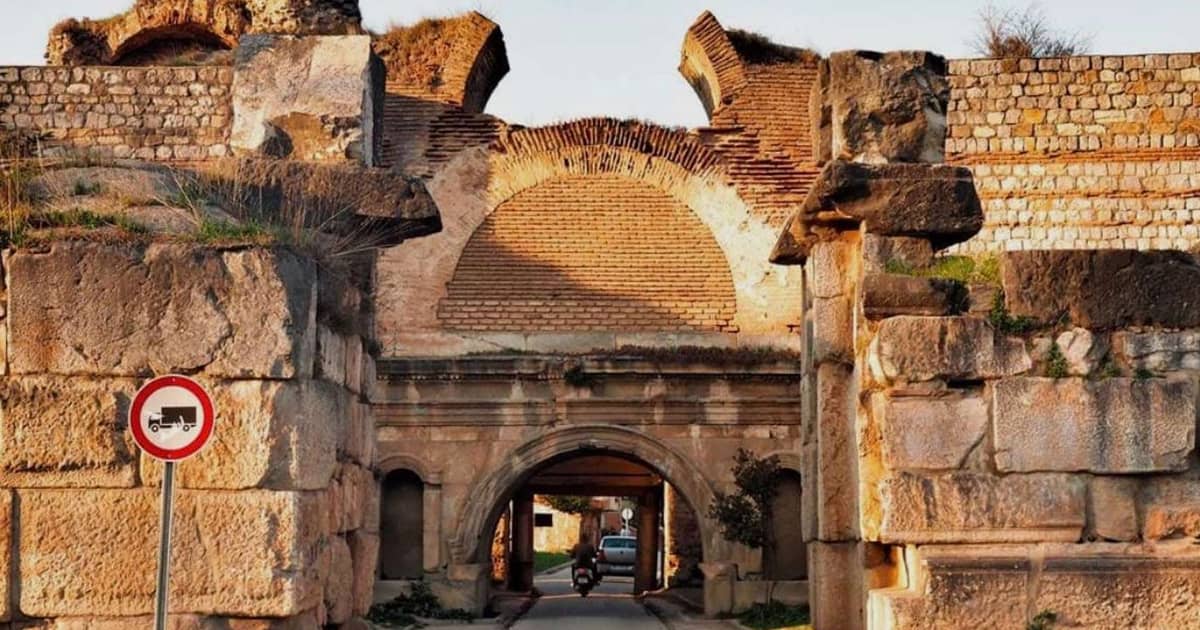
Four monumental gates open the walls: Istanbul north, Lefke east, Yenisehir south and the Lake Gate west. Roman stone survives in three of them along the Iznik Nicaea Bursa tour from Istanbul. Plancius Varus, a proconsul, is named in the Greek inscriptions.
Four gates stand opposite one another at right angles around Iznik. Strabo wrote that Nicaea had four gates and streets cut at right angles. One stone in the middle of the gymnasium gave a view of all four. Ataturk Avenue links the Istanbul and Yenisehir gates, and Kilicarslan Avenue ends at Lefke.
The Istanbul Gate stands where Ataturk Avenue reaches the wall in the north. Its name comes from the ancient road to Istanbul. This route reaches Iznik from the north along the Iznik Nicaea Bursa tour from Istanbul. Courtyard space, oval in plan, lies between the outer and innermost of its three gates.
The outer gate stands in the forward wall. Two half-cylindrical towers flank it. Its jambs are dark grey granite columns bound with iron bands, and a granite column lies across the top. A big arch rises above, and brick fills the gap between arch and jambs. A sarcophagus lid of Pamphylian type sits higher still.
The middle gate stands along the Iznik Nicaea Bursa tour from Istanbul. Limestone, cut and recrystallised, forms its round arch, four and a half metres wide, for carts and horses. Side passages for walkers are 0.90 metres wide. In the thirteenth century, under Theodore Laskaris, a slot was cut for a sliding iron gate.
The towers beside the middle gate rest on hundreds of reused grave stelae. Their upper floors hold domed cells. The innermost gate carries two high-relief masks on its jambs, one bearded and one female. Builders brought them from the Roman open-air theatre, and the municipal record dates them to the second century.
The Istanbul Gate carried an inscription of metal letters along the Iznik Nicaea Bursa tour from Istanbul. Nail holes let a reader trace the text, which names the proconsul Marcus Plancius Varus and Gaius Cassius Chrestus. The municipal record dates the building to the first century and a repair to the reign of Hadrian.
The Lefke Gate stands at the end of Kilicarslan Avenue, on the east side. Its name comes from the road that reaches Osmaneli. It closely resembles the Istanbul Gate: two cylindrical towers flank a gateway of thick marble columns. Masonry fills the arch above. A reused frieze on the left shows tightly packed human figures.
The central passage of the Lefke Gate has a round arch 4.30 metres wide for carts and riders. Two niches held marble statues of Marcus Plancius Varus along the Iznik Nicaea Bursa tour from Istanbul. Lines of Greek below each niche honour him as proconsul and patron of the city. A friend set up each text.
On the architrave, a two-line Greek text honours Hadrian. It calls Nicaea the first city of Bithynia and Pontus. A nine-line Greek text under the south pier of the main arch records Nicaea’s thanks to Gaius. Byzantine builders later closed the old courtyard into a corridor-like road.
The Yenisehir Gate stands in the south, where the road to Yenisehir and Bursa begins. Roman cut stone forms it, in three parts along the Iznik Nicaea Bursa tour from Istanbul. Sawtooth brick outlines a blocked arch in the west wall. Its middle gate, one opening 5.05 metres high, lies 10.75 metres north of the outer gate.
The Lake Gate ends the main avenue that runs on from Lefke, and no trace of it remains. The right tower stands half high, and only foundations mark the left. Brick faces the tower around a rubble core set in Horasan mortar. An architrave there recorded the repair of the walls under Vellius Macrinus and Sallius Antonius.
What did Pliny write about the theatre of Nicaea, as read past the Iznik Nicaea Bursa tour from Istanbul?
Pliny, governor of Bithynia, told Trajan that the theatre of Nicaea stood largely built, yet sinking and cracked. Past the Iznik Nicaea Bursa tour from Istanbul, Pliny’s letters keep that report and the emperor’s reply.
Pliny the Younger served as governor of Bithynia and Pontus around the year one hundred and ten. He wrote to the emperor Trajan, calling the finances of the cities disordered. Book ten of his letters holds that correspondence, and scholars consider it published after his death. A Paris manuscript of that book turned up in the late fifteenth century.
Istanbul comes up again in 5 Day Istanbul Tour Package.
Read past the Iznik Nicaea Bursa tour from Istanbul, letter thirty-nine of book ten concerns Nicaea. Work on the theatre is unfinished, though the greater part is built. It has swallowed a great sum. Pliny adds that the accounts have not been made out, so the sum is what he was told.
The building has sunk, Pliny says, and wide cracks gape in it. He names two causes: ground that is soft and damp, or stone that is brittle and crumbling. The substructures and buttresses that shore it up seem to him more costly than firm. He fears the whole outlay is wasted.
Private citizens had promised extra parts of the theatre, among them porticoes above the seating. Those gifts are postponed until the main work moves again. Pliny asks whether to finish the theatre, abandon it, or even pull it down. Taken past the Iznik Nicaea Bursa tour from Istanbul, Trajan receives a plain request: send an architect.
The same letter turns to the gymnasium of Nicaea, which a fire had destroyed. The Nicaeans began to rebuild it before Pliny arrived, on a wider scale than the old building. They had already paid out a considerable sum. A gymnasium was a Greek complex of changing rooms, exercise rooms, lecture halls and porticoes around an open space.
Pliny calls the rebuilt gymnasium poorly put together and disjointed. An architect declares that its walls cannot bear the weight laid on them. They are twenty-two feet thick, but the middle is not set in cement. Nor has brickwork strengthened them. Weighed past the Iznik Nicaea Bursa tour from Istanbul, cement and brick are the materials that complaint names.
Trajan answers in letter forty. He leaves Nicaea to Pliny, who is on the spot, and asks only to hear which plan Pliny adopts. The emperor also rules on the private gifts. They are to be demanded only once the theatre, the reason they were promised, stands finished.
Trajan remarks that all Greek peoples have a passion for gymnasia. The Nicaeans, he says, must be content to cut their coat according to their cloth. He adds that no province lacks skilled and clever architects. Noted past the Iznik Nicaea Bursa tour from Istanbul, architects, Trajan says, have long come to Rome from Greece.
The ruin stands on level ground, with no hillside behind it. Builders raised three storeys of seating on vaults, which scholars call rare in Anatolia. Work began under Trajan, in the early second century. It rose about twenty-four metres and held about ten thousand people. Much of it survived because the ground covered it.
Trapezoidal vaults carry the lower rows of seats, and barrel vaults carry the middle rows. Piers carry the top tier, which scholars link with a columned portico. Seen past the Iznik Nicaea Bursa tour from Istanbul, scholars call the plan a hybrid of vaults and arches. Only the plan of the stage building’s substructure has survived.
The ruin was first identified and sketched in the eighteenth century. Blocks from it were reused in houses nearby. Excavation began in the late twentieth century, and a university team took over. Traced past the Iznik Nicaea Bursa tour from Istanbul, marble paths and a drainage line emerged in the western part.
What did Hipparchus of Nicaea measure, as told beside the Iznik Nicaea Bursa tour from Istanbul?
Hipparchus of Nicaea timed the year to within 6.5 minutes, charted about 850 stars and found the equinoxes drift. Iznik, the town on the site of Nicaea, is the first stop beside the Iznik Nicaea Bursa tour from Istanbul. Rhodes, his later home, lies off this route.
Hipparchus was born in Nicaea, a city of Bithynia that later became the town of Iznik. Scholars date his life from about one hundred and ninety to about one hundred and twenty BC. Ptolemy attributes observations to him between one hundred and forty-seven and one hundred and twenty-seven BC.
Coins struck in his honour in Bithynia bear his name and show him with a globe. They belong to the second and third centuries AD. On this route the road runs east along the Gulf of Izmit, then south to Iznik. His story fits beside the Iznik Nicaea Bursa tour from Istanbul.
Records name Rhodes as one site of his observations. A historian of mathematics places him in Alexandria in the year one hundred and forty-six BC. Ptolemy also describes him observing in Bithynia, the region of his birth. He seems to have spent his later life on Rhodes.
His catalogue of about 850 stars is worth recalling beside the Iznik Nicaea Bursa tour from Istanbul. Magnitudes, a scale from 1 for the brightest to 6 for the faintest, are only conjectured to be his. Pliny the Elder writes that he devised instruments to mark each star’s place and brightness.
Precession of the equinoxes is his chief find. The Earth’s axis shifts slowly over time, much as the axis of a spinning top does. A full cycle takes about 26,000 years. Scholars credit Hipparchus with the discovery in the year one hundred and twenty-seven BC.
He measured the longitude of Spica and other bright stars. Timocharis of Alexandria had placed Spica 8 degrees west of the autumn equinox. Hipparchus found it at 6 degrees. The shift of 2 degrees showed that the equinox had moved. Such a result belongs beside the Iznik Nicaea Bursa tour from Istanbul.
Drift of not less than 1 degree a century was his conclusion. A historian of mathematics gives his yearly value as 46 seconds of arc, against 50.26 by the modern value. The pole star of ancient Greek sailors was a different star, not as close to the pole.
Hipparchus set the year at 365 days and a quarter, less a three-hundredth of a day. Historians put the error at 6.5 minutes. Old solstice records, set against his own, showed a gap of one day in about 300 years. That patience sits beside the Iznik Nicaea Bursa tour from Istanbul.
Eclipses can fall five months apart for the Moon and seven for the Sun. Pliny says that Hipparchus showed this. From an eclipse he put the Moon’s least distance at 71 Earth radii and its greatest at 83. His mean for the Moon was sixty and a half Earth radii.
Hipparchus measured the apparent diameters of the Sun and Moon with a diopter, a four-foot rod. A wedge slid along the rod until it hid the disc. He credited Eratosthenes with the armillary sphere, a sky model built from rings. Such tools sit beside the Iznik Nicaea Bursa tour from Istanbul.
Istanbul also features in Istanbul Classical Tour From Izmir.
Sources call him the founder of trigonometry. His table of chords gave the straight-line length for central angles in steps of 7.5 degrees. The 360-part division of the circle came into use in his time. He also proposed finding longitude from lunar eclipses seen at once in distant places.
Of at least fourteen books by Hipparchus, only his critical commentary on a poem by Aratus survived. A subset of the star coordinates in Ptolemy’s Almagest traces back to him. A lunar crater 150 kilometres wide carries his name. A main-belt asteroid is named for him too.
Which writers came from Bithynia, as told around the Iznik Nicaea Bursa tour from Istanbul?
Cassius Dio of Nicaea, Dio Chrysostom of Prusa, Arrian of Nicomedia and Parthenius of Nicaea all wrote in Greek. Their home cities lie around the Iznik Nicaea Bursa tour from Istanbul. Histories, speeches and love stories fill their books.
Cassius Dio was born and raised at Nicaea, the first stop of This route. His father, Cassius Apronianus, was a Roman senator. Dio held Roman citizenship, yet he wrote in Greek. He sat in the senate under Commodus, governed Smyrna and served as proconsul in Africa and Pannonia. He was consul twice.
The Roman History places Dio among the writers around the Iznik Nicaea Bursa tour from Istanbul. Aeneas opens the story, arriving in Italy as a legend, and the year two hundred and twenty-nine closes it. The text fills eighty books. Dio spent ten years collecting his material and twelve more composing it.
Books thirty-six to fifty-four survive almost complete, and books fifty-six to sixty are whole. Book fifty-five has a considerable gap. For books sixty-one to eighty, only fragments and a short abridgement by John Xiphilinus, an eleventh-century monk, remain. Zonaras, a chronicler of the twelfth century, drew on Dio for the early books.
Prusa, the old name of Bursa, is where This route spends its night. The orator Dio Chrysostom was born there, in the lands around the Iznik Nicaea Bursa tour from Istanbul. Chrysostom is Greek for golden-mouthed. A Byzantine tradition links the mother of Cassius Dio to the orator, though scholars dispute it.
One discourse is addressed to the Nicomedians and asks them to live in concord with the Nicaeans. Another, On Concord in Nicaea, speaks to the Nicaeans themselves. The Loeb headnote calls the first the opening of a series about affairs in his native Bithynia. Further speeches name Apameia and Prusa in their titles.
A city at concord, Dio tells the Nicaeans, owns an eye and an ear for each citizen. Eighty discourses survive for readers around the Iznik Nicaea Bursa tour from Istanbul. Fragments of fifteen more remain, with five letters. Photius, a ninth-century reader, knew only the eighty. Dio also carried out building projects in Prusa.
Arrian of Nicomedia adds history to the story told around the Iznik Nicaea Bursa tour from Istanbul. Aristobulus and Ptolemy are the main sources of his Anabasis of Alexander. It fills seven books, as Xenophon’s work of that name does. Nicomedia, the modern Izmit, lies near This route, on the gulf seen along the road.
Indica uses the Ionic dialect and takes Herodotus as its model. It sets the Indus and Ganges beside the Danube and Nile, and it names the elephant, tiger and parrot. The Periplus is a letter to Hadrian on the Black Sea coast from Trapezus to Byzantium. Photius lists a Bithynian history of eight books among his works.
Parthenius of Nicaea adds verse to the story told around the Iznik Nicaea Bursa tour from Istanbul. Heraclides was his father. He wrote elegies, especially dirges, and short epic poems, among them Arete and Anthippe. He is said to have lived until the reign of Tiberius began. Macrobius says he taught Greek to Virgil at Neapolis.
His prose Erotika Pathemata gathers thirty-six summaries of love stories with tragic or sentimental endings. Parthenius set them out in the shortest possible form, as a storehouse of material for Cornelius Gallus. One manuscript holds the whole text, probably written in the mid-ninth century. Janus Cornarius edited the first printed edition, at Basle in the sixteenth century.
Memnon wrote a local history of Heraclea Pontica, a city on the Bithynian coast at the mouth of the Lycus. The site lies beyond This route, at Karadeniz Eregli in Zonguldak Province. The work ran to at least sixteen books. Photius read books nine to sixteen and left an abstract. Books one to eight are lost.
How was Hagia Sophia of Iznik built, as seen across the Iznik Nicaea Bursa tour from Istanbul?
Rebuilt after an eleventh-century earthquake, Hagia Sophia of Iznik is a brick basilica with a central nave and two aisles. It stands across the Iznik Nicaea Bursa tour from Istanbul, stonework and brick showing its Roman, Byzantine and Ottoman stages.
Hagia Sophia stands in the town centre of Iznik, inside the old walled area. The roads that run in from the four gates of the walls meet at its site. The Greek name means Holy Wisdom. A Roman building stood on the spot first, and the brick basilica rose on its stone foundations.
Accounts place the first church in the fourth, the fifth or the sixth century. Justinian I is named for a rebuilding in the middle of the sixth century. An earthquake of the eleventh century struck, a turning point met across the Iznik Nicaea Bursa tour from Istanbul. Reconstruction followed around the year one thousand and sixty-five.
Much of the present church dates from that rebuilding. The floor was raised by 1.40 metres, and the outer walls were repaired. Walls of the central nave were built, and domed cells called pastophoria were added. UNESCO’s tentative list entry for Iznik describes the result as a basilica with three naves.
The basilica has a central nave and two side aisles, read across the Iznik Nicaea Bursa tour from Istanbul. Arcades of triple arches open each aisle onto the nave. Before the Ottoman remodelling, a clerestory wall with five windows rose above the arcades. A secondary dome also belongs to the building.
Timber roofs covered the basilica at first, as was customary for this kind of church. The lower part of the outer walls is regular ashlar masonry, thought to belong to a Roman predecessor. Brick forms the upper part. A narthex and a chapel to the southeast are described, and galleries are probable.
Details of the choir come into view across the Iznik Nicaea Bursa tour from Istanbul. Synthronon is the name for a semicircular tiered bench for the clergy, and one lies in the choir area. The walls keep faint traces of writing and pen-work decoration of the Turkish period.
For more on Istanbul, see 9 Day Cheap Turkey Bus Tour From Istanbul.
An opus sectile floor, made of thin polished pieces of cut stone, lies at the entrance. The surviving floor mosaic dates probably from the eleventh-century work. Fragments of mosaic found on the north wall of the nave in the nineteen-thirties include gold tesserae. Their date is unknown.
The Ottoman phase begins in the fourteenth century, when the church took the name Orhan Mosque and gained a mihrab. A fire in the reign of Suleyman the Magnificent later damaged it. Chief architect Sinan repaired it, a stage met across the Iznik Nicaea Bursa tour from Istanbul. Alterations reshaped its architecture to a large extent.
One change placed a mihrab at the corner of the right aisle on the south side. The interior arches and the columns that carried them were removed, and wide arches were built. The main mihrab was made of brick and decorated with muqarnas. The wall around it was probably covered with tiles of the sixteenth century.
A minaret by Sinan is attached to the north-west corner of the building. Its brick shaft is polygonal. Rows of cut stone and brick form its base, met across the Iznik Nicaea Bursa tour from Istanbul. Evliya Celebi of the seventeenth century wrote of a large place of worship with a lead roof and one minaret.
Von Hammer found the building ruined and half collapsed in the early nineteenth century. Specialists of the German Archaeological Institute made soundings in the nineteen-thirties. In the year nineteen fifty-three, the museum administration removed the thick layer of soil inside. A restoration campaign followed in the early twenty-first century.
How did the First Council of Nicaea meet, as told amid the Iznik Nicaea Bursa tour from Istanbul?
Bishops met in the imperial palace of Nicaea in the year three hundred and twenty-five, called by Constantine. Ancyra was the first choice, and Nicaea eased travel, as told amid the Iznik Nicaea Bursa tour from Istanbul. Eusebius described the hall.
Constantine first named Ancyra for the meeting of the bishops. He then moved the council to Nicaea in Bithynia. Nicaea lies near Nicomedia, which let the emperor attend in person. Bishops from across the empire also reached it more easily. Eusebius, the emperor’s biographer, judged the place suited to the occasion.
The imperial treasury paid the expenses of the council, travel of the bishops included. Eusebius adds that certain bishops received public means of conveyance and the others an ample supply of horses. This travel detail is told amid the Iznik Nicaea Bursa tour from Istanbul. Provisions came daily by the emperor’s command.
Eusebius lists the lands that sent bishops: Syria, Cilicia, Phoenicia, Arabia, Palestine, Egypt, Libya and Mesopotamia. Pontus, Galatia, Pamphylia, Cappadocia, Asia and Phrygia sent leading churchmen. Others came from Thrace, Macedonia, Achaia and Epirus. A Persian bishop attended, and a Scythian was not missing. One man of wide fame came from Spain.
Figures differ. Eusebius counted more than 250 bishops, with presbyters, deacons and attendants beyond counting. Contemporary reports range from 250 to 300. Athanasius names 318 in a letter, and later tradition kept that number. Lists of signatures carry 200 to 220 names. These totals are told amid the Iznik Nicaea Bursa tour from Istanbul.
Rows of seats lined both sides of the interior, in the central building of the palace. Eusebius found that building larger than the rest. Invited guests took the seats according to rank. Scholars reading his account picture a rectangular basilica hall. Silence held the room while all waited for the emperor.
Constantine opened the council with a formal entrance after the bishops arrived. Eusebius says he came with friends in the faith, not soldiers or guards. A low chair of wrought gold waited. He sat once the bishops beckoned, and the assembly sat after him. This scene opens the proceedings amid the Iznik Nicaea Bursa tour from Istanbul.
Hosius of Cordova is named as president of the debates, acting for the emperor. Constantine gave his opening speech in Latin, though Greek was the tongue of the greater part of the assembly. He joined the debates in Greek. He did not vote, because he was not a bishop.
Early collections of church law credit the council with twenty canons. Canon four covers the choice of a bishop by all the bishops of the province. Where need or distance blocks that, three at least meet, and absent bishops send votes in writing. This rule is read amid the Iznik Nicaea Bursa tour from Istanbul.
Synods fill canon five. Each province holds two a year, one before Lent and one about autumn. Their task is to inquire into cases of exclusion from a church community. A person cast out by one bishop is not taken back by another. Canon fourteen sets three years as hearers for lapsed catechumens.
Seating and posture have canons too. Canon eighteen tells deacons to keep within their own bounds and not to sit among the presbyters. Canon twenty asks for prayer standing on the Lord’s Day and at Pentecost, so practice is uniform everywhere. These small rules show the council at work amid the Iznik Nicaea Bursa tour from Istanbul.
Letters carried the results out. Both the bishops and the emperor issued letters recounting the decisions, to be circulated through the empire. No detailed record of the debates survives. Gelasius of Cyzicus wrote a Greek history of the council in the fifth century. This route reaches Iznik, the Turkish town, on the first day.
How is Iznik tile made, as seen through the Iznik Nicaea Bursa tour from Istanbul?
Quartz, frit and white clay make the tile body, as seen through the Iznik Nicaea Bursa tour from Istanbul. Frit is ground glass. A thin white slip coats it, and colours go on under a clear glaze.
The Victoria and Albert Museum defines fritware as a body of sand or quartz with a little white clay. Frit, which is ground glass, binds it. Potters in Turkey lacked the clay for true porcelain, the Metropolitan Museum explains. They built a stonepaste of clay and quartz to copy its white look.
Through the Iznik Nicaea Bursa tour from Istanbul, soda serves as the flux, mixed with powdered quartz to make frit. A treatise of about the year thirteen hundred set out ten parts silica, one part frit and one part clay. A laboratory study found more glass in Iznik bodies than that recipe gives.
A study of Iznik pottery, tiles and glass lumps found lead oxide in the bodies, beside soda and lime. The glaze is very pure, which points to purified plant ash or a mineral soda as its flux. The same study proposes that tin oxide gave the glaze slight opacity, hiding flaws in the body.
Through the Iznik Nicaea Bursa tour from Istanbul, slip is a thin coat laid over the body. Its parts are ground finer and chosen with care to keep iron impurities out. A Raman study traced white colour to a quartz slip in a majority of samples. Slip can be tinted: one dish shows white tulips on a chocolate-brown ground.
A related page on Istanbul: 9 Day Turkey Holy Lands Tour From Istanbul.
Vessels were built in sections, dried and joined with fritware paste, which gave them slightly angular shapes. Dishes were probably shaped on a wheel using a mould, and their foliate rims were sculpted by hand. A biscuit firing probably preceded painting. Firing took place in an updraft kiln, to about 900 degrees Celsius.
Painters ground pigments with glass frit in a wet quern. Outlines of certain designs were pounced through a stencil. Through the Iznik Nicaea Bursa tour from Istanbul, cobalt blue is the oldest colour, alone in the early period. Copper oxide added turquoise from about fifteen twenty. Manganese oxide gave purple, and green, grey and black followed.
Catalogue entries record the method as fritware painted under the glaze. Another study found small amounts of boron and lithium in Iznik glazes. It proposes salts left by dried hot-spring water in western Turkey as the source of the soda. Raman tests at a French museum found the same lead silicate glaze structure from sample to sample.
In the fifteen fifties, potters tried decoration in coloured slips, which are liquid clays. Their great achievement was a slip that turned red when fired under the glaze. That red replaced the purple of earlier wares. Through the Iznik Nicaea Bursa tour from Istanbul, emerald replaced sage green in the same change.
Museum labels call the intense red Armenian bole. It is an iron-rich slip, a liquid clay, applied thickly to stop the painting running under the glaze. The entry for one dish names it relief red. That dish has designs trailed in slip, white or tinted cobalt, with iron oxide for the red.
Through the Iznik Nicaea Bursa tour from Istanbul, lamps of clay show how potters copied glass models. A fritware lamp of about fifteen fifty-seven stands 48 centimetres tall. It was not meant to give light. The same museum calls it the earliest Iznik piece with underglaze red, a difficult colour to produce.
A British Museum lamp is painted in cobalt blue and grey-green, outlined in black, under a transparent glaze. The foot ring carries a date, and the potter Musli signed it. Jugs, cups, bowls and dishes drew on metalwork, illuminated books and Chinese ceramics. Pierced foot rings let large dishes be hung up.
Which kilns fired the tiles of Iznik, as passed by the Iznik Nicaea Bursa tour from Istanbul?
Workshops in Iznik fired the Ottoman court’s tiles from the late fifteenth century. Their kiln field lies in the town visited on day one by the Iznik Nicaea Bursa tour from Istanbul. Ovens there ran from the fourteenth to the seventeenth century.
Iznik made simple earthenware before the court took an interest. Excavations in the early nineteen sixties, led by Oktay Aslanapa, uncovered such pottery and kiln wasters. The wasters proved local manufacture. The ware is assumed to belong to the fifteenth century, as the digs gave no clear date.
Scholars hold that the young Ottoman court in Istanbul almost certainly pushed the potters of Iznik towards white fritware. No written record tells how this began. The earliest specific mention appears in the palace kitchen accounts, written in the closing years of the fifteenth century.
The earliest datable Iznik objects are blue-and-white border tiles on a prince’s mausoleum in Bursa. The prince died in the early sixteenth century. Bursa is the night stop reached by the Iznik Nicaea Bursa tour from Istanbul. Wares of that first age are dated from about fourteen ninety to about fifteen twenty-five.
Iznik tiles carried court designs. The Met catalogues a tile of the late fifteen seventies. Its pattern was designed in the imperial workshop in Istanbul and fired in the kilns of Iznik. Shahkulu headed that workshop from fifteen twenty-six to fifteen fifty-six, and Kara Memi succeeded him by fifteen fifty-eight.
The Suleymaniye Mosque stands in the city that starts the road followed by the Iznik Nicaea Bursa tour from Istanbul. Sinan designed it in the fifteen fifties, and Iznik became a major centre for underglaze tiles. Imperial tilemakers are believed to have made the tiles of royal buildings until then. Only three remained by fifteen sixty-six.
Production peaked in the second half of the sixteenth century, though the town itself stayed small. A court order of fifteen eighty-five complained that potters had been working for merchants. The fifteen eighties show a dearth of tiles, and builders reused panels from earlier buildings.
Kutahya lies beyond the road taken by the Iznik Nicaea Bursa tour from Istanbul. Wasters dug up there show that its kilns also made pots in the Iznik style. Iznik was the main centre of the earlier earthenware known as Miletus ware, with smaller output at Kutahya.
Chinese porcelain came into Turkey in growing quantities from the middle of the sixteenth century. Iznik potters failed to match the high quality of these imports and painted rustic designs instead. Towards the century’s end their quality fell. The fall is linked to the loss of court patronage.
In sixteen forty-eight Evliya Celebi counted only nine workshops at Iznik, against three hundred under Ahmed I. The Ministry of Culture and Tourism gives falling demand from Istanbul as the accepted explanation. The last dated pottery consists of dishes with crude Greek lettering from sixteen seventy-eight.
Furnaces east of Murad II’s bath ran between the fourteenth and seventeenth centuries. That kiln field lies in the town crossed by the Iznik Nicaea Bursa tour from Istanbul. Digs of Istanbul University ran a second round from nineteen eighty-one to nineteen eighty-eight. Only slight traces of the kilns remain.
Excavators of the Roman theatre found an early Ottoman tile workshop of the fourteenth and fifteenth centuries. It holds ten kilns, a glaze furnace and two marble chambers for making quartz. One oven is well preserved. The excavators saw a Seljuk background in the Ottoman ceramics of Iznik.
The Iznik Foundation was set up in September of nineteen ninety-three. Its research centre came in nineteen ninety-five and its atelier in mid nineteen ninety-six. The foundation sponsors digs in Iznik, the lake town met by the Iznik Nicaea Bursa tour from Istanbul. Thousands of experimental plates were broken before the atelier’s tiles nearly equalled sixteenth-century quality.
Istanbul City Tour From Ankara covers Istanbul too.
What does the Green Mosque of Iznik show within the Iznik Nicaea Bursa tour from Istanbul?
Hayreddin Pasha started the Green Mosque of Iznik in the late fourteenth century, and his son Ali Pasha finished it. One dome covers its square hall, as met within the Iznik Nicaea Bursa tour from Istanbul. Minaret tiles give the mosque its Turkish name, Yesil, which means green.
Candarli Halil Hayreddin Pasha served as grand vizier to Sultan Murad I. He is counted as the first grand vizier of the Ottoman state. He began the mosque in Iznik, and his son Ali Pasha completed it. On this route the building stands near the Lefke Gate, on the eastern edge of the town.
Two inscribed plaques record the building. The first sits above the main entrance and measures 0.57 by 0.51 metres. It gives the years thirteen seventy-eight and thirteen seventy-nine, in the reign of Murad I. The record is read within the Iznik Nicaea Bursa tour from Istanbul.
Haci bin Musa is named on the second plaque, set over the lintel on the portico axis. It measures 0.57 by 2.87 metres. The text says the work began at the order of Hayreddin Pasha. It ended in the years thirteen ninety-one and thirteen ninety-two. This is the first Ottoman mosque whose architect is known by name.
The prayer hall is a square, eleven metres on each side, set on a north to south axis. A three-bay portico runs on an east to west axis. Pointed arches divide the interior in two, and the middle arch is wider and taller than the rest. This plan is met within the Iznik Nicaea Bursa tour from Istanbul.
Drum and dome rise above the square hall. Outside, the dome sits on an octagonal drum. Inside, a belt of triangles, called Turkish triangles, carries the dome over the square walls. Such triangles were common in Anatolian Seljuk and early Ottoman building. The dome rises seventeen and a half metres above the floor and has four windows.
This mosque is an early example of the single-domed type. Grey marble panels cover the lower interior walls. Yellowish-white marble stones appear in the walls. The crown portal at the entrance is carved in marble. These features are met within the Iznik Nicaea Bursa tour from Istanbul.
Mihrab, the prayer niche, is made of marble and shows strong stonework. It is counted as the first marble mihrab of the Ottoman period. Stone-carved muqarnas appear among the details of the building. Scholars note the careful exterior design and the antechamber before the large domed chamber.
A single minaret stands at the north-west corner. It rises from a square base, and marble faces the base and the triangles that lead to the shaft. The shaft starts as a polygonal prism and turns round. One balcony and a conical cap finish it. This is the minaret met within the Iznik Nicaea Bursa tour from Istanbul.
Brickwork carries the colour on this minaret. Glazed tiles form patterns in the brickwork, and glazed brick stands beside them on the shaft. The tile colours are green, yellow, turquoise and dark purple. A zigzag motif runs through them. These bands of colour are the reason for the name Yesil.
The tile decoration here counts among the earliest known in Ottoman architecture. Tiles set into brickwork are a technique inherited from the Seljuk period. The minaret also shows traces of Seljuk building, and its tiles are modern restorations. This tile story is read within the Iznik Nicaea Bursa tour from Istanbul.
Cemetery outside the Lefke Gate, east of the town, holds the tomb of Hayreddin Pasha. Restoration ran from the year nineteen fifty-six to nineteen sixty-nine, after earlier repairs in the early twentieth century. The General Directorate of Waqfs carried it out. A madrasa to the north no longer survives, and a bath to the south-east lies in ruins.
Which early Ottoman buildings stand alongside the Iznik Nicaea Bursa tour from Istanbul?
Prince Suleyman had the Suleyman Pasha Madrasa built with eleven student cells around a courtyard. Murad I raised the Nilufer Hatun Imaret under a lofty dome. Both fourteenth-century works stand alongside the Iznik Nicaea Bursa tour from Istanbul. Tiled domes crown both.
Prince Suleyman, a son of Orhan, gave the madrasa its name. Orhan had the first Ottoman madrasa raised in the name of this son. No founding inscription survives, so the exact date is unknown. Surveys place it in the mid-fourteenth century. Eight madrasas worked in Ottoman times, and two remain.
Its U-shaped plan appears alongside the Iznik Nicaea Bursa tour from Istanbul. Cells and a gallery enclose three sides of a rectangular courtyard that opens east. Eleven cells served the students. The lecture hall, the dershane, stands at the centre of the west side. Doors link it to the courtyard and the teacher’s room.
Nineteen domes cover the classroom, the gallery and the cells. Terra-cotta tiles roof the domes, which follow a decreasing order of height. Rubble stone and brick form the walls, with reused material in places. The colonnades stand on granite and marble columns. Restorers worked on it in the nineteenth century and again in nineteen sixty-eight.
Lessons were given at the madrasa alongside the Iznik Nicaea Bursa tour from Istanbul. Alaaddin-i Misri is recorded as a teacher there. Ottoman madrasas in general taught writing styles, grammar, syntax, poetry, composition, natural sciences, political sciences and etiquette. Across the empire, madrasas trained doctors, engineers, lawyers and religious officials, among others.
An imaret was a public soup kitchen. Imarets gave free food to chosen groups and to people in need. The earliest imarets rose in Iznik and Bursa in the thirteen-thirties. Meals were served in shifts: staff first, guests second and the poor last. Rules fixed who ate, what they ate and in what order.
Murad I built the imaret in the late fourteenth century, in memory of his mother Nilufer Hatun. A plaque over the entrance names Murad, son of Orhan I, as builder. It stands on Museum Street, across from the Green Mosque, alongside the Iznik Nicaea Bursa tour from Istanbul. Zaviye is another name for it, a Sufi lodge.
An open porch of five bays leads in, with five arches in front and two on either side. A small dome covers the central bay, and cross vaults cover the four side bays. Inside, the main hall is a square under a lofty dome. Buildings of this plan type carry a portico across the full width of the front.
On either side of the hall stand large rooms under much lower domes. Its inverted T plan is an early Ottoman example alongside the Iznik Nicaea Bursa tour from Istanbul. Side halls of this plan housed Sufi students and travelling dervishes, historians suggest. The walls alternate courses of stone and brick in a style linked with Byzantine craft.
Ceramic tiles cover the vaults and domes. The hall stood unused for years and later served as a storehouse. Restoration followed, and the building opened as a museum in nineteen sixty. Orhan built an earlier imaret just outside the Yenisehir Gate in the thirteen-thirties. By the fifteen thirties the empire counted eighty-three imarets.
Readers interested in Istanbul can open Ertugrul Ghazi Tour From Istanbul.
The Iznik Museum shows objects from the town and its surroundings, from prehistoric times to the Ottoman era. Reconstructions of tile making and firing are displayed alongside the Iznik Nicaea Bursa tour from Istanbul. Coins from different civilizations complete the display. The garden holds Islamic tombstones, well rings, a fountain and inscriptions.
Roman and Byzantine sarcophagi are also shown in the garden. Finds from the Iznik tile kiln excavations are on display too. Other early Ottoman works in town include the Haci Ozbek Mosque, the Green Mosque and two baths. Ottoman complexes pair a mosque with services such as a madrasa, a bath, an imaret or a market.
What lies in and under Lake Iznik, as met behind the Iznik Nicaea Bursa tour from Istanbul?
Ascania was the ancient name of Lake Iznik, about 32 kilometres long and 80 metres deep. A church of the late fourth or early fifth century lies in its shallows. This route reaches the water at Iznik, behind the Iznik Nicaea Bursa tour from Istanbul. Hills rise north and south of the basin.
Lake Iznik lies in Bursa Province, and the town of Iznik stands in a fertile basin at its eastern end. The lake is the fifth-largest in Turkey and covers 298 square kilometres. Homer’s Iliad speaks of Phrygians from a far-off Ascania, a name that the lake carried in antiquity.
Geologists describe the Iznik Basin as an active depression created by a series of faults. These faults developed in relation to the middle strand of the North Anatolian Fault. Chief among them is the oblique Soloz fault, which runs parallel to that strand. An oval hollow lies in the southern part of the lake.
Geology belongs behind the Iznik Nicaea Bursa tour from Istanbul. Coastal faults are cut by the main fault zone and shifted sideways by about seven to eight kilometres. Seismic data show that the lake stood about 40 metres lower in the last glacial period. A study of the basin estimates an earthquake periodicity of about 2,000 to 2,500 years.
Streams that feed the lake include the Narlica, the Cakirca and the Kirandere. Arable fields, olive groves and poplar plantations surround the water, and vineyards and gardens reach its shores. In the nineteen-twenties the region was known for rice production. The lake became a reservoir in nineteen sixty-three.
The water is fresh. Its salinity is 0.05 to 0.10 per cent, too low for a person to taste. Fish fill the water behind the Iznik Nicaea Bursa tour from Istanbul. Carp, tench, roach, bleak and wels catfish are among 19 species that a survey recorded. Five species, tench among them, were recorded there for the first time.
Crayfish were once the main source of income for the lake’s fishermen. Silverside, a small fish with the Latin name Atherina boyeri, has replaced them in the commercial catch. The silver crucian carp is an invasive fish. It multiplies excessively in the lake and harms other fish species.
The lake is a bird site behind the Iznik Nicaea Bursa tour from Istanbul. Waterfowl led BirdLife International to name it an Important Bird Area. Two breeding populations give it that standing: about 30 pairs of pygmy cormorant and 250 pairs of night heron. Reedbeds grow where streams enter the lake.
Aerial photographs of the lake revealed a Byzantine basilica in the year two thousand and fourteen. The Archaeological Institute of America listed the find among the top ten archaeological discoveries of that year. The church rests behind the Iznik Nicaea Bursa tour from Istanbul. Neophytos, a saint of Nicaea, gives the building its dedication.
Divers with archaeologists of the Iznik Museum Directorate stayed underwater for about two and a half hours at the site. They monitored and photographed the naves and the rite room, which separate the building into three main parts. The church is big, with walls one metre thick and a semicircular apse.
Underwater excavation began in the year two thousand and fifteen under the Iznik Archaeology Museum. The remains lie outside the walls of ancient Nicaea, in two or three metres of water. Work of the year two thousand and nineteen focused on the atrium of the church.
The trench sits behind the Iznik Nicaea Bursa tour from Istanbul. Willibald, a pilgrim of the eighth century, wrote of an open courtyard with a source of oil in its middle. Excavators sought a well there. They dug 60 centimetres below the foundation walls without reaching its bottom. Cup-shaped coins, glass bracelets and pottery point to the thirteenth century.
What stood in the Church of the Dormition beyond the Iznik Nicaea Bursa tour from Istanbul?
Hyakinthos, the abbot named in its inscriptions, is thought to have built the domed Church of the Dormition. Its mosaics, a prepared throne, four angels and the Virgin, are told beyond the Iznik Nicaea Bursa tour from Istanbul. Drawings and photographs keep them.
Called Koimesis in Greek, the church stood within the Hyakinthos monastery of Nikaia. Scholars date it between the seventh and the eighth century. Hyakinthos is thought to have founded it. His name and titles appear on the apse inscription and on pier capitals. They appear too on floor slabs thought to be re-used.
The ground plan is told beyond the Iznik Nicaea Bursa tour from Istanbul. Foundations lie about four metres below the level of the modern road. The near-square plan measures 22.5 metres by 21 metres and runs from east to west. The plan reads as a basilica with three aisles under a dome.
A naos with three aisles formed the centre. On the west side lay a narthex, flanked at each end by towers holding stairs. The bema, the apse and the side rooms called pastophoria lay on the east. At the middle, a dome rested on four large arches above a nave shaped like a cross.
Wulff published a book on the church and its mosaics in the year nineteen oh three. Schmit followed with a book on the building and the mosaics in nineteen twenty-seven. Both works are read beyond the Iznik Nicaea Bursa tour from Istanbul. Kluge photographed the mosaics in nineteen twelve.
The panels on the east piers are placed beyond the Iznik Nicaea Bursa tour from Istanbul. Eleousa, the compassionate Virgin, filled the north-east pier. Antiphonitis, Christ the answering, filled the south-east pier. Schmit cleared plaster from both. Each panel rose from about 1.05 metres to 2.73 metres above the floor and measured 0.45 metres across.
The apse half-dome held the oldest scheme. Gold ground, a half-circle for heaven and the hand of God belong to its first phase. Scholars read three stages here: a first figure, a cross and the standing Virgin with the Child. Traces of the cross show on the gold behind her.
The Hetoimasia of the bema arch shows a prepared throne with a book on the seat and a cross behind. A large circle of blue glass tesserae framed it, lighter towards the centre. The scene is told beyond the Iznik Nicaea Bursa tour from Istanbul. Purple cloth hung over a dark red seat with black stripes along both edges.
More about Istanbul: Istanbul Classical Tour From Ankara.
Four angels flanked the throne. Arche and Dynamis stood on the south side, Kyriotetes and Exousia on the north. Each wore imperial dress, wings and a gold halo. One hand held a labarum and the other a globe. Dynamis, better preserved than the others, stood 1.83 metres high with a wingspan of 1.09 metres.
A vertical inscription between the angels reads: Naukratios draws the holy icons. It is a rare signature of a Byzantine mosaic artist. Its letters are of dark blue glass, uneven and joined. The dating is argued beyond the Iznik Nicaea Bursa tour from Istanbul. Underwood places the work after the year eight hundred and forty-three.
An earthquake in the year ten sixty-five left the church standing but heavily damaged. Inscriptions name the patriarch Nikephoros as the patron who rebuilt the narthex with two floors. Mosaics then filled it. Above the main door stood a Virgin with her hands spread. The central vault showed an eight-armed cross inside a circle.
Four medallions, 64 centimetres wide, surrounded the cross with busts of Christ, the Virgin, John the Baptist and Saint Joachim. Evangelists sat writing between them. Mango dates them to the years just after the earthquake. Their story is told beyond the Iznik Nicaea Bursa tour from Istanbul. Plates and coloured drawings keep mosaics that survive only in that record.
Who are Karagoz and Hacivat, as told after the Iznik Nicaea Bursa tour from Istanbul?
Karagoz and Hacivat are Turkish shadow theatre’s main pair, as told after the Iznik Nicaea Bursa tour from Istanbul. Leather puppets cast their shadows on a lit cotton screen. Legend ties the pair to Bursa, the night stop of this route.
Karagoz is the shadow theatre of Turkey. Its flat figures, named tasvirs, show people or things and are made of camel or ox hide. Rods hold each figure before a light source. The shadows fall on a cotton screen. A play opens with an introductory figure.
The white muslin screen is the ayna, meaning mirror. The lamp behind it, the sem’a, literally means candle and in the usual form burns oil. Any place dark enough for shadows can host a show, as heard after the Iznik Nicaea Bursa tour from Istanbul. Coffeehouses and private houses held them.
Makers oil and work the hide until it is semi-transparent, then colour it. Figures stand 35 to 40 centimetres high. Waxed thread joins neck, arms, waist and knees, and rods at the back move the limbs. Horse, water buffalo or calf skin served too, but camel gave the finest.
A museum record of one Karagoz figure lists seven pieces of hide tied together at the waist. It has an articulated arm and legs. Polychrome pigments and pierced detailing decorate it. A feather and a flower trim the hat. Its size is 357 by 205 by 3 millimetres.
One lead artist, the hayali, works every figure. The title means imaginary and image creator. A single hayali voices each character by mimicking sounds. Apprentices learn the craft by helping make the tasvirs, as recalled after the Iznik Nicaea Bursa tour from Istanbul. Yardak, the singer, never voices a character.
A play has four parts. The mukaddime opens it, with Hacivat singing a semai and reciting the curtain poem. The muhavere follows as a dialogue between the pair. The fasil carries the main plot, and the bitis closes with a short quarrel. Songs, poetry and riddles fill the main show.
Karagoz is Turkish for Blackeye. He stands for the uneducated but straightforward public, brave, blunt and quick to anger. He tolerates neither hypocrisy nor lies, as shown after the Iznik Nicaea Bursa tour from Istanbul. Wordplay, dance and movement carry the humour. His native wit outmatches the learning of Hacivat.
Hacivat is a shortened form of Haci Ivaz, meaning Ivaz the Pilgrim. He belongs to the educated class and speaks Ottoman Turkish. He keeps trying to tame Karagoz, with little progress. Respected for his advice, he also tells people what they want to hear. He employs Karagoz.
The cast reaches past the pair. Kantocu is a cabaret singer and Hokkabaz an illusionist and acrobat. Uzun Efe is the long-necked fellow, Civan the spendthrift and Nigar a flirtatious woman. Puns and imitations of regional accents add to the jokes. The humour turns milder when women or children watch.
In the legend, Orhan Gazi has a mosque built in Bursa in the mid-fourteenth century. Two site workers distract the crew by bickering, as retold after the Iznik Nicaea Bursa tour from Istanbul. Kusteri, a sage, recreates their banter with a candle, a screen and the workers’ shoes as first figures.
The Karagoz Museum in Bursa was set up in a former power distribution building. Opened as an art house in the late twentieth century, it became a museum under the Bursa Metropolitan Municipality. One gallery tells the history of shadow play, and the other shows 61 original puppets from traditional collections.
A monument to Karagoz and Hacivat faces the building, as noted after the Iznik Nicaea Bursa tour from Istanbul. Karagoz House was the name the building took from it. UNESCO listed the art as intangible heritage of humanity in the year two thousand and nine. Its entry says the theatre strengthens cultural identity.
What stands at the Emir Sultan Mosque, as met at the Iznik Nicaea Bursa tour from Istanbul?
Hundi Hatun, daughter of Sultan Bayezid I, is named as builder of the first mosque for her husband Emir Sultan. Cypress trees, a tomb room and a long courtyard wait at the Iznik Nicaea Bursa tour from Istanbul. Rebuilding in the early nineteenth century shaped the present mosque.
The mosque stands on a hill on the flank of Uludag, to the east of Bursa. The city itself lies on the northwestern slopes of that mountain, which towers over it. This route gives the second morning to Bursa, at the Iznik Nicaea Bursa tour from Istanbul. Quarter and mosque share one name, Emirsultan.
Emir Sultan was a dervish and scholar from Bukhara. His birthplace gave him the name Muhammed Bukhari. People also called him Emir Bukhari, because he was a Sayyid. He received the name Emir Sultan as a sultan of hearts, dear to people. English books also spell it Amir Sultan, and the quarter spells it as one word.
Sultan Bayezid I invited Emir Sultan to Anatolia in the late fourteenth century. There Emir Sultan married Hundi Fatma Hatun, a daughter of the sultan. He died in Bursa in the year fourteen twenty-nine. The complex that bears his name began to take shape in the early fifteenth century.
Istanbul also features in 7 Day Turkey Bus Tour From Istanbul.
The first mosque dates to the early fifteenth century, and Hundi Hatun is named as its builder. One account puts the work in the reign of Sultan Murad II. She is credited with the bath south of the mosque at the Iznik Nicaea Bursa tour from Istanbul. Hamam, tomb, timekeeping room and fountain joined the complex later.
An earthquake brought the first mosque down in the eighteenth century. Selim III rebuilt the mosque met at the Iznik Nicaea Bursa tour from Istanbul. Plan stayed the same, and part of the old foundations was reused. Another earthquake struck in the middle of the nineteenth century. Sultan Abdulaziz had the mausoleum rebuilt in the year eighteen sixty-eight.
Scholars of the decoration link the rebuild to baroque, empire and rococo styles. The building is made of stone and brick, with a square plan and one dome. The dome rests on an eight-sided drum. Twelve windows pierce the drum, and forty large windows open in the walls.
A tall prayer hall of masonry stands on the south side of the courtyard. Two minarets of cut stone rise at the northern corners of the building. A long courtyard fronts the hall, at the Iznik Nicaea Bursa tour from Istanbul. Pedestals of marble, sixteen in all, carry the wooden arcade with its pointed arches round the courtyard.
Portals with tall domes mark the bays where the arcade leads into the buildings. A large ablution fountain stands inside the courtyard. Historic fountains lie scattered across the complex, and the earliest dates to the year seventeen forty-three. One of them appears in a drawing by the British traveller and artist Thomas Allom.
The tomb room has a domed central space with smaller rooms on either side. It holds the tombs of Emir Sultan and his family. His wife Hundi Hatun, his son Emir Ali and two daughters lie in it. Rooms for the imams stand at the north corner of the courtyard.
Plaster, wood, stone and pencil work were all used for the decoration. Pencil work gained importance, in line with the period. Plant motifs include flowers, acanthus and stylised palmettes. Star motifs lead the geometric patterns. Inscriptions also serve widely as decoration, on the building and in the courtyard.
An Ottoman cemetery runs downhill from the complex, at the Iznik Nicaea Bursa tour from Istanbul. Cypress and plane trees stand around the mosque, beside the Emir Sultan cemetery. The area next to the mosque was turned into a cemetery. The Emirsultan district formed as the population grew.
What do the old baths of Cekirge show, as read toward the Iznik Nicaea Bursa tour from Istanbul?
Cekirge shows hot springs turned into bath buildings and water works. Read toward the Iznik Nicaea Bursa tour from Istanbul, Eski Kaplica stands on Byzantine bath ruins. Yeni Kaplica, a sixteenth-century bath, has a star-plan hot room lined with tiles.
Hot springs rise in two districts at the western end of Bursa, just above the plain: Cekirge and Kukurtlu. Kukurtlu lies two kilometres east of Cekirge. Bursa itself stands on the northern slope of Mount Uludag, on a large travertine complex. Thermal water climbs there along a fault zone.
Eski Kaplica means old public bath, and Pythia was its name in ancient times. A geothermal study dates that first bath to about the year five hundred. Toward the Iznik Nicaea Bursa tour from Istanbul, Murad I is the named builder of the present double bath.
The building dates to the late fourteenth century and rests on Byzantine bath ruins. As a double bath, it holds separate halls for men and women. Roof tiles cover the domes of the hot section, and lead covers the cooling-section dome. Sultan Bayezid II renovated and enlarged the domed baths in the early sixteenth century.
Seen toward the Iznik Nicaea Bursa tour from Istanbul, columns carry the hot-section dome. Eight stand around a pool seven metres across, joined by round arches. The columns and their capitals are Byzantine pieces, reused as building material. Glass eyes set into the domes let daylight in.
Toward the Iznik Nicaea Bursa tour from Istanbul, hammams follow a set order of rooms. Bathers pass from the changing hall, the camekan, through the warm iliklik to the hot sicaklik. As a rule, the hot room carried the richest decoration. Heating followed a version of the Roman hypocaust, with furnaces in a service room behind the walls.
Yeni Kaplica uses the hottest of the Kukurtlu springs, at 82 degrees Celsius. Rustem Pasha, grand vizier of Suleyman, is credited with the sixteenth-century bath. Another record states that a bath already stood there and Rustem Pasha rebuilt it at the sultan’s wish. A third account names a judge of Bursa as first builder.
Met toward the Iznik Nicaea Bursa tour from Istanbul, Rustem Pasha is named in a hot-room inscription. The words Bina-i Rustem Dara sit above the entrance to the hot room. Researchers read the letters as a date code for the Hijri year nine hundred and sixty. Nothing in the text marks a code, which leaves the date in question.
Two large domes roof the dressing hall. In the warm room, a dome covers the square centre, and half-domes widen the space at the sides. A passage in the north-east corner leads to the shaving rooms and the toilets. Walls of stone and brick, laid in alternating courses, make up the bath.
Toward the Iznik Nicaea Bursa tour from Istanbul, iwans give the hot room its star plan: eight of them. Two private cubicles, called halvets, flank the entrance iwan. The right-hand cubicle is the hottest part of the bath, and its name speaks of sweating. A large, deep pool fills the centre of the room.
Tiles line the hot-room walls up to about two metres. They are hexagons, with eight different plant designs in blue, white, turquoise, lilac and green. Pattern one pairs turquoise cypress shapes with dark blue hyacinths and lilac tulips. Kilns at Iznik made the group, and Yeni Kaplica is one of only two buildings in Anatolia identified with it.
Two main springs rise in Cekirge itself: Vakifbahce at 46 degrees Celsius and Zeyninene at 44. Their flow is put between 700 and 1,700 cubic metres a day. An early water network let users control and regulate the thermal water over centuries. Murad I’s mosque and madrasa complex at Cekirge is also called the Kaplica Imareti, after the springs.
What do Mudanya and Trilye show, as met under the Iznik Nicaea Bursa tour from Istanbul?
Mudanya stands on the site of ancient Apameia, and Trilye keeps a Byzantine domed church of about the eighth century. Under the Iznik Nicaea Bursa tour from Istanbul, Trilye and Mudanya are places near Bursa, on the same Marmara coast.
This route runs from Istanbul to Iznik and on to Bursa. Mudanya and Trilye lie near it, on the Sea of Marmara coast. Mudanya is a district of Bursa Province, 25 km northeast of the city, on the Gulf of Gemlik. Summers in Mudanya are hot and dry, while winters are warm and rainy.
Istanbul comes up again in 6 Day Turkey Bus Tour From Istanbul.
Ancient Apameia lay where Mudanya stands. Settlers from Colophon, one of the twelve big cities of Ionia, founded the town in the seventh century BC. They called it Myrleia. Prusias I of Bithynia renamed it Apameia, after his wife Apama. Mudanya is read under the Iznik Nicaea Bursa tour from Istanbul, Moudania being its Greek name.
Apameia was the port of Prusa, the ancient name of Bursa. Mudanya has only an open anchorage, usable in calm weather. A pier serves local fishing and cargo boats. A railway linked Mudanya with Bursa from the late nineteenth century into the middle of the twentieth. Silk was a popular export.
The old town of Mudanya is a protected area. Turkish and Greek communities lived together in the Giritli quarter. On 12 Eylul Street, seven historic buildings show Late Ottoman, Neoclassical and Rococo influences in their facades. These buildings are seen under the Iznik Nicaea Bursa tour from Istanbul.
Zeytinbagi, meaning olive yard, was the name of Trilye from the late nineteen-sixties until the early twenty-first century. Greek sources call the village Trigleia or Brylleion, and Tirilye is another spelling. Trilye lies on the Marmara shore, 12 km west of Mudanya. It is placed under the Iznik Nicaea Bursa tour from Istanbul.
Habitation here dates from the eighth century BC. In the Byzantine period the village was a religious centre and a port for goods from its fertile hinterland. Its old harbour, in the Kapanca quarter, dates to the Roman period. It has been a first-level protected area since the early nineteen-eighties.
Greek houses went up at the end of the eighteenth century and in the nineteenth. An olive oil factory dates from about the second half of the nineteenth century. Frescoes in the Panagia Pantobasilissa church lie in two layers. The first dates from the start of the fourteenth century, the second from the eighteenth.
The Fatih Mosque of Trilye began as a Byzantine church of the eighth or early ninth century. Its Greek name is Hagios Stephanos, which means Saint Stephen. Cyril Mango and Ihor Sevcenko linked it with the Trigleia monastery in nineteen seventy-three. The church is told under the Iznik Nicaea Bursa tour from Istanbul.
Cross-in-square describes the plan, one of the oldest known examples of that Byzantine type. The central dome stands on a cylindrical drum pierced by eight windows and rises 19 metres. A tiled mihrab with a half-dome was set in the central apse. Traces of a black and white mosaic, in a checkerboard of large cubes, mark the transept soffits.
Gemlik is counted under the Iznik Nicaea Bursa tour from Istanbul, Cius being its ancient name. It stands on the eastern shore of the gulf. Its black olive is small to medium in size and rich in oil. The oil yield is 29.9 per cent. The variety makes up 75 to 80 per cent of the regional groves.
Hand picking runs from November to February, and a tree can bear up to forty kilograms in a good year. The villages of Karacaali, Umurbey and Kumla are known for traditionally cured Gemlik olives. Cures include Yagli Sele, Salamura and Duble. The European Union has registered the name Gemlik Zeytini as a geographical indication.